
What is CRT Dr Ricky Lee Allen Associate
- Slides: 15
“What is CRT? ” Dr. Ricky Lee Allen Associate Professor Educational Thought & Sociocultural Studies
2018 Critical Race Studies in Education Association Conference • • Held at UNM May 30 -June 1 Proposals are due January 15 www. crsea. org
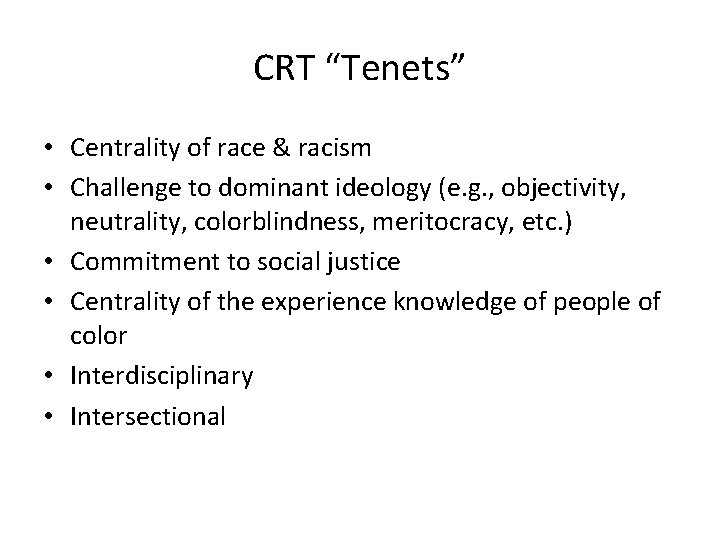
CRT “Tenets” • Centrality of race & racism • Challenge to dominant ideology (e. g. , objectivity, neutrality, colorblindness, meritocracy, etc. ) • Commitment to social justice • Centrality of the experience knowledge of people of color • Interdisciplinary • Intersectional
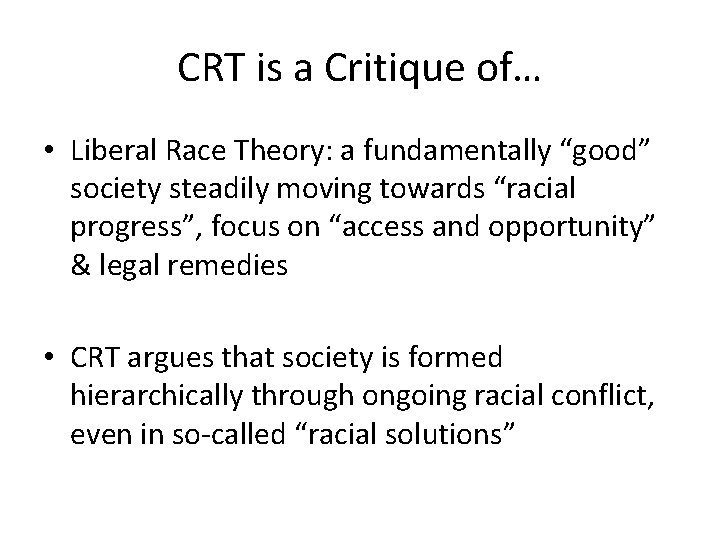
CRT is a Critique of… • Liberal Race Theory: a fundamentally “good” society steadily moving towards “racial progress”, focus on “access and opportunity” & legal remedies • CRT argues that society is formed hierarchically through ongoing racial conflict, even in so-called “racial solutions”
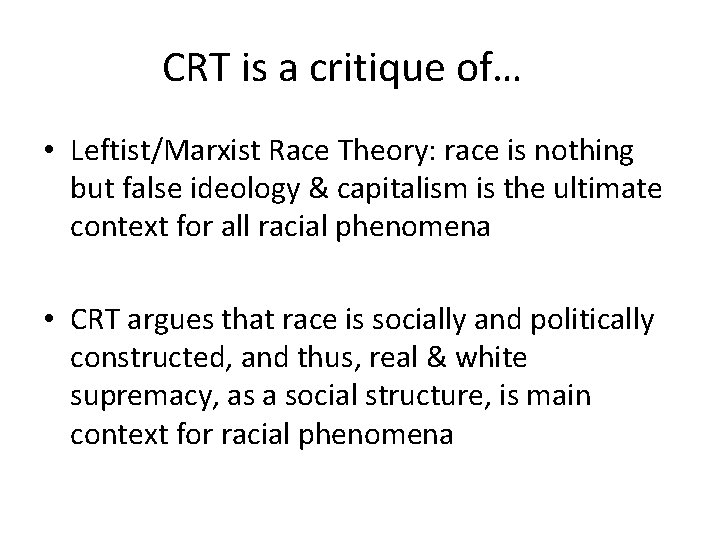
CRT is a critique of… • Leftist/Marxist Race Theory: race is nothing but false ideology & capitalism is the ultimate context for all racial phenomena • CRT argues that race is socially and politically constructed, and thus, real & white supremacy, as a social structure, is main context for racial phenomena
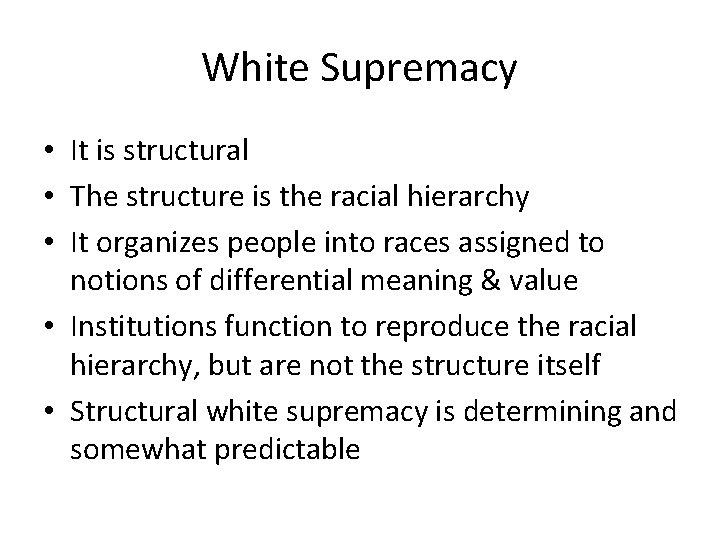
White Supremacy • It is structural • The structure is the racial hierarchy • It organizes people into races assigned to notions of differential meaning & value • Institutions function to reproduce the racial hierarchy, but are not the structure itself • Structural white supremacy is determining and somewhat predictable
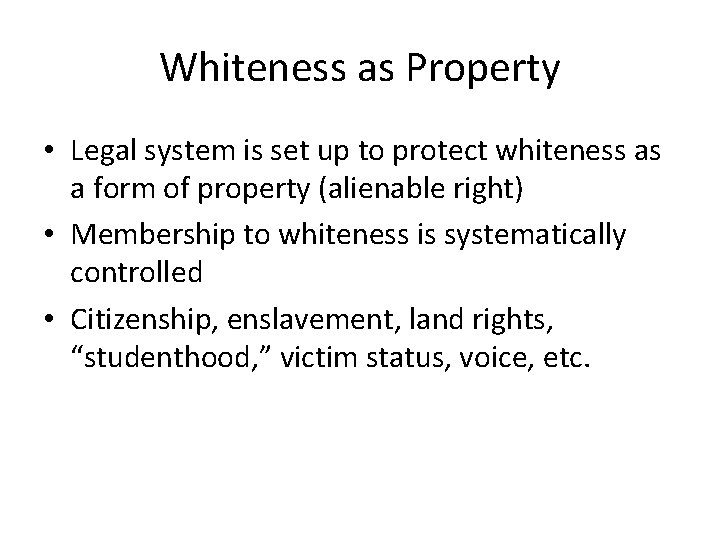
Whiteness as Property • Legal system is set up to protect whiteness as a form of property (alienable right) • Membership to whiteness is systematically controlled • Citizenship, enslavement, land rights, “studenthood, ” victim status, voice, etc.
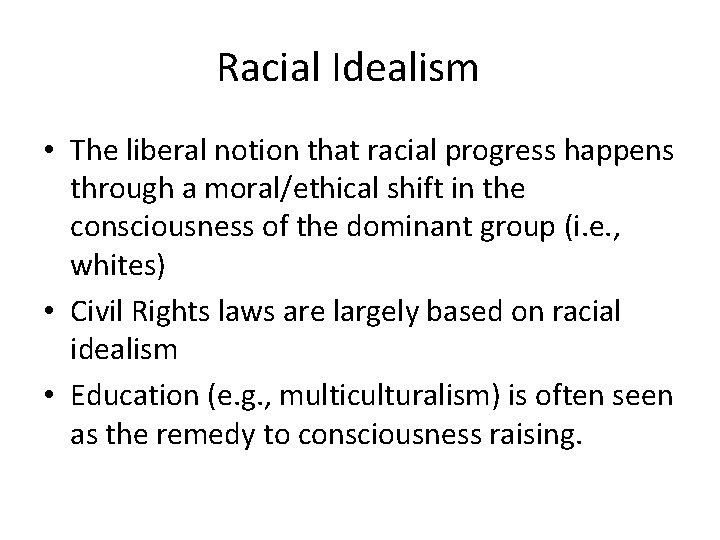
Racial Idealism • The liberal notion that racial progress happens through a moral/ethical shift in the consciousness of the dominant group (i. e. , whites) • Civil Rights laws are largely based on racial idealism • Education (e. g. , multiculturalism) is often seen as the remedy to consciousness raising.
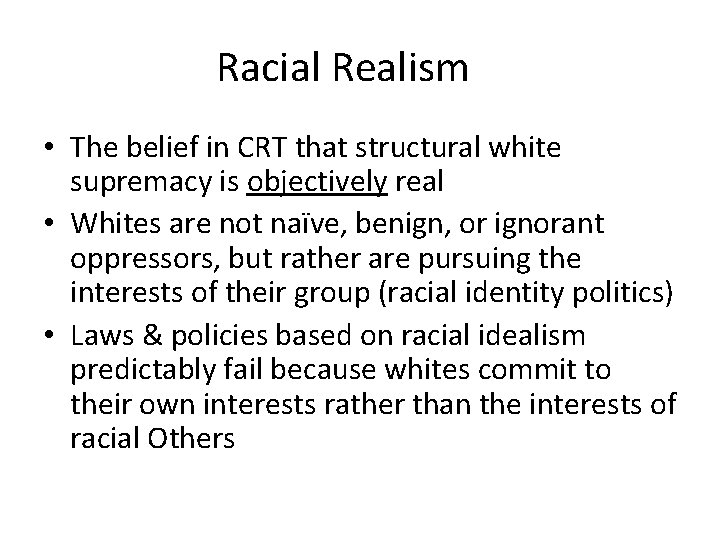
Racial Realism • The belief in CRT that structural white supremacy is objectively real • Whites are not naïve, benign, or ignorant oppressors, but rather are pursuing the interests of their group (racial identity politics) • Laws & policies based on racial idealism predictably fail because whites commit to their own interests rather than the interests of racial Others
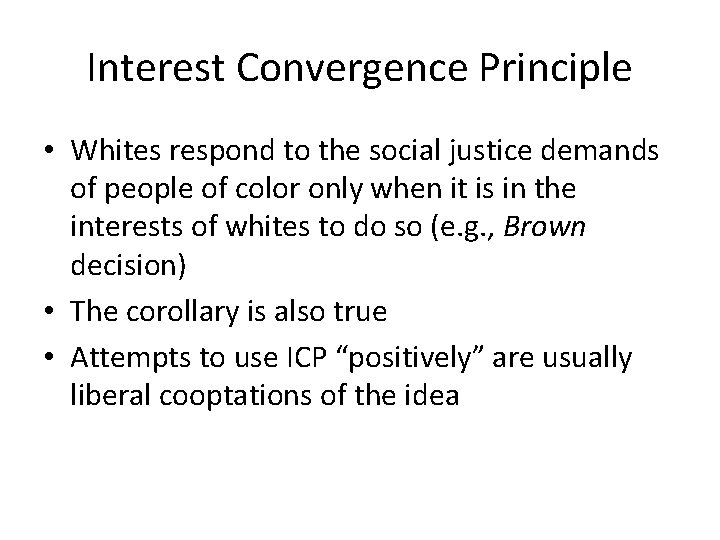
Interest Convergence Principle • Whites respond to the social justice demands of people of color only when it is in the interests of whites to do so (e. g. , Brown decision) • The corollary is also true • Attempts to use ICP “positively” are usually liberal cooptations of the idea
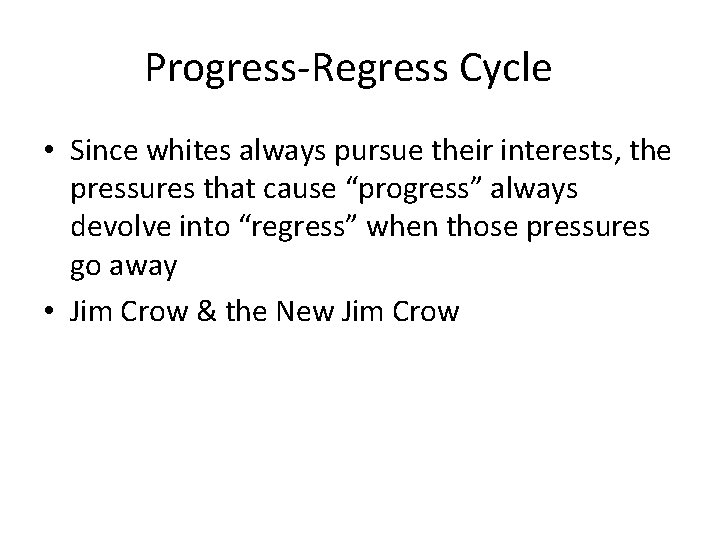
Progress-Regress Cycle • Since whites always pursue their interests, the pressures that cause “progress” always devolve into “regress” when those pressures go away • Jim Crow & the New Jim Crow
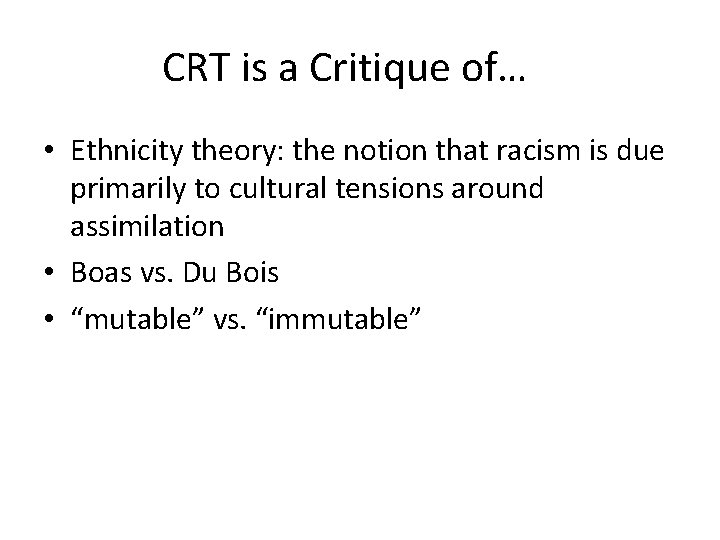
CRT is a Critique of… • Ethnicity theory: the notion that racism is due primarily to cultural tensions around assimilation • Boas vs. Du Bois • “mutable” vs. “immutable”
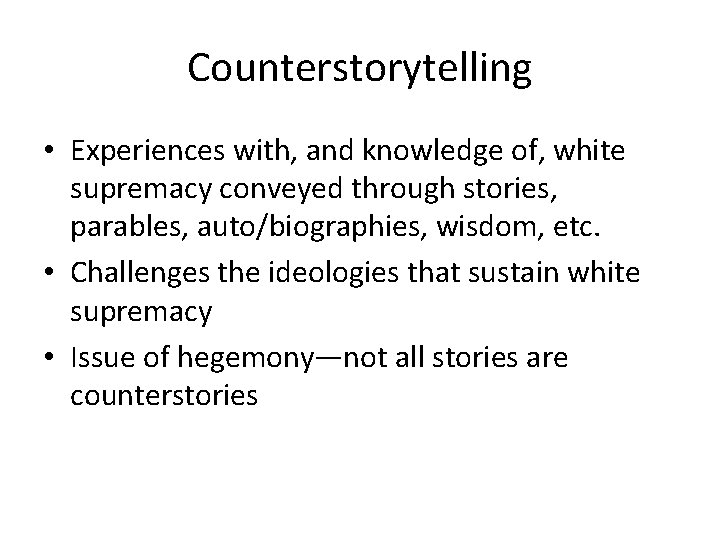
Counterstorytelling • Experiences with, and knowledge of, white supremacy conveyed through stories, parables, auto/biographies, wisdom, etc. • Challenges the ideologies that sustain white supremacy • Issue of hegemony—not all stories are counterstories
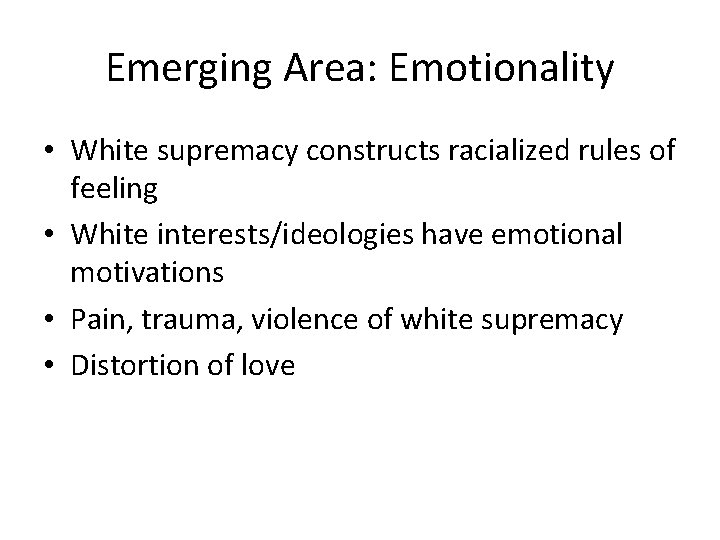
Emerging Area: Emotionality • White supremacy constructs racialized rules of feeling • White interests/ideologies have emotional motivations • Pain, trauma, violence of white supremacy • Distortion of love
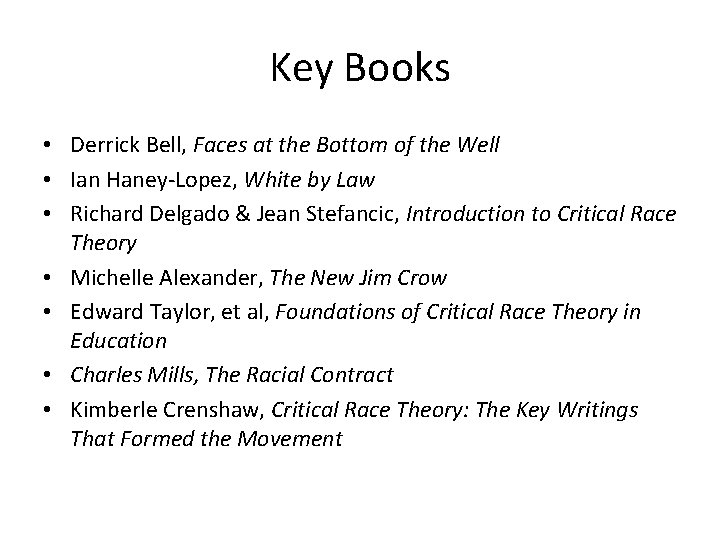
Key Books • Derrick Bell, Faces at the Bottom of the Well • Ian Haney-Lopez, White by Law • Richard Delgado & Jean Stefancic, Introduction to Critical Race Theory • Michelle Alexander, The New Jim Crow • Edward Taylor, et al, Foundations of Critical Race Theory in Education • Charles Mills, The Racial Contract • Kimberle Crenshaw, Critical Race Theory: The Key Writings That Formed the Movement