
What is Crime ThinkPairShare Activity 4 Perspectives Legalistic
- Slides: 15
What is Crime? Think-Pair-Share Activity
4 Perspectives • • Legalistic Political Sociological Psychological
Legalistic Perspective • Breaking the law • 10 laws you break every day • Definition: – Human conduct in violation of the criminal laws of a state, the federal government or a local jurisdiction that has the power to make such laws.
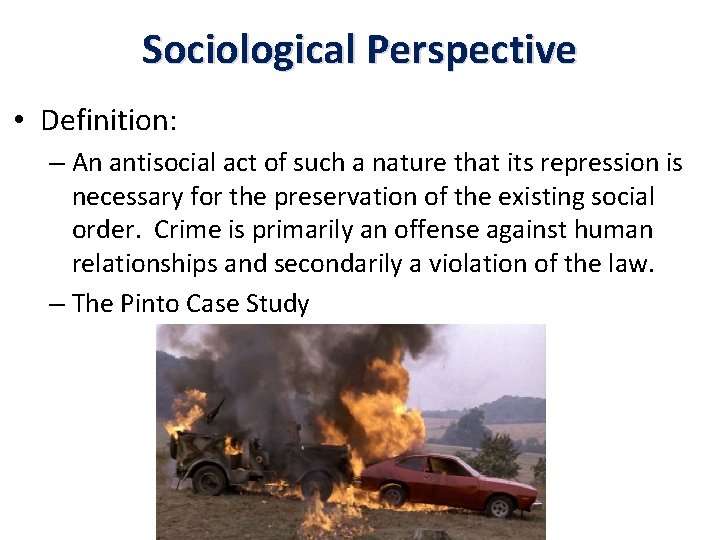
Sociological Perspective • Definition: – An antisocial act of such a nature that its repression is necessary for the preservation of the existing social order. Crime is primarily an offense against human relationships and secondarily a violation of the law. – The Pinto Case Study
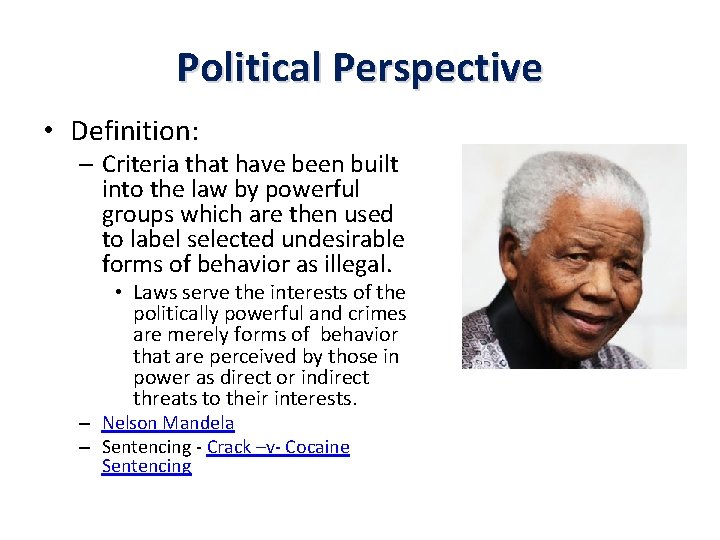
Political Perspective • Definition: – Criteria that have been built into the law by powerful groups which are then used to label selected undesirable forms of behavior as illegal. • Laws serve the interests of the politically powerful and crimes are merely forms of behavior that are perceived by those in power as direct or indirect threats to their interests. – Nelson Mandela – Sentencing - Crack –v- Cocaine Sentencing
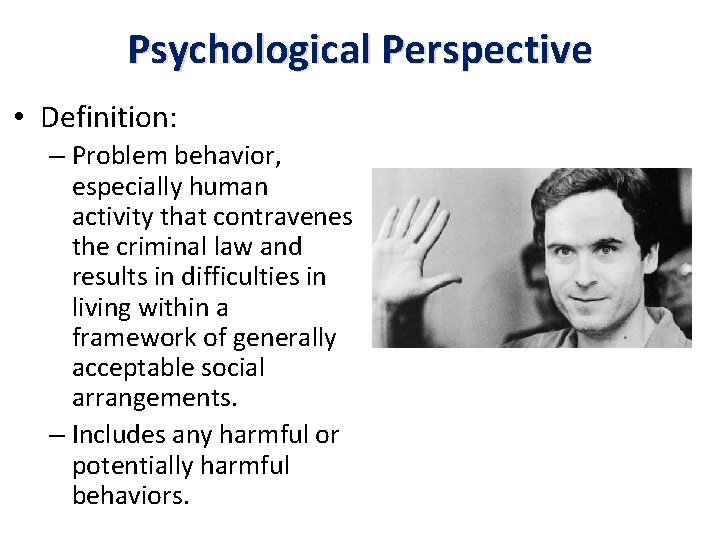
Psychological Perspective • Definition: – Problem behavior, especially human activity that contravenes the criminal law and results in difficulties in living within a framework of generally acceptable social arrangements. – Includes any harmful or potentially harmful behaviors.
Society & Learning • Society - the aggregate of people living together in a more or less ordered community. • Learning - the acquisition of knowledge or skills through experience, study, or by being taught. • Messing with Sasquatch – Illegal in Whatcom County
What Should be Criminal? • Consensus – Laws are enacted to criminalize given forms of behavior when agreed upon by members of society. – Most applicable to homogeneous socieies • Pluralist – Behaviors typically criminalized through a political process after debate over appropriate course of action. – Legislation, appellate court action. – Most applicable to diverse societies.
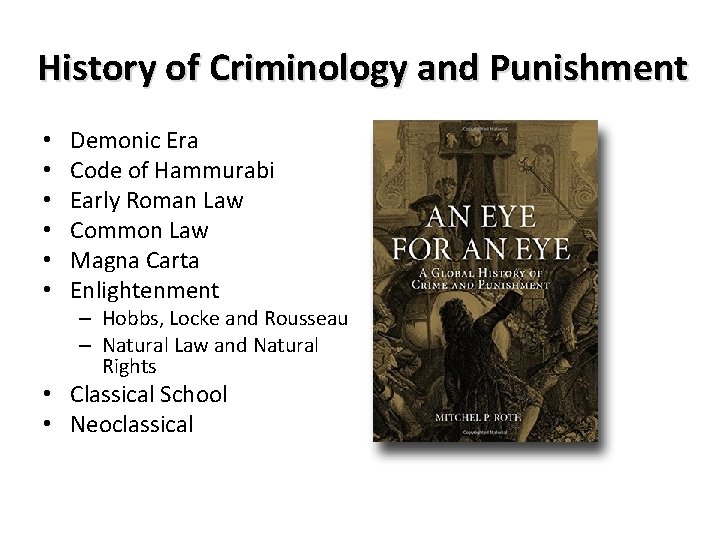
History of Criminology and Punishment • • • Demonic Era Code of Hammurabi Early Roman Law Common Law Magna Carta Enlightenment – Hobbs, Locke and Rousseau – Natural Law and Natural Rights • Classical School • Neoclassical
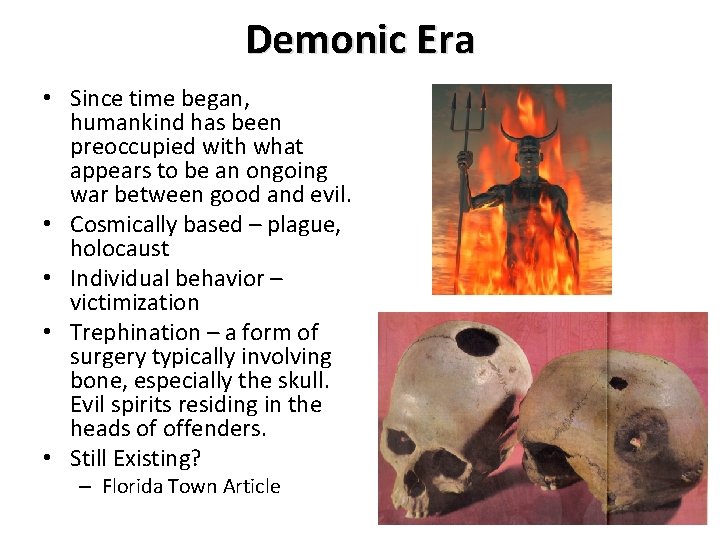
Demonic Era • Since time began, humankind has been preoccupied with what appears to be an ongoing war between good and evil. • Cosmically based – plague, holocaust • Individual behavior – victimization • Trephination – a form of surgery typically involving bone, especially the skull. Evil spirits residing in the heads of offenders. • Still Existing? – Florida Town Article
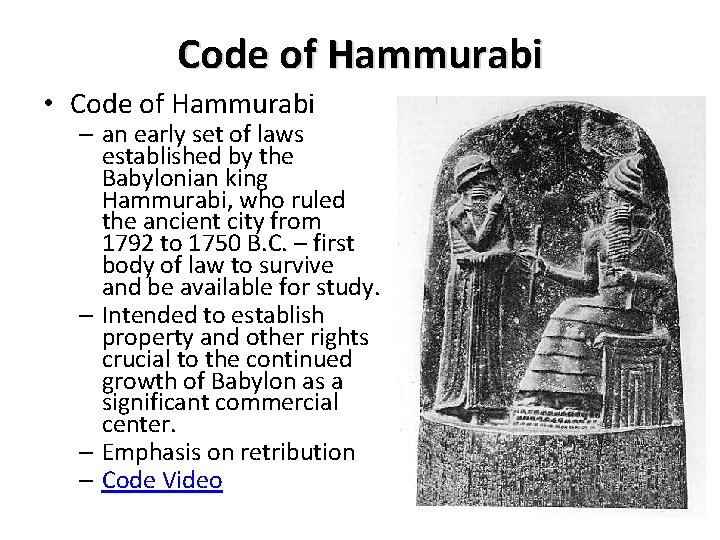
Code of Hammurabi • Code of Hammurabi – an early set of laws established by the Babylonian king Hammurabi, who ruled the ancient city from 1792 to 1750 B. C. – first body of law to survive and be available for study. – Intended to establish property and other rights crucial to the continued growth of Babylon as a significant commercial center. – Emphasis on retribution – Code Video
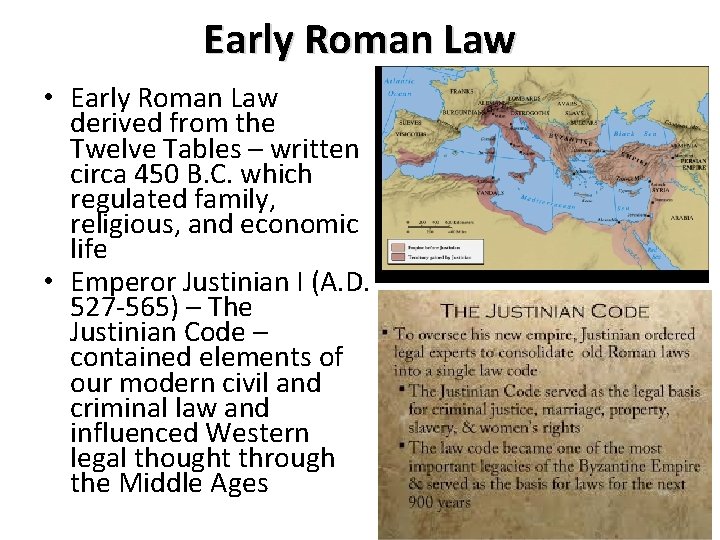
Early Roman Law • Early Roman Law derived from the Twelve Tables – written circa 450 B. C. which regulated family, religious, and economic life • Emperor Justinian I (A. D. 527 -565) – The Justinian Code – contained elements of our modern civil and criminal law and influenced Western legal thought through the Middle Ages
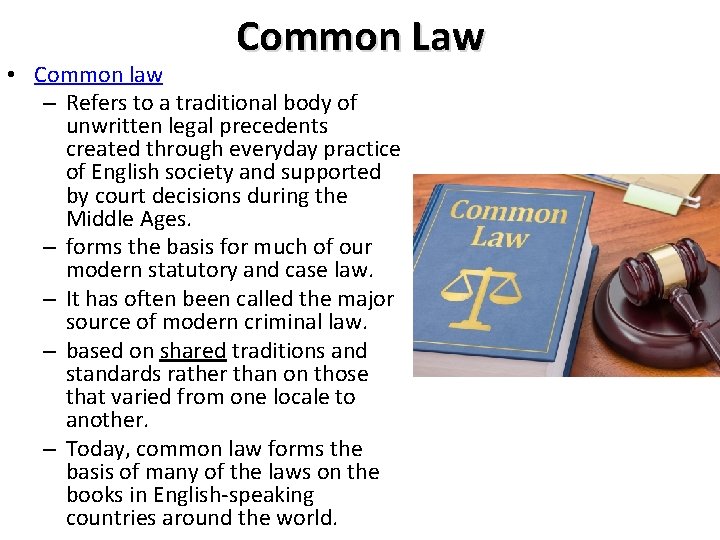
Common Law • Common law – Refers to a traditional body of unwritten legal precedents created through everyday practice of English society and supported by court decisions during the Middle Ages. – forms the basis for much of our modern statutory and case law. – It has often been called the major source of modern criminal law. – based on shared traditions and standards rather than on those that varied from one locale to another. – Today, common law forms the basis of many of the laws on the books in English-speaking countries around the world.
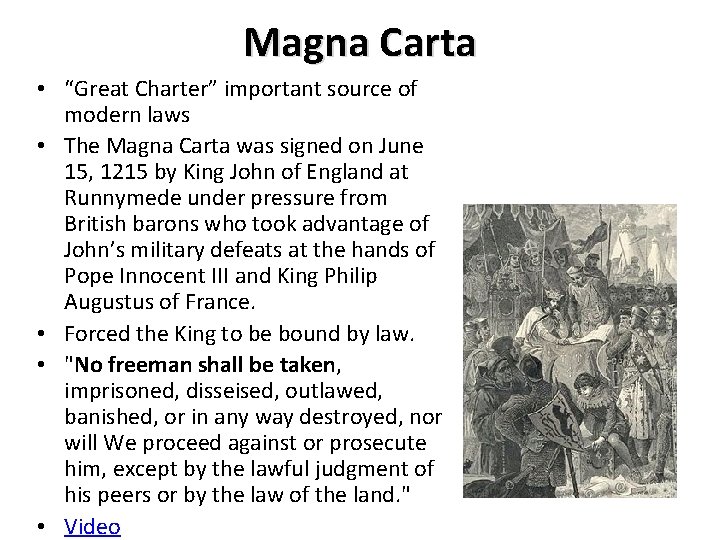
Magna Carta • “Great Charter” important source of modern laws • The Magna Carta was signed on June 15, 1215 by King John of England at Runnymede under pressure from British barons who took advantage of John’s military defeats at the hands of Pope Innocent III and King Philip Augustus of France. • Forced the King to be bound by law. • "No freeman shall be taken, imprisoned, disseised, outlawed, banished, or in any way destroyed, nor will We proceed against or prosecute him, except by the lawful judgment of his peers or by the law of the land. " • Video
Enlightenment • A social movement that arose during the eighteenth century and that built upon ideas like empiricism, rationally, free will, humanism, and natural law.