
What is Copyright Why is this important Robert
What is Copyright? Why is this important? Robert Mc. Andrews Humble ISD Career & Technology Education Center
What is Copyright? l Copyright is a federal law. It is Title 17 of the United States Code. l Copyright is the right of authors to control the use of their work for a limited period of time. l A copyrighted work must be an original work of authorship which is fixed in a tangible medium of expression.
Why Has Copyright become an Issue? Due to the ease of copying graphics, images, text and video from the Internet, there has been a heightened concern about copyright violation. You cannot just use a work that belongs to someone else and use it as your own. You must give credit (cite your sources)
Why is copyright law important? l Copyright law has a dual role. It provides exclusive rights to authors in order to protect their work for a limited period of time but it was also established to promote creativity and learning.
Where did copyright law originate? Copyright law originated with the United States Constitution. In Article I, Section 8, the Constitution states that "Congress shall have the power. . . To promote the Progress of Science and useful Arts, by securing for limited Times to Authors and Inventors the exclusive Right to their respective Writings and Discoveries". l The Copyright Office of the Library of Congress is responsible for overseeing the administrative functions of the copyright law. l Congress enacts copyright laws. l The Federal courts interpret and enforce the copyright law. l

What are the copyright holder's exclusive rights? The owner of a copyright has six exclusive rights: l l l To reproduce the work. To distribute the work. To create derivative works*. To publicly perform* the work. To publicly display* the work. To publicly perform sound recordings by means of a digital audio transmission.
What can be copyrighted? Eight categories of works are copyrightable: l l l l Literary, musical and dramatic works. Pantomimes and choreographic works. Pictorial, graphic and sculptural works. Sound recordings. Motion pictures and other AV works. Computer programs. Compilations of works and derivative works. Architectural works.
What cannot be copyrighted? Ideas, procedures, methods, systems, and processes are not copyrightable. Example: The list of ingredients for recipes are not copyrightable. However, the recipes' instructions are protected.
What cannot be copyrighted? Titles, names, short phrases, and slogans are not copyrightable. Example: Nike's slogan "Just do it" is not copyrightable. However, a slogan can receive trademark protection as is the case in the example.
What cannot be copyrighted? Facts, news, and research are not copyrightable. Example: A standard calendar. Works that are not fixed in a tangible medium of expression. Example: Extemporaneous speeches that are not written or recorded.
What cannot be copyrighted? Works in the public domain are not copyrightable. Example 1: Works created by United States government employees, where the works they created are a result of what they were hired to do. Example 2: Work published in the United States prior to 1923.
“What if it is for An Educational Purpose? ” 3/10/2021
Fair Use Allows you to use material for : ¡ criticism ¡ comment ¡ news reporting ¡ teaching ¡ scholarship ¡ research 3/10/2021
Four Fair Use Factors l Purpose and Character of the Use ¡ l The Nature of the Copyrighted Work ¡ l Factual or Artistic The Amount That Is Used ¡ l Nonprofit or Educational Purposes Less is More! Adhere to Guidelines The Effect of the Use on the Potential Market ¡ Are you preventing the creator from profiting financially? 3/10/2021
What are the Rules for Fair Use for Instructors? Copying by teachers must meet the tests of brevity and spontaneity: ·Brevity refers to how much of the work you can copy. ·Spontaneity refers to how many times you can copy. One Semester Rule You are expected to request permission as soon as possible. 3/10/2021
What Can Be Copied? • A chapter from a book (never the entire book). ·An article from a periodical or newspaper. ·A short story, essay, or poem. One work is the norm whether it comes from an individual work or an anthology. ·A chart, graph, diagram, drawing, cartoon or picture from a book, periodical, or newspaper. 3/10/2021
What Should Be Avoided? Making multiple copies of different works that could substitute for the purchase of books, publisher's reprints, or periodicals. Copying the same works from semester to semester. Copying the same material for several different courses at the same or different institutions. Copying more than nine separate times in a single semester. 3/10/2021
“I got it from the Internet” 3/10/2021
Internet Copyright You cannot print web pages, photos, or other information from the internet without permission from the source These are considered literary works under the copyright law The Internet IS NOT the public domain. There are both non-copyrighted and copyrighted materials available. If you are not sure, assume that a work is copyrighted. 3/10/2021
Tips for the Internet Always credit the source of your information Find out if the author of a work (e. g. , video, audio, graphic, icon) provides information on how to use his or her work. If explicit guidelines exist, follow them. Whenever feasible, ask the owner of the copyright for permission. Keep a copy of your request for permission and the permission received. 3/10/2021
“I’m not selling it” 3/10/2021
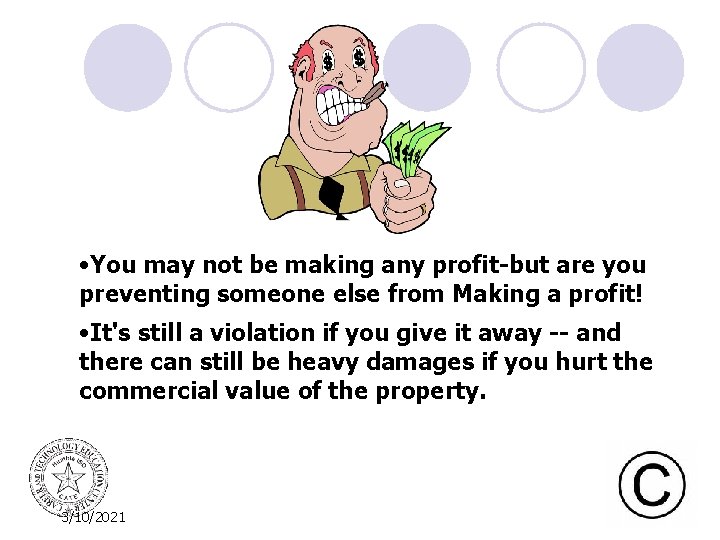
• You may not be making any profit-but are you preventing someone else from Making a profit! • It's still a violation if you give it away -- and there can still be heavy damages if you hurt the commercial value of the property. 3/10/2021
“What is it doesn’t have the little 3/10/2021 © ? ”
© In the United States, almost everything created privately and originally after April 1, 1989 is copyrighted and protected whether it has a notice or not. You should assume for other people's works is that they are copyrighted and may not be copied unless you know otherwise. 3/10/2021
© Nowhere in copyright law does it say that if you give credit to the author you are not in violation of the law. The only exception is if you have a licensing agreement with an author, publication, or company. 3/10/2021
When Should You Get Permission? When you intend to use the project for commercial or non-educational purposes. When you plan to distribute the project beyond the scope of the guidelines. When in doubt, get permission. 3/10/2021
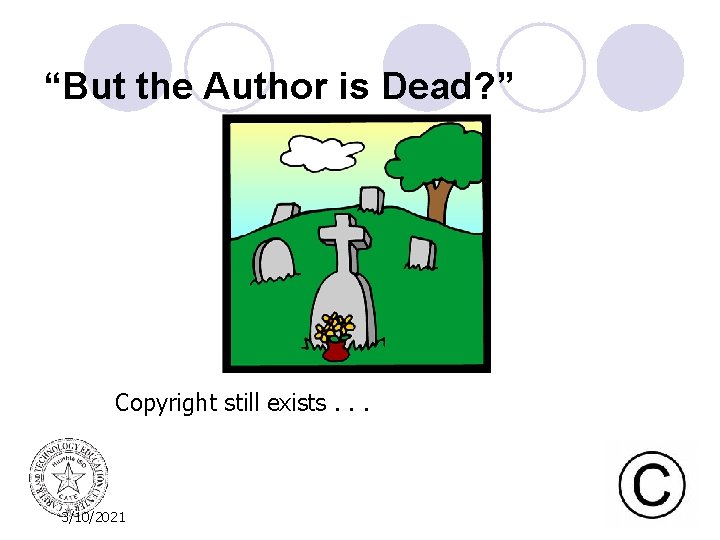
“But the Author is Dead? ” Copyright still exists. . . 3/10/2021
How long does copyright last? Works created on or after January 1, 1978 are protected for a term of the life of the author plus 70 years. If it is a corporate author then the protection is for the shorter of 95 years from publication* or 120 years from creation*. Works created and published prior to 1978 may be protected for different lengths of time. l For more information regarding the length of a copyright, please see the copyright duration chart. l Example: Author James Michener died in 1997. His works such as Alaska, Texas, and The Eagle and the Raven, which were all created after 1978, are protected under the copyright law until 2067. l 3/10/2021
What is the public domain? The public domain consists of all works that never had copyright protection and works that no longer have copyright protection. The public domain also includes most works created by the United States government. All works in the public domain are free for the public to use. Works published in the United States prior to 1923 are in the public domain. Example: Census reports, which are compiled and published by the United States government are in the public domain.
Summary Best practice is to get permission from the source for everything you use! l Always keep records of permission agreements. l Give credit where credit is due! l Adhere to the 4 Fair Use Factors and Guidelines l Only the Courts can determine Fair Use l Copyright violation is a Civil violation not Criminal! l 3/10/2021
Power Point Resources This presentation contained graphics from Microsoft Clip Art Gallery (Copyright, 2000, Microsoft Corp. ) Exempted under the Fair Use to US Copyright laws. Facts reproduced under the Fair Use Copyright Act from the following web site: United States Copyright Office Library of Congress (200, Jan. 10). Copyright Basics. Available online at: http: //lcweb. loc. gov/copyright/ 3/10/2021
For More Information Visit: http: //www. lib. purdue. edu/uco/Copyright. Basics/basics. html
- Slides: 32