
What is ContextAware Computing u Some definitions l
- Slides: 11
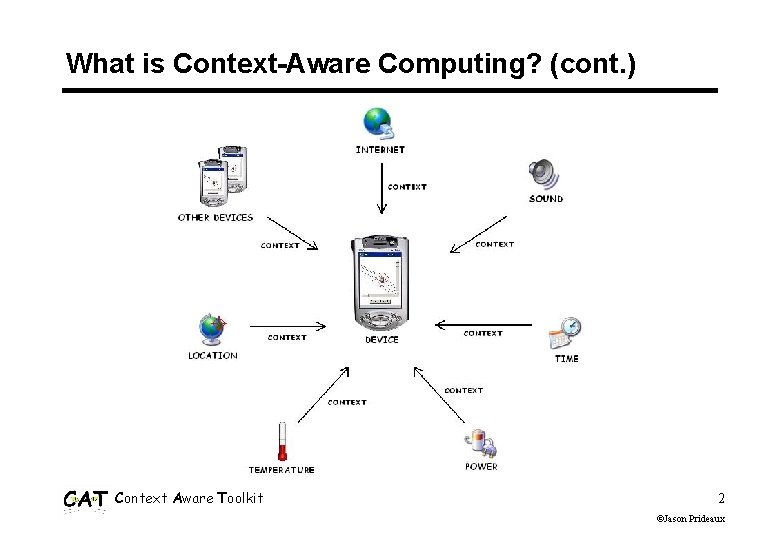
What is Context-Aware Computing? u Some definitions: l Context: The physical and social situation in which the person/ device is a part of. l Example Contexts: time of day, location, other people/devices, temperature, sound, light/vision, motion, network/internet, etc. u Goal of Context-Aware Computing: Acquire and utilize context from a computer device in order to provide services that are appropriate given the acquired context. Context Aware Toolkit 1 ©Jason Prideaux
What is Context-Aware Computing? (cont. ) Context Aware Toolkit 2 ©Jason Prideaux
Navigator Application u We want to build a navigation aid that will give a person’s location and give directions to some destination. u Contexts that we need: l Location u So, we need to build an app that will be able to read in context from a location sensor, such as a GPS device. Context Aware Toolkit 3 ©Jason Prideaux
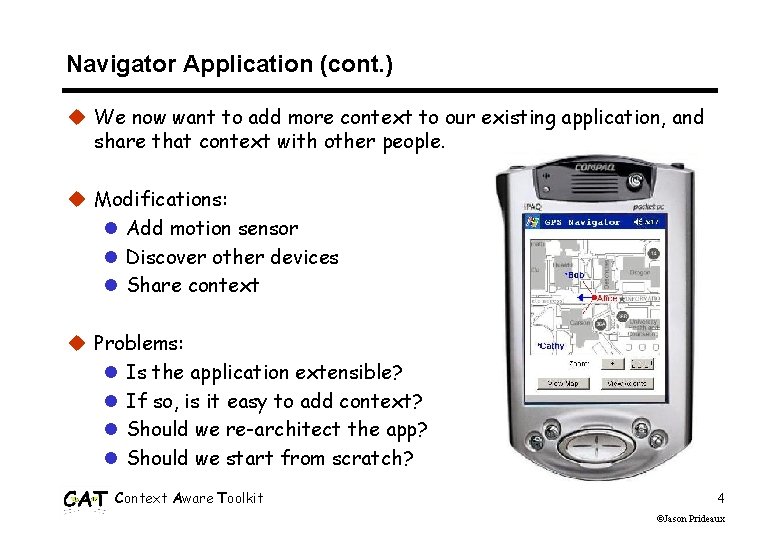
Navigator Application (cont. ) u We now want to add more context to our existing application, and share that context with other people. u Modifications: l Add motion sensor l Discover other devices l Share context u Problems: l Is the application extensible? l If so, is it easy to add context? l Should we re-architect the app? l Should we start from scratch? Context Aware Toolkit 4 ©Jason Prideaux
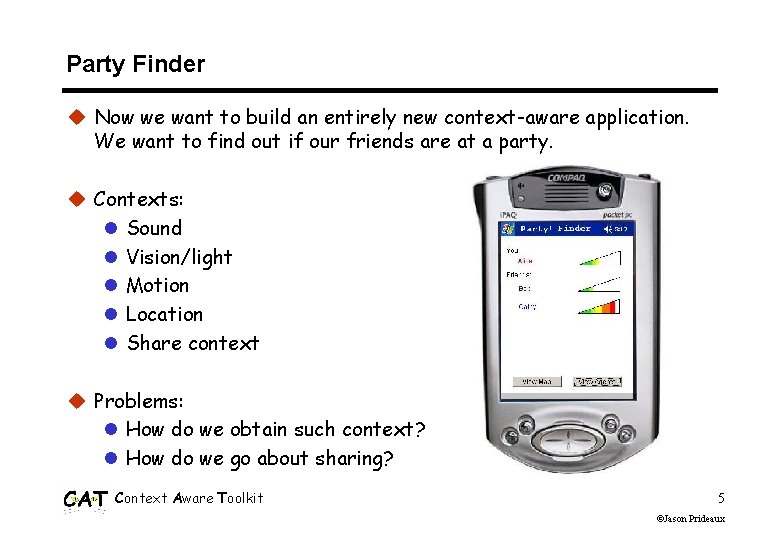
Party Finder u Now we want to build an entirely new context-aware application. We want to find out if our friends are at a party. u Contexts: l Sound l Vision/light l Motion l Location l Share context u Problems: l How do we obtain such context? l How do we go about sharing? Context Aware Toolkit 5 ©Jason Prideaux
Solution: Create a Middleware u Notice that there are needs that context-aware applications have in common: l Access to sensors that provide context. l Discovery of other people/devices around us. l Ability to share context with other people/devices. u Solution: Create a middleware that will provide all of the above features. Advantages of a middleware: l Maximum code reuse. l Lightweight applications. l A common language/description for context. l Rapid development of context-aware applications. Context Aware Toolkit 6 ©Jason Prideaux
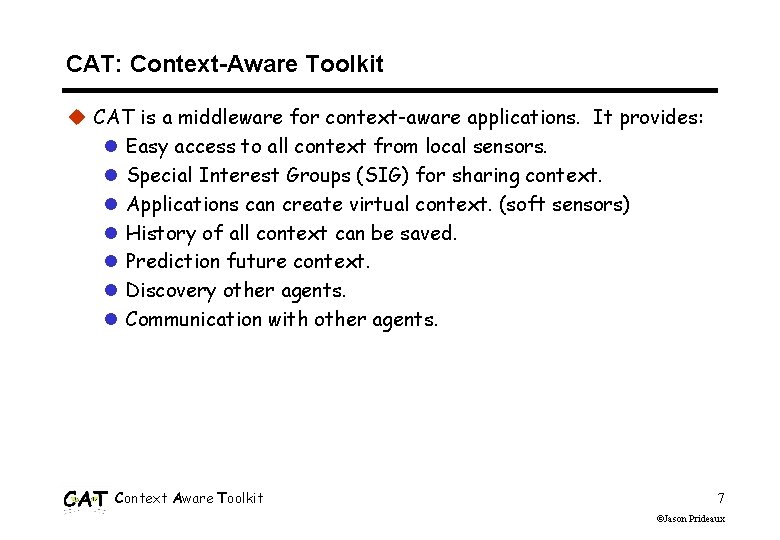
CAT: Context-Aware Toolkit u CAT is a middleware for context-aware applications. It provides: l Easy access to all context from local sensors. l Special Interest Groups (SIG) for sharing context. l Applications can create virtual context. (soft sensors) l History of all context can be saved. l Prediction future context. l Discovery other agents. l Communication with other agents. Context Aware Toolkit 7 ©Jason Prideaux
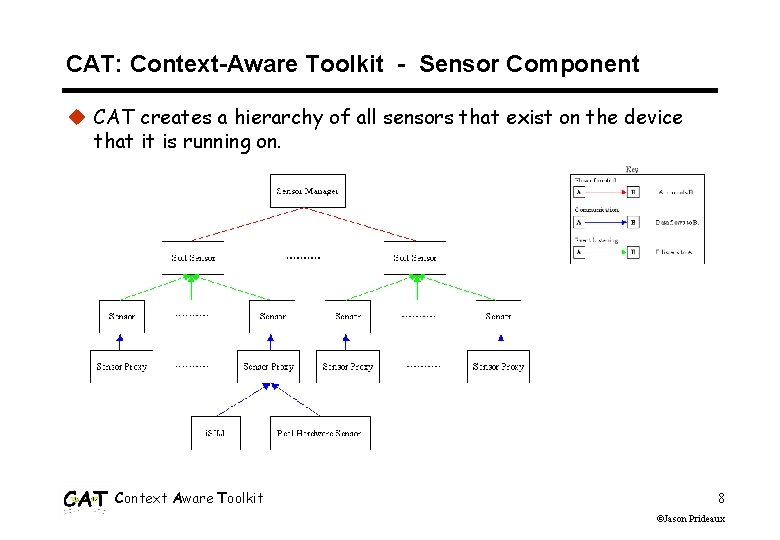
CAT: Context-Aware Toolkit - Sensor Component u CAT creates a hierarchy of all sensors that exist on the device that it is running on. Context Aware Toolkit 8 ©Jason Prideaux
CAT: Context-Aware Toolkit u The Sensors in CAT then generate Context events, which applications can listen to. Available Context includes: l Location, sound, light, and any other sensor data. l Discovery of other agents. l Incoming communication from other agents. l Shared context from other agents. (remote sensing) u CAT applications also have access to several tools for: l Creating SIGs. l Joining SIGs. l Sending messages/data to other agents. l Accessing history/prediction of local and remote context. Context Aware Toolkit 9 ©Jason Prideaux
Conclusion u Retrieving context and sharing context is now simple and uniform for all context-aware applications. u Applications like Navigator and Party Finder can be rapidly developed with CAT, and developers need very little contextaware experience. u CAT itself is extensible, giving developers the ability to add new sensors and context types. Context Aware Toolkit 10 ©Jason Prideaux
References: u “Introduction to Context-Aware Computing” Thomas P. Moran, Paul Dourish. IBM Almaden Research Center, University of Califormia, Irvine. Special Issue of Human-Computer Interaction, Volume 16, 2001. u “CAT: Context-Aware Toolkit” Jason Prideaux, Stephen Fickas. Tentative Release: Spring 2004. u http: //www. cs. uoregon. edu/research/wearables/CAT Context Aware Toolkit 11 ©Jason Prideaux