
What is Conflict in the Classroom and How
- Slides: 24
What is Conflict in the Classroom and How to Deal With It? Aidan Moir, Teaching Commons Tutor Thursday, November 1, 2018
Intended Learning Outcomes By the end of this session, you will have a greater understanding as to how to… − define ‘conflict’ in relation to the classroom − identify the various scenarios conflict can present itself in your classroom − incorporate strategies into your teaching to assist you should any conflict arise − utilize York University services and resources for assistance/professional development
What is conflict?
Definitions of ‘Conflict’ • As a verb… − “to be different, opposed, or contradictory: to fail to be in agreement” • As a noun… − “fight, battle, war” − “mental struggle resulting from opposing needs, drives, wishes, or external/internal demands” − “the opposition of persons of forces that gives rise to the dramatic action in a drama/fiction” Source: Mirriam-Webster
How do you define conflict?
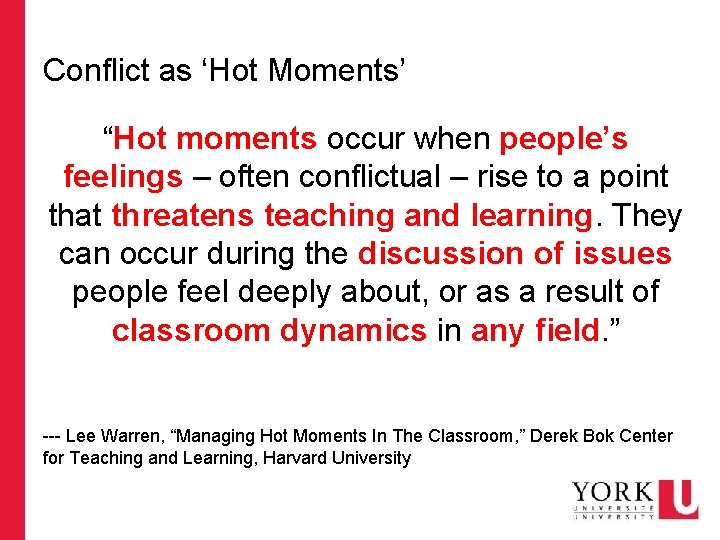
Conflict as ‘Hot Moments’ “Hot moments occur when people’s feelings – often conflictual – rise to a point that threatens teaching and learning. They can occur during the discussion of issues people feel deeply about, or as a result of classroom dynamics in any field. ” --- Lee Warren, “Managing Hot Moments In The Classroom, ” Derek Bok Center for Teaching and Learning, Harvard University
How and when does conflict occur in our classrooms?
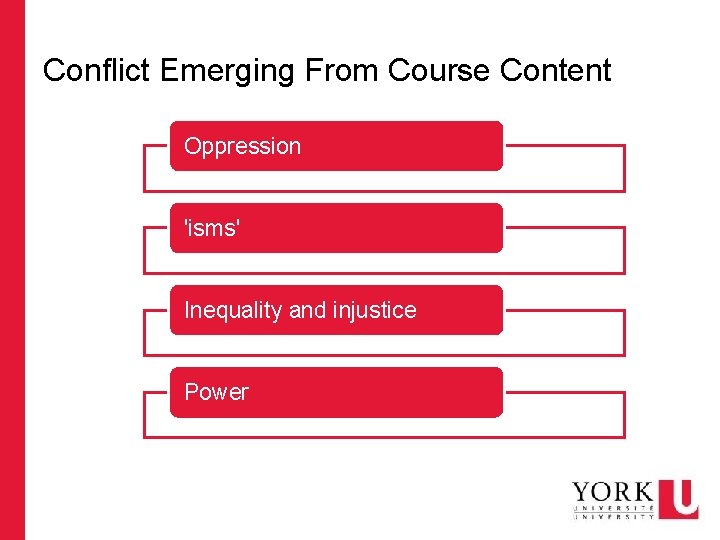
Conflict Emerging From Course Content Oppression 'isms' Inequality and injustice Power
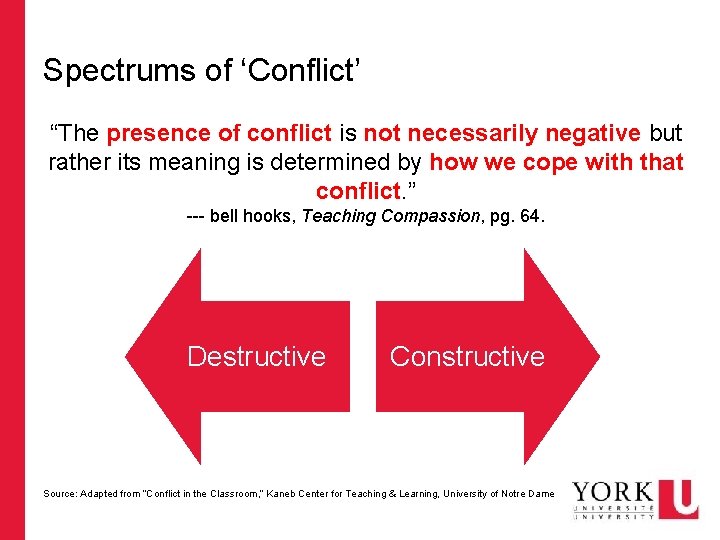
Spectrums of ‘Conflict’ “The presence of conflict is not necessarily negative but rather its meaning is determined by how we cope with that conflict. ” --- bell hooks, Teaching Compassion, pg. 64. Destructive Constructive Source: Adapted from “Conflict in the Classroom, ” Kaneb Center for Teaching & Learning, University of Notre Dame
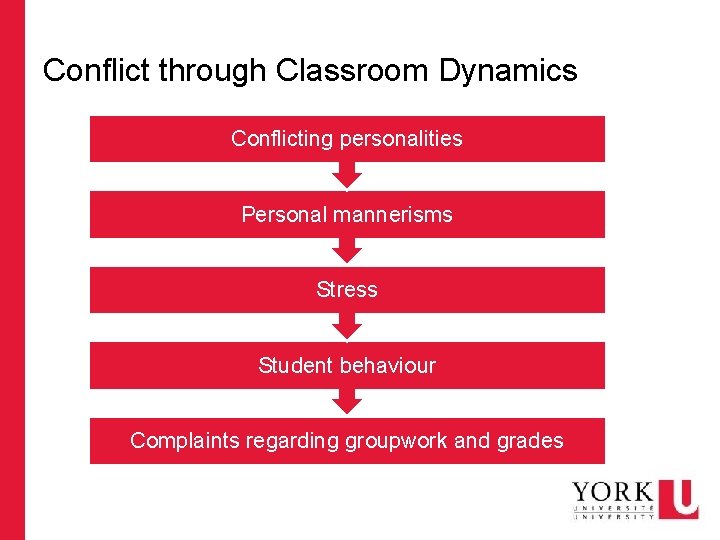
Conflict through Classroom Dynamics Conflicting personalities Personal mannerisms Stress Student behaviour Complaints regarding groupwork and grades
How do you feel when a conflict occurs?
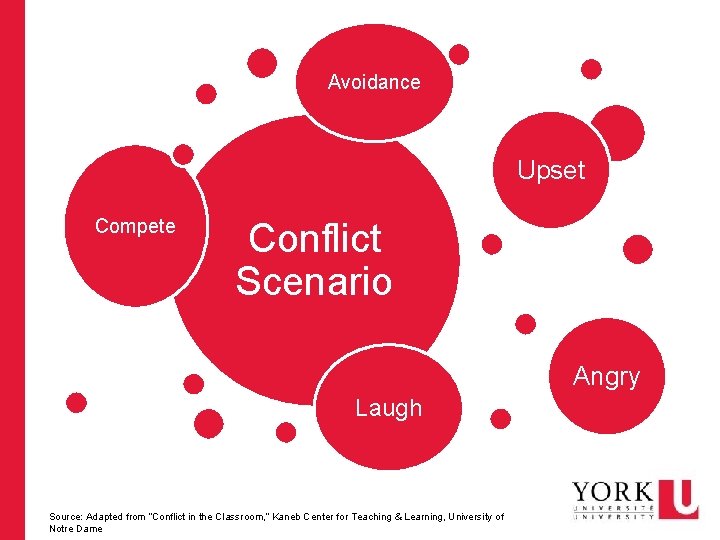
Avoidance Upset Compete Conflict Scenario Angry Laugh Source: Adapted from “Conflict in the Classroom, ” Kaneb Center for Teaching & Learning, University of Notre Dame
Classroom Relationships, Ethics, and Dynamics • • Be aware of power dynamics Assert your authority Be professional Balance different personality traits Encourage diversity Be clear and concise Objective and unbiased grading and assessment Identify any potential conflicts of interest
How do we prepare for conflict in our classrooms? What are strategies we can integrate into our teaching?
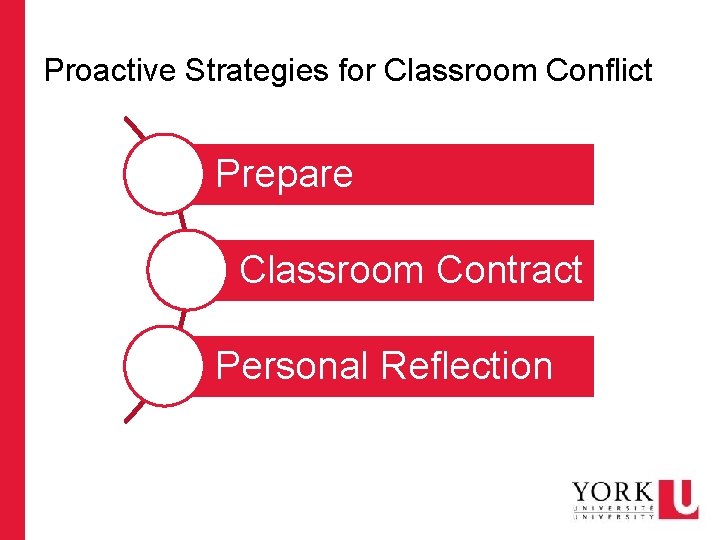
Proactive Strategies for Classroom Conflict Prepare Classroom Contract Personal Reflection
Personal Reflection “Know yourself. Know your biases, know what will push your buttons and what will cause your mind to stop. Every one of us has areas in which we are vulnerable to strong feelings. Knowing what those areas are in advance can diminish the element of surprise. This self-knowledge can enable you to devise in advance strategies for managing yourself and the class when such a moment arises. You will have thought about what you need to do in order to enable your mind to work again. ” Lee Warren, “Managing Hot Moments in the Classroom, ” Derek Bok Center, Harvard University
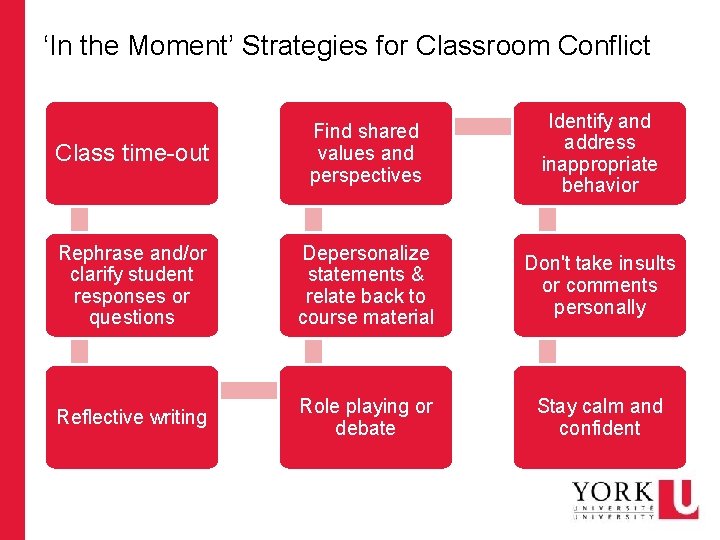
‘In the Moment’ Strategies for Classroom Conflict Class time-out Find shared values and perspectives Identify and address inappropriate behavior Rephrase and/or clarify student responses or questions Depersonalize statements & relate back to course material Don't take insults or comments personally Reflective writing Role playing or debate Stay calm and confident
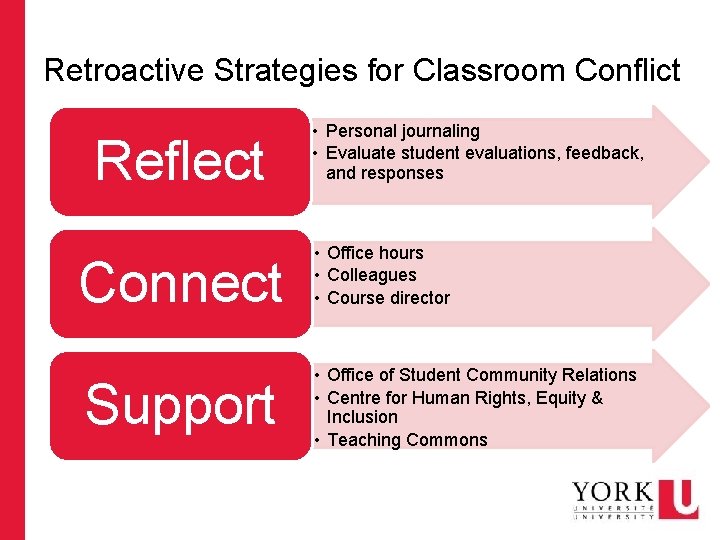
Retroactive Strategies for Classroom Conflict Reflect Connect Support • Personal journaling • Evaluate student evaluations, feedback, and responses • Office hours • Colleagues • Course director • Office of Student Community Relations • Centre for Human Rights, Equity & Inclusion • Teaching Commons
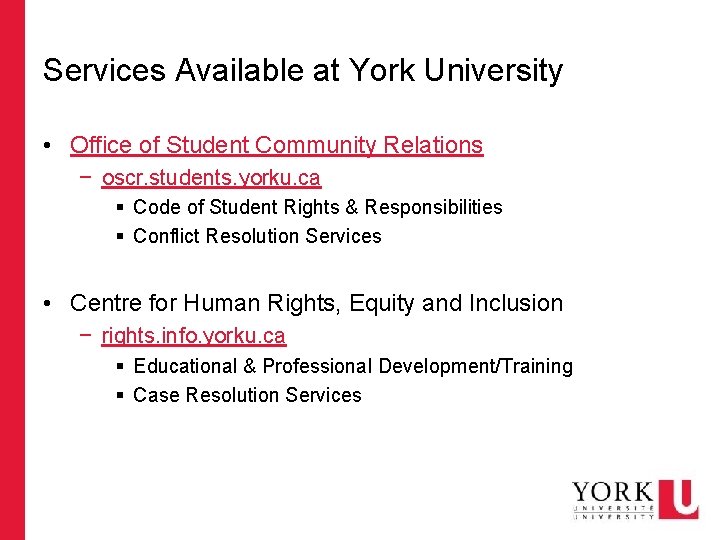
Services Available at York University • Office of Student Community Relations − oscr. students. yorku. ca § Code of Student Rights & Responsibilities § Conflict Resolution Services • Centre for Human Rights, Equity and Inclusion − rights. info. yorku. ca § Educational & Professional Development/Training § Case Resolution Services
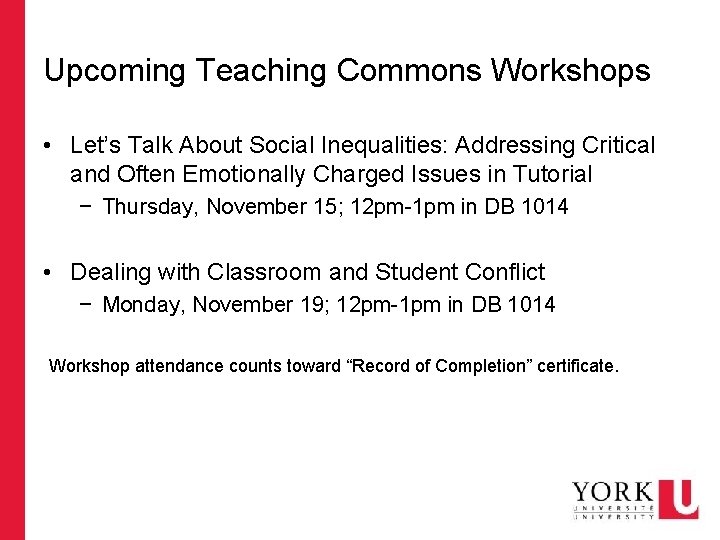
Upcoming Teaching Commons Workshops • Let’s Talk About Social Inequalities: Addressing Critical and Often Emotionally Charged Issues in Tutorial − Thursday, November 15; 12 pm-1 pm in DB 1014 • Dealing with Classroom and Student Conflict − Monday, November 19; 12 pm-1 pm in DB 1014 Workshop attendance counts toward “Record of Completion” certificate.
Revisiting What is Conflict? • ‘Conflict’ can be expressed and experienced in different ways − course material − classroom dynamics • We all have our own unique biases, mannerisms, and subjectivities • Self-reflection is an important practice in mitigating any potential conflict that may arise • There is no ‘magical’ solution or strategy preventing or resolving classroom conflict
Questions?
Thank You!
Bibliography “Conflict in the Classroom. ” Kaneb Center for Teaching & Learning, University of Notre Dame, April 18, 2016. “Conflict. ” Mirriam-Webster. Accessed October 22, 2018. https: //www. merriamwebster. com/dictionary/conflict? utm_campaign=sd&utm_medium=serp&utm_source=jsonld hooks, bell. Teaching Community: A Pedagogy of Hope. New York: Routledge, 2003. ”Making the Most of ‘Hot Moments’ in the Classroom. ” University of Michigan Center for Research on Learning and Teaching. “Managing Conflict in the Classroom. ” Teaching Commons, York University. Accessed October 22, 2018. https: //teachingcommons. yorku. ca/resources/teaching-strategies/managing-conflict-inthe-classroom/ “Reluctance and Conflict in the Classroom. ” University of Wisconsin. Accessed October 22, 2018. https: //www. uww. edu/learn/improving/aboutdiversity/approachdiversity/reluctanceconflict Warren, Lee. “Managing Hot Moments in the Classroom. ” Derek Bok Center, Harvard University.