
What is Computing Informatics l What is computer
![def is_the_end_of_learning_of(): [x for x in …] Compsci 06/101, Spring 2012 17. 25](https://slidetodoc.com/presentation_image_h2/5723b8b399ebe590c7614a08c64be25f/image-25.jpg "def is_the_end_of_learning_of(): [x for x in …] Compsci 06/101, Spring 2012 17. 25")
- Slides: 36
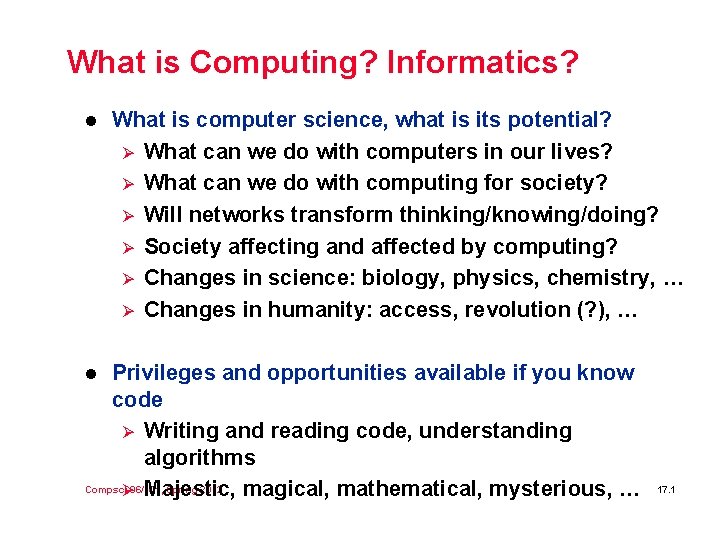
What is Computing? Informatics? l What is computer science, what is its potential? Ø What can we do with computers in our lives? Ø What can we do with computing for society? Ø Will networks transform thinking/knowing/doing? Ø Society affecting and affected by computing? Ø Changes in science: biology, physics, chemistry, … Ø Changes in humanity: access, revolution (? ), … Privileges and opportunities available if you know code Ø Writing and reading code, understanding algorithms Compsci Spring 2012 Ø 06/101, Majestic, magical, mathematical, mysterious, … l 17. 1
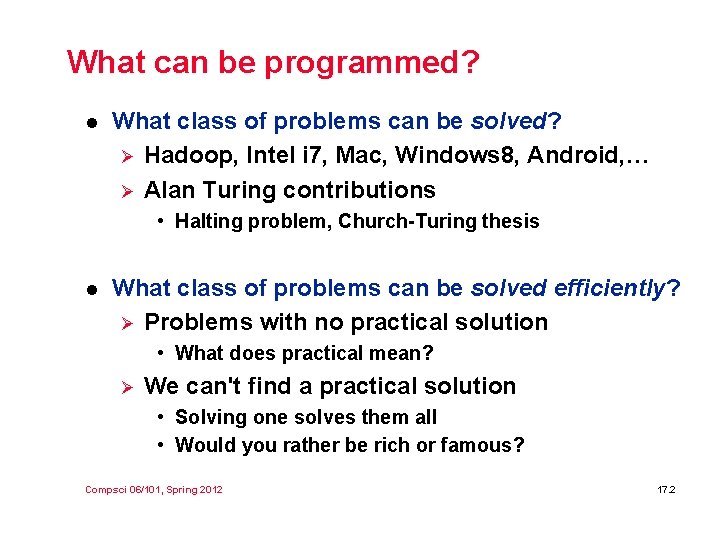
What can be programmed? l What class of problems can be solved? Ø Hadoop, Intel i 7, Mac, Windows 8, Android, … Ø Alan Turing contributions • Halting problem, Church-Turing thesis l What class of problems can be solved efficiently? Ø Problems with no practical solution • What does practical mean? Ø We can't find a practical solution • Solving one solves them all • Would you rather be rich or famous? Compsci 06/101, Spring 2012 17. 2
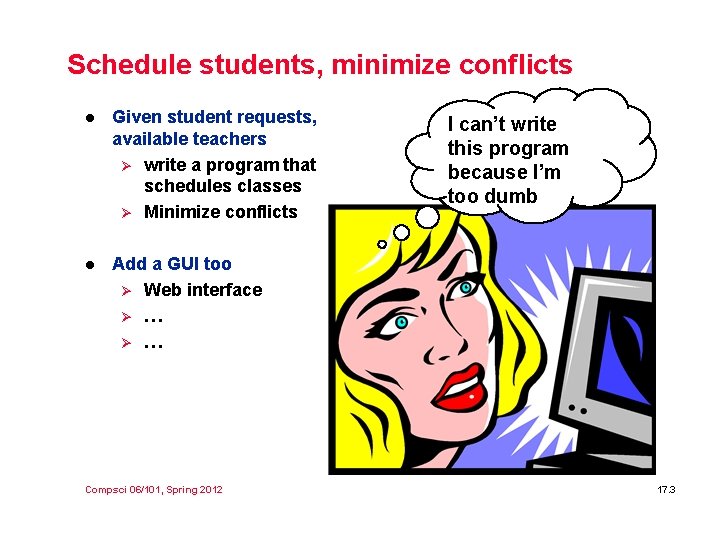
Schedule students, minimize conflicts l Given student requests, available teachers Ø write a program that schedules classes Ø Minimize conflicts l Add a GUI too Ø Web interface Ø … Compsci 06/101, Spring 2012 I can’t write this program because I’m too dumb 17. 3
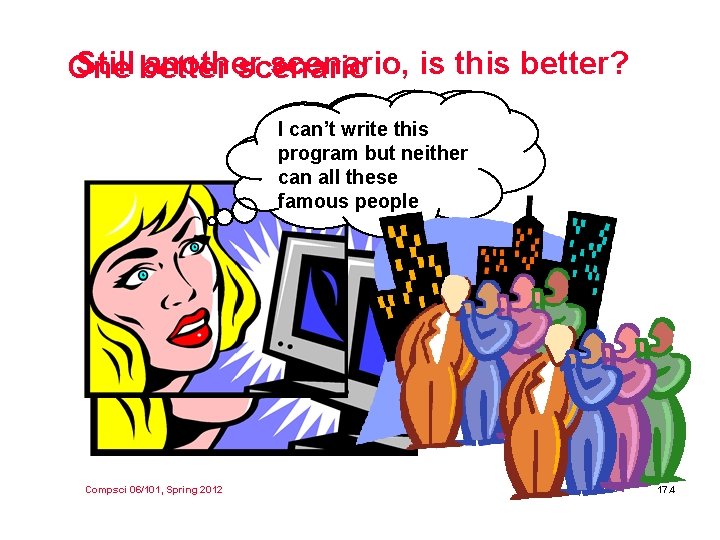
Still better another scenario, is this better? One scenario can’t write this II can’t program but because program neither it’s provably can all these impossible famous people Compsci 06/101, Spring 2012 17. 4
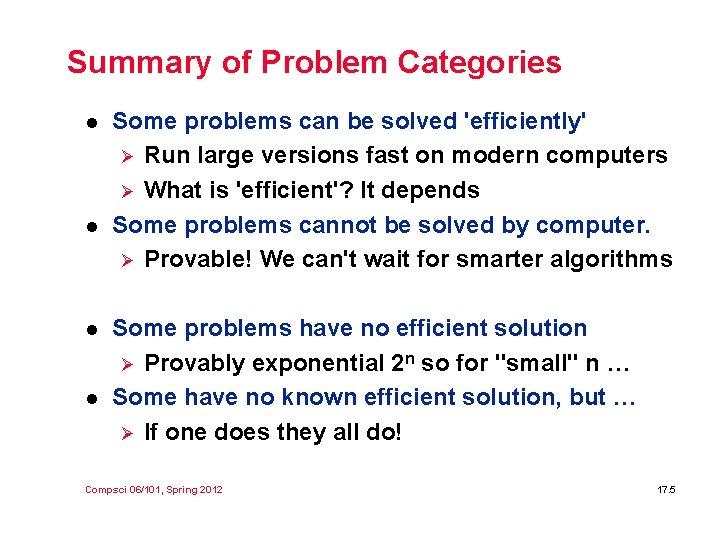
Summary of Problem Categories l l Some problems can be solved 'efficiently' Ø Run large versions fast on modern computers Ø What is 'efficient'? It depends Some problems cannot be solved by computer. Ø Provable! We can't wait for smarter algorithms Some problems have no efficient solution Ø Provably exponential 2 n so for "small" n … Some have no known efficient solution, but … Ø If one does they all do! Compsci 06/101, Spring 2012 17. 5
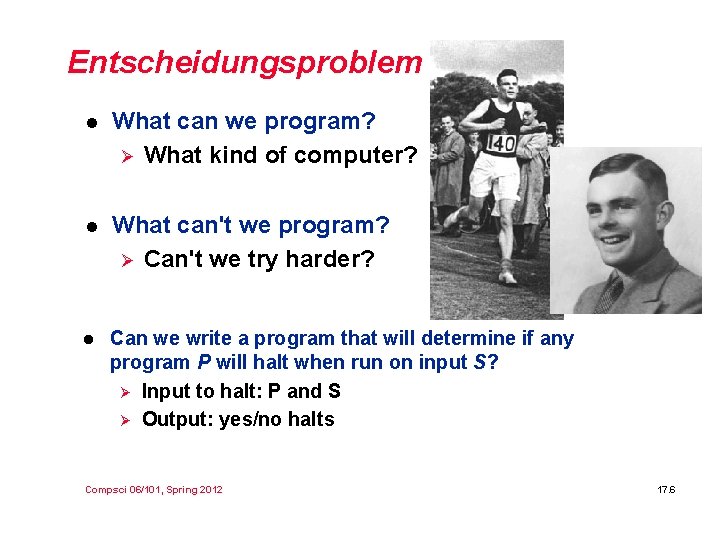
Entscheidungsproblem l What can we program? Ø What kind of computer? l What can't we program? Ø Can't we try harder? l Can we write a program that will determine if any program P will halt when run on input S? Ø Input to halt: P and S Ø Output: yes/no halts Compsci 06/101, Spring 2012 17. 6
Good sites: http: //del. icio. us/ l What is social bookmarking? Ø Why is del. icio. us interesting? Ø Who posts, who visits? l What about a website of interesting websites? Ø What would you expect to find there? Ø Would the site list itself? l What about sites that list/link to themselves? Ø What about a site with all sites that list themselves? Compsci 06/101, Spring 2012 17. 7
Bad sites: http: //haz. ardo. us l Sites listing bad sites (don’t visit them? ) Ø Where would this be useful? Ø What about censorship (internationally? ) Ø Is this a good site or a bad site? l What about sites that list/link themselves? Ø Is haz. ardo. us there? l Website of all the sites that don’t list themselves? Ø Is notlisted. com listed on notlisted. com? Compsci 06/101, Spring 2012 17. 8
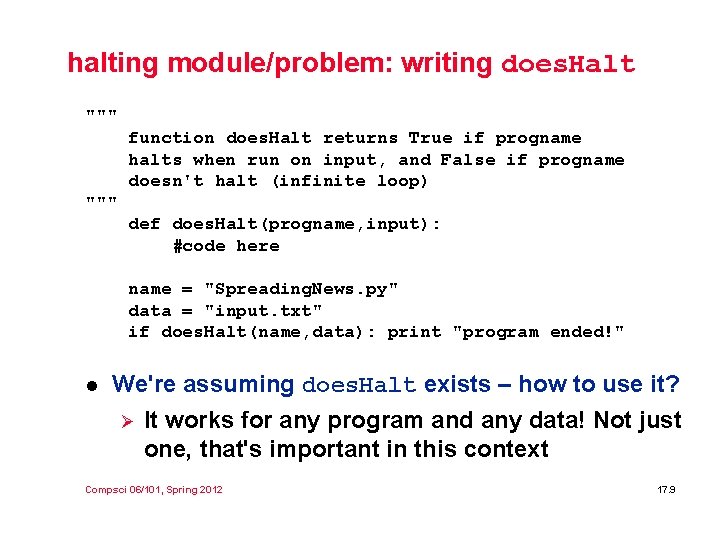
halting module/problem: writing does. Halt """ function does. Halt returns True if progname halts when run on input, and False if progname doesn't halt (infinite loop) """ def does. Halt(progname, input): #code here name = "Spreading. News. py" data = "input. txt" if does. Halt(name, data): print "program ended!" l We're assuming does. Halt exists – how to use it? Ø It works for any program and any data! Not just one, that's important in this context Compsci 06/101, Spring 2012 17. 9
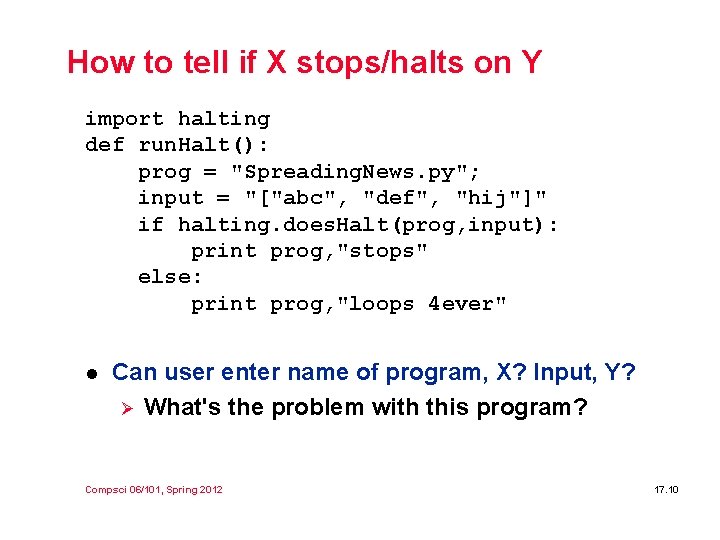
How to tell if X stops/halts on Y import halting def run. Halt(): prog = "Spreading. News. py"; input = "["abc", "def", "hij"]" if halting. does. Halt(prog, input): print prog, "stops" else: print prog, "loops 4 ever" l Can user enter name of program, X? Input, Y? Ø What's the problem with this program? Compsci 06/101, Spring 2012 17. 10
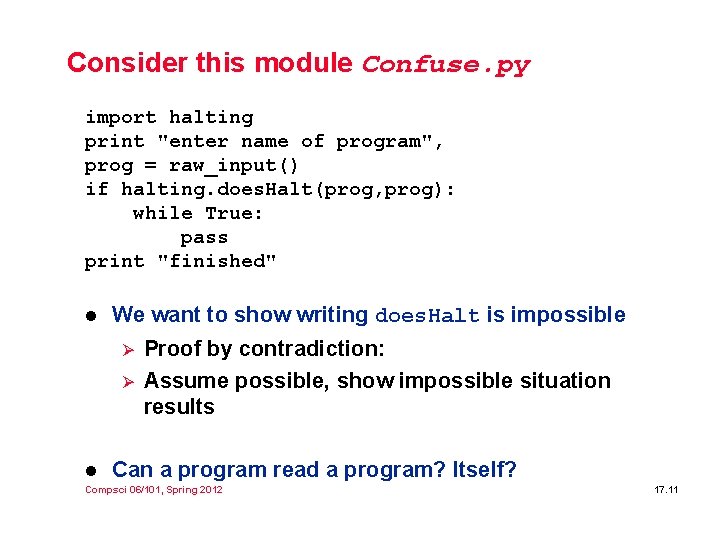
Consider this module Confuse. py import halting print "enter name of program", prog = raw_input() if halting. does. Halt(prog, prog): while True: pass print "finished" l We want to show writing does. Halt is impossible Ø Ø l Proof by contradiction: Assume possible, show impossible situation results Can a program read a program? Itself? Compsci 06/101, Spring 2012 17. 11
Are hard problems easy? Clay Prize l P = easy problems, NP = “hard” problems Ø P means solvable in polynomial time • Difference between N, N 2, N 10 ? Ø NP means non-deterministic, polynomial time • guess a solution and verify it efficiently Question: P = NP ? Ø if yes, a whole class of difficult problems , the NP-complete problems, can be solved efficiently Ø if no, no hard problems can be solved efficiently Ø showing the first problem was NP complete was an exercise in intellectual bootstrapping, Compsci 06/101, Spring 2012 satisfiability/Cook/(1971) l 17. 12
How is Python like all other programming languages, how is it different? Compsci 06/101, Spring 2012 17. 13
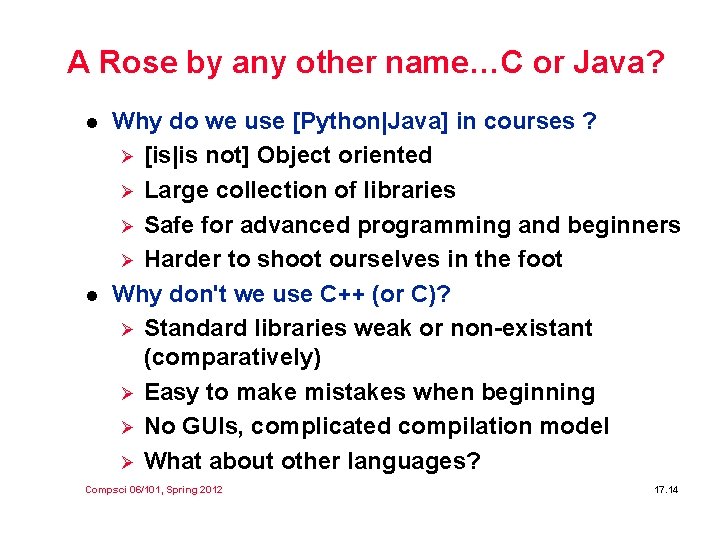
A Rose by any other name…C or Java? l l Why do we use [Python|Java] in courses ? Ø [is|is not] Object oriented Ø Large collection of libraries Ø Safe for advanced programming and beginners Ø Harder to shoot ourselves in the foot Why don't we use C++ (or C)? Ø Standard libraries weak or non-existant (comparatively) Ø Easy to make mistakes when beginning Ø No GUIs, complicated compilation model Ø What about other languages? Compsci 06/101, Spring 2012 17. 14
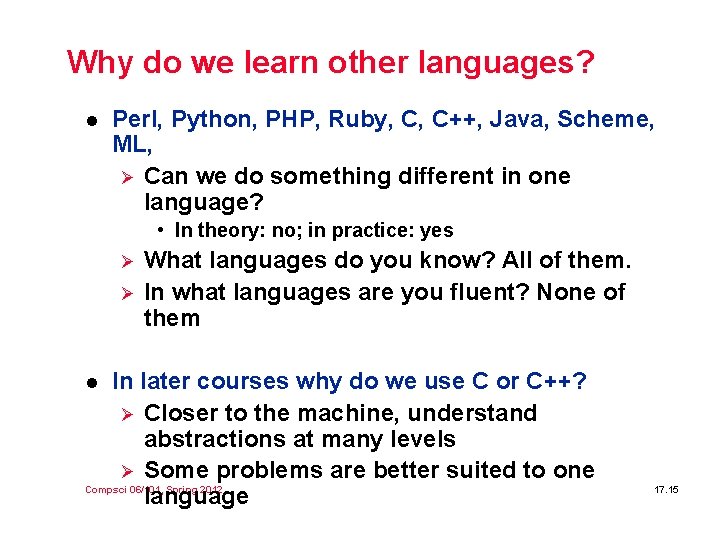
Why do we learn other languages? l Perl, Python, PHP, Ruby, C, C++, Java, Scheme, ML, Ø Can we do something different in one language? • In theory: no; in practice: yes Ø Ø What languages do you know? All of them. In what languages are you fluent? None of them In later courses why do we use C or C++? Ø Closer to the machine, understand abstractions at many levels Ø Some problems are better suited to one Compsci 06/101, Spring 2012 language l 17. 15
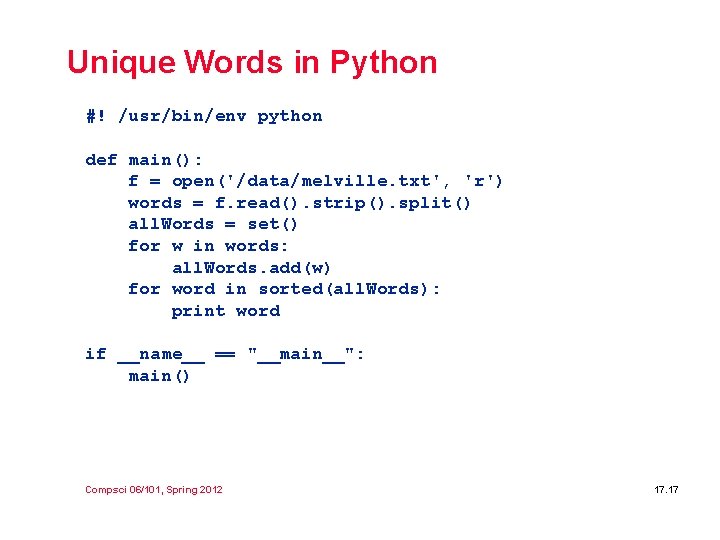
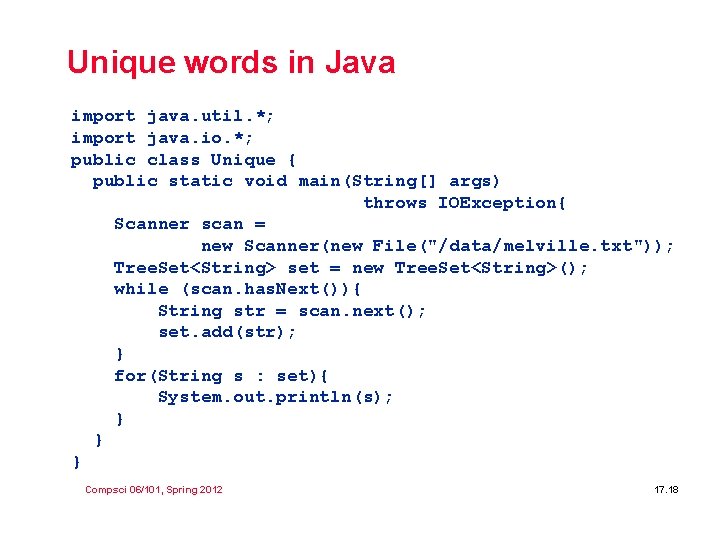
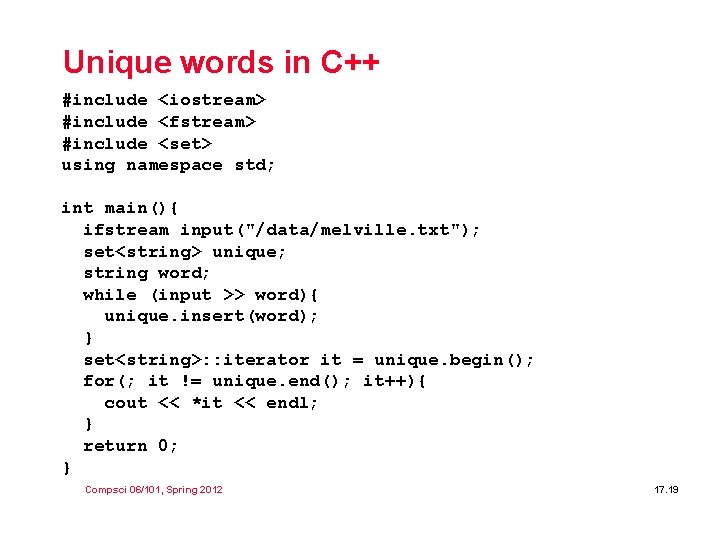
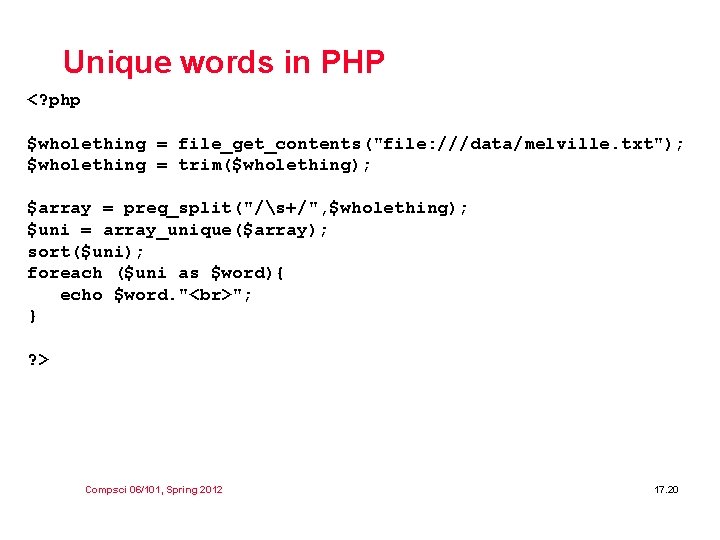
Find all unique/different words in a file Across different languages: do these languages have the same power? Compsci 06/101, Spring 2012 17. 16
Unique Words in Python #! /usr/bin/env python def main(): f = open('/data/melville. txt', 'r') words = f. read(). strip(). split() all. Words = set() for w in words: all. Words. add(w) for word in sorted(all. Words): print word if __name__ == "__main__": main() Compsci 06/101, Spring 2012 17. 17
Unique words in Java import java. util. *; import java. io. *; public class Unique { public static void main(String[] args) throws IOException{ Scanner scan = new Scanner(new File("/data/melville. txt")); Tree. Set<String> set = new Tree. Set<String>(); while (scan. has. Next()){ String str = scan. next(); set. add(str); } for(String s : set){ System. out. println(s); } } } Compsci 06/101, Spring 2012 17. 18
Unique words in C++ #include <iostream> #include <fstream> #include <set> using namespace std; int main(){ ifstream input("/data/melville. txt"); set<string> unique; string word; while (input >> word){ unique. insert(word); } set<string>: : iterator it = unique. begin(); for(; it != unique. end(); it++){ cout << *it << endl; } return 0; } Compsci 06/101, Spring 2012 17. 19
Unique words in PHP <? php $wholething = file_get_contents("file: ///data/melville. txt"); $wholething = trim($wholething); $array = preg_split("/s+/", $wholething); $uni = array_unique($array); sort($uni); foreach ($uni as $word){ echo $word. " "; } ? > Compsci 06/101, Spring 2012 17. 20
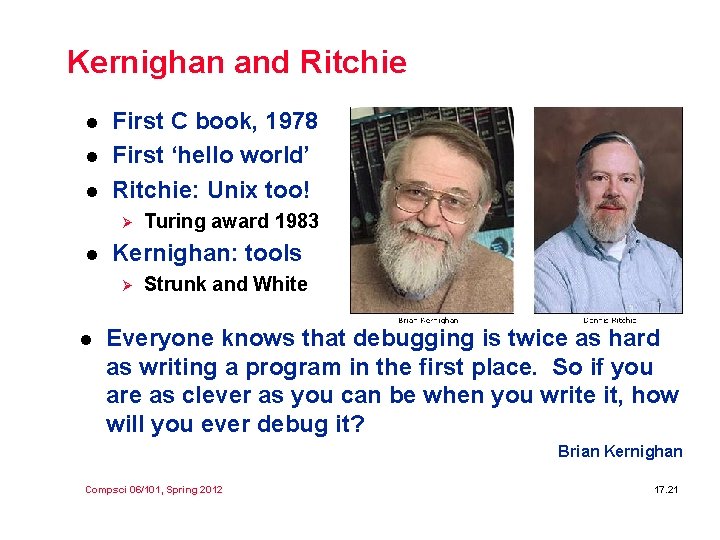
Kernighan and Ritchie l l l First C book, 1978 First ‘hello world’ Ritchie: Unix too! Ø l Kernighan: tools Ø l Turing award 1983 Strunk and White Everyone knows that debugging is twice as hard as writing a program in the first place. So if you are as clever as you can be when you write it, how will you ever debug it? Brian Kernighan Compsci 06/101, Spring 2012 17. 21
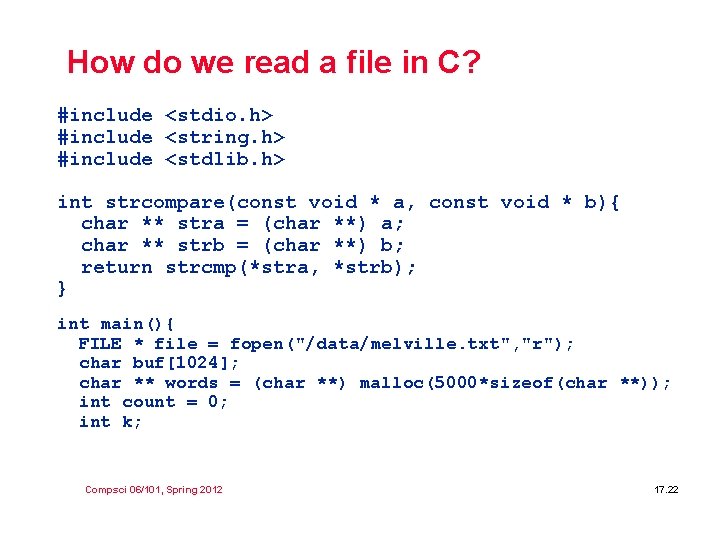
How do we read a file in C? #include <stdio. h> #include <string. h> #include <stdlib. h> int strcompare(const void * a, const void * b){ char ** stra = (char **) a; char ** strb = (char **) b; return strcmp(*stra, *strb); } int main(){ FILE * file = fopen("/data/melville. txt", "r"); char buf[1024]; char ** words = (char **) malloc(5000*sizeof(char **)); int count = 0; int k; Compsci 06/101, Spring 2012 17. 22
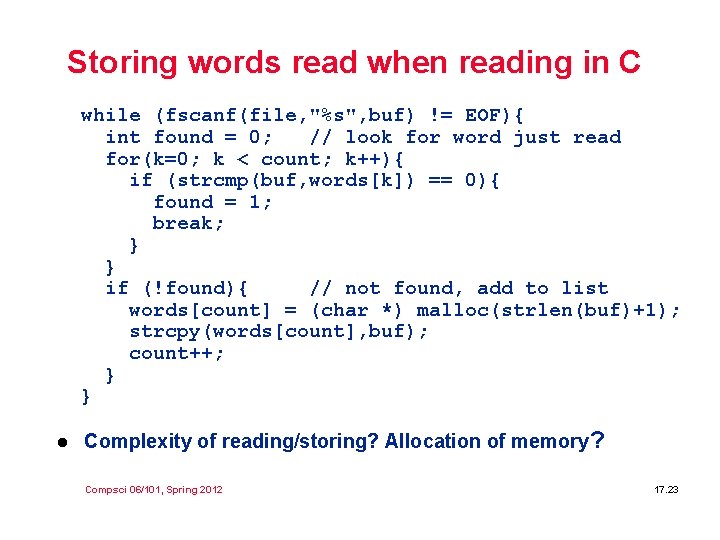
Storing words read when reading in C while (fscanf(file, "%s", buf) != EOF){ int found = 0; // look for word just read for(k=0; k < count; k++){ if (strcmp(buf, words[k]) == 0){ found = 1; break; } } if (!found){ // not found, add to list words[count] = (char *) malloc(strlen(buf)+1); strcpy(words[count], buf); count++; } } l Complexity of reading/storing? Allocation of memory? Compsci 06/101, Spring 2012 17. 23
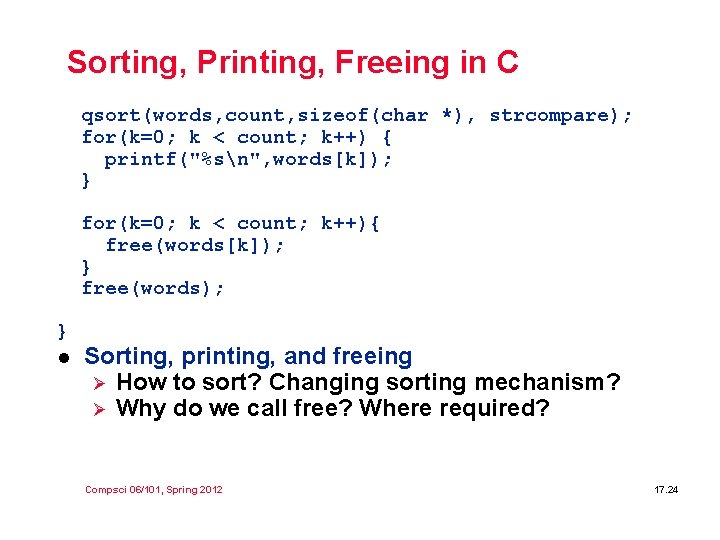
Sorting, Printing, Freeing in C qsort(words, count, sizeof(char *), strcompare); for(k=0; k < count; k++) { printf("%sn", words[k]); } for(k=0; k < count; k++){ free(words[k]); } free(words); } l Sorting, printing, and freeing Ø How to sort? Changing sorting mechanism? Ø Why do we call free? Where required? Compsci 06/101, Spring 2012 17. 24
def is_the_end_of_learning_of(): [x for x in …] Compsci 06/101, Spring 2012 17. 25
Tim French (Mathemetics) Four FBF in common Compsci 06/101, Spring 2012 17. 26
Kristin Oakley (English, Visual/Media) Three FBF in common Compsci 06/101, Spring 2012 17. 27
Graham Oxley (Sociology) 1 FBF in common Compsci 06/101, Spring 2012 17. 28
Dmitri Tran (I 8 N Comparative Studies) invisible Compsci 06/101, Spring 2012 17. 29
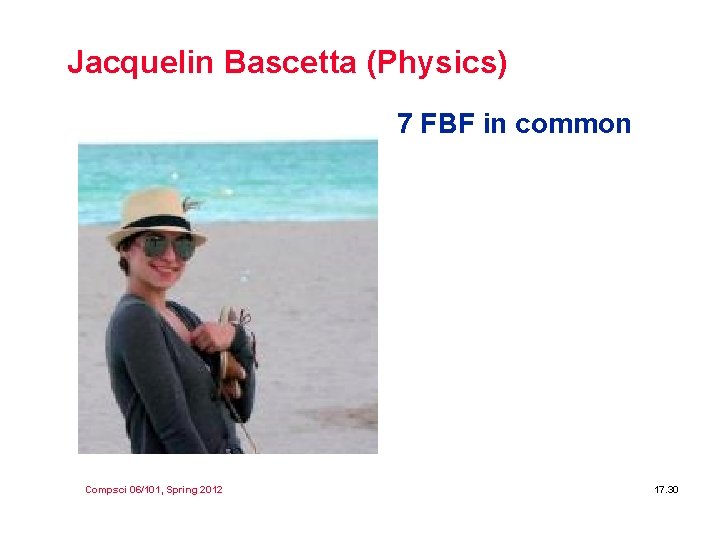
Jacquelin Bascetta (Physics) 7 FBF in common Compsci 06/101, Spring 2012 17. 30
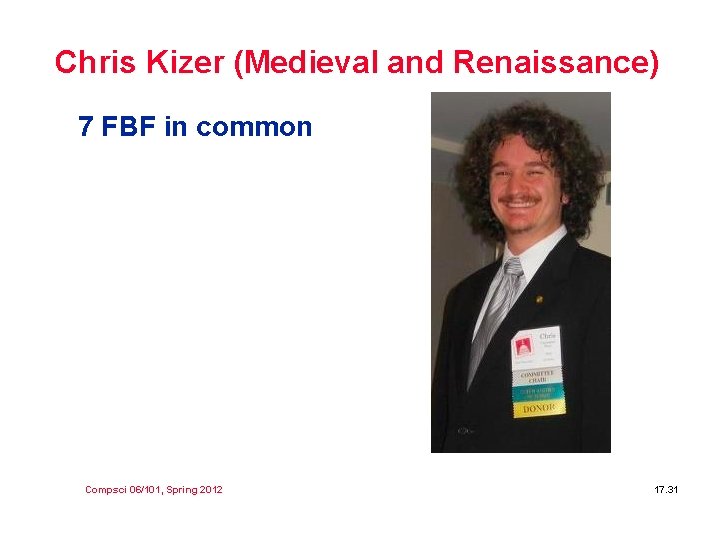
Chris Kizer (Medieval and Renaissance) 7 FBF in common Compsci 06/101, Spring 2012 17. 31
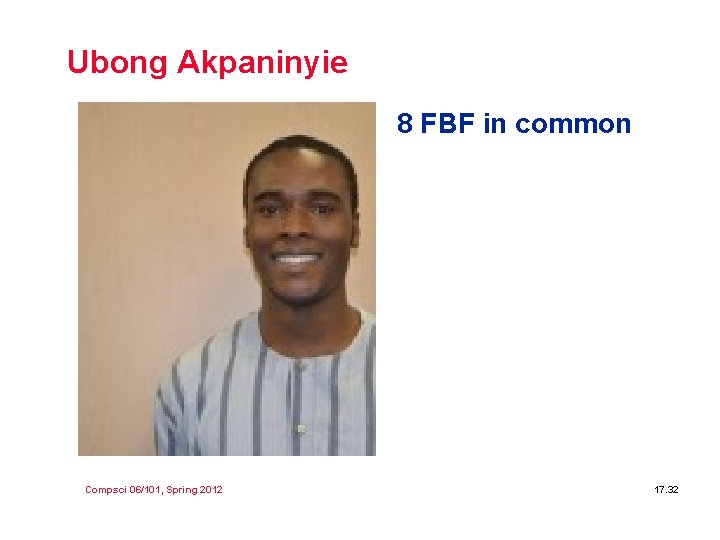
Ubong Akpaninyie 8 FBF in common Compsci 06/101, Spring 2012 17. 32
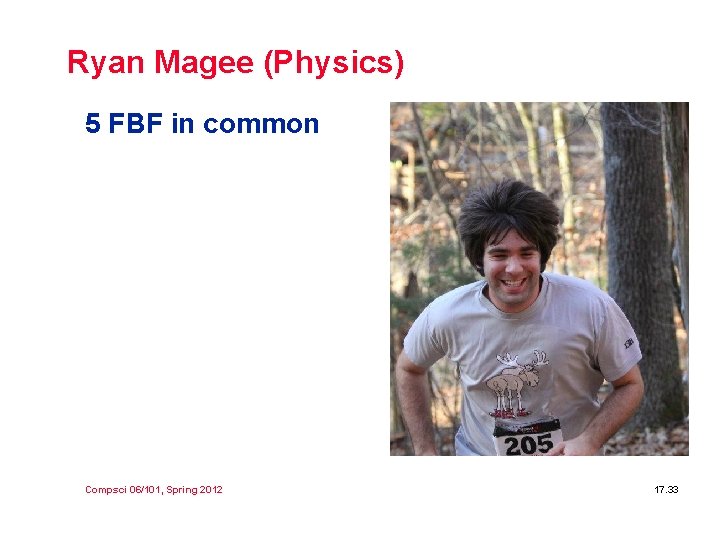
Ryan Magee (Physics) 5 FBF in common Compsci 06/101, Spring 2012 17. 33
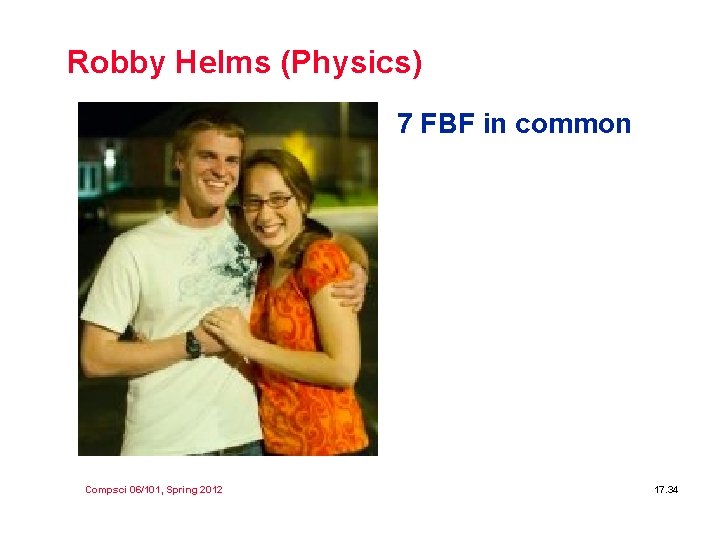
Robby Helms (Physics) 7 FBF in common Compsci 06/101, Spring 2012 17. 34
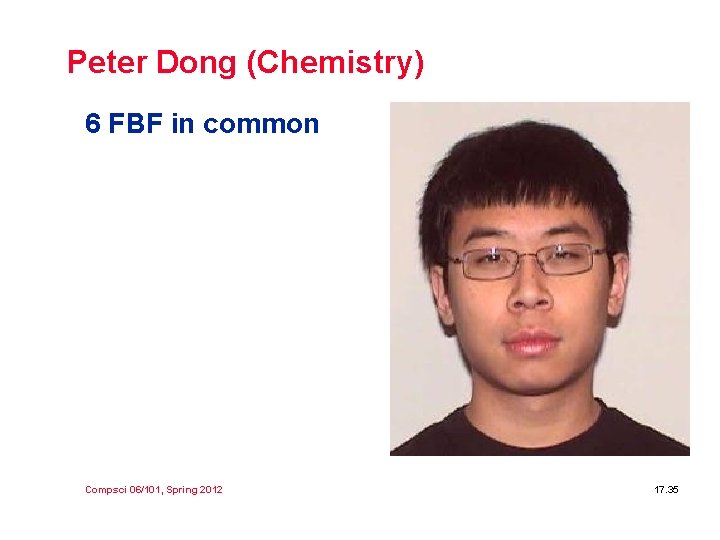
Peter Dong (Chemistry) 6 FBF in common Compsci 06/101, Spring 2012 17. 35
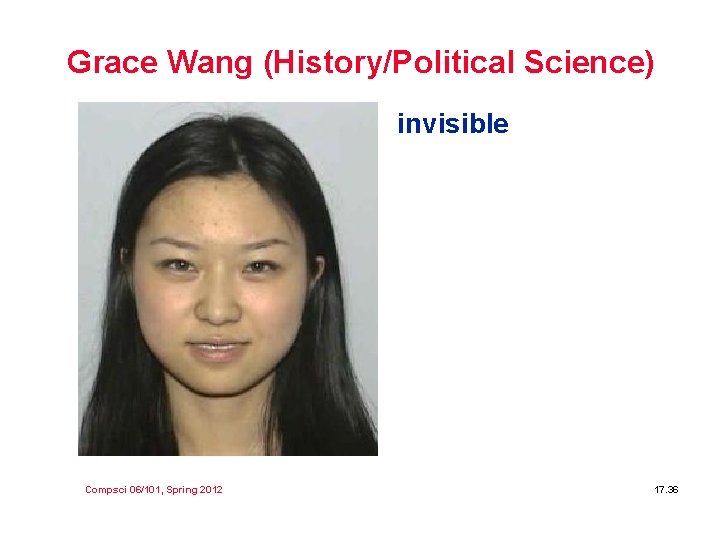
Grace Wang (History/Political Science) invisible Compsci 06/101, Spring 2012 17. 36