
What is Computer Science What is it that
- Slides: 23
What is Computer Science? What is it that distinguishes it from the separate subjects with which it is related? What is the linking thread which gathers these disparate branches into a single discipline? My answer to these questions is simple --- it is the art of programming a computer. It is the art of designing efficient and elegant methods of getting a computer to solve problems, theoretical or practical, small or large, simple or complex. C. A. R (Tony) Hoare CPS 100 19. 1
What is Computer Science? l If it's programming, then Ø Is there life in a cubicle? Ø Are there opportunities outside of Google? Ø Are all the jobs in Bangalore? Ø Why don't biology majors take computer science course? Ø Can we find palindromes recursively? Who cares? l Managing and understanding information and the Internet Ø Is the Internet a phenomenon? A revolution (industrial)? Ø What is information? Ø What is innovation and is it teachable or understandable? Ø Questions, questions, … how about answers? CPS 100 19. 2
What can be programmed? l What class of problems can be solved? Ø G 5, TRS-80, Pascal, C++, Scheme, Cray, Pencil/Paper Ø Alan Turing proved some things, hypothesized others • Halting problem, Church-Turing thesis l What class of problems can be solved efficiently? Ø Problems with no practical solution • What does practical mean? Ø Problems for which we can’t find a practical solution • Solving one solves them all • Would you rather be rich or famous? CPS 100 19. 3
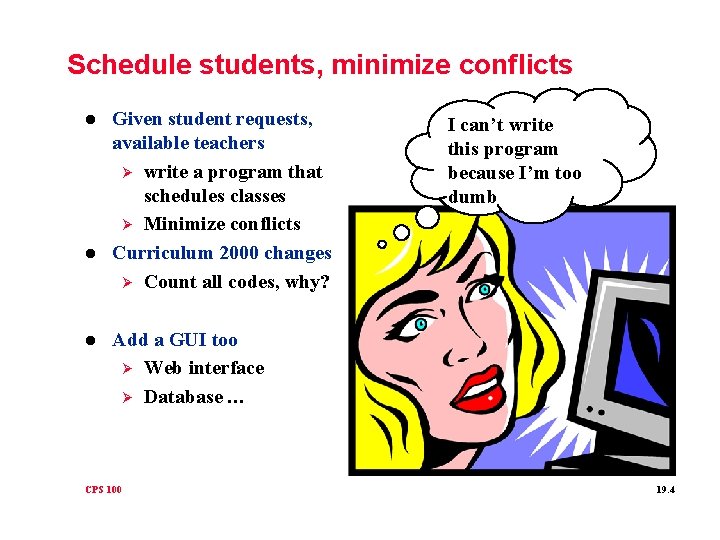
Schedule students, minimize conflicts l l l Given student requests, available teachers Ø write a program that schedules classes Ø Minimize conflicts Curriculum 2000 changes Ø Count all codes, why? I can’t write this program because I’m too dumb Add a GUI too Ø Web interface Ø Database … CPS 100 19. 4
One better scenario I can’t write this program because it’s provably impossible CPS 100 19. 5
Another possible scenario I can’t write this program but neither can all these famous people CPS 100 19. 6
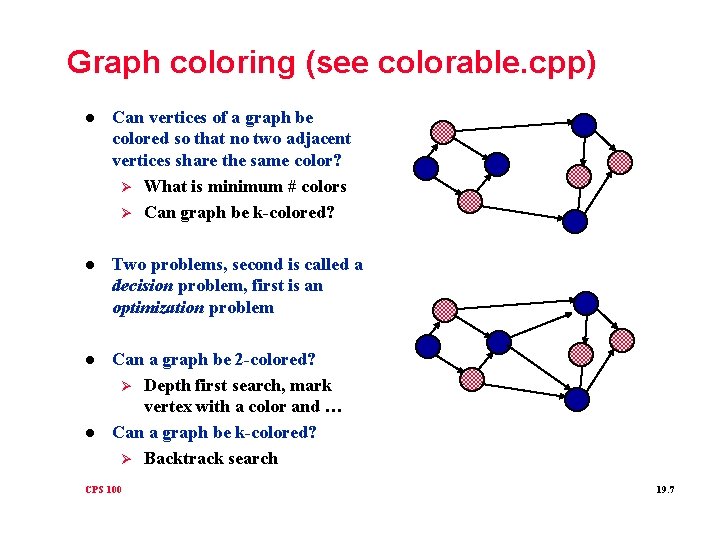
Graph coloring (see colorable. cpp) l Can vertices of a graph be colored so that no two adjacent vertices share the same color? Ø What is minimum # colors Ø Can graph be k-colored? l Two problems, second is called a decision problem, first is an optimization problem l Can a graph be 2 -colored? Ø Depth first search, mark vertex with a color and … Can a graph be k-colored? Ø Backtrack search l CPS 100 19. 7
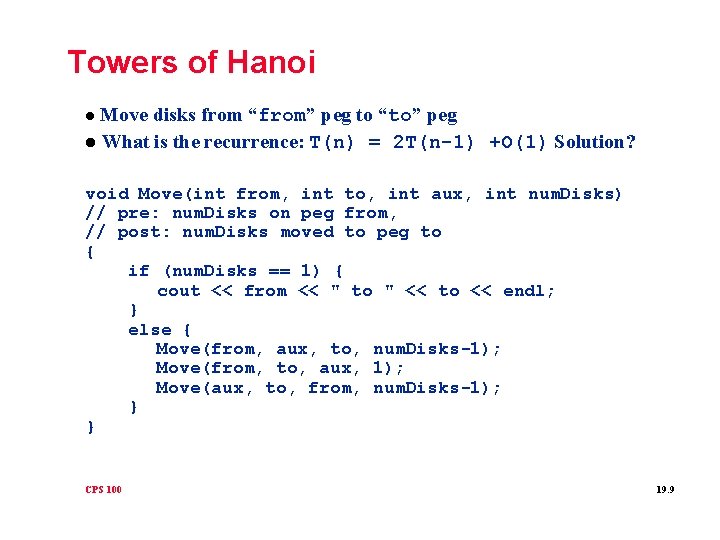
Graph coloring continued l Two-color problem solving using depth-first search, see code in colorable. cpp that uses stack Ø Every reachable vertex put on stack, Ø Every edge processed once Ø Complexity is O(…. . ) l K-colorable problem tries each of k-colors Ø For each color, use it on a vertex and then visit all adjacent vertices that aren’t colored yet Ø Backtrack to undo colorings if they don’t work out before trying next color Ø Recurrence is at best: T(n) = k T(n-1) + O(1) Ø What is solution to Towers of Hanoi problem? CPS 100 19. 8
Towers of Hanoi Move disks from “from” peg to “to” peg l What is the recurrence: T(n) = 2 T(n-1) +O(1) Solution? l void Move(int from, int to, int aux, int num. Disks) // pre: num. Disks on peg from, // post: num. Disks moved to peg to { if (num. Disks == 1) { cout << from << " to " << to << endl; } else { Move(from, aux, to, num. Disks-1); Move(from, to, aux, 1); Move(aux, to, from, num. Disks-1); } } CPS 100 19. 9
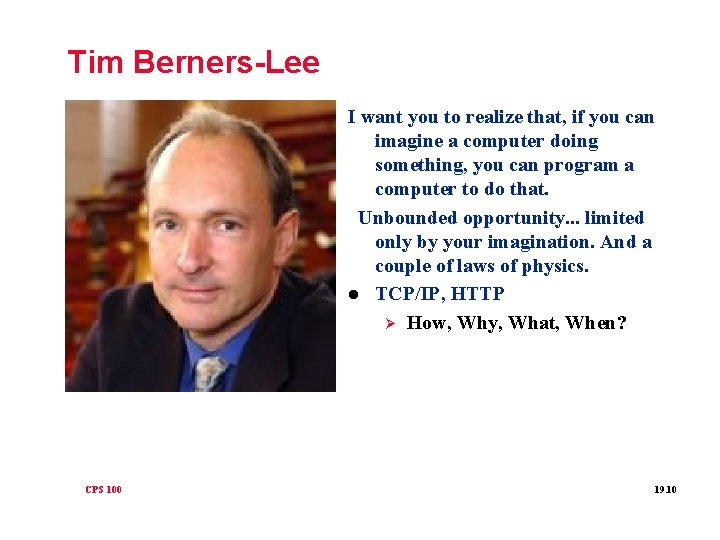
Tim Berners-Lee I want you to realize that, if you can imagine a computer doing something, you can program a computer to do that. Unbounded opportunity. . . limited only by your imagination. And a couple of laws of physics. l TCP/IP, HTTP Ø How, Why, What, When? CPS 100 19. 10
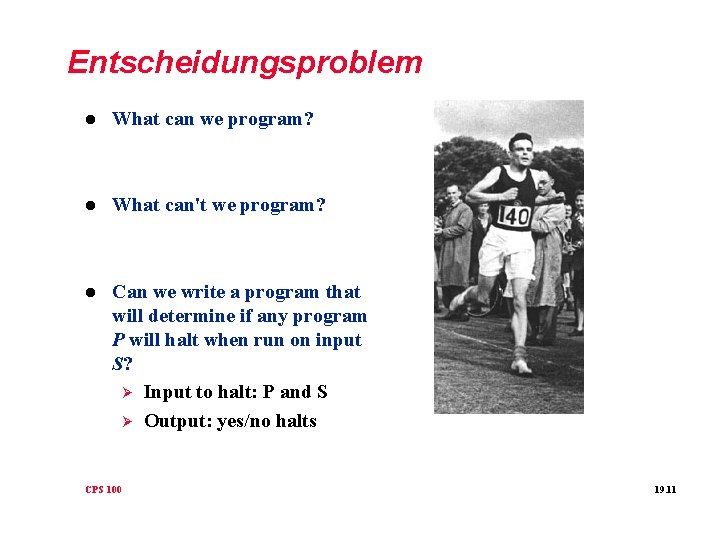
Entscheidungsproblem l What can we program? l What can't we program? l Can we write a program that will determine if any program P will halt when run on input S? Ø Input to halt: P and S Ø Output: yes/no halts CPS 100 19. 11
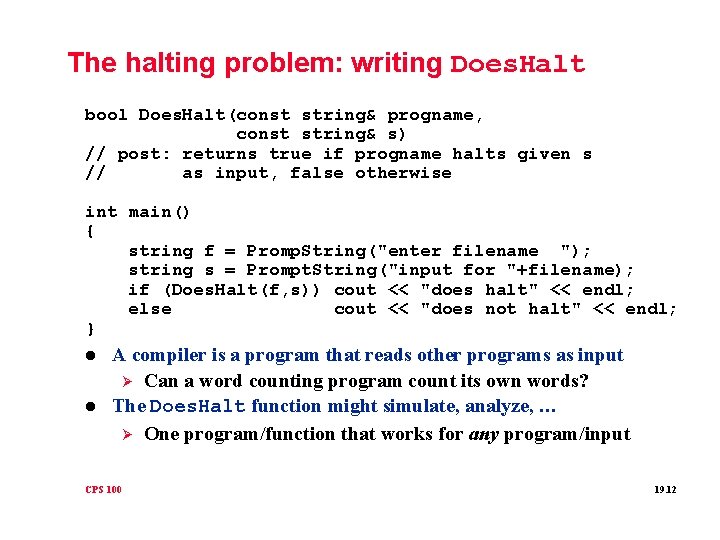
The halting problem: writing Does. Halt bool Does. Halt(const string& progname, const string& s) // post: returns true if progname halts given s // as input, false otherwise int main() { string f = Promp. String("enter filename "); string s = Prompt. String("input for "+filename); if (Does. Halt(f, s)) cout << "does halt" << endl; else cout << "does not halt" << endl; } l l A compiler is a program that reads other programs as input Ø Can a word counting program count its own words? The Does. Halt function might simulate, analyze, … Ø One program/function that works for any program/input CPS 100 19. 12
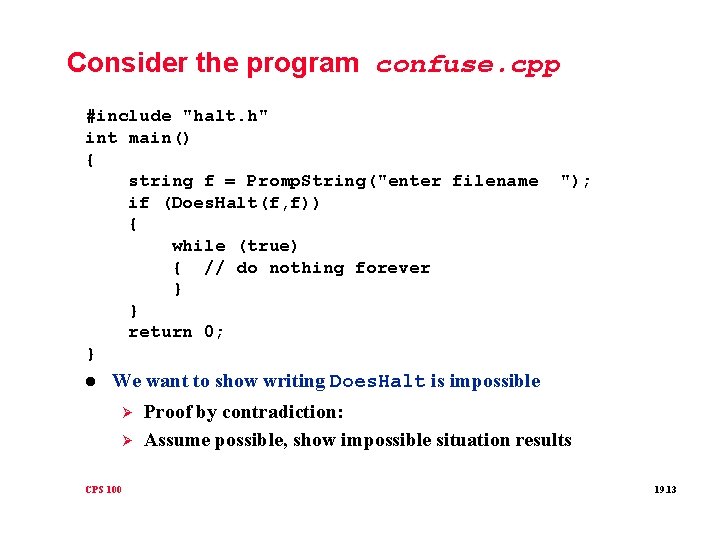
Consider the program confuse. cpp #include "halt. h" int main() { string f = Promp. String("enter filename if (Does. Halt(f, f)) { while (true) { // do nothing forever } } return 0; } l "); We want to show writing Does. Halt is impossible Ø Ø CPS 100 Proof by contradiction: Assume possible, show impossible situation results 19. 13
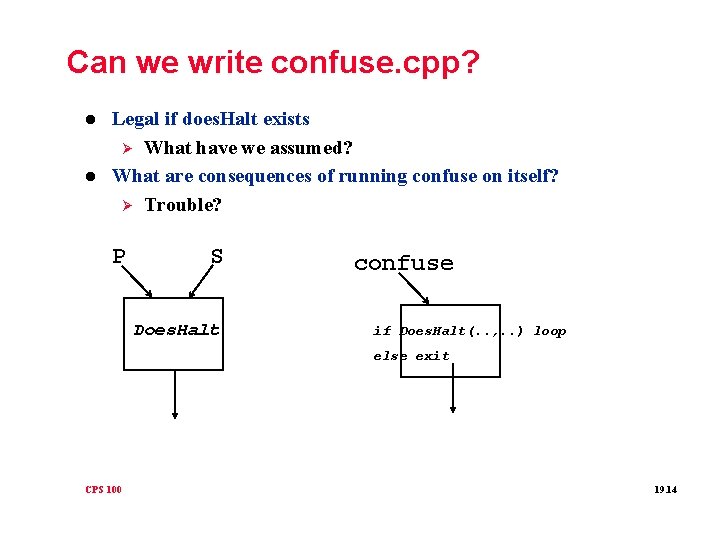
Can we write confuse. cpp? l l Legal if does. Halt exists Ø What have we assumed? What are consequences of running confuse on itself? Ø Trouble? P S Does. Halt confuse if Does. Halt(. . , . . ) loop else exit CPS 100 19. 14
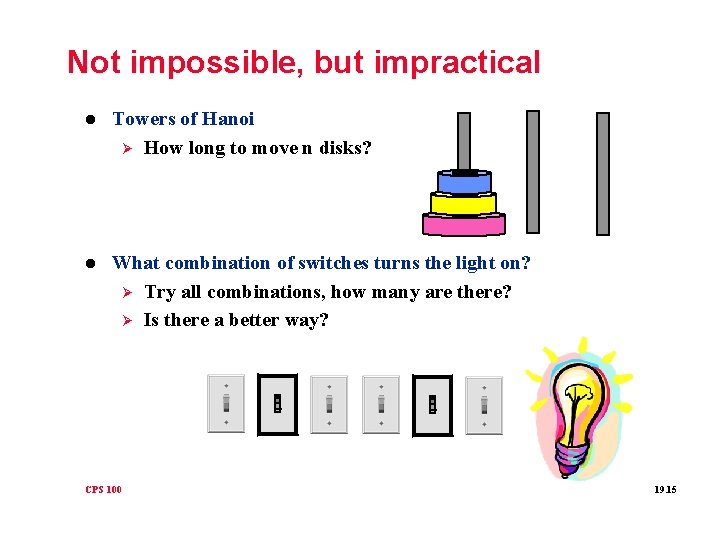
Not impossible, but impractical l Towers of Hanoi Ø How long to move n disks? l What combination of switches turns the light on? Ø Try all combinations, how many are there? Ø Is there a better way? CPS 100 19. 15
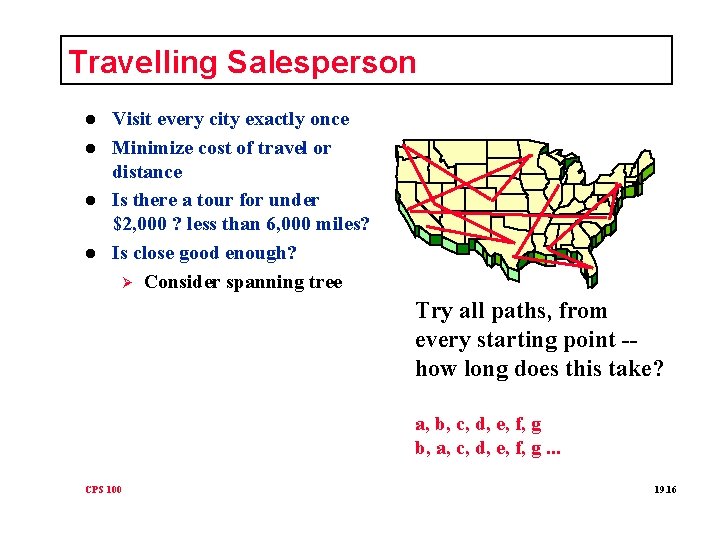
Travelling Salesperson l l Visit every city exactly once Minimize cost of travel or distance Is there a tour for under $2, 000 ? less than 6, 000 miles? Is close good enough? Ø Consider spanning tree Try all paths, from every starting point -how long does this take? a, b, c, d, e, f, g b, a, c, d, e, f, g. . . CPS 100 19. 16
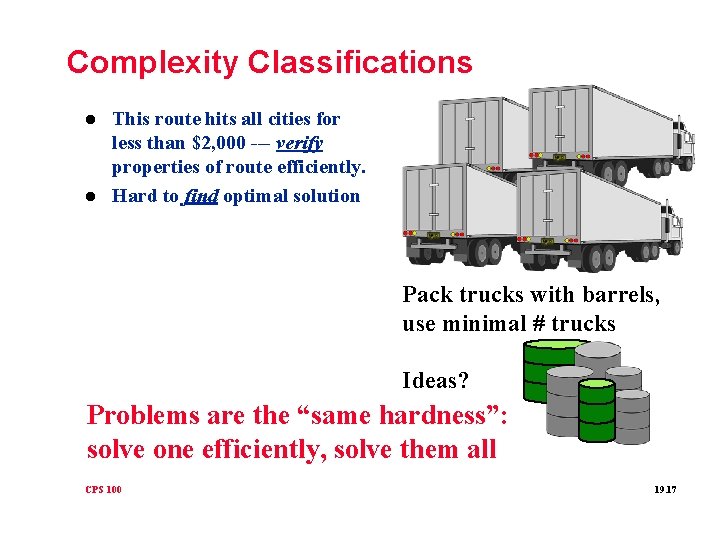
Complexity Classifications l l This route hits all cities for less than $2, 000 --- verify properties of route efficiently. Hard to find optimal solution Pack trucks with barrels, use minimal # trucks Ideas? Problems are the “same hardness”: solve one efficiently, solve them all CPS 100 19. 17
Are hard problems easy? l P = easy problems, NP = “hard” problems Ø P means solvable in polynomial time • Difference between N, N 2, N 10 ? Ø NP means non-deterministic, polynomial time • guess a solution and verify it efficiently l Question: P = NP ? Ø if yes, a whole class of difficult problems can be solved efficiently---one problem is reducible to another Ø if no, none of the hard problems can be solved efficiently Ø showing the first problem was NP complete was an exercise in intellectual bootstrapping, satisfiability/Cook/(1971) ØAn NP complete problem is in NP (guessable/verify) and is the same “difficulty” as every other problem in NP CPS 100 19. 18
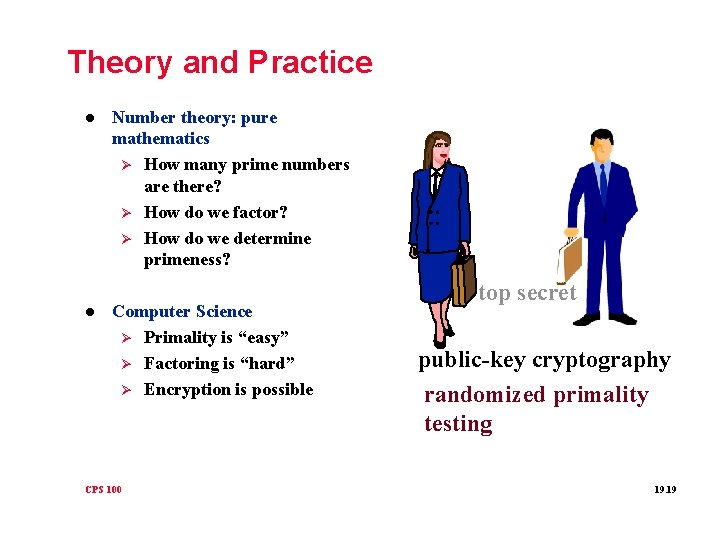
Theory and Practice l l Number theory: pure mathematics Ø How many prime numbers are there? Ø How do we factor? Ø How do we determine primeness? Computer Science Ø Primality is “easy” Ø Factoring is “hard” Ø Encryption is possible CPS 100 top secret public-key cryptography randomized primality testing 19. 19
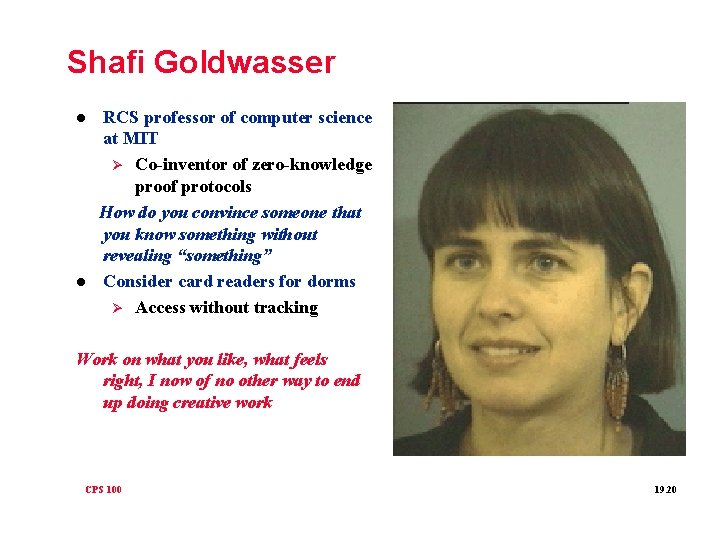
Shafi Goldwasser l l RCS professor of computer science at MIT Ø Co-inventor of zero-knowledge proof protocols How do you convince someone that you know something without revealing “something” Consider card readers for dorms Ø Access without tracking Work on what you like, what feels right, I now of no other way to end up doing creative work CPS 100 19. 20
Why is programming fun? What delights may its practitioner expect as a reward? First is the sheer joy of making things Second is the pleasure of making things that are useful Third is the fascination of fashioning complex puzzle-like objects of interlocking moving parts Fourth is the joy of always learning Finally, there is the delight of working in such a tractable medium. The programmer, like the poet, works only slightly removed from pure thought-stuff. Fred Brooks CPS 100 19. 21
What is computer science? l l l What is a computation? Ø Can formulate this precisely using mathematics Ø Can say “anything a computer can compute” Ø Study both theoretical and empirical formulations, build machines as well as theoretical models How do we build machines and the software that runs them? Ø Hardware: gates, circuits, chips, cache, memory, disk, … Ø Software: operating systems, applications, programs Art, Science, Engineering Ø How do we get better at programming and dealing with abstractions Ø What is hard about programming? CPS 100 19. 22
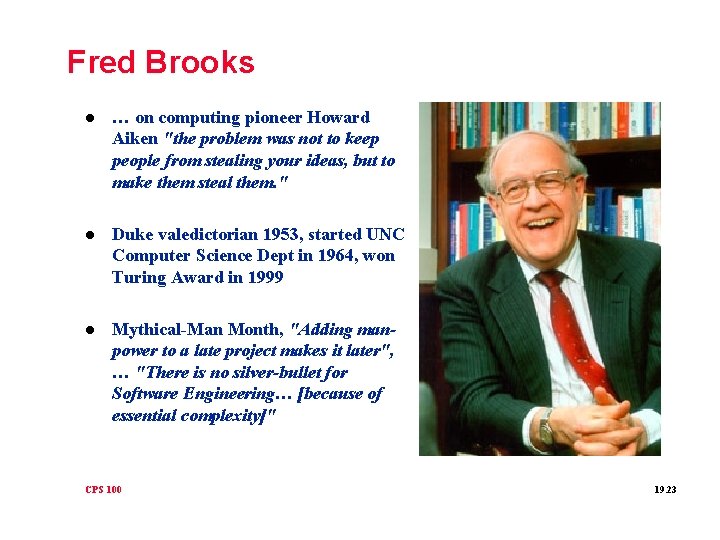
Fred Brooks l … on computing pioneer Howard Aiken "the problem was not to keep people from stealing your ideas, but to make them steal them. " l Duke valedictorian 1953, started UNC Computer Science Dept in 1964, won Turing Award in 1999 l Mythical-Man Month, "Adding manpower to a late project makes it later", … "There is no silver-bullet for Software Engineering… [because of essential complexity]" CPS 100 19. 23