
What is Communism A Simple Lesson What is


- Slides: 16
What is Communism? A Simple Lesson
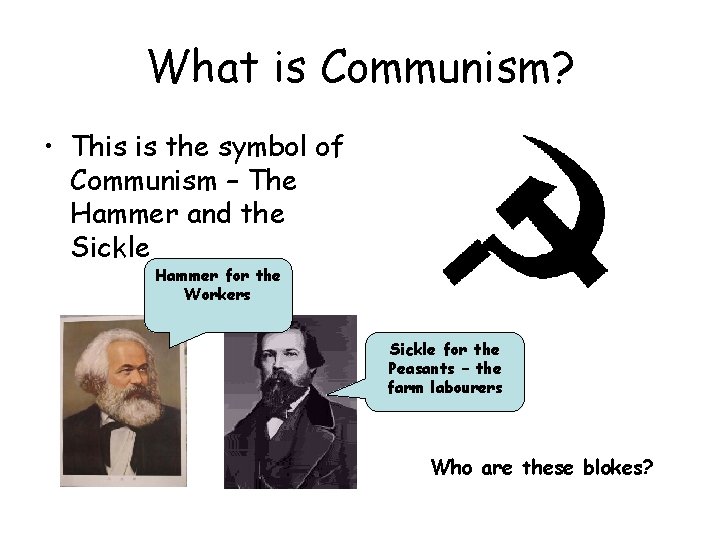
What is Communism? • This is the symbol of Communism – The Hammer and the Sickle Hammer for the Workers Sickle for the Peasants – the farm labourers Who are these blokes?
What is Communism? ‘Those Blokes’ wrote the ‘Communist Manifesto’ in 1847. It’s a short book – but billions of people have read it…. This is Karl Marx, the ‘Father of Communism’. People who believe in his ideas are called ‘Marxists’ This is his good friend, Frederick Engels.
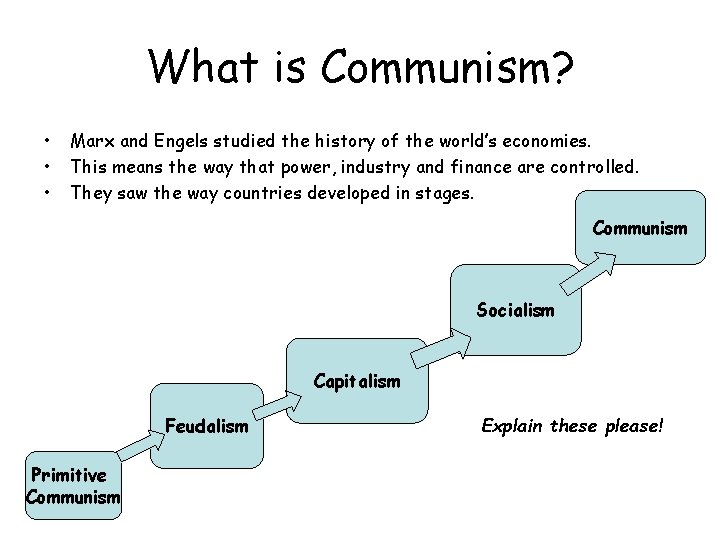
What is Communism? • • • Marx and Engels studied the history of the world’s economies. This means the way that power, industry and finance are controlled. They saw the way countries developed in stages. Communism Socialism Capitalism Feudalism Primitive Communism Explain these please!
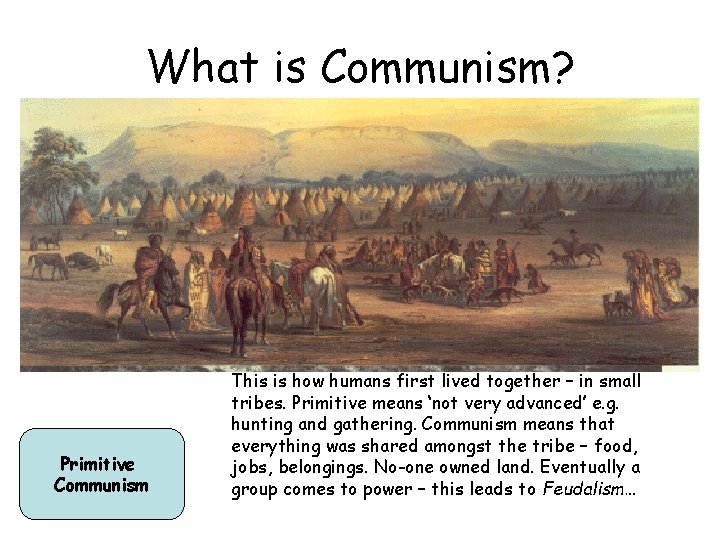
What is Communism? Primitive Communism This is how humans first lived together – in small tribes. Primitive means ‘not very advanced’ e. g. hunting and gathering. Communism means that everything was shared amongst the tribe – food, jobs, belongings. No-one owned land. Eventually a group comes to power – this leads to Feudalism…
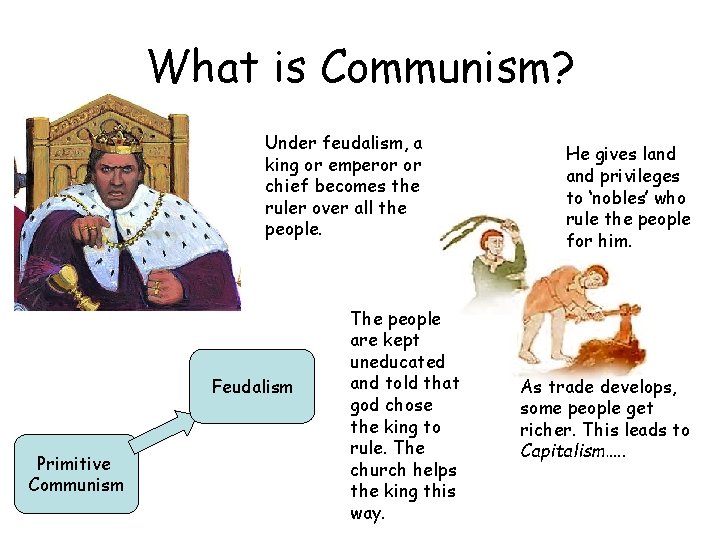
What is Communism? Under feudalism, a king or emperor or chief becomes the ruler over all the people. Feudalism Primitive Communism The people are kept uneducated and told that god chose the king to rule. The church helps the king this way. He gives land privileges to ‘nobles’ who rule the people for him. As trade develops, some people get richer. This leads to Capitalism…. .
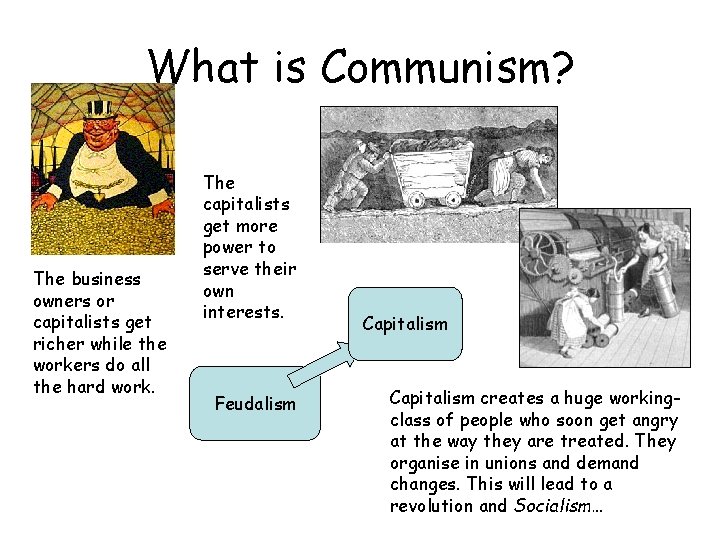
What is Communism? The business owners or capitalists get richer while the workers do all the hard work. The capitalists get more power to serve their own interests. Feudalism Capitalism creates a huge workingclass of people who soon get angry at the way they are treated. They organise in unions and demand changes. This will lead to a revolution and Socialism…
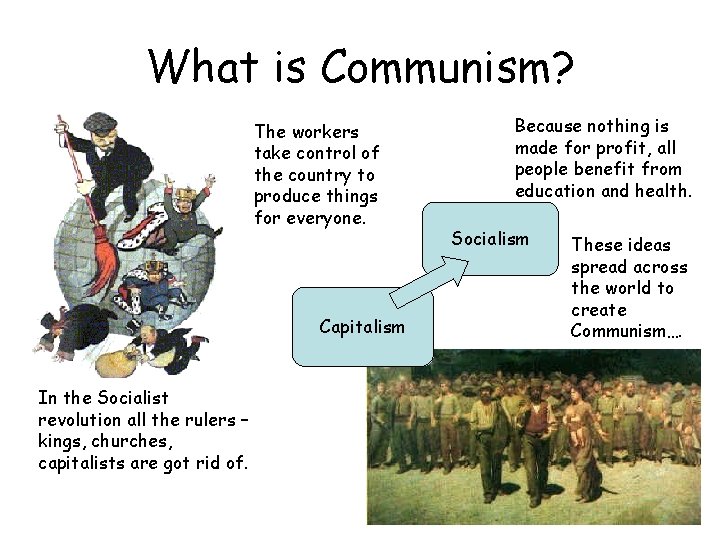
What is Communism? The workers take control of the country to produce things for everyone. Capitalism In the Socialist revolution all the rulers – kings, churches, capitalists are got rid of. Because nothing is made for profit, all people benefit from education and health. Socialism These ideas spread across the world to create Communism….
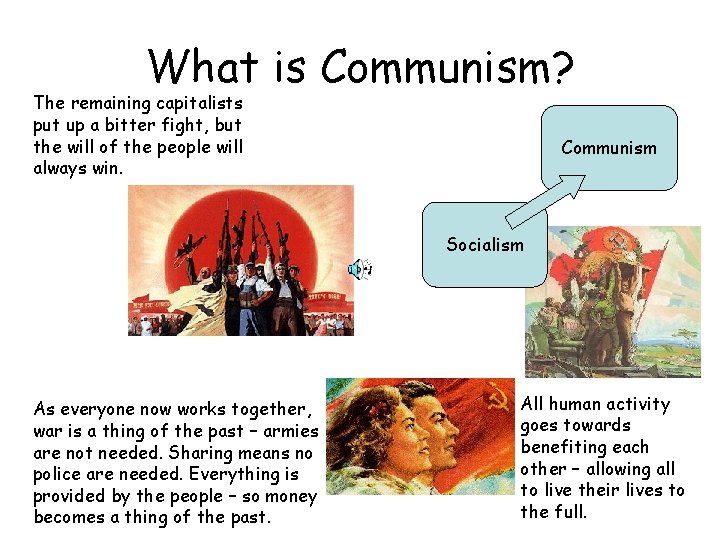
What is Communism? The remaining capitalists put up a bitter fight, but the will of the people will always win. Communism Socialism As everyone now works together, war is a thing of the past – armies are not needed. Sharing means no police are needed. Everything is provided by the people – so money becomes a thing of the past. All human activity goes towards benefiting each other – allowing all to live their lives to the full.
Some key terms for Communism • • Proletariat Bourgeoisie Class struggle Capitalism Socialism Communism
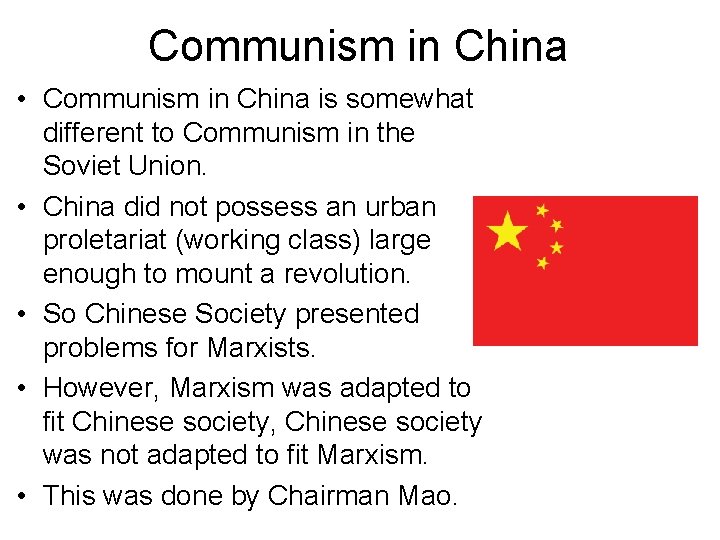
Communism in China • Communism in China is somewhat different to Communism in the Soviet Union. • China did not possess an urban proletariat (working class) large enough to mount a revolution. • So Chinese Society presented problems for Marxists. • However, Marxism was adapted to fit Chinese society, Chinese society was not adapted to fit Marxism. • This was done by Chairman Mao.
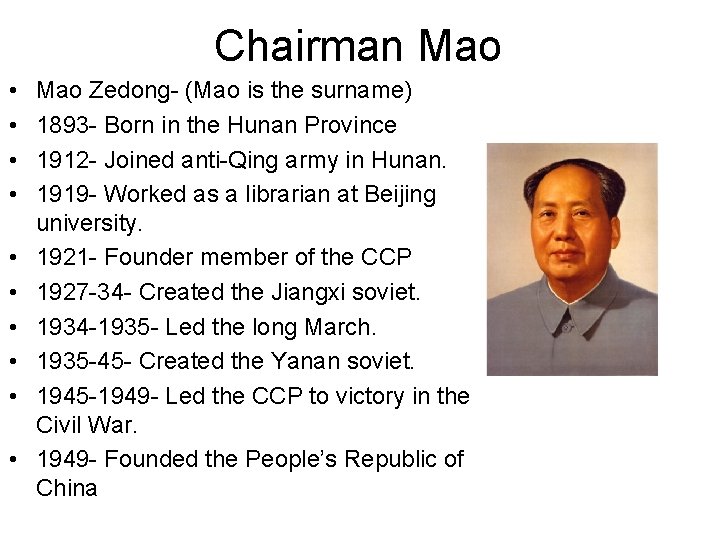
Chairman Mao • • • Mao Zedong- (Mao is the surname) 1893 - Born in the Hunan Province 1912 - Joined anti-Qing army in Hunan. 1919 - Worked as a librarian at Beijing university. 1921 - Founder member of the CCP 1927 -34 - Created the Jiangxi soviet. 1934 -1935 - Led the long March. 1935 -45 - Created the Yanan soviet. 1945 -1949 - Led the CCP to victory in the Civil War. 1949 - Founded the People’s Republic of China
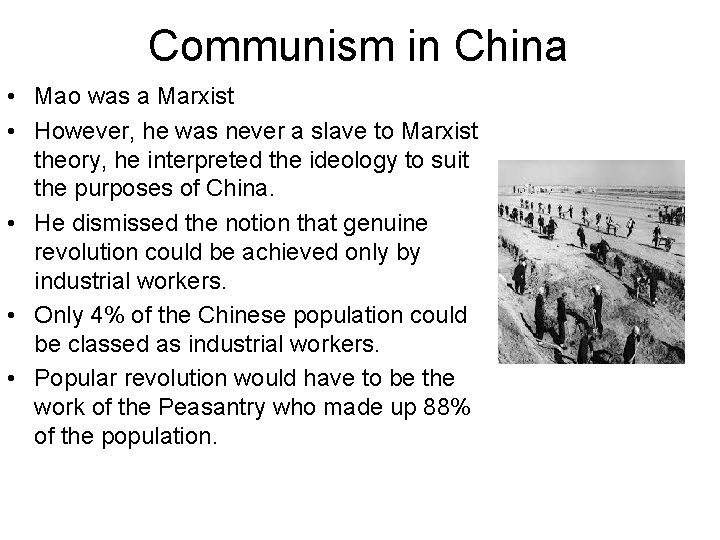
Communism in China • Mao was a Marxist • However, he was never a slave to Marxist theory, he interpreted the ideology to suit the purposes of China. • He dismissed the notion that genuine revolution could be achieved only by industrial workers. • Only 4% of the Chinese population could be classed as industrial workers. • Popular revolution would have to be the work of the Peasantry who made up 88% of the population.
Communism in China • Mao was cautious of following the Cominterm (Soviet organisation with the aim of promoting worldwide proletarian revolution). • Mao was criticised by the Cominterm for not following their advice and taking an independent line. • He rejected the Cominterms demand that the CCP (Chinese Communist Party) direct its efforts to create an urban revolution. • His central belief was that China’s revolution must be a peasant revolution, there was no need to wait for growth of an industrial proletariat in China.
Communism in China • Although Mao was choosing to follow a communist path, he was an ardent nationalist. • If China’s nationalist interest clashed with any other element of his ideology, Mao put nationalism first. • He saw in Marxism, a set of principles that he could turn into a practical programme for restoring China to its original greatness. • He believed that Chinese people had all the skills they needed to shape their own destiny. • Mao’s ideas were influenced by nationalism, feminism, personal experiences and traditional Chinese philosophy. • The way Mao adopted Marxism to suit Chinese society has become known as Maoism.
Communism in China • As you will see, Mao is a very peculiar character. • Power hunger, trusted no one, paranoid, violent in nature, and had very poor personal hygiene. • It is his character which add tension to an already fragile relationship with the Soviet Union, and arguably leads to several violent campaigns throughout his reign. • It also impacts the ideology he is promoting. At times he displays a more open minded approach in helping China to restore its greatness, at other times is must be his ideology alone, and his obsession with consolidating his own legacy also directs him on the path he takes.