
WHAT IS COACHING Coachingisisa arelatively collaborative relationship between
WHAT IS COACHING? Coachingisisa arelatively collaborative relationship between Coaching new field that borrows and doctor patient supports goals. It is builds onand theories andthat research from patient related fields. a “multi-theory and application of applied based on theirsynthesis own intuition and desire for selfbehavioral change. ” management.

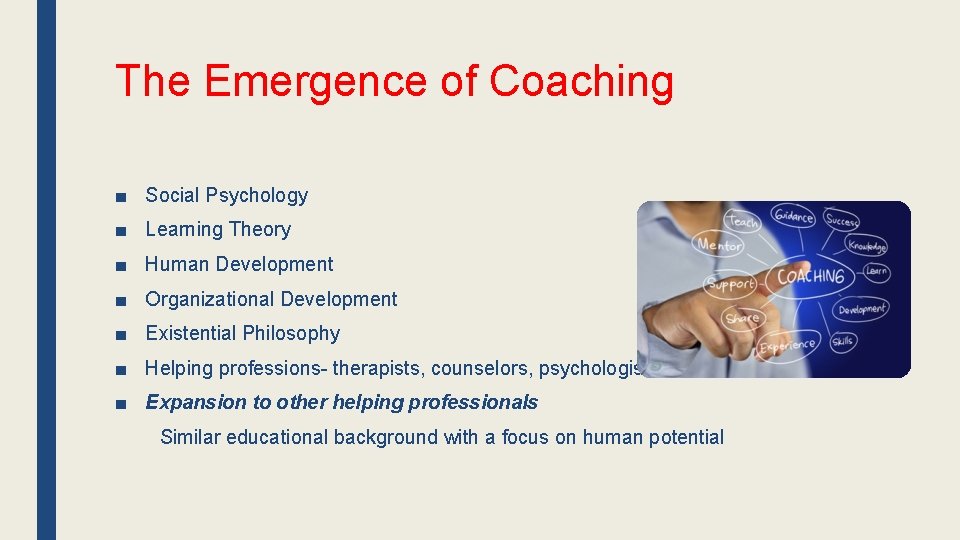
The Emergence of Coaching ■ Social Psychology ■ Learning Theory ■ Human Development ■ Organizational Development ■ Existential Philosophy ■ Helping professions- therapists, counselors, psychologists, ■ Expansion to other helping professionals Similar educational background with a focus on human potential
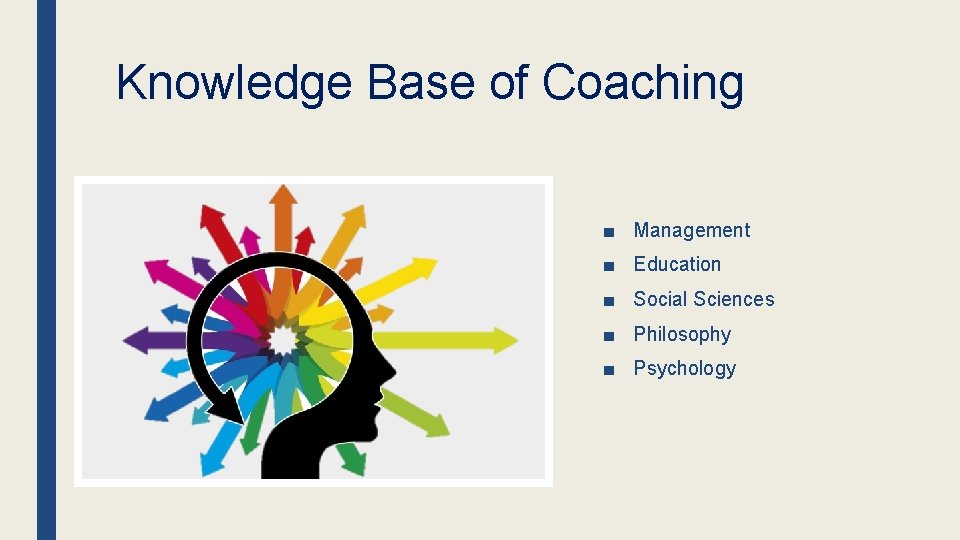
Knowledge Base of Coaching ■ Management ■ Education ■ Social Sciences ■ Philosophy ■ Psychology
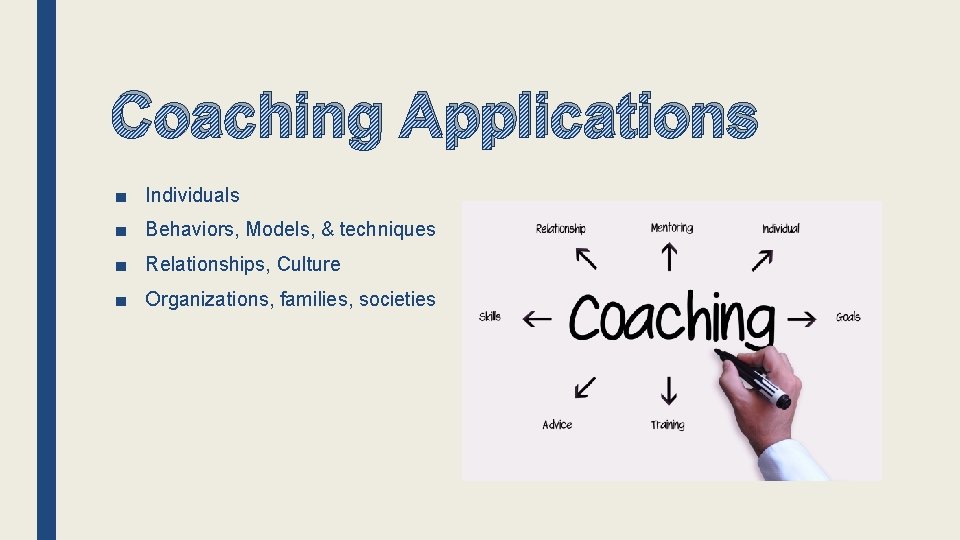
Coaching Applications ■ Individuals ■ Behaviors, Models, & techniques ■ Relationships, Culture ■ Organizations, families, societies
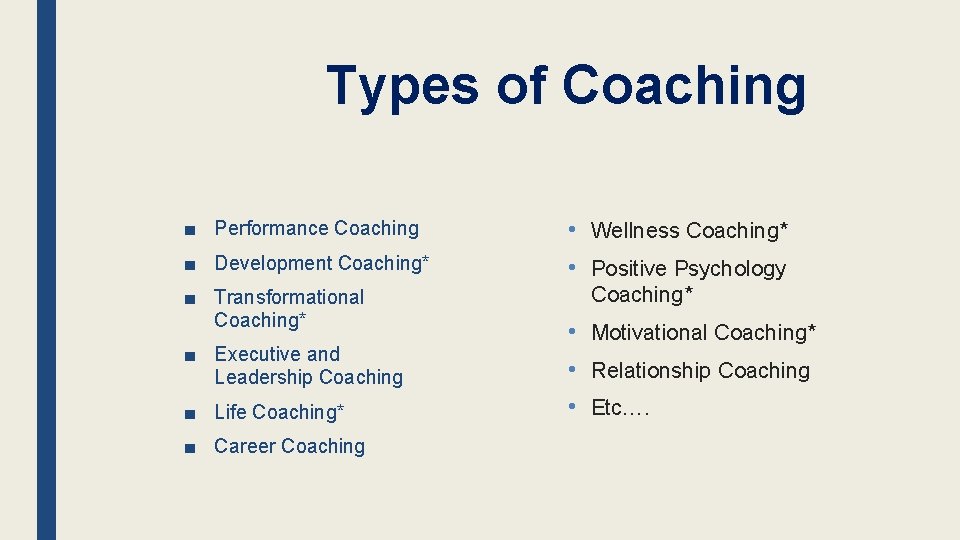
Types of Coaching ■ Performance Coaching ■ Development Coaching* ■ Transformational Coaching* ■ Executive and Leadership Coaching ■ Life Coaching* ■ Career Coaching • Wellness Coaching* • Positive Psychology Coaching* • Motivational Coaching* • Relationship Coaching • Etc….
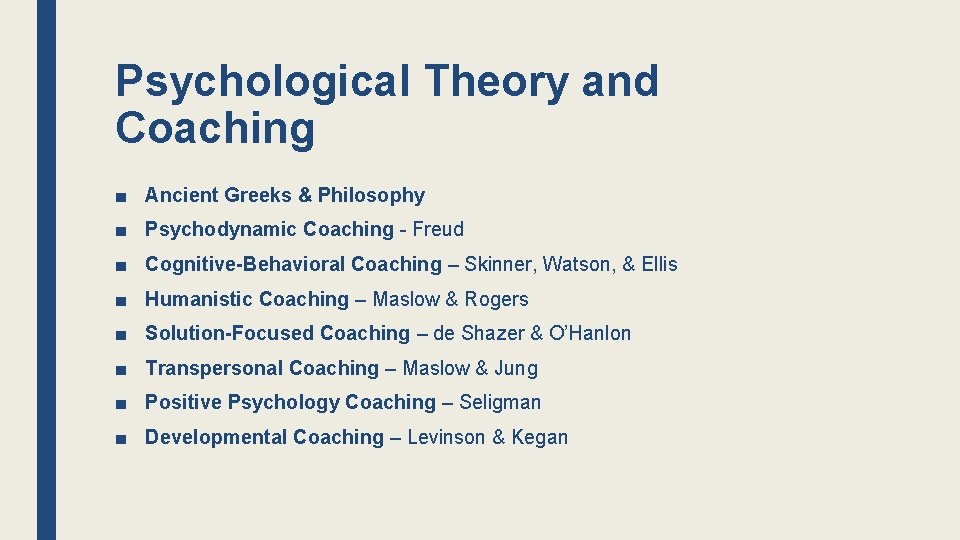
Psychological Theory and Coaching ■ Ancient Greeks & Philosophy ■ Psychodynamic Coaching - Freud ■ Cognitive-Behavioral Coaching – Skinner, Watson, & Ellis ■ Humanistic Coaching – Maslow & Rogers ■ Solution-Focused Coaching – de Shazer & O’Hanlon ■ Transpersonal Coaching – Maslow & Jung ■ Positive Psychology Coaching – Seligman ■ Developmental Coaching – Levinson & Kegan
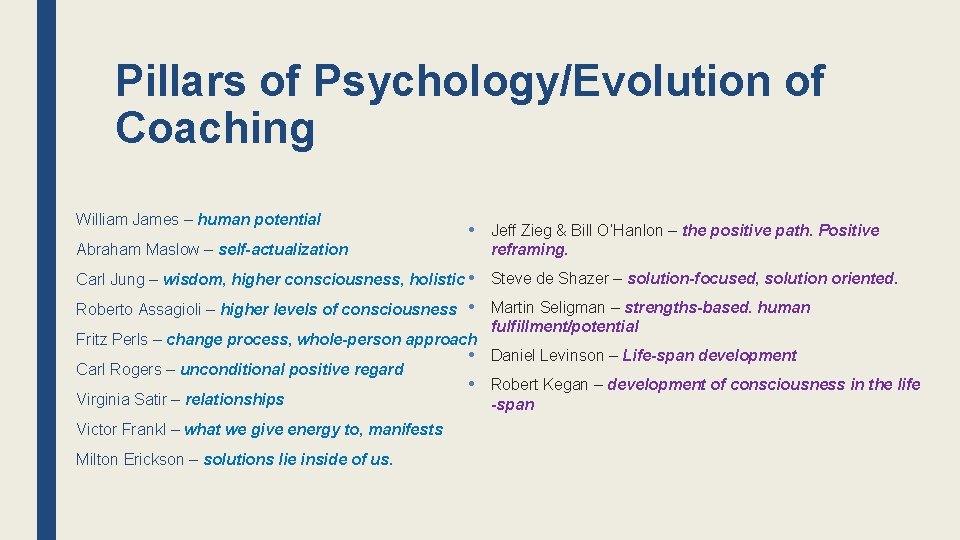
Pillars of Psychology/Evolution of Coaching ■ William James – human potential ■ Abraham Maslow – self-actualization ■ Carl Jung – wisdom, higher consciousness, holistic • Steve de Shazer – solution-focused, solution oriented. ■ ■ Roberto Assagioli – higher levels of consciousness • Martin Seligman – strengths-based. human fulfillment/potential Fritz Perls – change process, whole-person approach • Daniel Levinson – Life-span development Carl Rogers – unconditional positive regard • Robert Kegan – development of consciousness in the life Virginia Satir – relationships -span ■ Victor Frankl – what we give energy to, manifests ■ Milton Erickson – solutions lie inside of us. ■ ■ • Jeff Zieg & Bill O’Hanlon – the positive path. Positive reframing.
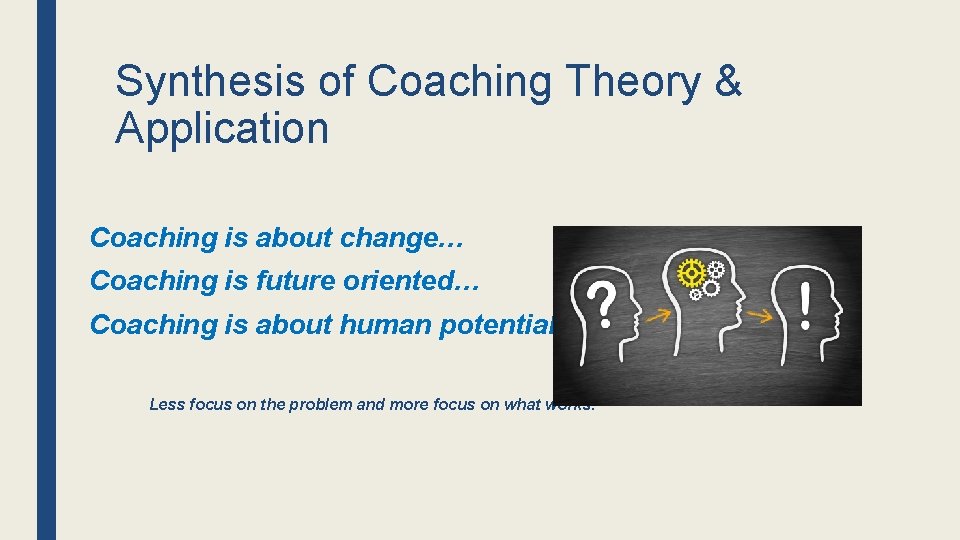
Synthesis of Coaching Theory & Application Coaching is about change… Coaching is future oriented… Coaching is about human potential… Less focus on the problem and more focus on what works.
The Role of the Coach ■ The role of the coach is to support the patients agenda by framing questions that enable intuition-based solutions to existing problems, or in support of continued growth and potentiality… ■ Coaches help keep people focused, challenged, and motivated for living with intention ■ Collaborative partnership with someone committed to helping us develop and implement a life worth living
Coaching and Meaning Making ■ Coaching gives clients the opportunity to think what they have not thought, say what they have not said, and dream what they have not dreamt, and create what they have not created ■ It is a conversation of awareness (getting the clearest possible picture of reality). As awareness increases, choices expand. ■ It is a conversation about choice (getting the clearest possible picture of a desired future outcome). As choice increases, clients learn to trust themselves (and their coaching relationship) more fully. ■ It is a conversation about gaining access to internal and external resources.
Possibilities ■Coaching is about possibilities…. discovering, harnessing, and expanding on client strengths…It entails listening to and for possibilities (not finding solutions, advising, or training).
Action Coaching is about taking action!
Fundamentals of Coaching. Big 5! ■ Focus. What are patients Williams & Menendez, 2007 goals? Have they articulated a desire for change? (MI principles) What’s missing or wanting? Is the focus clear or generalized? ■ Mindset – Helpful (possibilities) or limiting (only problems) ■ Capabilities – What are patient resources/strengths? Are they aligned with goals and vision? What are being utilized? What’s missing? ■ Habits – Do they support goal achievement? Are they consistent with possibilities? ■ Motivation – Where is passion? What is getting in the way/draining energy? Is there momentum?
Basic Coaching Model Williams & Menendez, 2007 ■ Step 1. Gain clarity: What do you want? How much do you want it? What is your vision? Why is this important to you? ■ Step 2. Listen. Clarify. Provide perspective. Create possibilities. Find the gaps. Support clarity. ■ Step 3. Honest Feedback and Observation. Tell the truth as you see it (respectfully, supportively, invitingly). “The power to change comes from being able to see circumstances from more than one perspective. ”
Basic Coaching Model ■ Step 4. Listen More. Play. Explore. Discover. Create new possibilities. Honor what is said. ■ Step 5. Create accountability. Do they own it? Are they excited? (refer to Big 5). Assess feasibility/identify obstacles (time, energy, space). Identify what they will do, when they will do it, and how they will do it. A session is not complete without a request for some kind of movement. ■ And…. repeat
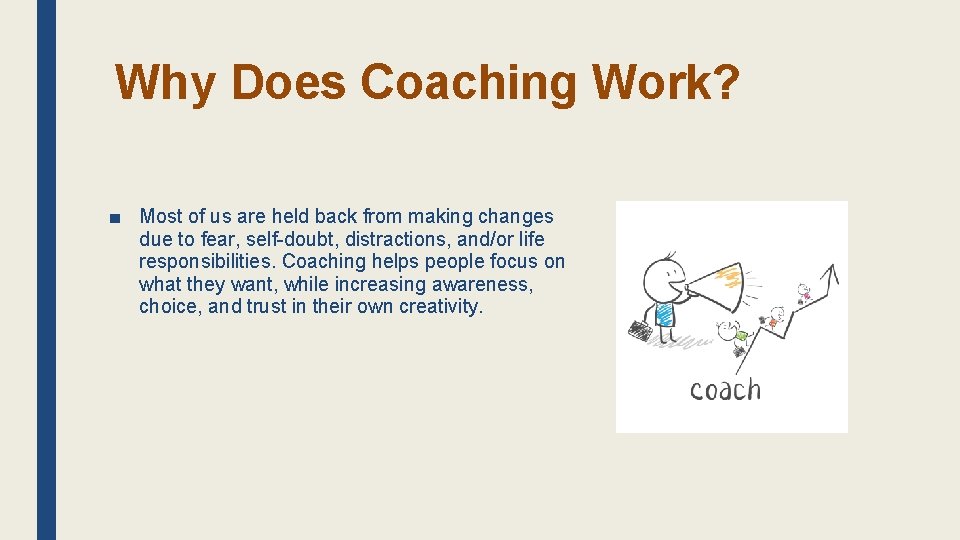
Why Does Coaching Work? ■ Most of us are held back from making changes due to fear, self-doubt, distractions, and/or life responsibilities. Coaching helps people focus on what they want, while increasing awareness, choice, and trust in their own creativity.
Example Session Williams & Menendez, 2007 ■ “C: So last week you said you wanted to have a conversation about how to rediscover fun in your life. Fun is an area on the wellness wheel and you want to have that be better for you. ■ P: Yes. ■ C: So, what do you want to be different regarding fun in your life? ■ P: Well, several years ago I had a serious back injury and had to stop playing tennis. I noticed ever since I stopped playing tennis and have injuries in my body and don’t really feel the athletic person I was, let’s say, 20 years ago, that I’ll choose working on my computer. I’ll choose staying in the house…I’ll choose other activities rather than plan something with my partner that would be fun. Fun is very low on my life design.
Example Session ■ C: Right. And yet it used to be a big important part…because tennis is the way you did it. Is that right? ■ P: Yeah. I loved it. I had so much fun. ■ C: Well, before we talk about other options for redesigning your life tell me what was fun about tennis. ■ P: It was being outdoors, in the sun, and it was playing with strangers sometimes, or just meeting people someone regularly…and it was the physical activity…. getting better at something…
Example Session ■ C: Where else in your life can you imagine being outdoors, meeting new people, engaging in some meaningful activity? . . . It still could be physical to the degree that it’s able to be…. what comes to mind? ■ P: I’m not at all sure. ■ C: What do you see in other people that you notice, “oh that’s something to consider? . . . How might you go about gathering that information?
Example Session ■ P: I think that’s good, only I always come up with having fun in a sport…So, that’s my problem. I feel like I almost have to reframe fun and I don’t know how to do that. ■ C: Good, good. What I picked from your conversation were some ingredients that…If being outdoors and meeting people were two parts of playing tennis, you can still have those. What you can’t have right now is playing tennis. ■ P: No. I can’t ever play tennis again.
Example Session ■ C: OK…. I’m closing my eyes as I try to imagine…what I’m hearing is it would be very important for you to find a way for fun to be a big factor in your life again and it wouldn’t be just doing something for the sake of doing something ■ P: Right ■ C: And there are physical limitations that we know about. ■ P: Right.
Example Session ■ C: So who do you know in your life either that you know or that you see publicly that have physical limitations and still seem to have fun in their life? Any models that you can think of? ■ P: (laughs). No. ■ C: So that would be a great research project, wouldn’t it? ■ P: Yeah.
Additional Sample coaching Questions ■ When did you take up tennis? ■ What did you do for fun before that? ■ Is that something that interests you now? (No) ■ Yeah. If sport equals fun…but sport isn’t the only kind of fun. It just seems right now that’s the fun you lost. ■ So, let’s move into the future…I do absolutely believe that there is an unknown for you, of having a life of fun, because not only do you deserve it I think there is also a unique experience that we haven’t yet come upon that would be fun for you in the future. So, if you had a future that had fun in it, how would you be different? Who would you become if that were part of your life? ”
Summary of Example Coaching Session ■ Coach is present, focused, ready to be of service to the patient. ■ Coach gets the patient to do the work instead of handing them answers. ■ Coach’s assumption is that the patient has the answers. The coach’s job is to facilitate their emergence. ■ Coach took her time, was curious. Nobody needed to know the answers in short order. Coach created space for exploration. ■ Coach believed wholeheartedly in the patients ability to find their own answers. ■ Coach was solution-focused. Focus was on possibilities, what works, patients intuition.
Coaching Fundamentals ■ Assist people in designing their own future rather than get over the past. ■ Helps create visions and goals. ■ Elicits strategies from the client or patient. ■ Provides multiple strategies, from numerous fields of study to support achieving those goals. ■ Believes wholeheartedly in the client/patients internal resources and personal power in discovering their own solutions. ■ Creates a sacred space to explore.
Solution-Focused Coaching ■ The ways in which we think and talk about anything gives energy to that focus. So, change the viewing and the doing! ■ Assist client in designing a desired future and co-construct a pathway (thinking and action) that moves them toward that end. ■ Non-pathological (What is right) ■ Client has internal resources – uncover them! ■ Action-oriented and personalized ■ Solutions are self-directed and lead to feelings of self-efficacy
Appreciative Inquiry David Cooperrider Inquiry and change happen simultaneously ■ Discover: potential for change through inquiry ■ Dream: create the vision ■ Design: possibilities ■ Destiny: momentum and hope relative to “deep purpose”
Health & Wellness Coaching ■ Patient centered ■ Based on behavior change theory ■ Delivered by health professionals of diverse backgrounds & education ■ Goal-directed & strengths-based ■ Accountability based ■ Coach is change partner
Health & Wellness Coaching Efficacy ■ Coaching techniques ■ Theoretical underpinnings ■ Frequency and duration of coaching process ■ Extent and nature of the coach-client relationship ■ Delivery and degree of educational content ■ Professional background and training of coaches
Great Coaching Questions ■ ■ ■ What gives you energy? What strength, skill, or gift do you wish to use more fully? What gets in the way of you manifesting your best life? What do you most want from coaching? What are three changes you could make right now that would move you closer to your desired outcome? ■ Where do you find yourself being careful or cautious about making changes in your life? ■ When do you find you waste energy? ■ What three things do you really want to accomplish in the next 30, 60, 90 days? ■ How will you know that you are making progress?
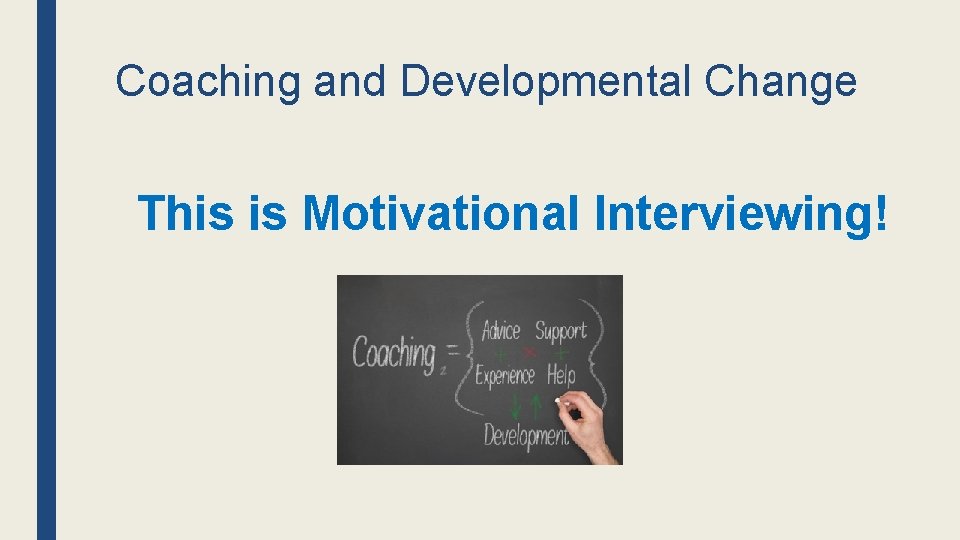
Coaching and Developmental Change This is Motivational Interviewing!
Coaching for Momentum ■ Empowerment: ■ Strengths-based (VIA Classification of Strengths) (Clifton. Strengths Finder) ■ Advocate: Remind them of what they want. Remind them of their strengths and capabilities. Hold their vision and agenda for change. ■ Dwell in possibility: What is life calling for here?
Coaching Patient Intuition Or, get out of your head and listen to your heart! ■ Our conscious, rational minds seek dominion over our intuition. ■ Coaching questions that are framed analytically encourage us to remain in that part of our brain. Change from ‘what’s going wrong to what’s going right? ’ ■ Obstacles cannot be removed by placing our attention on them ■ Seek wholehearted commitment by merging current reality with a clearly held vision of the ideal. ■ “What’s Right” questions inspire intuition. The more we can merge the analytic brain with the intuitive brain the more we inspire growth and change.
More Great Coaching Questions that Manifest Intuition ■ What if, overnight, a miracle occurred, and you woke up tomorrow morning and the problem was solved? What would be the first thing you would notice? ■ Are there any changes that may be taking place for you right now in your expectations for the future? ■ What is the most useful insight you have gained from todays session? ■ Does this insight stand out in your mind? In what ways do you see yourself benefitting from this insight? ■ What is the most powerful unanswered question for you right now? ■ What thought or idea appears to offer the greatest promise for getting you on a roll…and keeping you there? ■ How would you describe a key benefit you hope to gain in examining your resistance to change?
What Makes These Questions Impactful? ■ They draw on the patients hidden or untapped potential ■ They focus on the patients optimal leverage point for change ■ They speak to the patients creative power and their resources to generate new options. ■ They inspire patients to think, dream, and act beyond their current circumstances. ■ They generate self-awareness ■ They encourage an expansion of beliefs, behaviors, and attitudes. ■ They create more choices and personal responsibility.
What’s Right? Kurt Wright, 1998 ■ What’s right or what’s working? (agenda/mindset) ■ What makes it right or why does it work? (Intuition/energy) ■ What would be ideally right? (vision) ■ What’s not yet quite right? (what’s unknown/possibility) ■ What strengths and resources can I find to make it right? (action/engagement/motivation)
Challenge and Support ■ Introduce a new way of seeing something that has not yet been visible to them. ■ “What would it take for you to move from feeling lethargic and un-motivated to allowing your body to work more naturally? ■ Request Boldly ■ “I request that you stop suffering this week… What is the one request I should make of you to make this happen? That is what I am requesting. ” ■ Point out contradictions ■ “Last time we met you were excited about eating more fruit. Hmm. Can you help me understand what happened there? ■ Be Compassionate ■ “That’s good work but not nearly what you are capable of. What is the next step here? . . . Can you turn your complaint into a request? Who do you need to say what to? ”
Training ■ “The coach is a healthcare professional trained in behavior change theory, motivational strategies, and communication techniques which are used to assist patients to develop intrinsic motivation and obtain skills to create sustainable change for improved health and wellbeing” ■ Wolver et al. , 2013
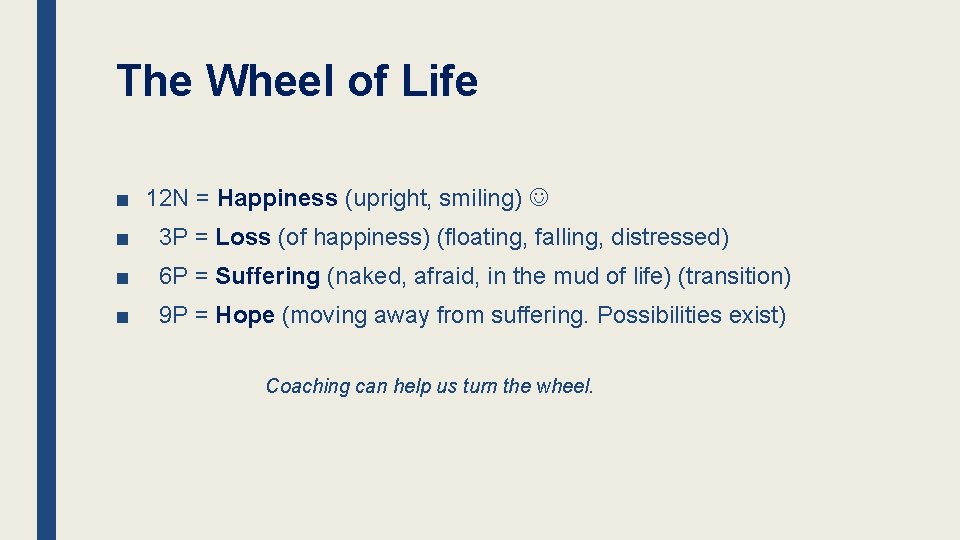
The Wheel of Life ■ 12 N = Happiness (upright, smiling) ■ 3 P = Loss (of happiness) (floating, falling, distressed) ■ 6 P = Suffering (naked, afraid, in the mud of life) (transition) ■ 9 P = Hope (moving away from suffering. Possibilities exist) Coaching can help us turn the wheel.
Thriving or Surviving? ■ Family ■ Finances ■ Friends and Community ■ Fun and Play ■ Health and well-being ■ Home and Environment ■ Personal Development and Growth ■ Relationships ■ Spirituality ■ Work and Career
References ■ Cooperrider, D. L. (1986). Appreciative Inquiry: Toward a methodology for understanding and enhancing organizational innovation. Unpublished Ph. D, Case Western Reserve University, Cleveland. ■ Cox, E. , Bachkirova, T. , & Clutterbuck, D. (2013). The Complete Handbook of Coaching. SAGE Publications. London ■ Williams, P. , & Menendez, D. S. (2007). Becoming a Professional Life Coach. W. W. Norton. New York. ■ Woliver, R. Q. , Simmons, L. A. , Sforzo, G. A. , Kaye, M. , Bechard, E. M. , Southard, M. E. , Kennedy, M. , Vosloo, J. , & Yang, N. (2013). A systematic review of the literature on health and wellness coaching: A defining key behavioral intervention in healthcare. Global Advances in Health Medicine, 2(4), 38 -57. ■ Wright, K. (1998). Breaking The Rules: Removing Obstacles to Effortless High Performance. CPM Publishing. Boise, ID.

Questions?
- Slides: 43