
What is civilization The word civilization comes from

- Slides: 8
What is civilization? • The word "civilization" comes from the Latin root civ-. Seen in such Latin words as civis (citizen) and civitas (city). Thus, cities appear crucial to our sense of what civilization is. • The Greek vocabulary is similarly revealing. Polis (city) gives us our words for politics and po • To be "civilized" essentially meant being a – townsman, – governed by the constitution and – legal statutes of that community
Elements of Civilisation • There are five key elements that make a society advanced enough to be considered a civilization. • 1. Centralized Government • 2. Organized Religion • 3. Job Specialization and Social Classes • 4. Arts, Architecture, and Infrastructure • 5. Writing
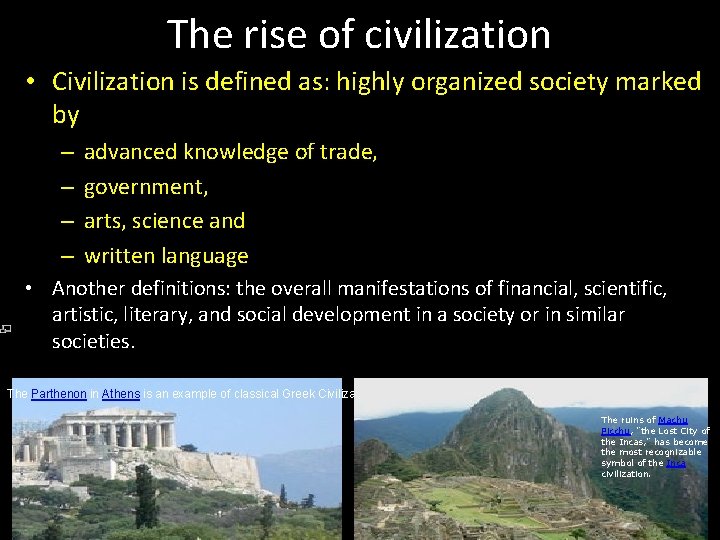
The rise of civilization • Civilization is defined as: highly organized society marked by – – advanced knowledge of trade, government, arts, science and written language • Another definitions: the overall manifestations of financial, scientific, artistic, literary, and social development in a society or in similar societies. The Parthenon in Athens is an example of classical Greek Civilization. The ruins of Machu Picchu, "the Lost City of the Incas, " has become the most recognizable symbol of the Inca civilization.
The Earliest Civilisations • The earliest known civilizations (as defined in the traditional sense) arose in Mesopotamia between the Tigris and Euphrates rivers in modern-day Iraq, Persia in modern-day Iran, the Nile valley of Egypt. • The inhabitants of these areas built cities, created writing systems, learned to make pottery and use metals, domesticated animals, and created complex social structures with class systems.
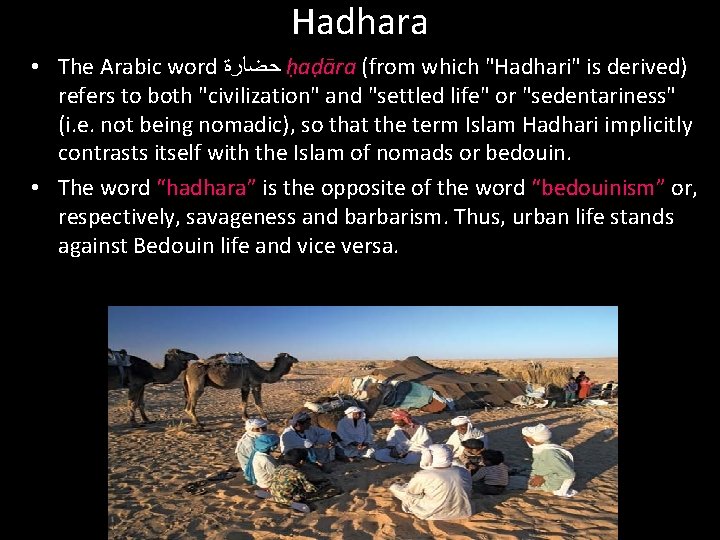
Hadhara • The Arabic word ﺣﻀﺎﺭﺓ ḥaḍāra (from which "Hadhari" is derived) refers to both "civilization" and "settled life" or "sedentariness" (i. e. not being nomadic), so that the term Islam Hadhari implicitly contrasts itself with the Islam of nomads or bedouin. • The word “hadhara” is the opposite of the word “bedouinism” or, respectively, savageness and barbarism. Thus, urban life stands against Bedouin life and vice versa.
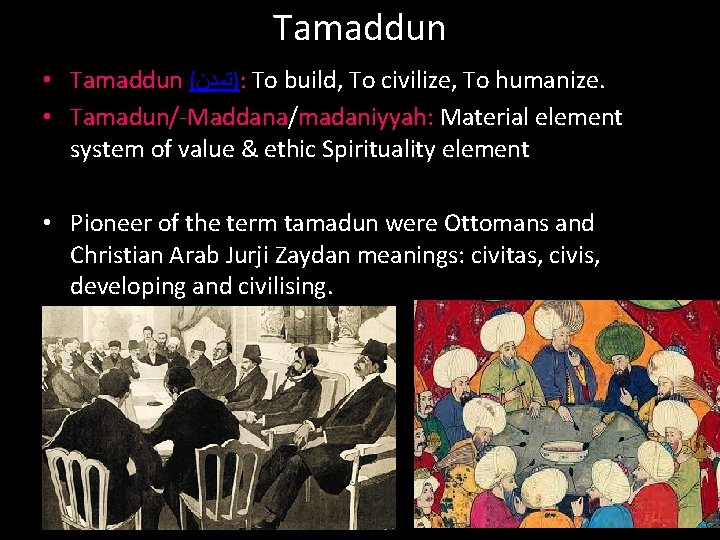
Tamaddun • Tamaddun ( )ﺗﻤﺪﻥ : To build, To civilize, To humanize. • Tamadun/-Maddana/madaniyyah: Material element system of value & ethic Spirituality element • Pioneer of the term tamadun were Ottomans and Christian Arab Jurji Zaydan meanings: civitas, civis, developing and civilising.
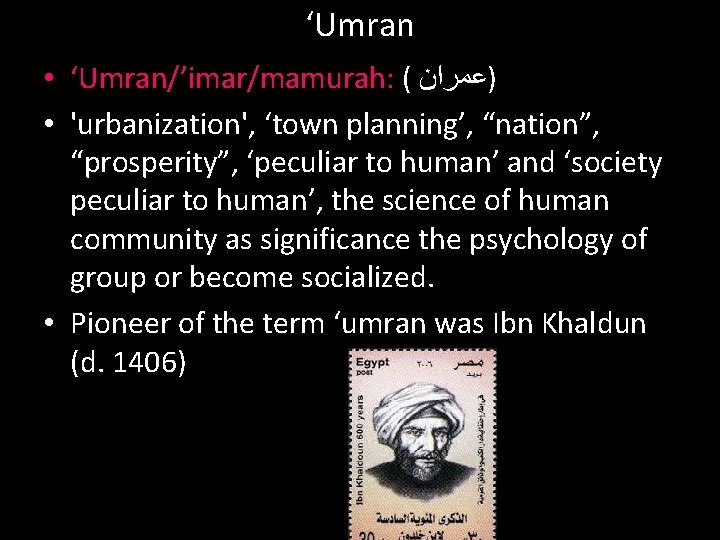
‘Umran • ‘Umran/’imar/mamurah: ( )ﻋﻤﺮﺍﻥ • 'urbanization', ‘town planning’, “nation”, “prosperity”, ‘peculiar to human’ and ‘society peculiar to human’, the science of human community as significance the psychology of group or become socialized. • Pioneer of the term ‘umran was Ibn Khaldun (d. 1406)
Main Demand of Islamic Civilisation • Islamic Civilization demands its followers to be the best of example for mankind, to other Muslim, and also to non-Muslim. • ‘You are the best of nation (people) evolved for mankind, enjoining what is right, forbidding what is wrong, and believing in Allah. ’ (Quran, Ali-Imran 3: 110)