
What is child abuse any act of commission
What is child abuse? “any act of commission or omission that impairs or endangers a child’s physical or emotional development” (O’meara & Fedderson, 1959)
Types of child abuse: Emotional abuse – humiliating a child, calling them names, verbally abusing them, bullying & threatening them, lack of physical contact Physical abuse – beating, inflicting injury, whether planned or inadvertent, (discipline teaches children right from wrong, physical abuse makes them live in fear)
English proverb: “spare the rod and spoil the child” Proverbs 13. 24(NIV): “Whoever spares the rod hates their children, but the one who loves their children is careful to discipline them. ” Translation: ‘rod of discipline’. Those who love their children care to discipline them
Neglect – failure to provide for child’s basic need: food, clothing, supervision, hygiene Sexual abuse – exposing them to sexual materials, sexual conditions, touching inappropriately, sexual contact/intercourse, taking pornographic pictures of children etc
Signs of child abuse: Child would be excessively fearful or withdrawn Extremes of behavior eg, extremely passive or extremely aggressive Child displays no obvious attachment to parent or caregiver Injuries, belt marks, stick marks, unusual fractures, repeated and multiple fractures
Dirty ill-fitting clothes Poor hygiene, oral & body Often late for school Runs away from home STD in a child <14 yo
Effects of child abuse on children: 1. Inability to trust and difficulty establishing relationships with people 2. Feeling like they are useless or not worth anything 3. Difficulty expressing emotions in appropriate manner
4. Alcohol and drug abuse when they become adults 5. Anxiety, depression, suicidal ideation, especially as teenages and young adults 6. After they grow up, divorce, inability to keep jobs, crime 7. They become abusers themselves, as husbands, wives or parents/authority figures
Unicef report (September 2015)(Rachel Harvey) “Majority of Nigerian children suffer violent abuse” www. voanews. com o Abuse starts before 5 yo o 6/10 experience violence before 18 yo o ½ abused before 11 yo o 1/10 before 5 yo o According to the author, report covered all 36 states and FCT
“CHILD ABUSE AND NEGLECT IN NIGERIA - SOCIOLEGAL ASPECTS” – Eunice Uzodike (professor of law, University of Lagos) (International Journal of Law and the Family, 1990) ü …”there is no unitary standard…” ü …”what is acceptable or unacceptable is linked…. to the cultural context in which the behaviour occurred” ü What is considered “child abuse” varies from period to period and from culture to culture
ü Some try to dichotomise - qualifying what they consider as abuse as one done intentionally, whether as an act of commission or omission
Ø Poverty, ignorance & religion – encourage child abuse in Nigeria (Uzodike) Ø Forms of child abuse in Nigeria: 1. excessive corporal punishment (poverty) 2. child marriage (religion) 3. child labor (poverty & ignorance) 4. neglect (poverty)
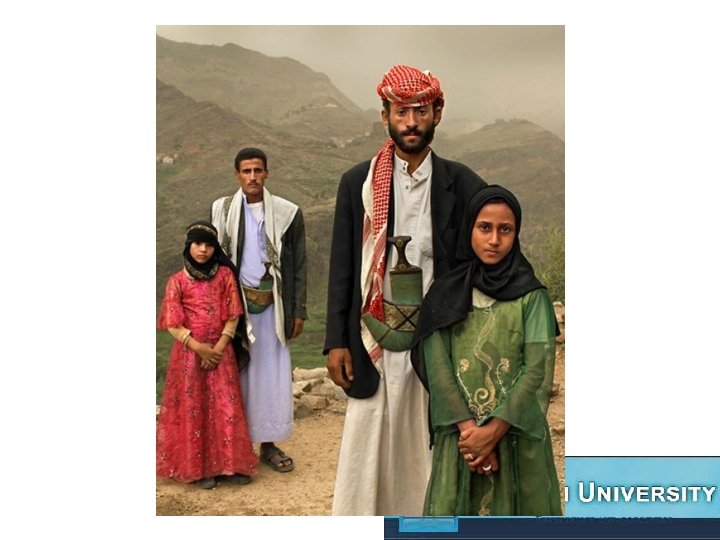
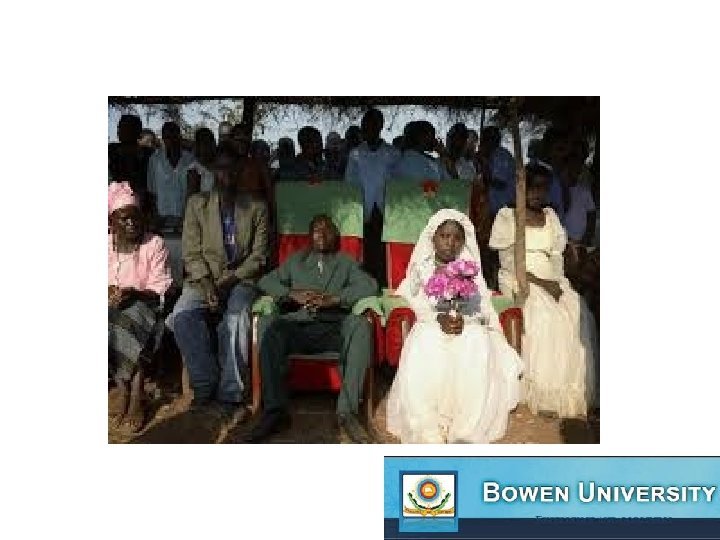
Ø In Nigeria, girls 11 yo are given in marriage Ø Nigerian Criminal Code, Section 218 prescribes: - life imprisonment for carnal knowledge of any girl <13 yo - 2 years’ imprisonment for carnal knowledge of any girl btwn 13 -16 yo Ø Exempts men married to any girl under 16 yo
Ø No minimum marriageable age in Nigeria, therefore, under the law, child marriage is permissible (influence of religion) Ø “…child marriage deprives a child of the opportunity to develop physically, mentally, morally and socially in a healthy & normal manner and this contravenes the UN declaration of the rights of the child”
Theodore Okeahialam (professor of paediatrics, University of Nigeria, Enugu campus) “Child abuse in Nigeria” (Child abuse & neglect, 1984) • People assume the extended family system precludes the occurrence of child abuse
• Children at risk in urban areas: gross physical abnormalities like hydrocephalus/spina bifida, mental handicaps, congenital malformations, twins/triplets in some Nigerian ethnic groups • Predisposing factors among abusers: urban stress, abusive traditional practices such as female circumcision, excessive corporal punishment
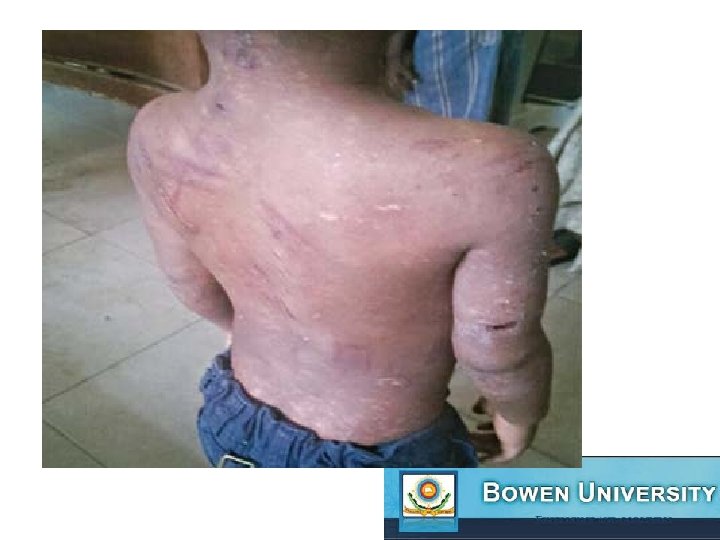
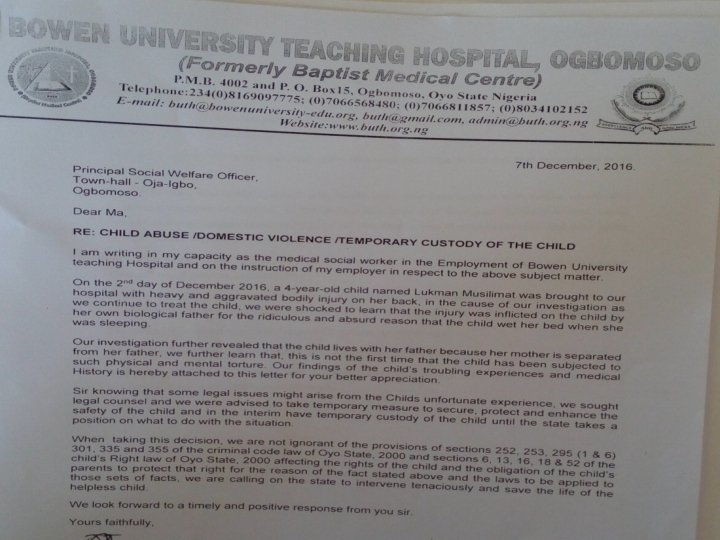
• 4 year old boy, beaten by his father( Sikiru Mustapha) over & over in Iwaya, Lagos • Eventually a neighbour intervened & father ended up with the police • Report can be found in The Guardian of June 15, 2015.
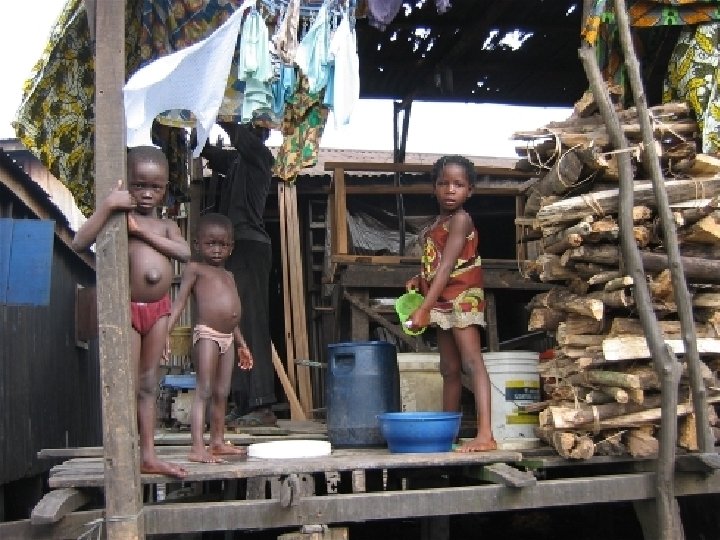
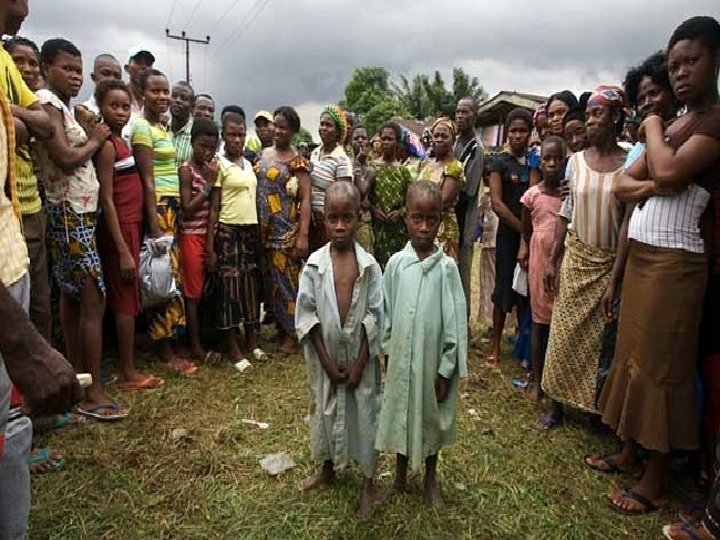
Twin boys in Akwa Ibom. Surrounded by villagers who believe they are bringing evil to their lives
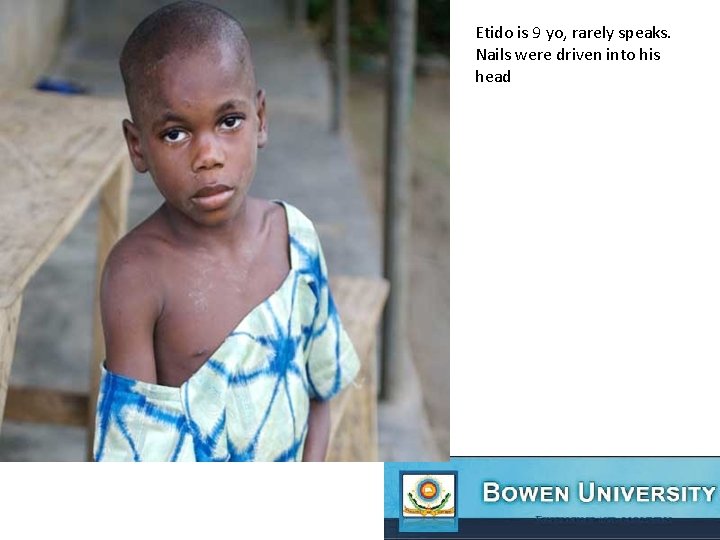
Etido is 9 yo, rarely speaks. Nails were driven into his head
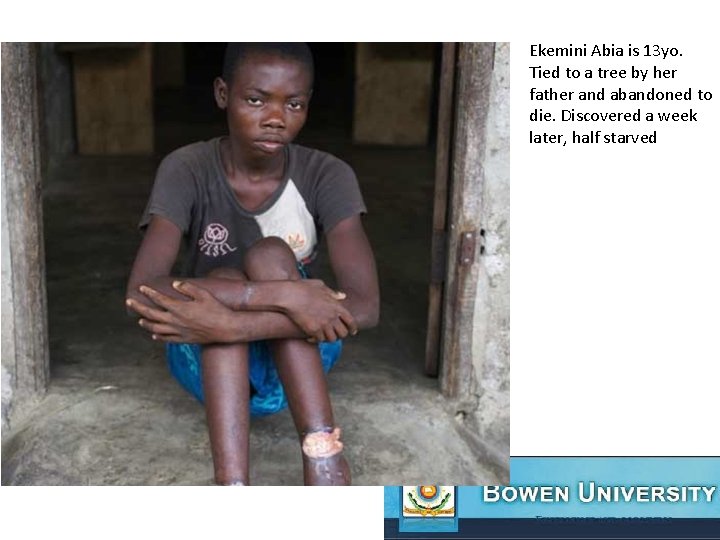
Ekemini Abia is 13 yo. Tied to a tree by her father and abandoned to die. Discovered a week later, half starved
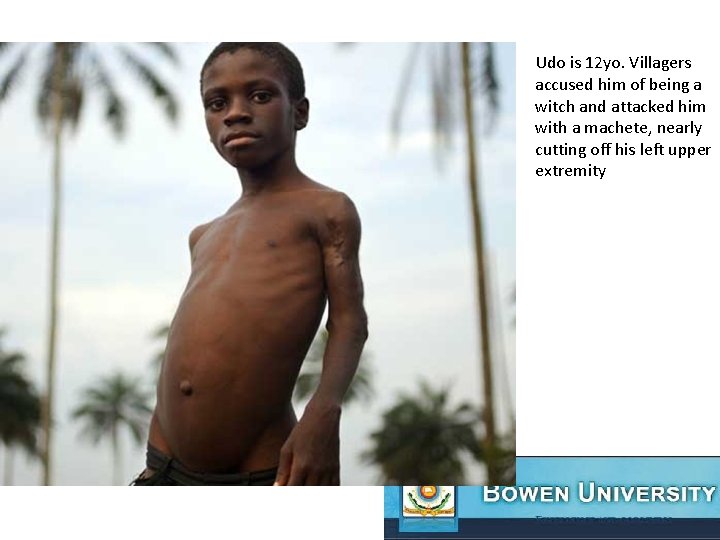
Udo is 12 yo. Villagers accused him of being a witch and attacked him with a machete, nearly cutting off his left upper extremity
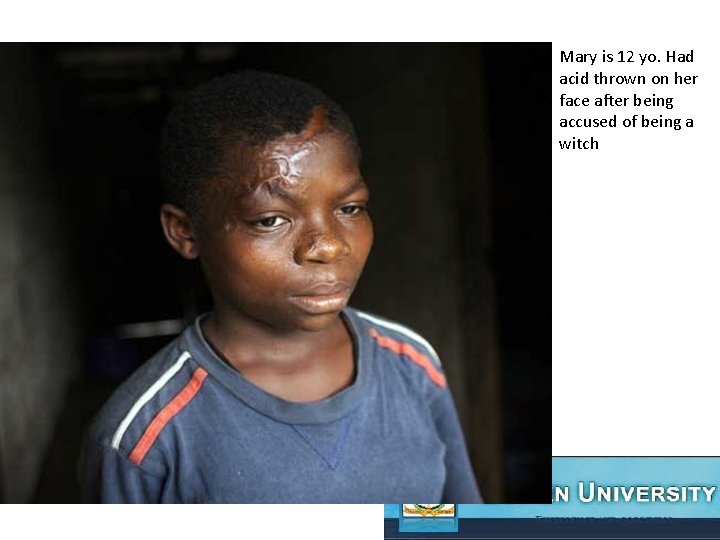
Mary is 12 yo. Had acid thrown on her face after being accused of being a witch
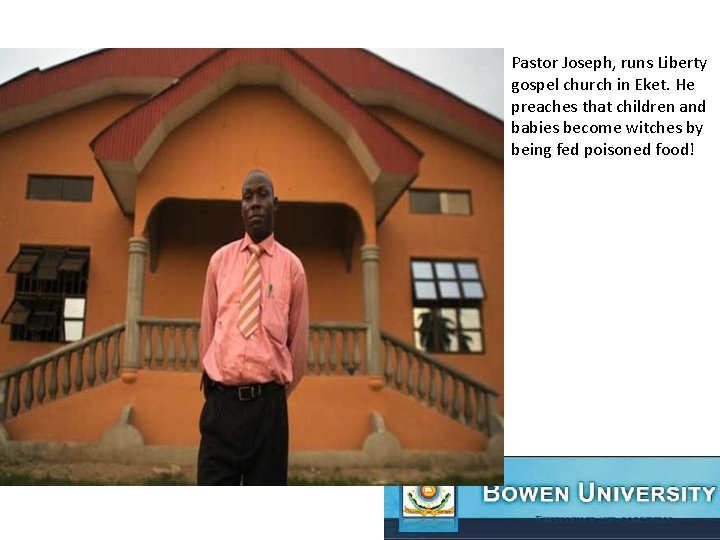
Pastor Joseph, runs Liberty gospel church in Eket. He preaches that children and babies become witches by being fed poisoned food!
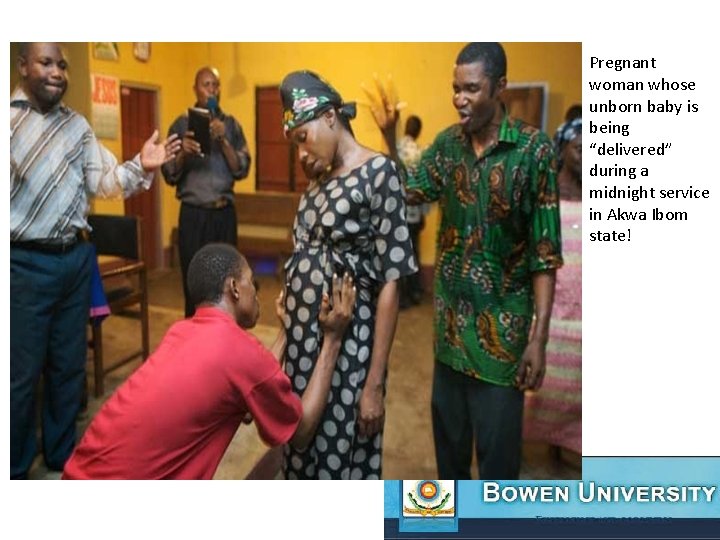
Pregnant woman whose unborn baby is being “delivered” during a midnight service in Akwa Ibom state!

Child abuse in Nigeria – what can be done? The United Nations has a human rights treaty called “Convention on the rights of the child”. It outlines the civil, political, economic, social, health and cultural rights of children. Adopted by the UN in 1989. Extensively lays down the rights of children as envisioned by the UN. In 2003, Nigeria adopted the Child Rights Act, as her own version of the above convention.
Included in the CRC are: -Children have rights to life, their own name & identity and to be raised in the family -right to express their own opinions -rights to be protected from exploitation and to have privacy -capital punishment is forbidden in children -prohibit and eliminate corporal punishment in children
Laws exist, infrastructure for enforcement lacking • African Network for the Prevention and Protection against Child abuse And Neglect (AN PPC AN) (1984) is an NGO whose mission is to protect against maltreatment of children
• Promote children’s rights & protection in Africa • Do research, documentation for data availability purposes • Advocacy, lobbying, networking etc • Capacity building
All forms of child abuse are an infringement upon the rights of the child The Nigerian constitution(1999) grants certain fundamental rights to all citizens, including children:
• The Right to life (S. 33) • • The Right to dignity of the human person (S. 34) The Right to personal liberty (S. 35) The Right to fair-hearing (S. 36) The Right to privacy and family life (S. 37)
• The Right to freedom of thought, conscience and religion (S. 38) • • The Right to freedom of expression and the press (S. 39) • • The Right of freedom of movement (S. 40) •
• The Right to freedom from discrimination (S. 41) • • The Right to acquire and own immovable property any where in Nigeria (S. 42) • • The Right against compulsory acquisition of one’s property without compensation (S. 43)
In addition, two international instruments take special care to protect the right of the child: 1. United Nations Convention on the Rights of the Child (1989) 2. African Charter on the Rights and Welfare of the Child (1991).
The provisions in these instruments include: right to life, health, education, special treatment in the administration of justice, protection against child abuse and torture, child labour, harmful social and cultural practices, sexual exploitation, drug abuse, sale, traffic and abduction, apartheid and discrimination, special provision for handicapped children, refugee children those separated from their parents and adopted children.
SUMMARY q Child abuse is a major problem in Nigeria and the political will to tackle it is often lacking among the authorities q Its flavor is slightly different from those in more industrialized parts of the world q It is fueled by poverty, lack of understanding and religiocultural beliefs
Laws must be strengthened & institutions such as child protective services put in place specifically to protect children, as occurs in other more developed parts of the world. Severe sanctions must be instituted to deter would-be offenders.

- Slides: 45