
What is Cerebral Palsy Libya International Medical University
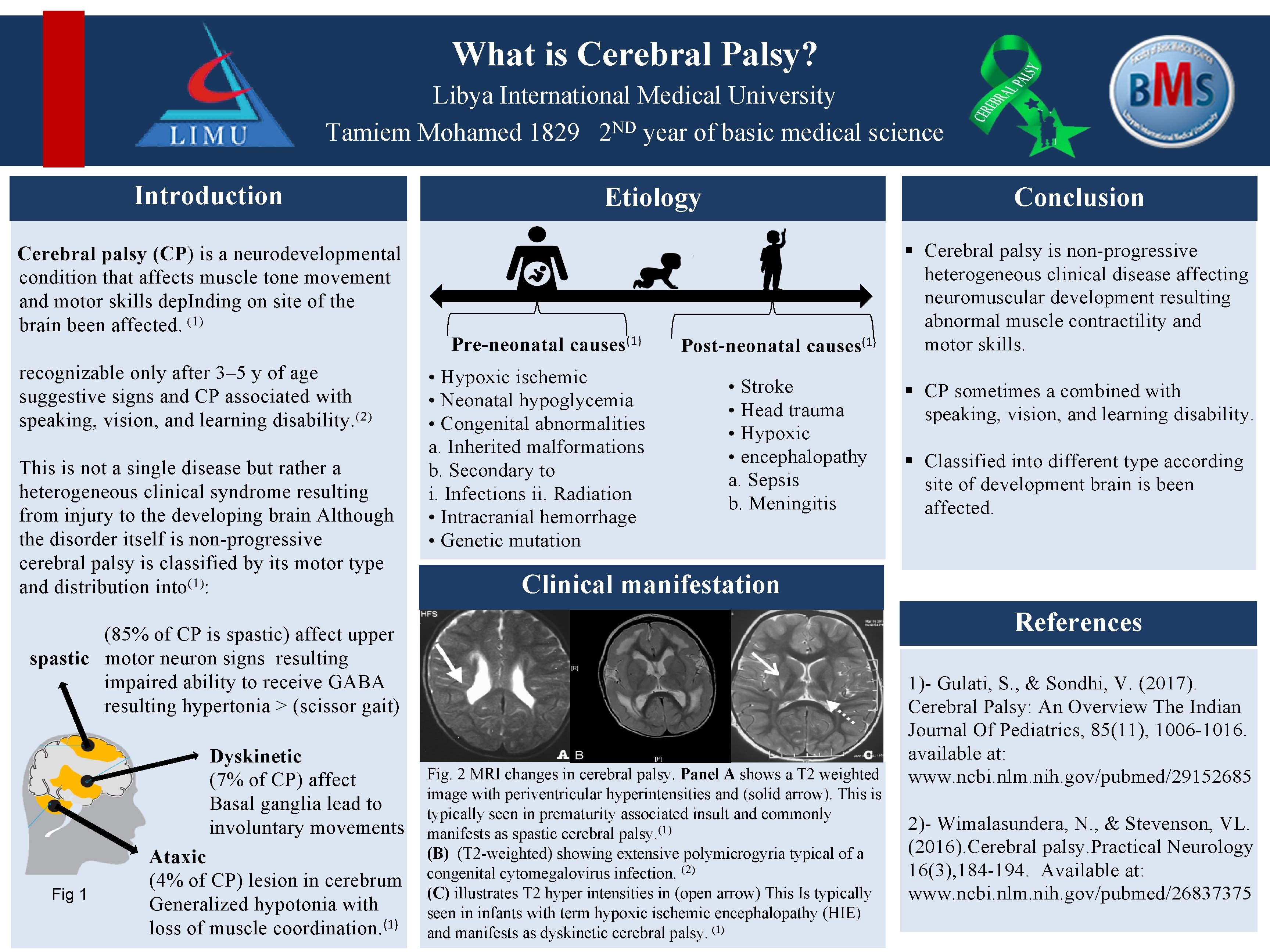
What is Cerebral Palsy? Libya International Medical University ND Tamiem Mohamed 1829 2 year of basic medical science Cerebral palsy (CP) is a neurodevelopmental condition that affects muscle tone movement and motor skills dep. Inding on site of the (1) brain been affected. recognizable only after 3– 5 y of age suggestive signs and CP associated with (2) speaking, vision, and learning disability. This is not a single disease but rather a heterogeneous clinical syndrome resulting from injury to the developing brain Although the disorder itself is non-progressive cerebral palsy is classified by its motor type (1) and distribution into : (85% of CP is spastic) affect upper spastic motor neuron signs resulting impaired ability to receive GABA resulting hypertonia > (scissor gait) Dyskinetic (7% of CP) affect Basal ganglia lead to involuntary movements Fig 1 Ataxic (4% of CP) lesion in cerebrum Generalized hypotonia with (1) loss of muscle coordination. . Introduction Etiology Pre-neonatal (1) causes Post-neonatal • Hypoxic ischemic • Neonatal hypoglycemia • Congenital abnormalities a. Inherited malformations b. Secondary to i. Infections ii. Radiation • Intracranial hemorrhage • Genetic mutation (1) causes • Stroke • Head trauma • Hypoxic • encephalopathy a. Sepsis b. Meningitis Conclusion § Cerebral palsy is non-progressive heterogeneous clinical disease affecting neuromuscular development resulting abnormal muscle contractility and motor skills. § CP sometimes a combined with speaking, vision, and learning disability. § Classified into different type according site of development brain is been affected. Clinical manifestation ` Fig. 2 MRI changes in cerebral palsy. Panel A shows a T 2 weighted image with periventricular hyperintensities and (solid arrow). This is typically seen in prematurity associated insult and commonly manifests as spastic cerebral palsy. (1) (B) (T 2 -weighted) showing extensive polymicrogyria typical of a congenital cytomegalovirus infection. (2) (C) illustrates T 2 hyper intensities in (open arrow) This Is typically seen in infants with term hypoxic ischemic encephalopathy (HIE) and manifests as dyskinetic cerebral palsy. (1) References 1)- Gulati, S. , & Sondhi, V. (2017). Cerebral Palsy: An Overview The Indian Journal Of Pediatrics, 85(11), 1006 -1016. available at: www. ncbi. nlm. nih. gov/pubmed/29152685 2)- Wimalasundera, N. , & Stevenson, VL. (2016). Cerebral palsy. Practical Neurology 16(3), 184 -194. Available at: www. ncbi. nlm. nih. gov/pubmed/26837375
- Slides: 1