
What is Big Maths Daily programme of mental

What is Big Maths? Daily programme of mental maths with a strong emphasis on learning facts and developing mental agility It develops core skills. All are taught in the same way, repeatedly, to embed these fundamental skills. Big Maths highlights how small steps of progress with core numeracy follow on logically from one to the next.
Why should we use Big Maths at L. V. P. S. ? Clear progression from year to year Consistent methods taught and language used throughout the school Build on prior learning and ensure children are secure in their knowledge Objectives are clearly matched to Curriculum for Excellence Improve mental maths skills and general numeracy across the school
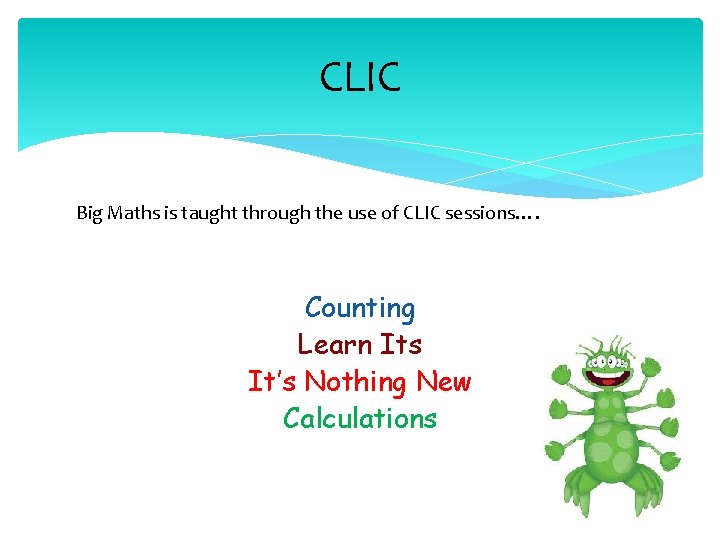
CLIC Big Maths is taught through the use of CLIC sessions…. Counting Learn Its It’s Nothing New Calculations
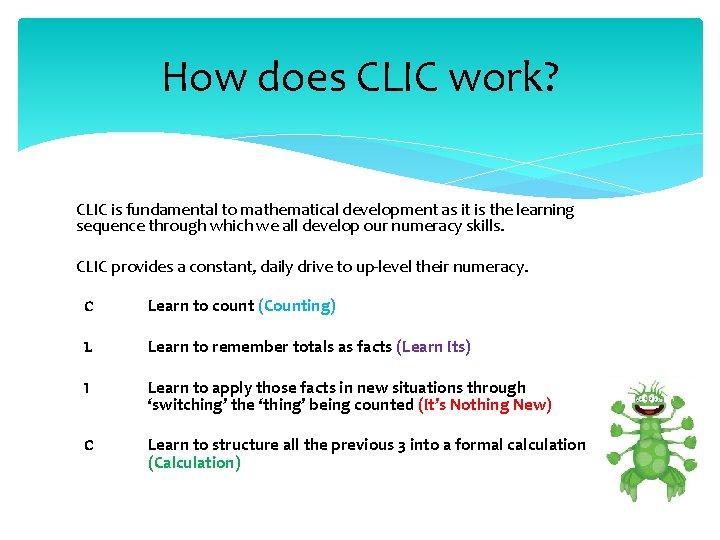
How does CLIC work? CLIC is fundamental to mathematical development as it is the learning sequence through which we all develop our numeracy skills. CLIC provides a constant, daily drive to up-level their numeracy. C Learn to count (Counting) L Learn to remember totals as facts (Learn Its) I Learn to apply those facts in new situations through ‘switching’ the ‘thing’ being counted (It’s Nothing New) C Learn to structure all the previous 3 into a formal calculation (Calculation)
How will the daily maths lesson be organised? Monday to Thursday (CLIC Sessions) Counting – 5 minutes Learn Its – 5 minutes It’s Nothing New – 5 minutes Calculations – 5 minutes
CLIC Counting
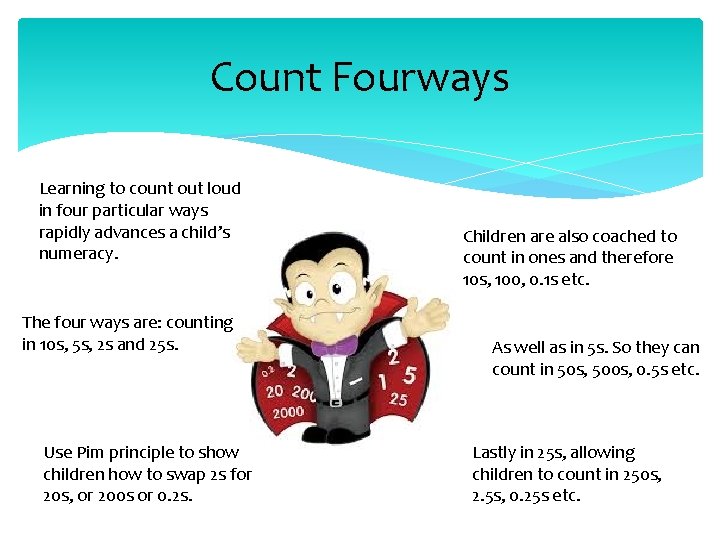
Count Fourways Learning to count out loud in four particular ways rapidly advances a child’s numeracy. The four ways are: counting in 10 s, 5 s, 2 s and 25 s. Use Pim principle to show children how to swap 2 s for 20 s, or 200 s or 0. 2 s. Children are also coached to count in ones and therefore 10 s, 100, 0. 1 s etc. As well as in 5 s. So they can count in 50 s, 500 s, 0. 5 s etc. Lastly in 25 s, allowing children to count in 250 s, 2. 5 s, 0. 25 s etc.
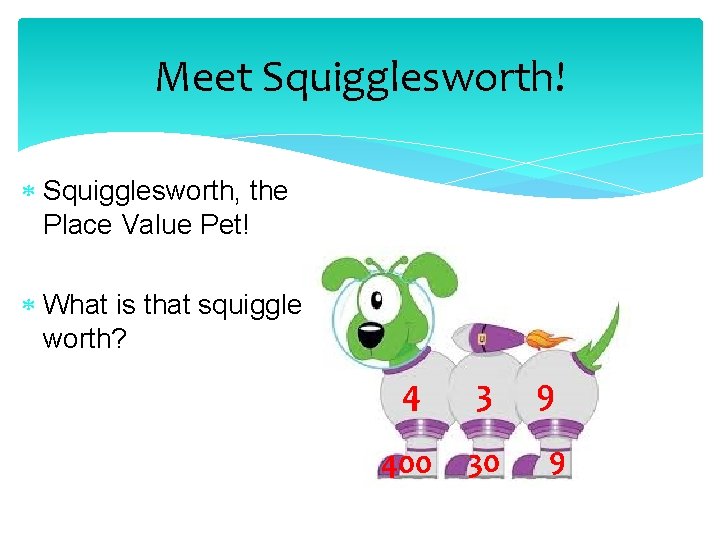
Meet Squigglesworth! Squigglesworth, the Place Value Pet! What is that squiggle worth? 4 3 400 30 9 9
CLIC Learn Its
Learn its : What is a Learn It? Recall of specific number facts – requires NO thinking time A learn it therefore is a number fact that is learnt so well that it can be recalled instantly. Learners should be in no doubt about the expectation of instant recall.
CLIC It’s Nothing New
It’s Nothing New ‘It’s Nothing New’ is the ‘Glue’ of CLIC. For each ‘It’s Nothing New’ step the teacher makes the learner conscious of two currently held ideas. They will then overlap these ideas and reveal how a third ‘new’ ideas must be true. The message that there is ‘no new maths’ is a critical part of making children conscious of the learning process and helps build their maths confidence. The ‘It’s Nothing New’ session is typically a group session that uses mainly talk and mini whiteboards. The teacher nudges forward with new concepts, taking the group with them as they go.
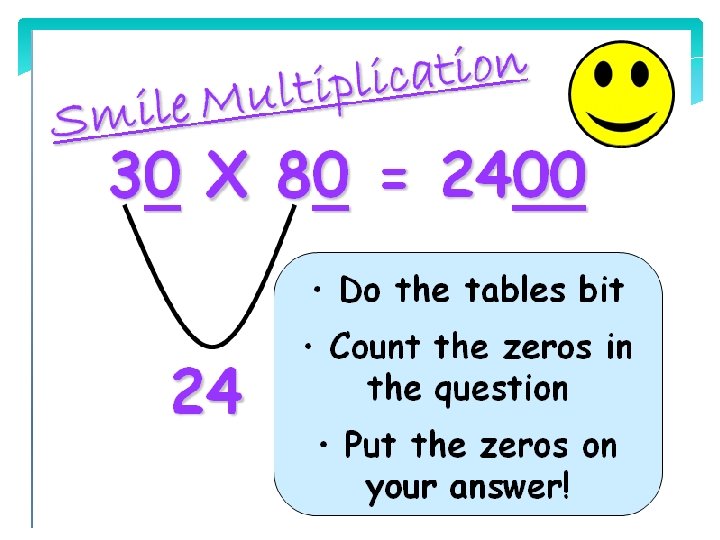
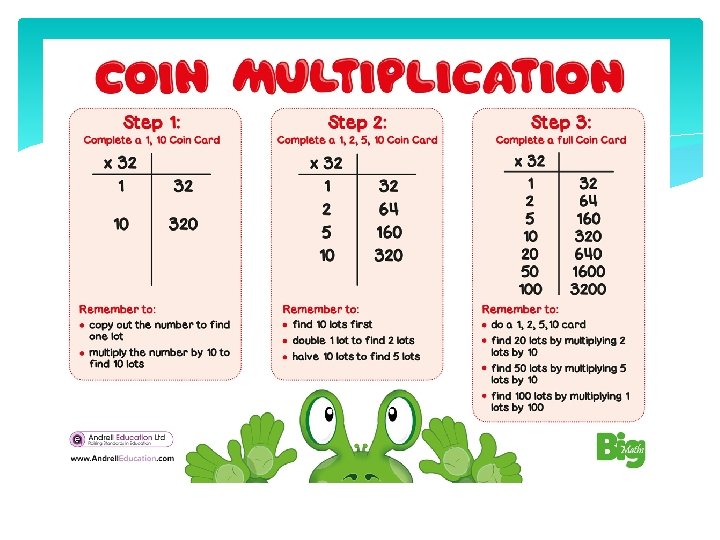
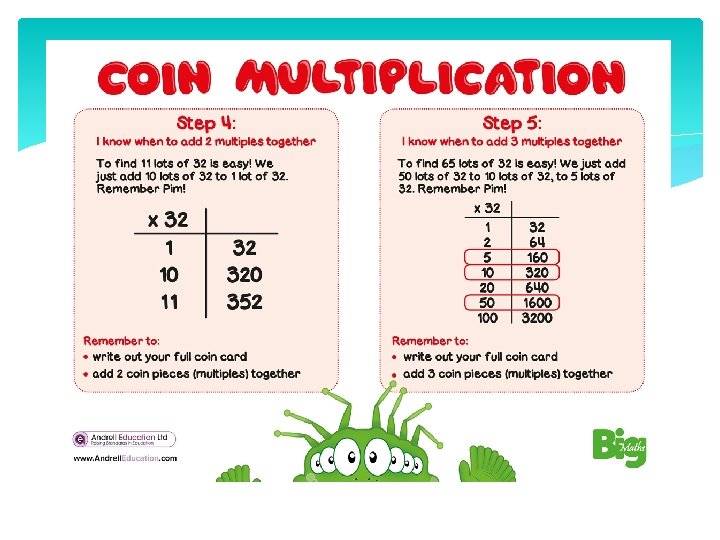
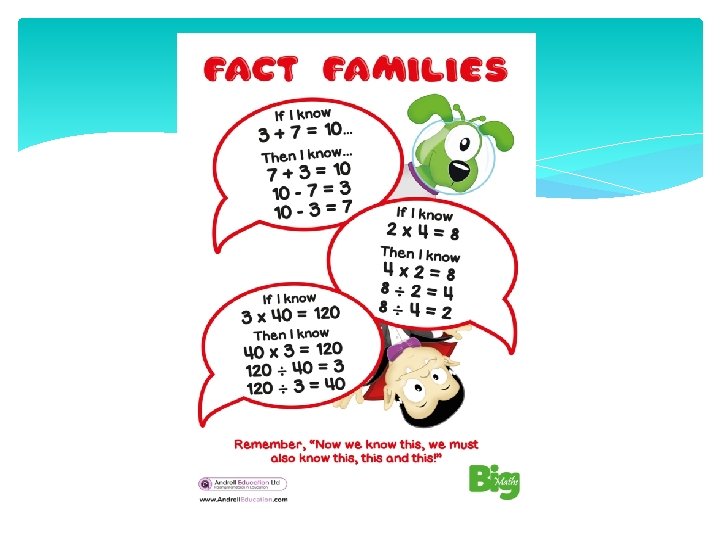
It’s Nothing New Some of the key elements of this aspect of CLIC are: Adding with Pim Jigsaw Numbers Smile Multiplication Coin Multiplication Where’s Mully Pom’s Words Fact Families Count Fourways
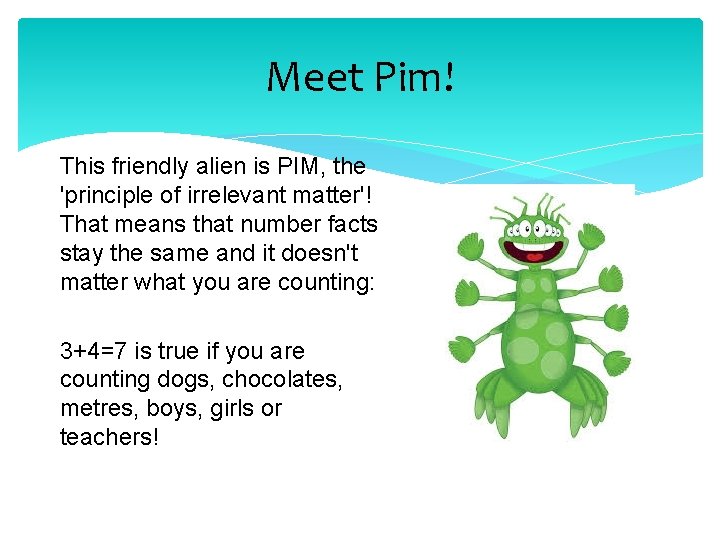
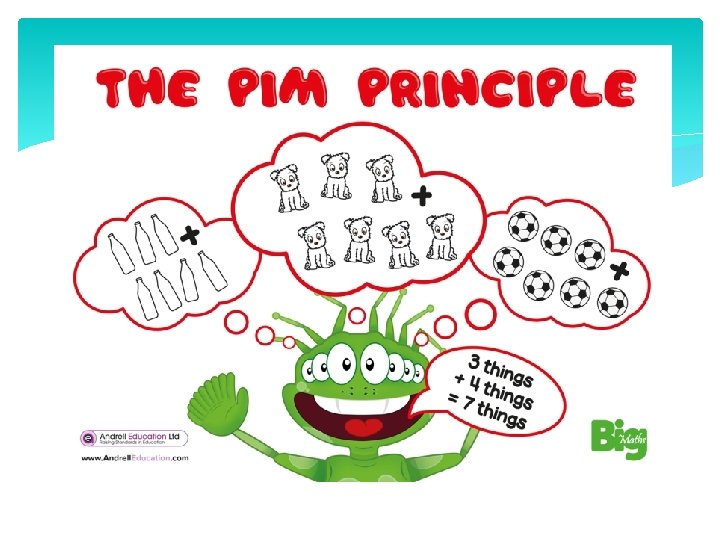
Meet Pim! This friendly alien is PIM, the 'principle of irrelevant matter'! That means that number facts stay the same and it doesn't matter what you are counting: 3+4=7 is true if you are counting dogs, chocolates, metres, boys, girls or teachers!
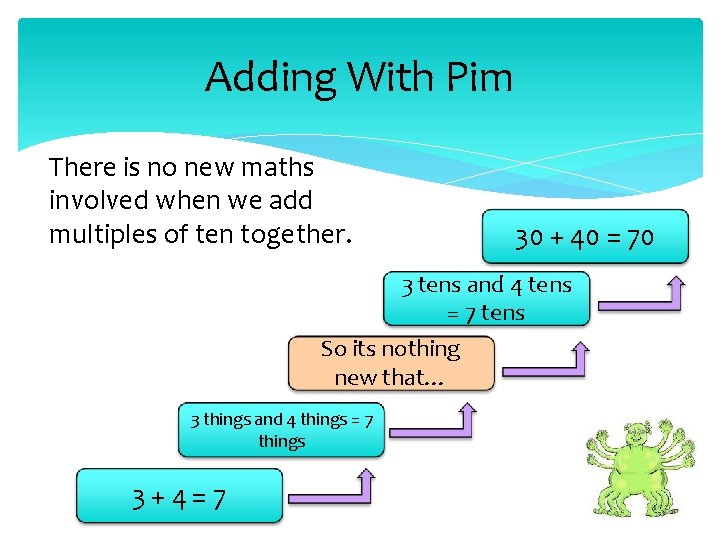
Adding With Pim There is no new maths involved when we add multiples of ten together. 30 + 40 = 70 3 tens and 4 tens = 7 tens So its nothing new that… 3 things and 4 things = 7 things 3+4=7
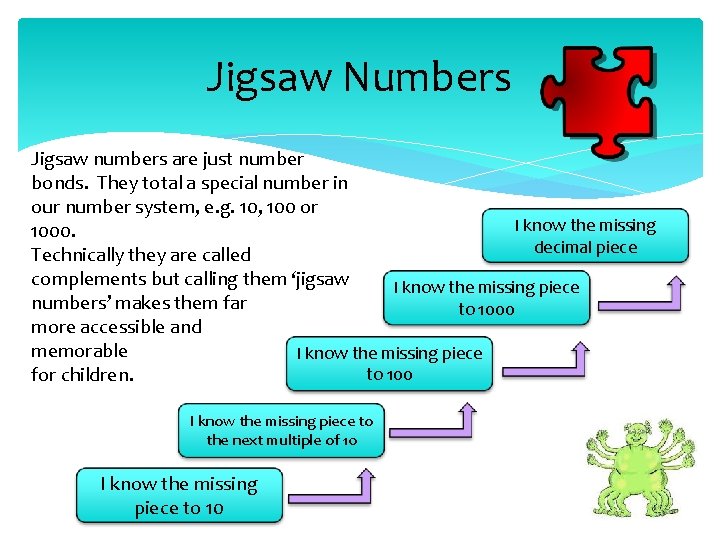
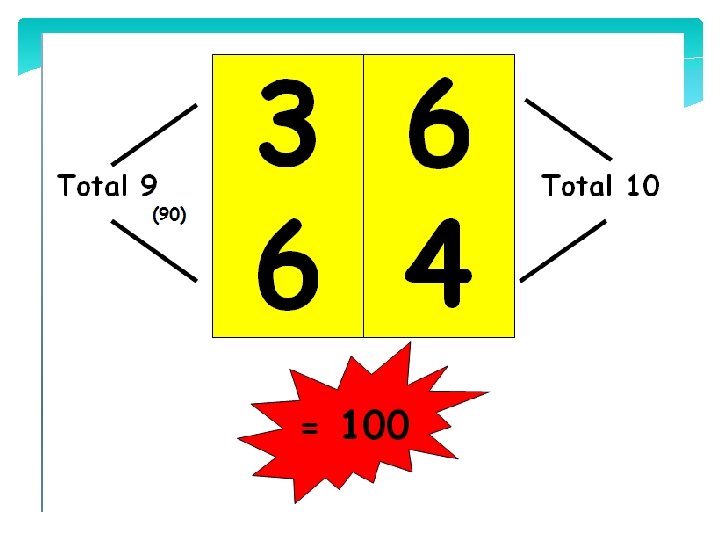
Jigsaw Numbers Jigsaw numbers are just number bonds. They total a special number in our number system, e. g. 10, 100 or I know the missing 1000. decimal piece Technically they are called complements but calling them ‘jigsaw I know the missing piece numbers’ makes them far to 1000 more accessible and memorable I know the missing piece to 100 for children. I know the missing piece to the next multiple of 10 I know the missing piece to 10
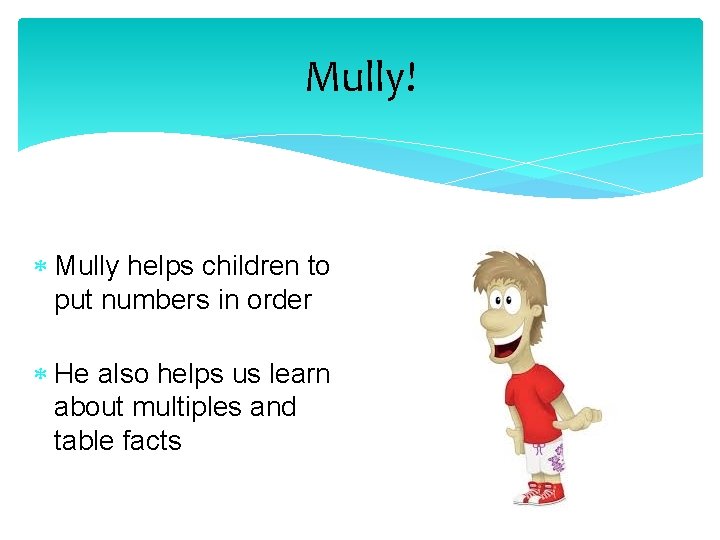
Mully! Mully helps children to put numbers in order He also helps us learn about multiples and table facts
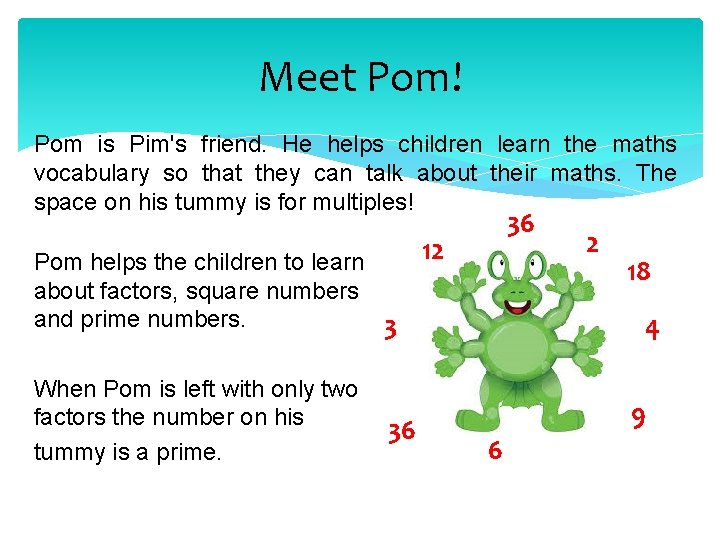
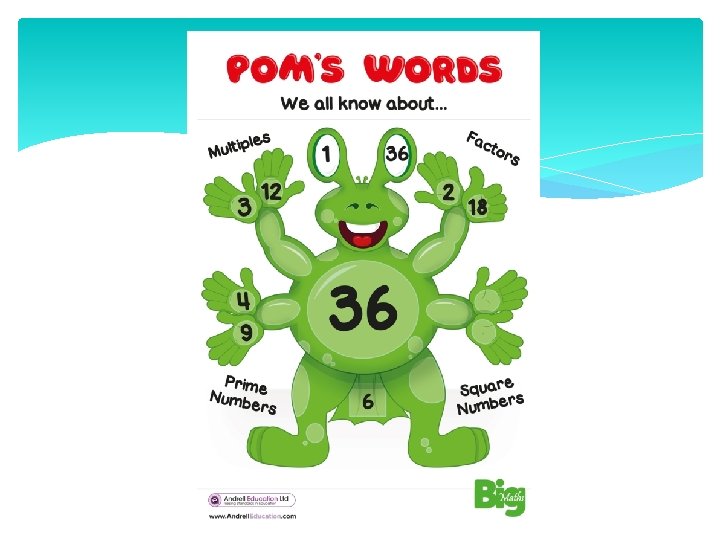
Meet Pom! Pom is Pim's friend. He helps children learn the maths vocabulary so that they can talk about their maths. The space on his tummy is for multiples! Pom helps the children to learn about factors, square numbers and prime numbers. 3 When Pom is left with only two factors the number on his tummy is a prime. 36 36 12 2 18 4 9 6
CLIC Calculations The progression of Counting, Learn Its! and Its Nothing New are consolidated in this part of CLIC.
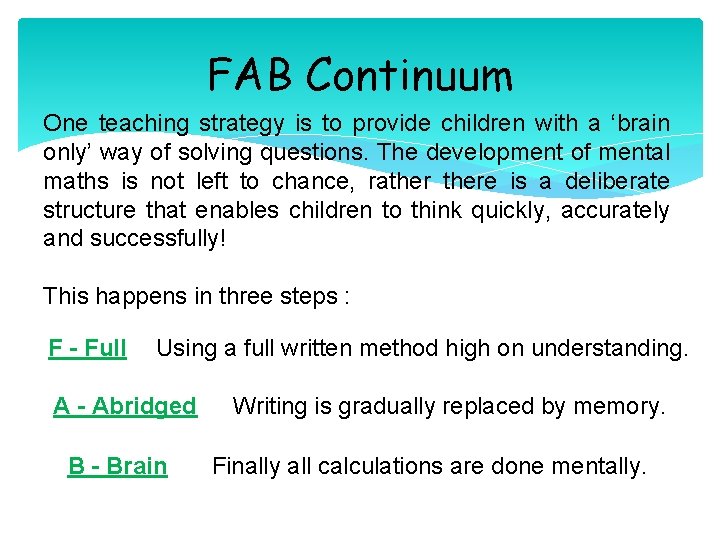
FAB Continuum One teaching strategy is to provide children with a ‘brain only’ way of solving questions. The development of mental maths is not left to chance, rathere is a deliberate structure that enables children to think quickly, accurately and successfully! This happens in three steps : F - Full Using a full written method high on understanding. A - Abridged B - Brain Writing is gradually replaced by memory. Finally all calculations are done mentally.
Super-FAB helps children to hold numbers in their heads, do something else, and then come back to those numbers again. Super-FAB reminds children they are challenged to move along the FAB continuum.
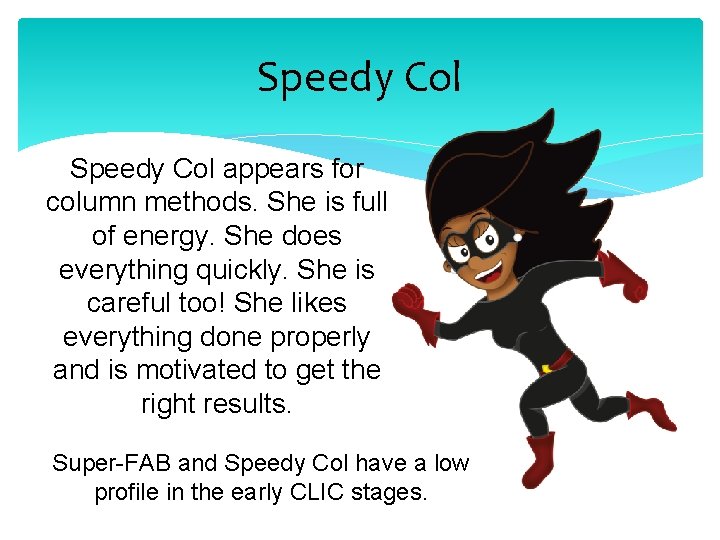
Speedy Col appears for column methods. She is full of energy. She does everything quickly. She is careful too! She likes everything done properly and is motivated to get the right results. Super-FAB and Speedy Col have a low profile in the early CLIC stages.
What will happen on Friday? Fridays will be our Challenge session Big Maths Beat That – timed challenge where children answer ‘Learn Its’ questions. The aim is to beat their previous score or time. CLIC test – A termly assessment used to identify areas to work on and progress made






How can I support my child? Help your child to practice their ‘Learn Its’ at home. These will be in their homework jotters. Ask your child to tell you about Big Maths. Praise! Celebrate the successes. Visit the publishers website: http: //www. andrelleducation. co. uk/courses/numeracy/bigmaths/
Any Questions?
- Slides: 39