
What Is Behavior Behavior Is what an animal
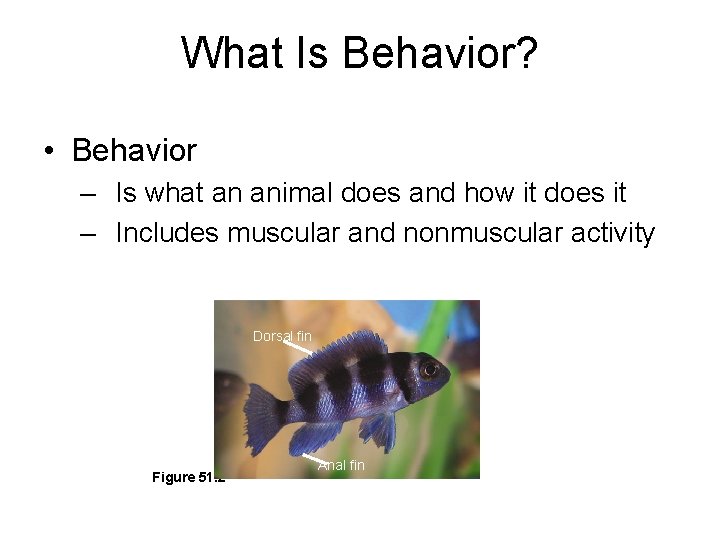
What Is Behavior? • Behavior – Is what an animal does and how it does it – Includes muscular and nonmuscular activity Dorsal fin Figure 51. 2 Anal fin
Fixed Action Patterns • A fixed action pattern (FAP) – Is a sequence of unlearned, innate behaviors that is unchangeable – Once initiated, is usually carried to completion • A FAP is triggered by an external sensory stimulus – Known as a sign stimulus
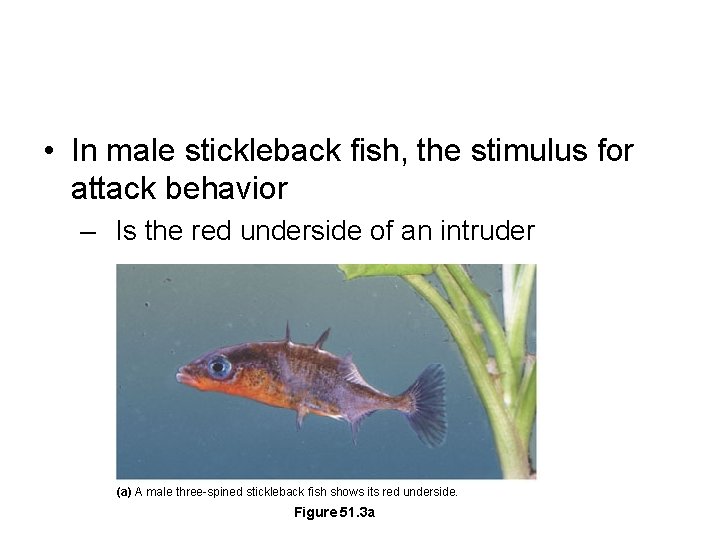
• In male stickleback fish, the stimulus for attack behavior – Is the red underside of an intruder (a) A male three-spined stickleback fish shows its red underside. Figure 51. 3 a
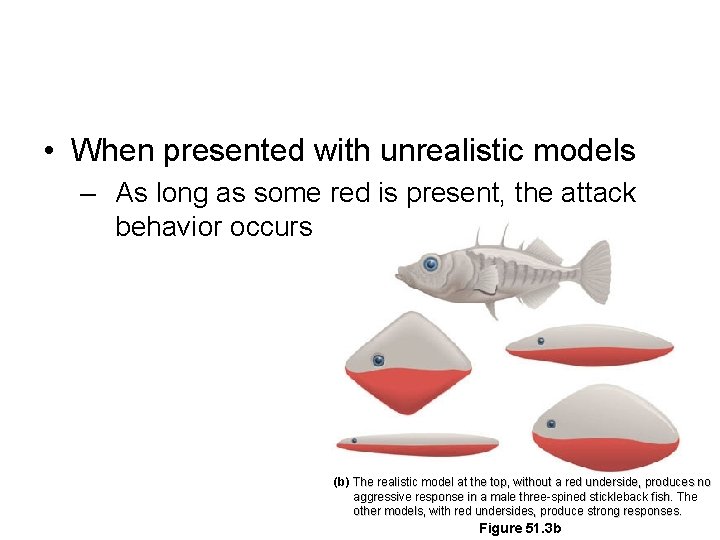
• When presented with unrealistic models – As long as some red is present, the attack behavior occurs (b) The realistic model at the top, without a red underside, produces no aggressive response in a male three-spined stickleback fish. The other models, with red undersides, produce strong responses. Figure 51. 3 b
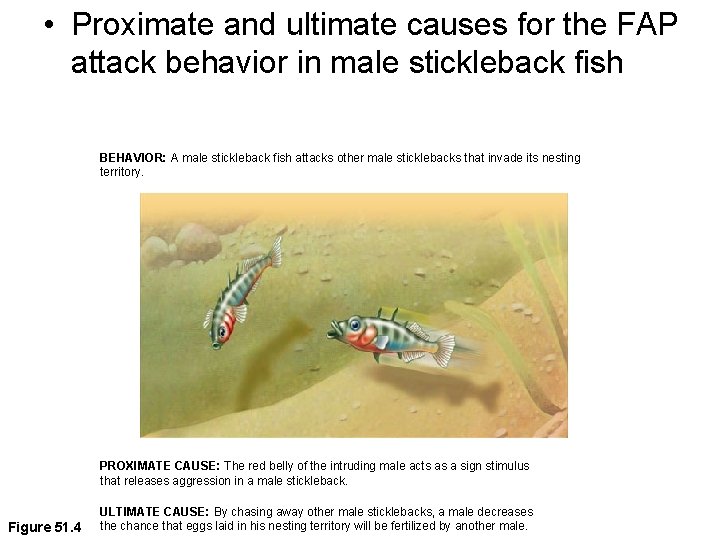
• Proximate and ultimate causes for the FAP attack behavior in male stickleback fish BEHAVIOR: A male stickleback fish attacks other male sticklebacks that invade its nesting territory. PROXIMATE CAUSE: The red belly of the intruding male acts as a sign stimulus that releases aggression in a male stickleback. Figure 51. 4 ULTIMATE CAUSE: By chasing away other male sticklebacks, a male decreases the chance that eggs laid in his nesting territory will be fertilized by another male.
Imprinting • Imprinting is a type of behavior – That includes both learning and innate components and is generally irreversible Imprinting is distinguished from other types of learning by a sensitive period A limited phase in an animal’s development that is the only time when certain behaviors can be learned An example of imprinting is young geese Following their mother
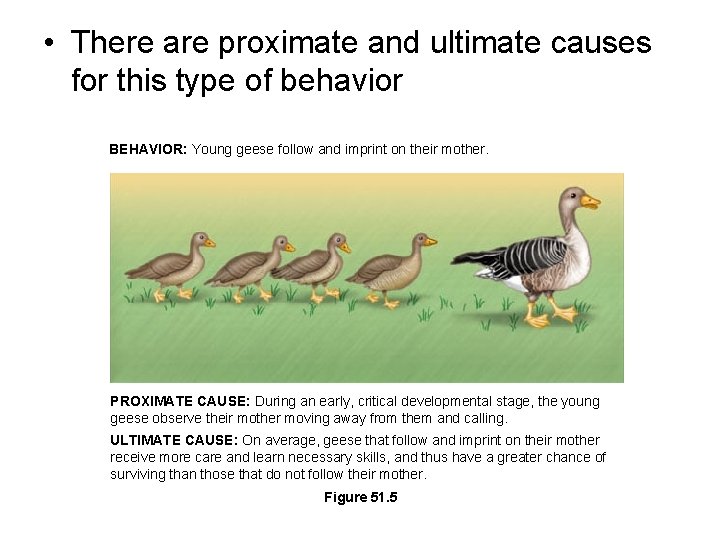
• There are proximate and ultimate causes for this type of behavior BEHAVIOR: Young geese follow and imprint on their mother. PROXIMATE CAUSE: During an early, critical developmental stage, the young geese observe their mother moving away from them and calling. ULTIMATE CAUSE: On average, geese that follow and imprint on their mother receive more care and learn necessary skills, and thus have a greater chance of surviving than those that do not follow their mother. Figure 51. 5
Behavior and Territories • http: //bcs. whfreeman. com/thelifewire/conte nt/chp 53/5302001. html
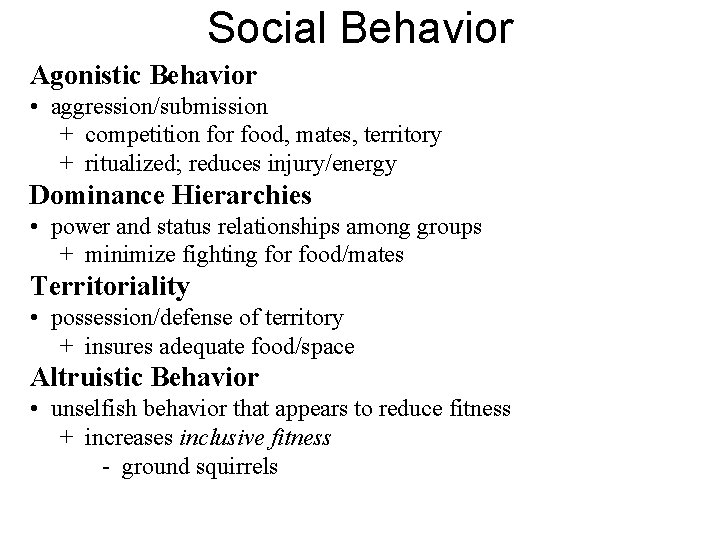
Social Behavior Agonistic Behavior • aggression/submission + competition for food, mates, territory + ritualized; reduces injury/energy Dominance Hierarchies • power and status relationships among groups + minimize fighting for food/mates Territoriality • possession/defense of territory + insures adequate food/space Altruistic Behavior • unselfish behavior that appears to reduce fitness + increases inclusive fitness - ground squirrels
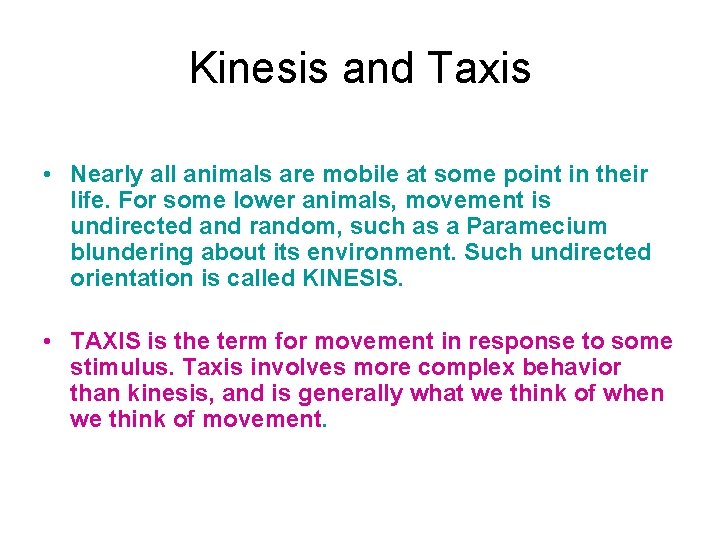
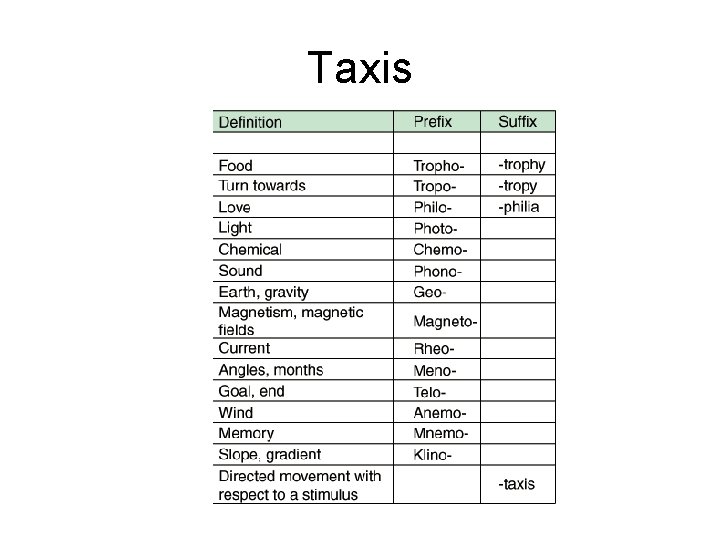
Kinesis and Taxis • Nearly all animals are mobile at some point in their life. For some lower animals, movement is undirected and random, such as a Paramecium blundering about its environment. Such undirected orientation is called KINESIS. • TAXIS is the term for movement in response to some stimulus. Taxis involves more complex behavior than kinesis, and is generally what we think of when we think of movement.
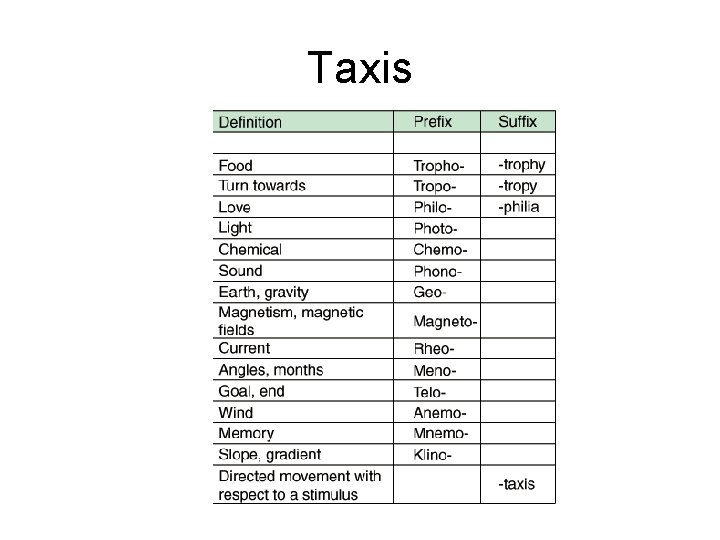
Taxis

Kinesis Animal Movement • undirected change in speed of movement in response to stimulus + speed up in unfavorable; slow down in favorable - light, touch, air temp. , etc. + Avon bug in the bathroom tub Taxis • directed movement in response to stimulus + toward/away from stimulus - phototaxis, chemotaxis + mosquitos and CO 2 Migration • long-distance, seasonal movement + availability of food, degradation of environment - whales, birds, elks, insects, bats
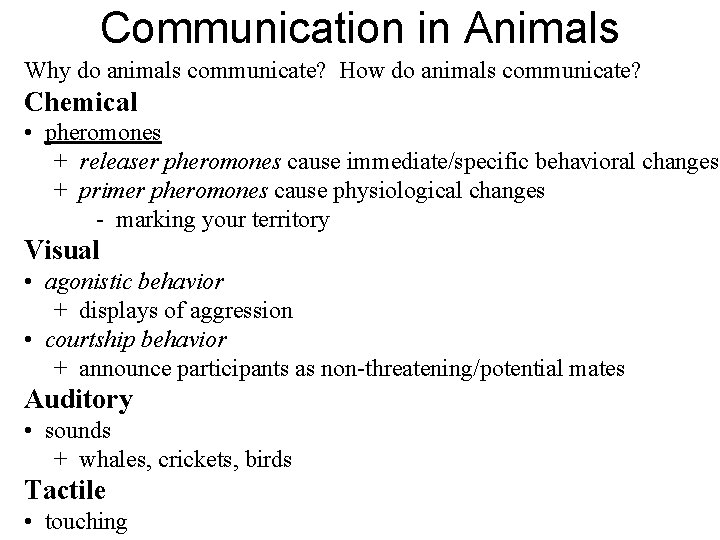
Communication in Animals Why do animals communicate? How do animals communicate? Chemical • pheromones + releaser pheromones cause immediate/specific behavioral changes + primer pheromones cause physiological changes - marking your territory Visual • agonistic behavior + displays of aggression • courtship behavior + announce participants as non-threatening/potential mates Auditory • sounds + whales, crickets, birds Tactile • touching
Learning • Learning is the modification of behavior – Based on specific experiences • Learned behaviors – Range from very simple to very complex
Classic conditioning • http: //vimeo. com/6217895 • What is the Stimulus and Response?
Operant Conditioning • http: //blogs. cornell. edu/gp 08 ha 1115/files/2 010/04/Big-Bang-Theory-OB-21. mp 4
• Operant conditioning is a form of psychological learning where an individual modifies the occurrence and form of its own behavior due to the association of the behavior with a stimulus. • Operant conditioning is distinguished from classical conditioning (also called respondent conditioning) in that operant conditioning deals with the modification of "voluntary behavior" or operant behavior
Take out yellow mini-book and write the following HEADINGS. See Vicktoria! Invasive Species Atmospheric Pollution Habitat Destruction Overexploitation TEST TOMORROW 6 ECOLOGY CHAPTERS
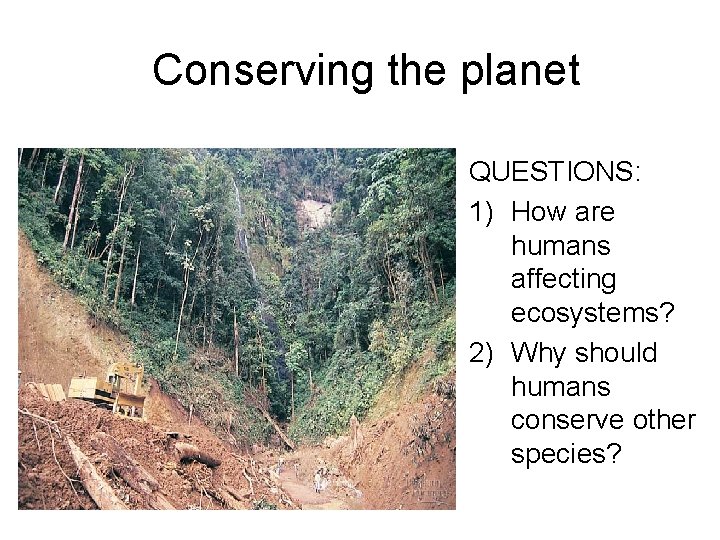
Conserving the planet QUESTIONS: 1) How are humans affecting ecosystems? 2) Why should humans conserve other species?
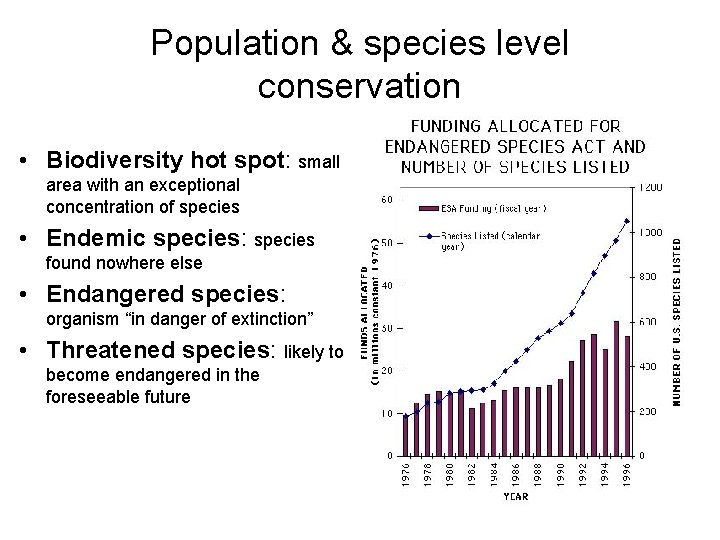
Population & species level conservation • Biodiversity hot spot: small area with an exceptional concentration of species • Endemic species: species found nowhere else • Endangered species: organism “in danger of extinction” • Threatened species: likely to become endangered in the foreseeable future
Biodiversity: Human welfare Why humans should protect other species: • 25% of all medical prescriptions come from plants • Aesthetic and ethical reasons • Ecotourism can provide money • Forests regulate climate
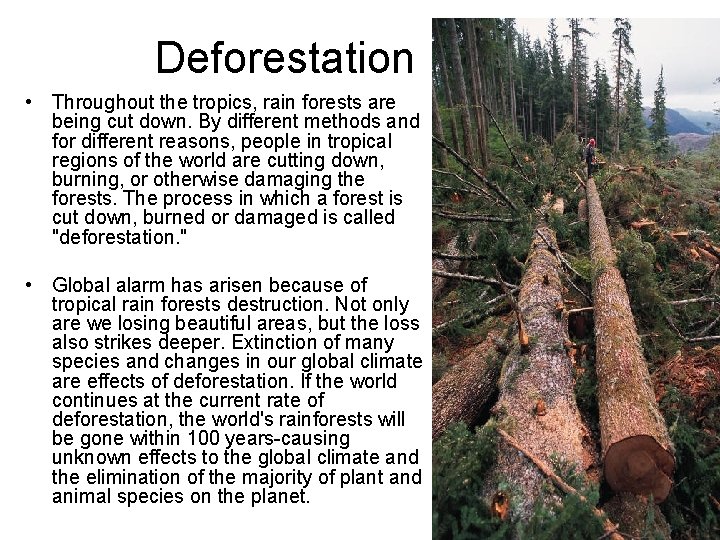
Deforestation • Throughout the tropics, rain forests are being cut down. By different methods and for different reasons, people in tropical regions of the world are cutting down, burning, or otherwise damaging the forests. The process in which a forest is cut down, burned or damaged is called "deforestation. " • Global alarm has arisen because of tropical rain forests destruction. Not only are we losing beautiful areas, but the loss also strikes deeper. Extinction of many species and changes in our global climate are effects of deforestation. If the world continues at the current rate of deforestation, the world's rainforests will be gone within 100 years-causing unknown effects to the global climate and the elimination of the majority of plant and animal species on the planet.
What is the relationship between loss of habitat and loss of species?
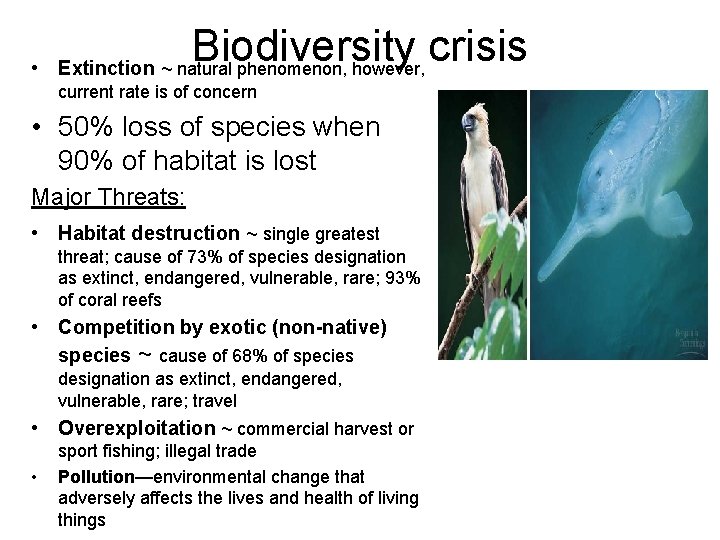
Biodiversity crisis • Extinction ~ natural phenomenon, however, current rate is of concern • 50% loss of species when 90% of habitat is lost Major Threats: • Habitat destruction ~ single greatest threat; cause of 73% of species designation as extinct, endangered, vulnerable, rare; 93% of coral reefs • Competition by exotic (non-native) species ~ cause of 68% of species designation as extinct, endangered, vulnerable, rare; travel • Overexploitation ~ commercial harvest or • sport fishing; illegal trade Pollution—environmental change that adversely affects the lives and health of living things
• Toxins in the Environment Humans release an immense variety of toxic chemicals – Including thousands of synthetics previously unknown to nature • One of the reasons such toxins are so harmful – Is that they become more concentrated in successive trophic levels of a food web
• In some cases, harmful substances – Persist for long periods of time in an ecosystem and continue to cause harm
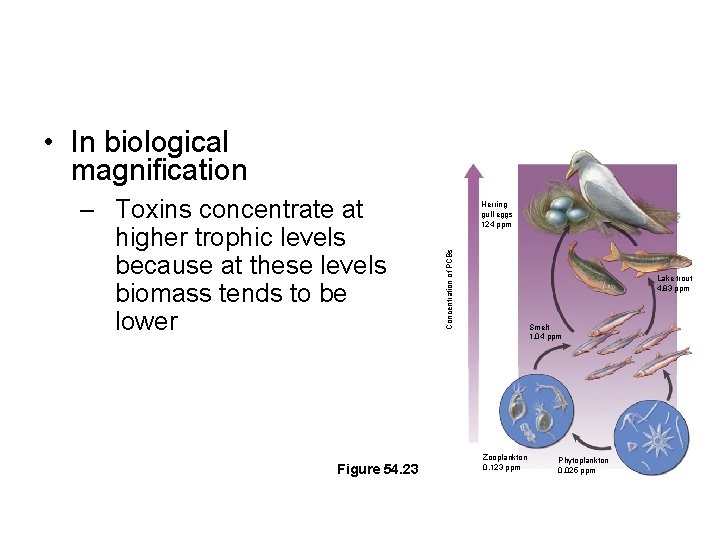
• In biological magnification Figure 54. 23 Herring gull eggs 124 ppm Concentration of PCBs – Toxins concentrate at higher trophic levels because at these levels biomass tends to be lower Lake trout 4. 83 ppm Smelt 1. 04 ppm Zooplankton 0. 123 ppm Phytoplankton 0. 025 ppm
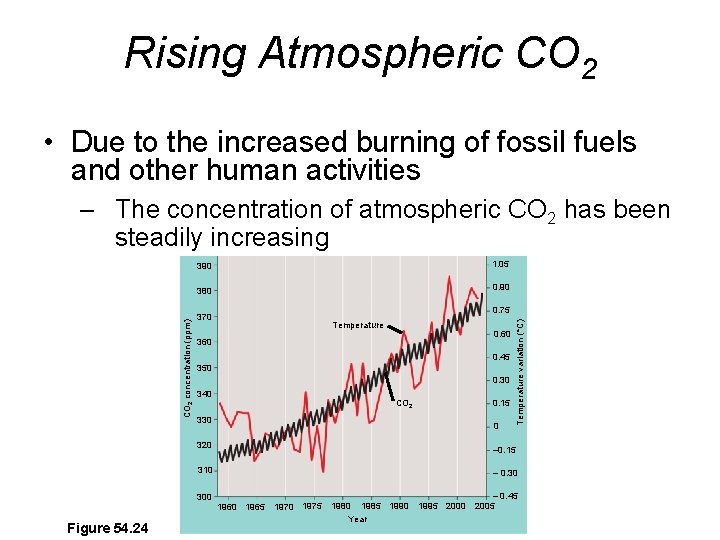
Rising Atmospheric CO 2 • Due to the increased burning of fossil fuels and other human activities 390 1. 05 380 0. 90 Temperature 0. 60 360 0. 45 350 0. 30 340 CO 2 330 0. 15 0 320 0. 15 310 0. 30 300 Figure 54. 24 0. 75 370 Temperature variation ( C) CO 2 concentration (ppm) – The concentration of atmospheric CO 2 has been steadily increasing 1960 1965 1970 1975 0. 45 1980 1985 1990 1995 2000 2005 Year
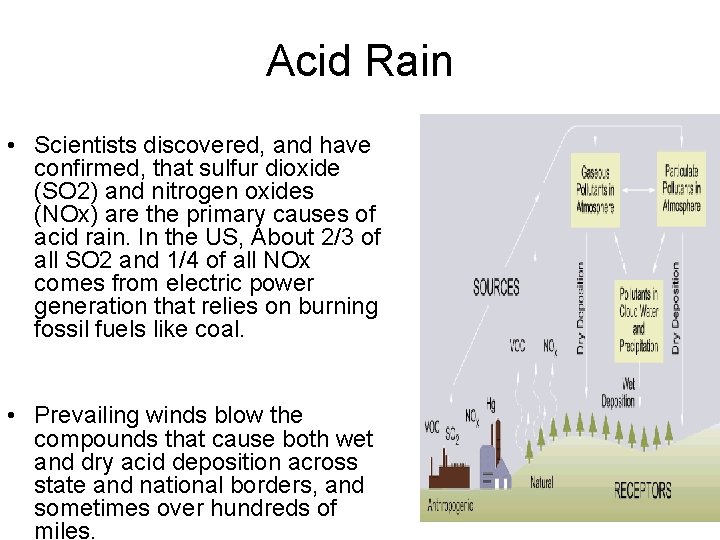
Acid Rain • Scientists discovered, and have confirmed, that sulfur dioxide (SO 2) and nitrogen oxides (NOx) are the primary causes of acid rain. In the US, About 2/3 of all SO 2 and 1/4 of all NOx comes from electric power generation that relies on burning fossil fuels like coal. • Prevailing winds blow the compounds that cause both wet and dry acid deposition across state and national borders, and sometimes over hundreds of miles.
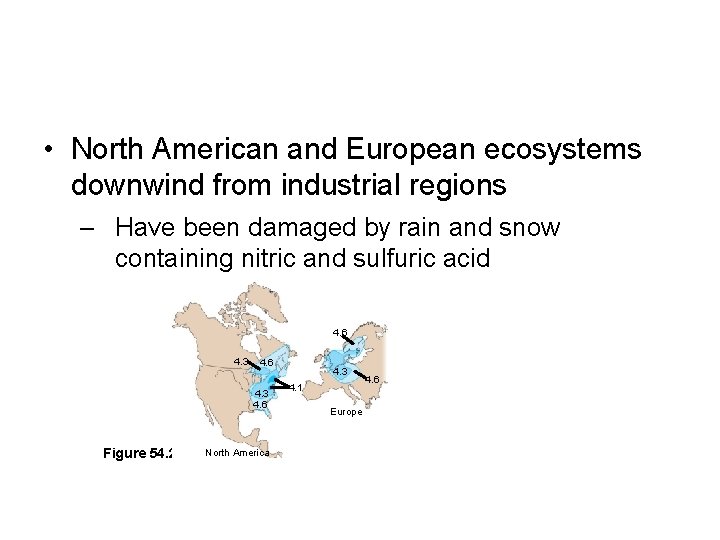
• North American and European ecosystems downwind from industrial regions – Have been damaged by rain and snow containing nitric and sulfuric acid 4. 6 4. 3 4. 6 Figure 54. 21 North America 4. 3 4. 1 Europe 4. 6
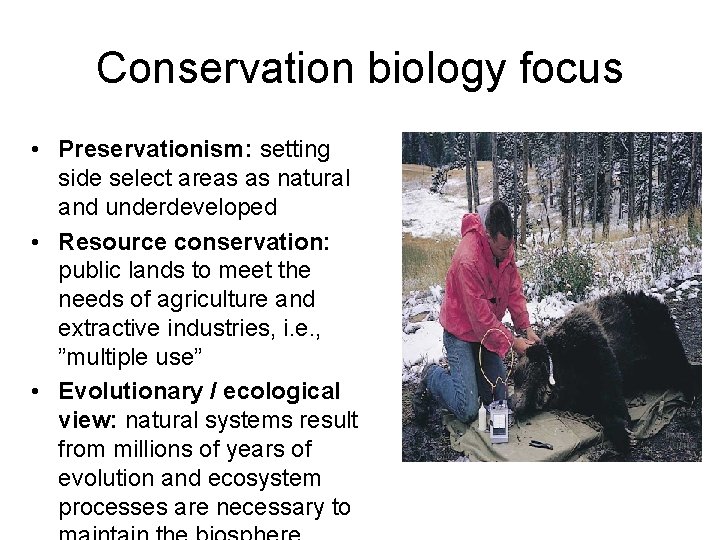
Conservation biology focus • Preservationism: setting side select areas as natural and underdeveloped • Resource conservation: public lands to meet the needs of agriculture and extractive industries, i. e. , ”multiple use” • Evolutionary / ecological view: natural systems result from millions of years of evolution and ecosystem processes are necessary to
Taxis
- Slides: 32