
What is Applied Behavioral Analysis ABA and How
What is Applied Behavioral Analysis (ABA) and How it is Applied Richard M. Foxx, Ph. D.
1
Science builds consensus because the nature of its proofs makes dissent so difficult. The path to consensus via science is rarely straight; it can take years to achieve and the battles can be bloody. But eventually, the accumulation of evidence is hard, even impossible to ignore (Finn and Martin, 2007) 2
Science Ø Direct testing of questions and hypotheses. Ø Operational definitions. Ø Measurement — direct, accurate, reliable, objective. Ø Controlled experiments to rule out alternative explanations. Ø Conclusions, implications, predictions based on data. Ø Replication is paramount. 3
ABA and the Treatment of Autism: The Evidence Ø 40 years of success with individuals of all ages. Ø 45 years of success treating children. Ø More than 1, 000 peer-reviewed, scientific articles reporting success. Ø Over 40 years of NIMH funding of Applied Behavioral Analysis (ABA) research. Ø Agencies have been using ABA as the dominate intervention for more than 30 years, providing nonresidential and residential education/treatment for thousands of children. Ø All individuals benefit. 4
ABA and the Treatment of Autism: The Evidence Ø Only educational/treatment approach supported by the state of New York Health Department (1999) and the United States surgeon general (1999). Ø Meets the areas of agreement for effective intervention in autism. Ø No other treatment/educational approach meets the same standards of scientific proof. Ø No other treatment/educational approach produces similar clinical outcomes. 5
ABA and the Treatment of Autism: The Evidence Ø Competency requirement guidelines for delivery of ABA services are well established (ABA-International Autism Special Interest Group). Ø Levels of certification of ABA practitioners have been in existence since 1999 (Behavior Analyst Certification Board). Ø Investing in early intervention ABA is financially worthwhile, whether the results lead to complete or partial effects (Jacobson, Mulick and Green, 1998). 6
Eclecticism is not the Best approach to the Treatment of Children with Autism Ø The eclectic practitioner is often an apprentice of many models but master of none (Heward, 2003). Ø A little bit of everything and a lot of nothing often reduces eclecticism to a recipe for failure (Kauffman, 1997). Ø Adding ineffective treatment(s) to an effective one may be detrimental (Smith 2005). 7
Eclecticism is not the Best approach to the Treatment of Children with Autism Ø The more models represented, the greater the likelihood of including ineffective and possibly harmful components. Ø The most important and effective parts of each model might not be selected. Ø Some components of a model may be ineffective when implemented in isolation. Ø Elements from different models may be incompatible. Ø An eclectic mix might prevent any model from being implemented continuously or intensively enough to obtain significant effects. 8
The Science of ABA Interventions Ø Developed in the laboratory. Ø Derived from learning principles. Ø Systematically applied. Ø Geared to create or improve socially significant behavior. Ø Geared to decrease or eliminate maladaptive behavior. Ø Require experimental demonstrations proving responsibility for the improvement in behavior. 9
Components of Comprehensive ABA Program Ø Individualized behavior assessment and goal selection. Ø Behaviors assessed in all domains, gross motor skills, selfhelp, independence, receptive language, expressive language; nonproductive behaviors that interfere with learning. Ø Updated on continual basis. Ø Goals selected by parents, therapists, and other professionals. 10
Components of Comprehensive ABA Program Ø Operational definitions, measurement procedures, generalization and maintenance of treatment effects. Ø Data collection on every program. Ø Major emphasis on accountability. 11
Model THE ABA CONSULTANT MODEL Applying ABA to BHRS services in PA in a comprehensive approach. 12
Dr. Foxx Ø Contacted by Perform. Care to address the needs of “at risk” children and adolescents by: Ø Facilitating the transition back home from a hospital or residential setting. Ø Preventing a placement into a hospital or residential setting. Ø Addressing family crises that arise from behavioral concerns. Ø Makes initial assessment. Ø Assigns behavior analyst as consultant. Ø Oversees treatment decisions and progress. 13
ABA Consultants: The Many Hats We Wear Ø Gather information and set goals. Ø Collaborate with multiple systems across several organizational levels. Ø Advocate for the family regarding services. Ø Design treatment protocols, teaching strategies, and data collection systems. Ø Train others. Ø Fade involvement. 14
Families Ø The X factor: The buck stops here. Ø Applying the scientific approach to family dynamics without losing compassion. Ø Social skills are essential for a good consultant. 15
Providers Ø Administrators and supervisors. Ø Behavioral Specialist Consultants. Ø Therapists. Ø Therapeutic Staff Support. 16
School Systems Ø Department of Public Education. Ø School districts. Ø Special education: Ø The teacher. Ø The aide. Ø The therapist. 17
Private Facilities Ø Private schools. Ø Hospitals. Ø Residential facilities. Ø Private therapists and consultants. 18
When the Rubber Hits the Road… Ø Cooperation vs. suspicion. – Cooperation: • Severe behavior breeds a desire to accept help. • Various agencies are more likely to collaborate. – Suspicion: • Previous therapeutic failure/inertia creates suspicion. • Authorities within agencies can be hesitant regarding outside consultants. 19
Perform. Care Cases Examples of the successful treatment of severe behavior. 20
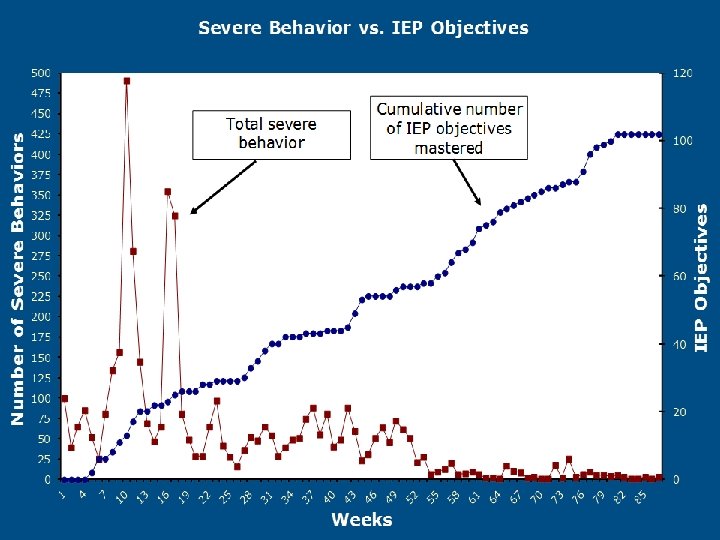
Severe Behavior and IEP Objectives 21
Caveats Ø Don’t rush in to prove yourself. Ø Look for an adult in the room or at the table. Ø Pick your battles. Ø Recognize you work for an organization and owe the organization your loyalty but keep one foot in and one foot out. Ø Make a simple change that produces an observable outcome. 22
Caveats Ø Recognize that your heart will be broken. Ø The nice thing about telling the truth is you don’t have to remember what you said. Ø Most people care and want to do a good job. Ø Sleeping dogs will bite you. Ø Walk in others’ moccasins. Ø It doesn’t matter how good you are if you have bad social skills. 23
Caveats Ø Reinforcement applies to typical adults. Ø Don’t exceed your skill level. Ø Less is more. Ø Avoid recipes. Ø Programming: 10% is knowing what to do; 90% is getting people to do it. Ø Programming: No one conducts it for very long if it is not working. 24
Caveats Ø Extinction – Easy to recommend; hard to do. Ø Active programming is like playing chess. Ø Changing behavior is like a pas de deux. Ø How useful you are must outweigh how annoying you are. Ø Success truly does breed success. 25
Caveats Ø How to know parents are happy with you and your handling of their child’s case: Ø They become more realistic in their expectations because they know there will always be progress. Ø Meetings don’t last more than one hour. Ø Other staff are more relaxed around them. Ø The ITPS process begins to work as it was originally intended. 26
Caveats Ø How to know parents are happy with you and your handling of their child’s case: – They get to act like parents. – They focus on very minor concerns because the big ones are being taken care of. – They don’t act suspicious. – They become selective as to when they contact you. – Their family begins having more of a life. 27
Thank You
- Slides: 29