
What is ANOVA and Why do we use


- Slides: 6
What is ANOVA and Why do we use it?
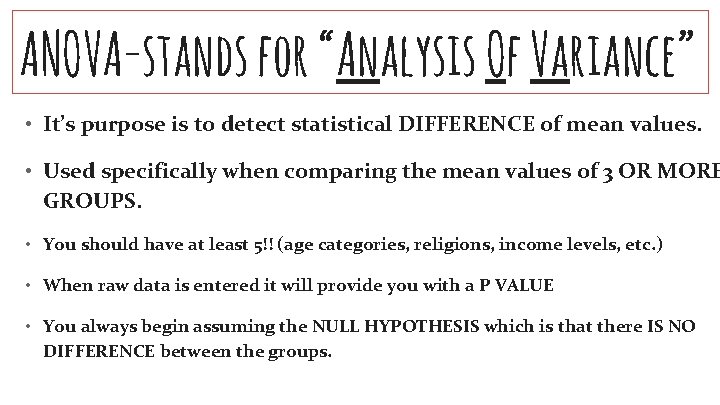
ANOVA-stands for “Analysis Of Variance” • It’s purpose is to detect statistical DIFFERENCE of mean values. • Used specifically when comparing the mean values of 3 OR MORE GROUPS. • You should have at least 5!! (age categories, religions, income levels, etc. ) • When raw data is entered it will provide you with a P VALUE • You always begin assuming the NULL HYPOTHESIS which is that there IS NO DIFFERENCE between the groups.
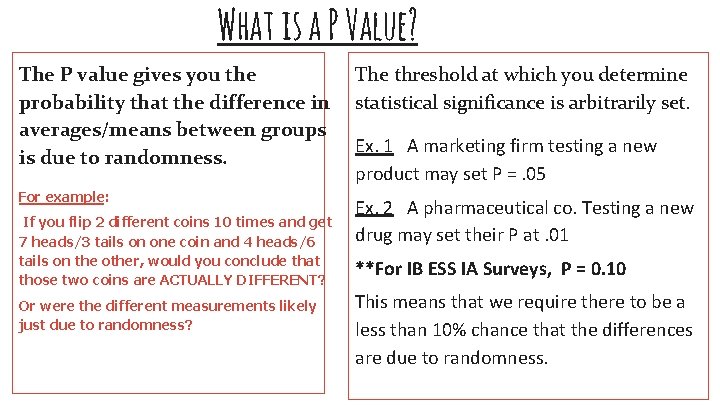
What is a P Value? The P value gives you the probability that the difference in averages/means between groups is due to randomness. The threshold at which you determine statistical significance is arbitrarily set. For example: Ex. 2 A pharmaceutical co. Testing a new drug may set their P at. 01 If you flip 2 different coins 10 times and get 7 heads/3 tails on one coin and 4 heads/6 tails on the other, would you conclude that those two coins are ACTUALLY DIFFERENT? Or were the different measurements likely just due to randomness? Ex. 1 A marketing firm testing a new product may set P =. 05 **For IB ESS IA Surveys, P = 0. 10 This means that we require there to be a less than 10% chance that the differences are due to randomness.
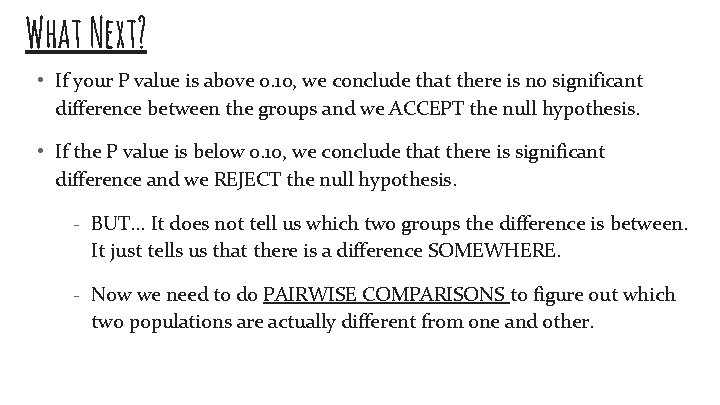
What Next? • If your P value is above 0. 10, we conclude that there is no significant difference between the groups and we ACCEPT the null hypothesis. • If the P value is below 0. 10, we conclude that there is significant difference and we REJECT the null hypothesis. - BUT. . . It does not tell us which two groups the difference is between. It just tells us that there is a difference SOMEWHERE. - Now we need to do PAIRWISE COMPARISONS to figure out which two populations are actually different from one and other.
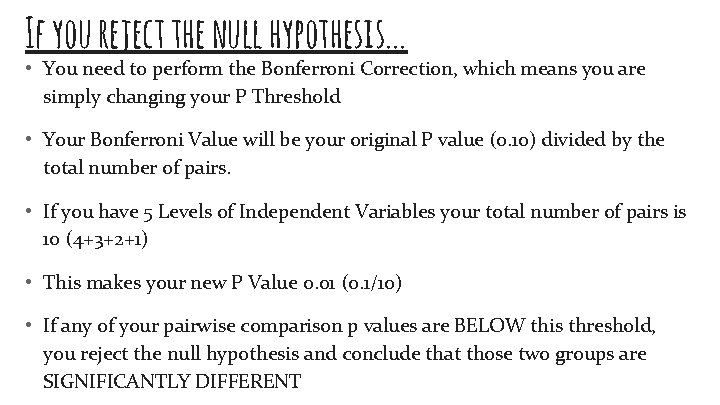
If you reject the null hypothesis. . . • You need to perform the Bonferroni Correction, which means you are simply changing your P Threshold • Your Bonferroni Value will be your original P value (0. 10) divided by the total number of pairs. • If you have 5 Levels of Independent Variables your total number of pairs is 10 (4+3+2+1) • This makes your new P Value 0. 01 (0. 1/10) • If any of your pairwise comparison p values are BELOW this threshold, you reject the null hypothesis and conclude that those two groups are SIGNIFICANTLY DIFFERENT
One-Way ANOVA Analysis Tutorial for Google Sheets http: //www. youtube. com/watch? v=Fc. O 4 KJg. Rcpo&t=239 s