
What is an IP address Every machine on




- Slides: 41
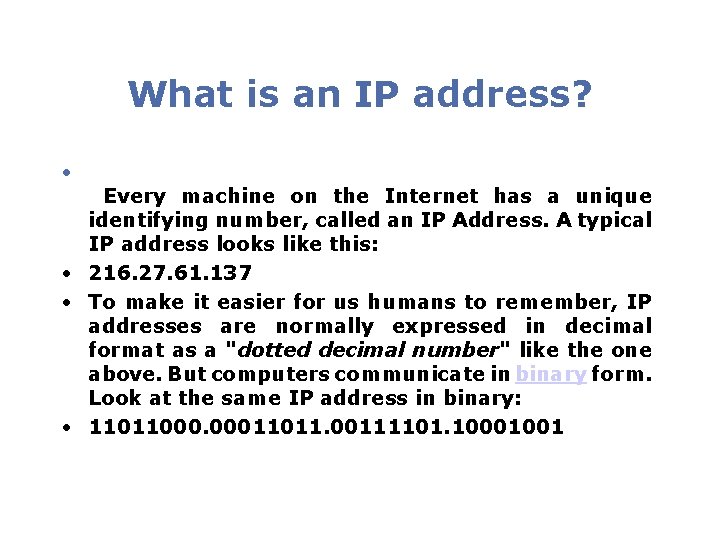
What is an IP address? • Every machine on the Internet has a unique identifying number, called an IP Address. A typical IP address looks like this: • 216. 27. 61. 137 • To make it easier for us humans to remember, IP addresses are normally expressed in decimal format as a "dotted decimal number" like the one above. But computers communicate in binary form. Look at the same IP address in binary: • 11011000. 00011011. 00111101. 10001001
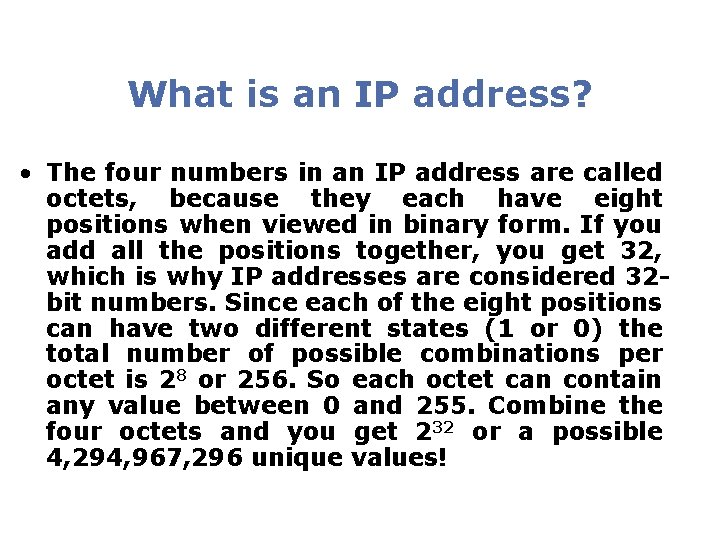
What is an IP address? • The four numbers in an IP address are called octets, because they each have eight positions when viewed in binary form. If you add all the positions together, you get 32, which is why IP addresses are considered 32 bit numbers. Since each of the eight positions can have two different states (1 or 0) the total number of possible combinations per octet is 28 or 256. So each octet can contain any value between 0 and 255. Combine the four octets and you get 232 or a possible 4, 294, 967, 296 unique values!
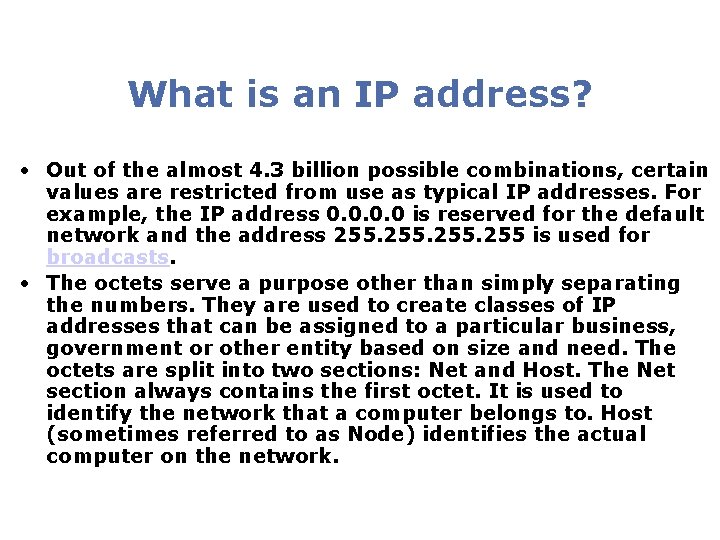
What is an IP address? • Out of the almost 4. 3 billion possible combinations, certain values are restricted from use as typical IP addresses. For example, the IP address 0. 0 is reserved for the default network and the address 255 is used for broadcasts. • The octets serve a purpose other than simply separating the numbers. They are used to create classes of IP addresses that can be assigned to a particular business, government or other entity based on size and need. The octets are split into two sections: Net and Host. The Net section always contains the first octet. It is used to identify the network that a computer belongs to. Host (sometimes referred to as Node) identifies the actual computer on the network.
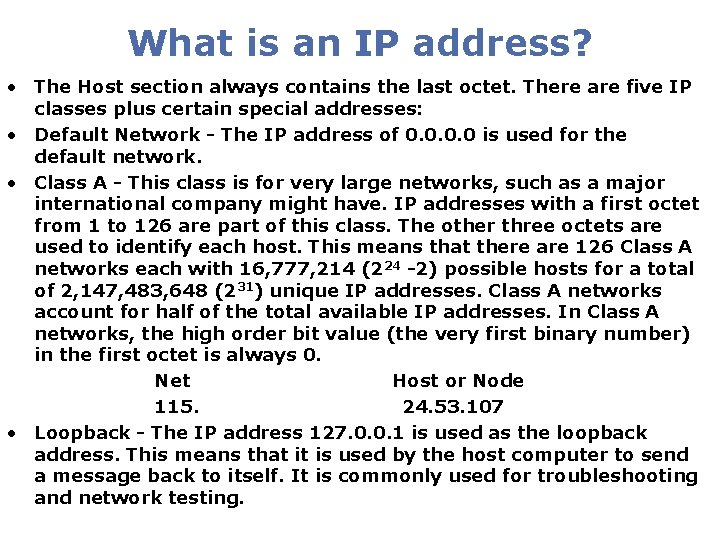
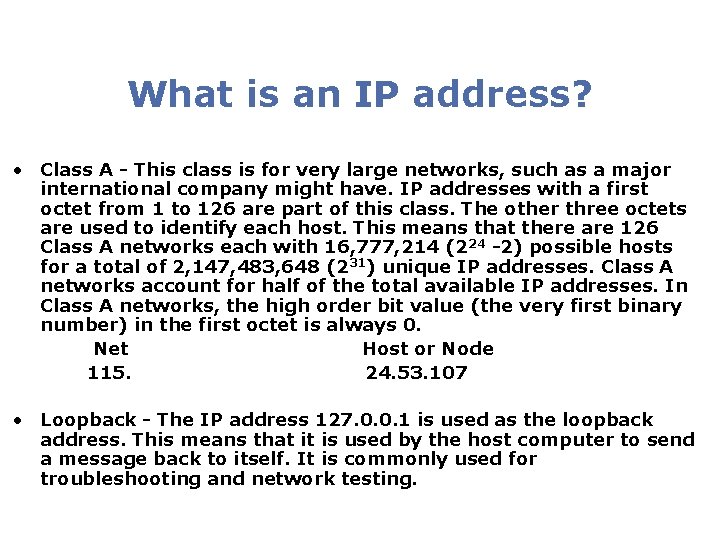
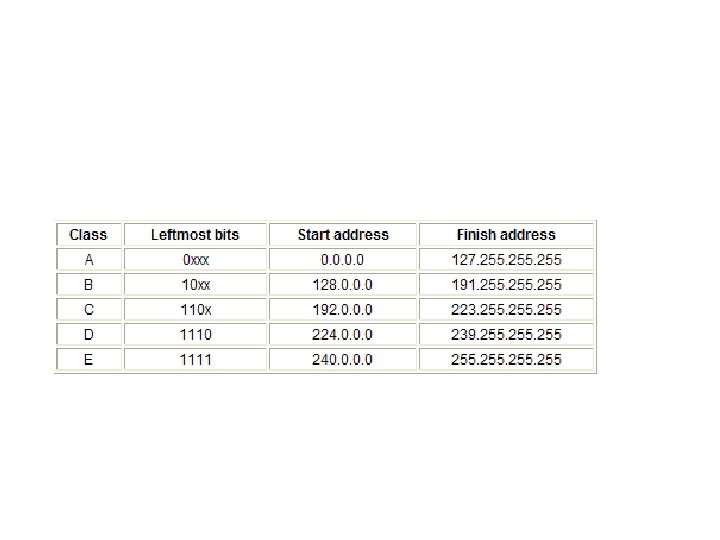
What is an IP address? • The Host section always contains the last octet. There are five IP classes plus certain special addresses: • Default Network - The IP address of 0. 0 is used for the default network. • Class A - This class is for very large networks, such as a major international company might have. IP addresses with a first octet from 1 to 126 are part of this class. The other three octets are used to identify each host. This means that there are 126 Class A networks each with 16, 777, 214 (224 -2) possible hosts for a total of 2, 147, 483, 648 (231) unique IP addresses. Class A networks account for half of the total available IP addresses. In Class A networks, the high order bit value (the very first binary number) in the first octet is always 0. Net Host or Node 115. 24. 53. 107 • Loopback - The IP address 127. 0. 0. 1 is used as the loopback address. This means that it is used by the host computer to send a message back to itself. It is commonly used for troubleshooting and network testing.
What is an IP address? • Class A - This class is for very large networks, such as a major international company might have. IP addresses with a first octet from 1 to 126 are part of this class. The other three octets are used to identify each host. This means that there are 126 Class A networks each with 16, 777, 214 (224 -2) possible hosts for a total of 2, 147, 483, 648 (231) unique IP addresses. Class A networks account for half of the total available IP addresses. In Class A networks, the high order bit value (the very first binary number) in the first octet is always 0. Net Host or Node 115. 24. 53. 107 • Loopback - The IP address 127. 0. 0. 1 is used as the loopback address. This means that it is used by the host computer to send a message back to itself. It is commonly used for troubleshooting and network testing.
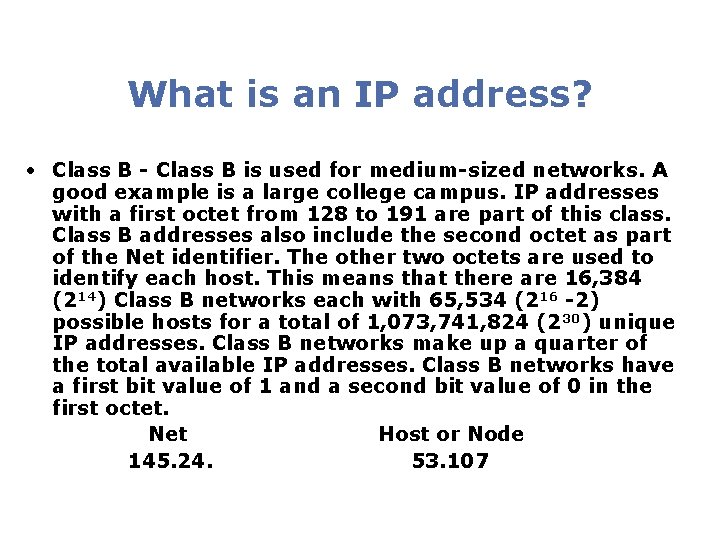
What is an IP address? • Class B - Class B is used for medium-sized networks. A good example is a large college campus. IP addresses with a first octet from 128 to 191 are part of this class. Class B addresses also include the second octet as part of the Net identifier. The other two octets are used to identify each host. This means that there are 16, 384 (214) Class B networks each with 65, 534 (216 -2) possible hosts for a total of 1, 073, 741, 824 (230) unique IP addresses. Class B networks make up a quarter of the total available IP addresses. Class B networks have a first bit value of 1 and a second bit value of 0 in the first octet. Net Host or Node 145. 24. 53. 107
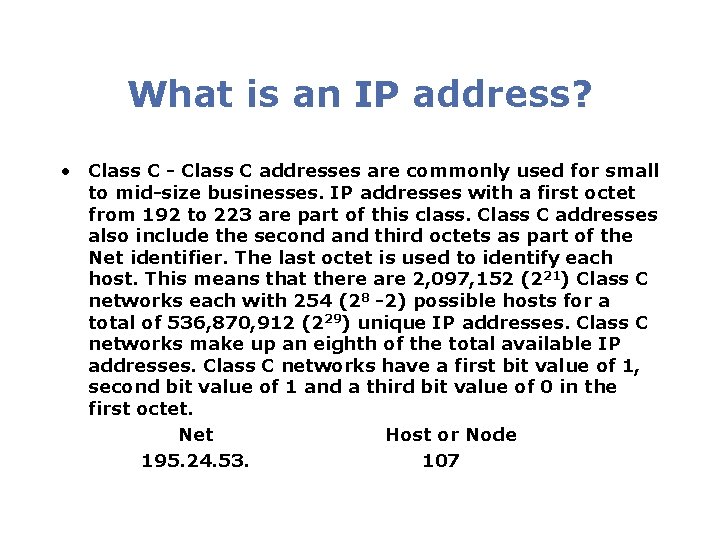
What is an IP address? • Class C - Class C addresses are commonly used for small to mid-size businesses. IP addresses with a first octet from 192 to 223 are part of this class. Class C addresses also include the second and third octets as part of the Net identifier. The last octet is used to identify each host. This means that there are 2, 097, 152 (221) Class C networks each with 254 (28 -2) possible hosts for a total of 536, 870, 912 (229) unique IP addresses. Class C networks make up an eighth of the total available IP addresses. Class C networks have a first bit value of 1, second bit value of 1 and a third bit value of 0 in the first octet. Net Host or Node 195. 24. 53. 107
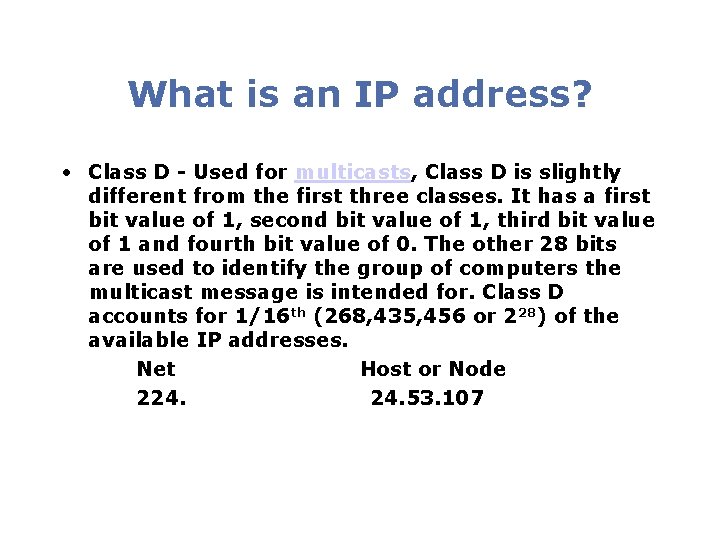
What is an IP address? • Class D - Used for multicasts, Class D is slightly different from the first three classes. It has a first bit value of 1, second bit value of 1, third bit value of 1 and fourth bit value of 0. The other 28 bits are used to identify the group of computers the multicast message is intended for. Class D accounts for 1/16 th (268, 435, 456 or 228) of the available IP addresses. Net Host or Node 224. 53. 107
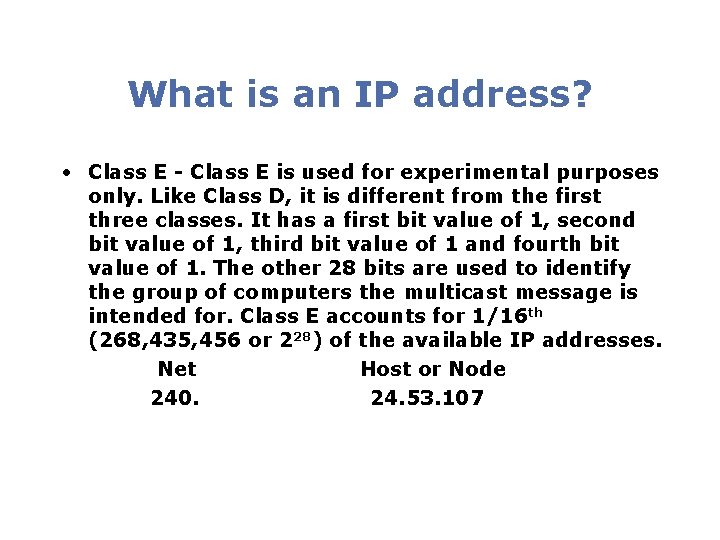
What is an IP address? • Class E - Class E is used for experimental purposes only. Like Class D, it is different from the first three classes. It has a first bit value of 1, second bit value of 1, third bit value of 1 and fourth bit value of 1. The other 28 bits are used to identify the group of computers the multicast message is intended for. Class E accounts for 1/16 th (268, 435, 456 or 228) of the available IP addresses. Net Host or Node 240. 24. 53. 107
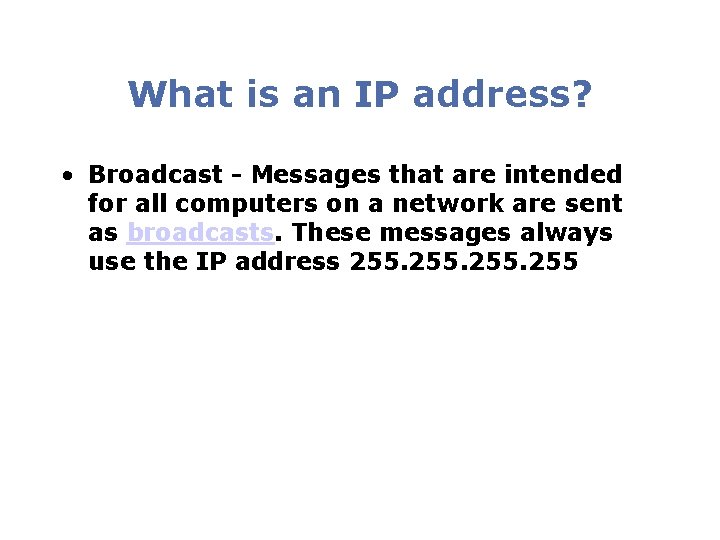
What is an IP address? • Broadcast - Messages that are intended for all computers on a network are sent as broadcasts. These messages always use the IP address 255
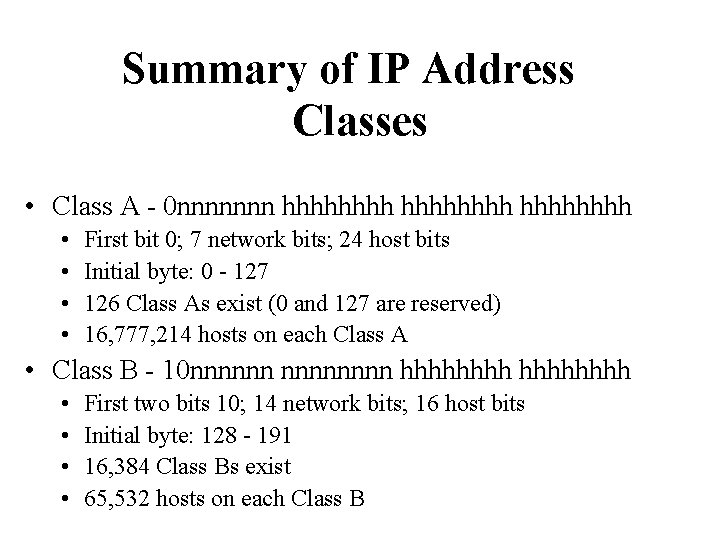
Summary of IP Address Classes • Class A - 0 nnnnnnn hhhhhhhh • • First bit 0; 7 network bits; 24 host bits Initial byte: 0 - 127 126 Class As exist (0 and 127 are reserved) 16, 777, 214 hosts on each Class A • Class B - 10 nnnnnn hhhhhhhh • • First two bits 10; 14 network bits; 16 host bits Initial byte: 128 - 191 16, 384 Class Bs exist 65, 532 hosts on each Class B
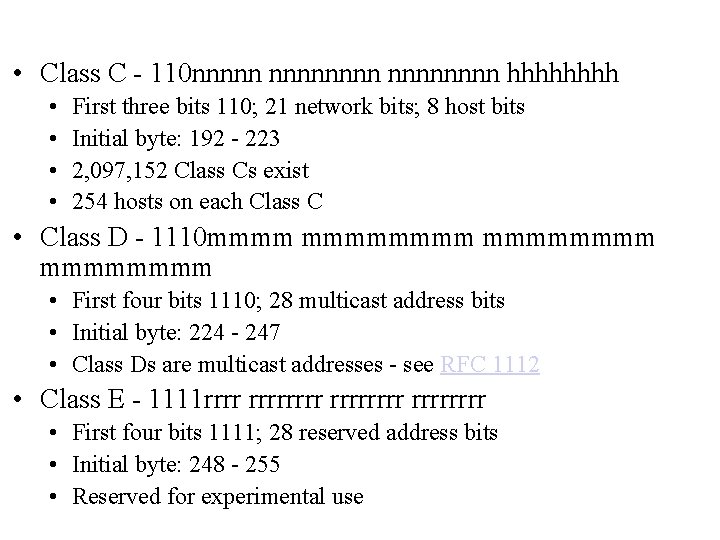
• Class C - 110 nnnnnnnn hhhh • • First three bits 110; 21 network bits; 8 host bits Initial byte: 192 - 223 2, 097, 152 Class Cs exist 254 hosts on each Class C • Class D - 1110 mmmmmmmm • First four bits 1110; 28 multicast address bits • Initial byte: 224 - 247 • Class Ds are multicast addresses - see RFC 1112 • Class E - 1111 rrrrrrrr • First four bits 1111; 28 reserved address bits • Initial byte: 248 - 255 • Reserved for experimental use
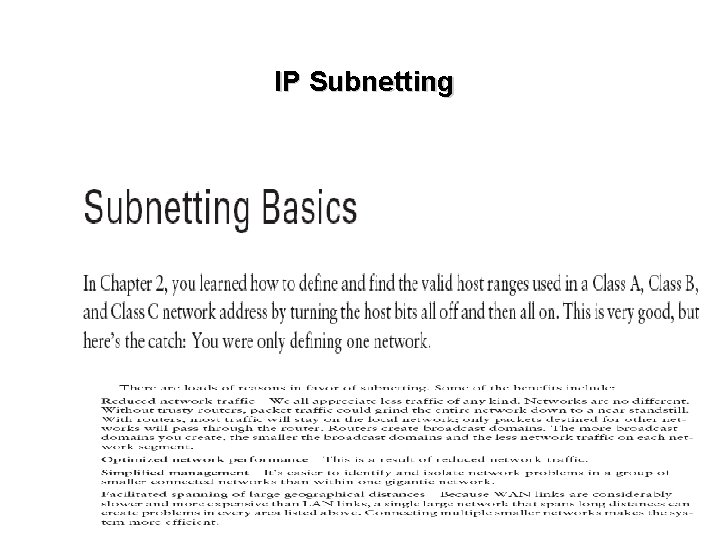
IP Subnetting
Benefits of Subnetting
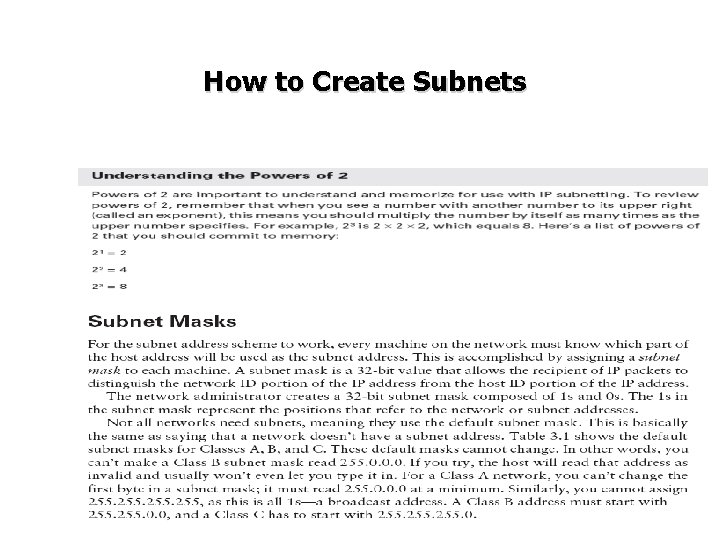
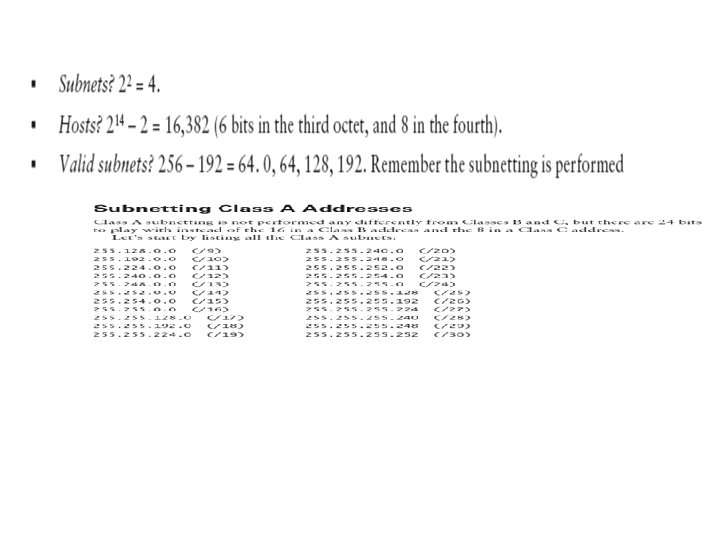
How to Create Subnets
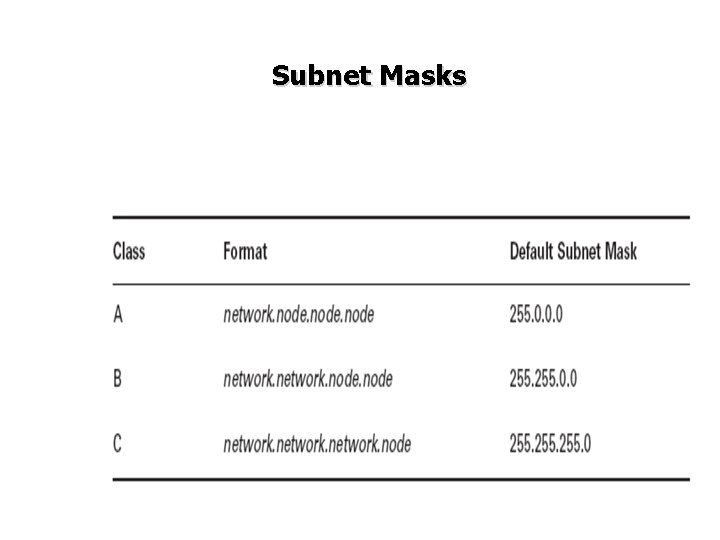
Subnet Masks
IP address Classes
CIDR
1111. 10000000
11111111. 11000000 2^6 = 64
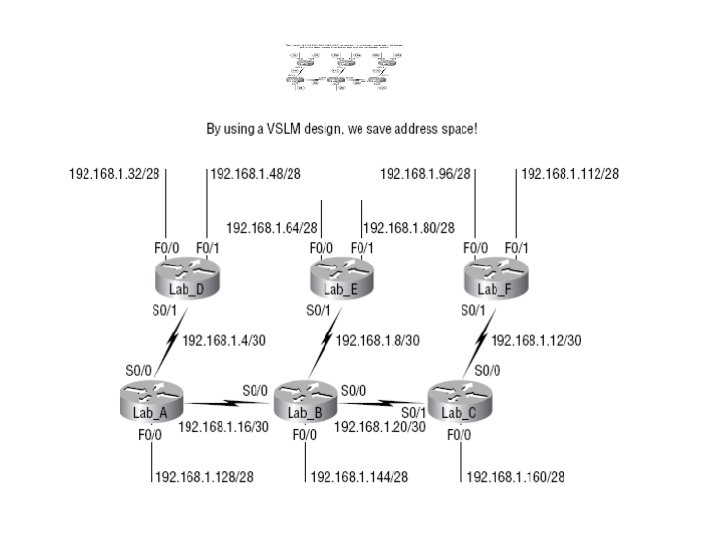
VLSMs
Router Summarization
The End
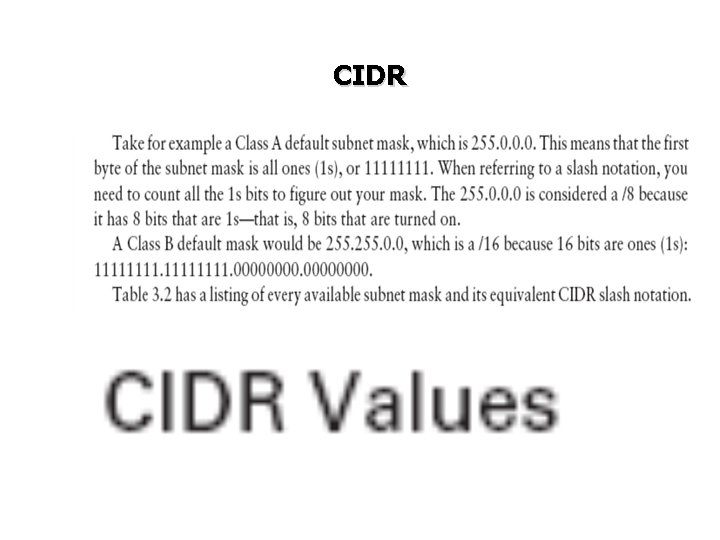
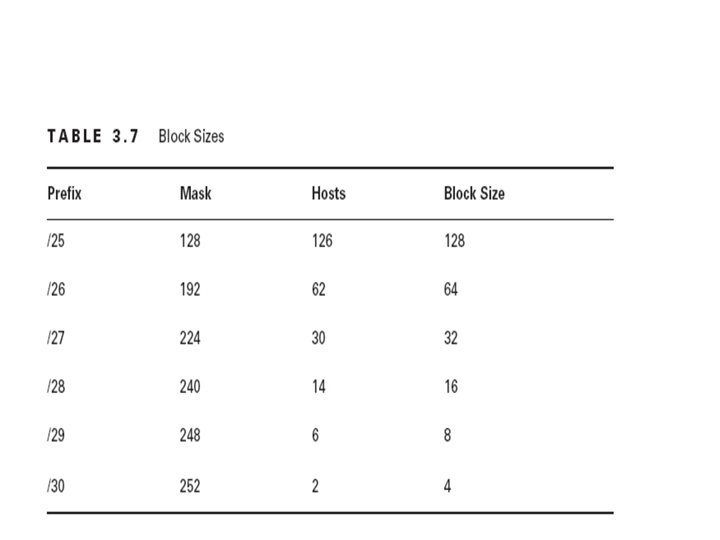
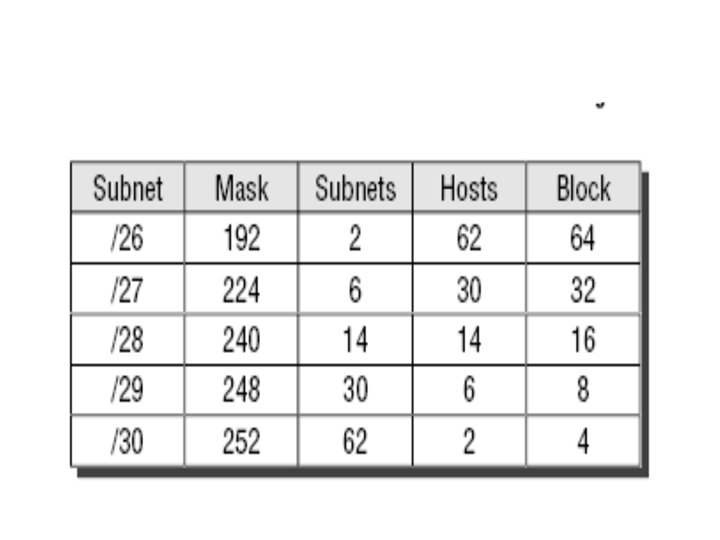
A subnet mask • A subnet mask is a 32 -bit number that determines how an IP address is split into network and host portions, on a bitwise basis. For example, 255. 0. 0 is a standard class B subnet mask, since the first two bytes are all ones (network), and the last two bytes are all zeros (host). In a subnetted network, the network portion is extended. For example, a subnet mask of 255. 0 would subnet a class B address space using its third byte. Using this scheme, the first two bytes of an IP address would identify the class B network, the next byte would identify the subnet within that network, and the final byte would select an individual host. Since subnet masks are used on a bit-by-bit basis, masks like 255. 240. 0 (4 bits of subnet; 12 bits of host) are perfectly normal.
• In a traditional subnetted network, several restrictions apply, which have been lifted by CIDR Classless Inter-Domain Routing. However, if older, non-CIDR routing protocols (such as RIP version 1) are in use, these restrictions must still be observed. 1. Identical subnet masks. Since non-CIDR routing updates do not include subnet masks, a router must assume that the subnet mask it has been configured with is valid for all subnets. Therefore, a single mask must be used for all subnets with a network. Different masks can be used for different networks. Based on this assumption, a router can exchange subnet routes with other routers within the network. Since the subnet masks are identical across the network, the routers will interpret these routes in the same manner. However, routers not attached to the subnetted network can't interpret these subnet routes, since they lack the subnet mask. Therefore, subnet routes are not relayed to routers on other networks. This leads to our second restriction. 2. Contiguous subnets. A subnetted network can't be split into isolated portions. All the subnets must be contiguous, since routing information can't be passed to non-members. Within a network, all subnets must be able to reach all other subnets without passing traffic through other networks.
1. Contiguous subnets. A subnetted network can't be split into isolated portions. All the subnets must be contiguous, since routing information can't be passed to non-members. Within a network, all subnets must be able to reach all other subnets without passing traffic through other networks.
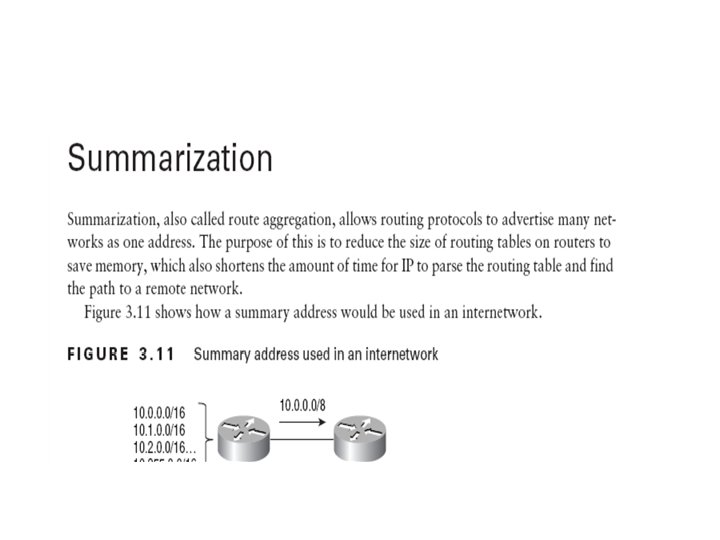
Classless Inter-Domain Routing CIDR • Faced with exhaustion of class B address space and the explosion of routing table growth triggered by a flood of new class Cs, IETF began implementing Classless Interdomain Routing (CIDR), in the early 1990 s. The primary requirement for CIDR is the use of routing protocols that support it, such as RIP Version 2, OSPF Version 2, and BGP Version 4. • CIDR can be thought of as "subnetting on steroids". The subnetting mask, previously a magic number set in a computer's boot sequence, becomes an integral part of routing tables and protocols. A route is no longer an IP address, broken down into network and host bits according to its class. A route is now a combination of address and mask. Not only can we break networks into "subnets", but we can combine networks into "supernets", so long as they have a common network prefix. CIDR defines address assignment and aggregation strategies designed to minimize the size of top-level Internet routing tables.
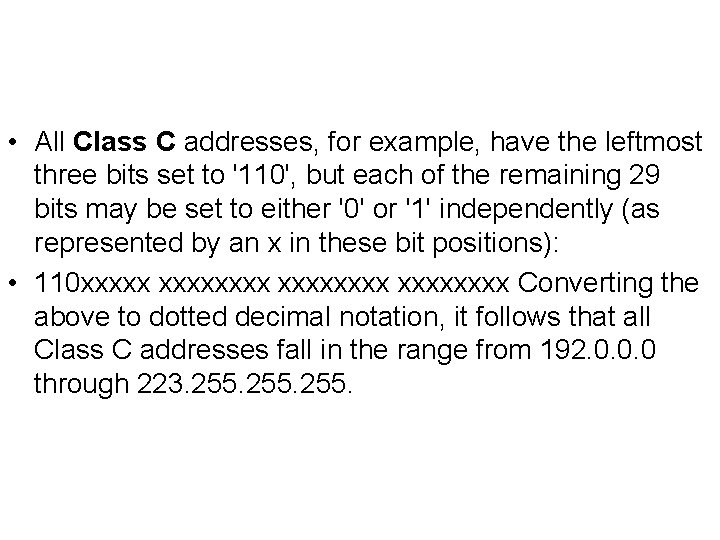
• All Class C addresses, for example, have the leftmost three bits set to '110', but each of the remaining 29 bits may be set to either '0' or '1' independently (as represented by an x in these bit positions): • 110 xxxxxxxx xxxx Converting the above to dotted decimal notation, it follows that all Class C addresses fall in the range from 192. 0. 0. 0 through 223. 255.