
What is an Experience Modifier The Experience Rating





- Slides: 25
What is an Experience Modifier? The Experience Rating Plan (E-Mod) is a multiplier for each employer based on risk classification, payroll, and loss experience. The E-Mod multiplier increases or decreases the amount of premium to be paid during each policy period.
The Experience Modifier(E-Mod) refers to your claims “experience” and builds your claims history into the calculation of premiums. The more claims you have, the higher your experience modifier rate will be. • The fewer claims you have, the lower your experience modifier will be.
THE EXPERIENCE MODIFICATION FACTOR The E-Mod Multiplier is calculated every policy year and is used in the premium calculation for that year
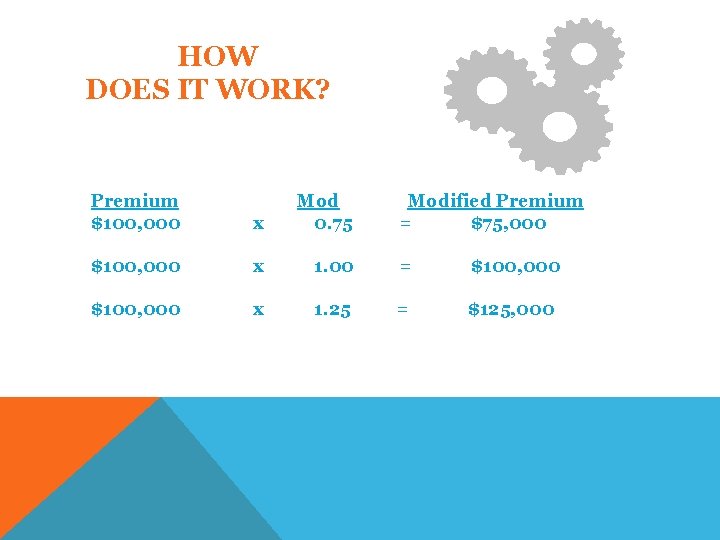
HOW DOES IT WORK? Premium $100, 000 x Mod 0. 75 Modified Premium = $75, 000 $100, 000 x 1. 00 = $100, 000 x 1. 25 = $125, 000
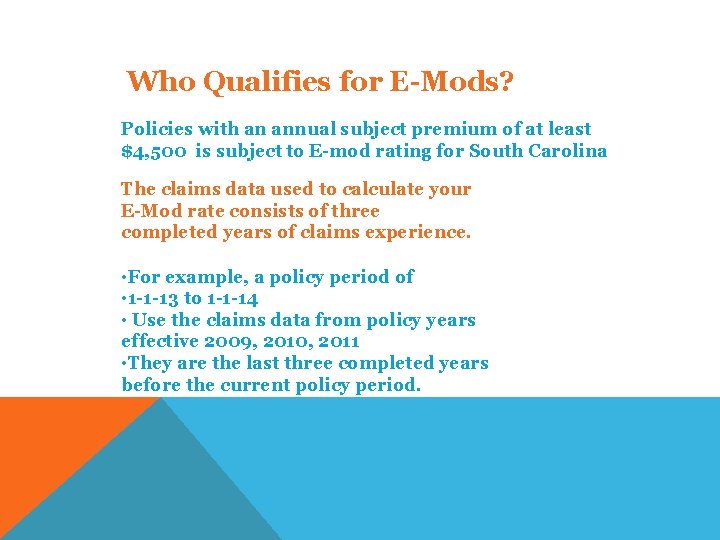
Who Qualifies for E-Mods? Policies with an annual subject premium of at least $4, 500 is subject to E-mod rating for South Carolina The claims data used to calculate your E-Mod rate consists of three completed years of claims experience. • For example, a policy period of • 1 -1 -13 to 1 -1 -14 • Use the claims data from policy years effective 2009, 2010, 2011 • They are the last three completed years before the current policy period.
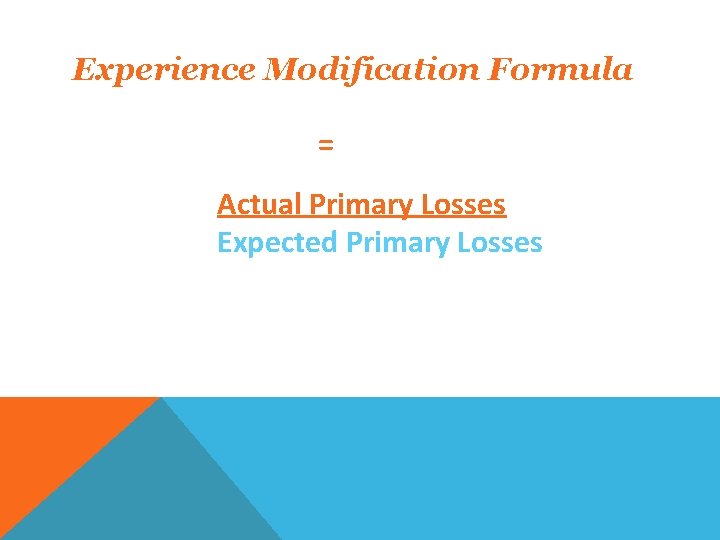
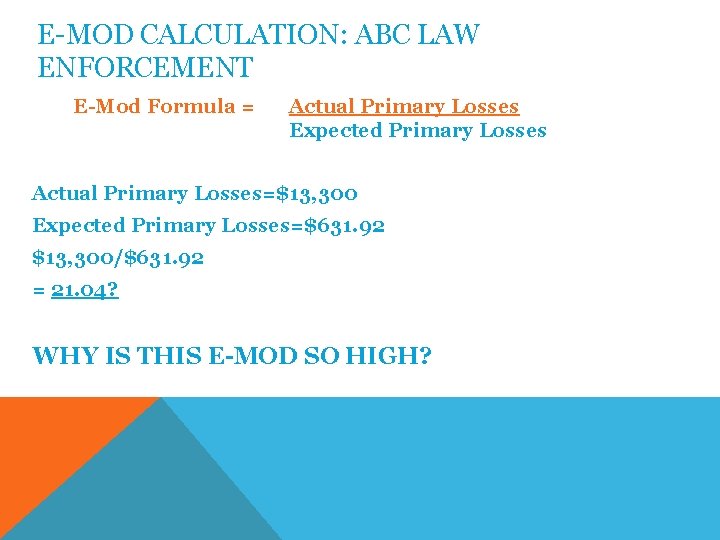
Experience Modification Formula = Actual Primary Losses Expected Primary Losses
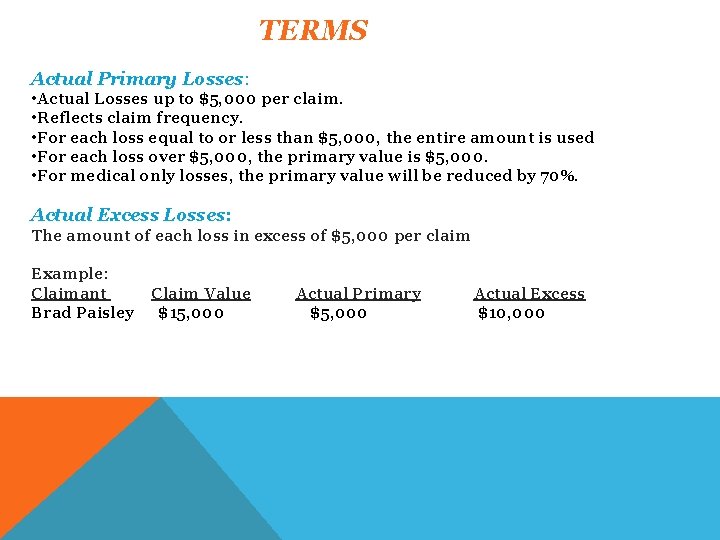
TERMS Actual Primary Losses: • Actual Losses up to $5, 000 per claim. • Reflects claim frequency. • For each loss equal to or less than $5, 000, the entire amount is used • For each loss over $5, 000, the primary value is $5, 000. • For medical only losses, the primary value will be reduced by 70%. Actual Excess Losses: The amount of each loss in excess of $5, 000 per claim Example: Claimant Brad Paisley Claim Value $15, 000 Actual Primary $5, 000 Actual Excess $10, 000
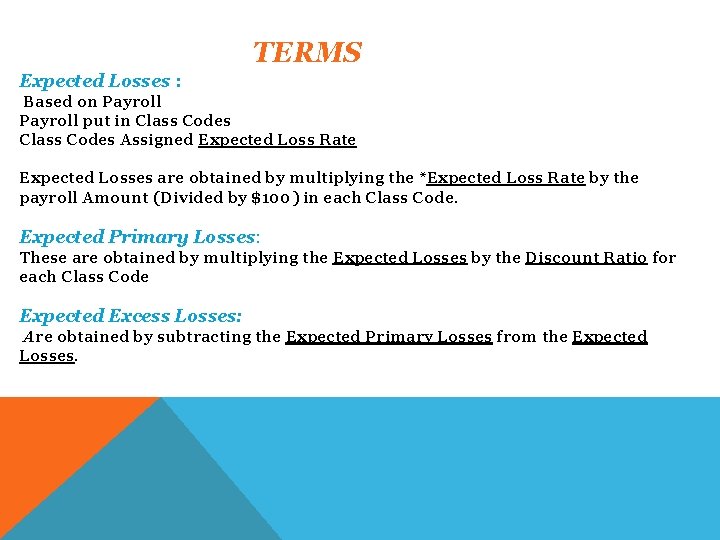
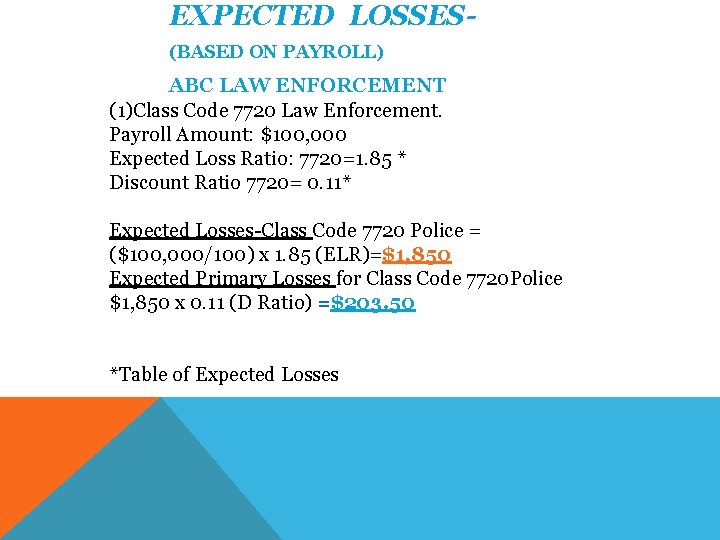
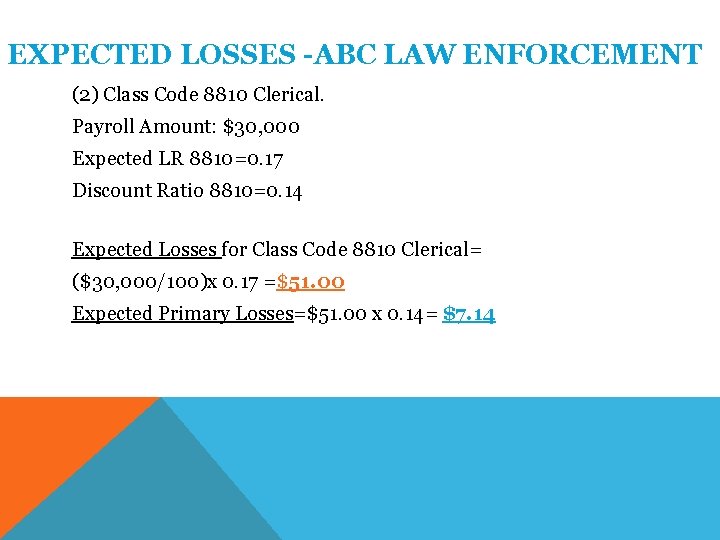
TERMS Expected Losses : Based on Payroll put in Class Codes Assigned Expected Loss Rate Expected Losses are obtained by multiplying the *Expected Loss Rate by the payroll Amount (Divided by $100) in each Class Code. Expected Primary Losses: These are obtained by multiplying the Expected Losses by the Discount Ratio for each Class Code Expected Excess Losses: Are obtained by subtracting the Expected Primary Losses from the Expected Losses.
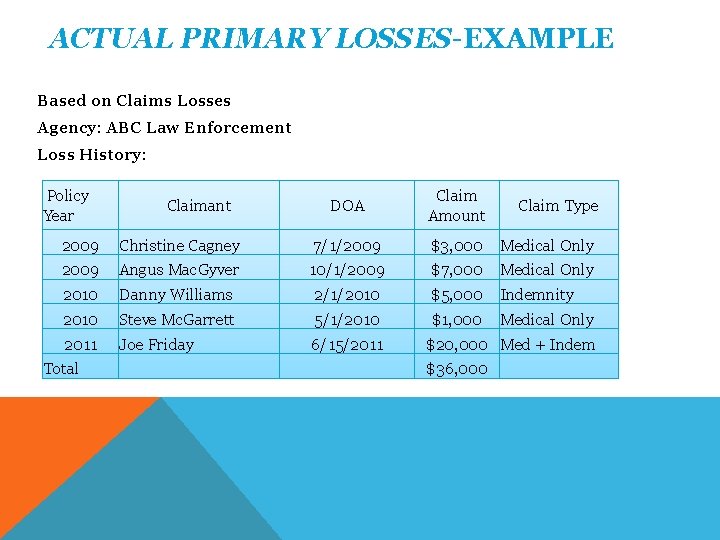
ACTUAL PRIMARY LOSSES-EXAMPLE Based on Claims Losses Agency: ABC Law Enforcement Loss History: Policy Year Claimant DOA Claim Amount Claim Type 2009 Christine Cagney 7/1/2009 $3, 000 Medical Only 2009 Angus Mac. Gyver 10/1/2009 $7, 000 Medical Only 2010 Danny Williams 2/1/2010 $5, 000 Indemnity 2010 Steve Mc. Garrett 5/1/2010 $1, 000 Medical Only 2011 Joe Friday 6/15/2011 Total $20, 000 Med + Indem $36, 000
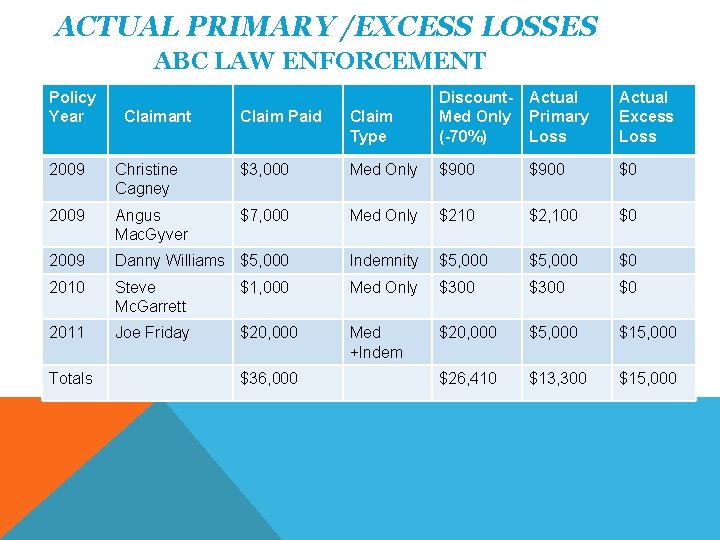
ACTUAL PRIMARY /EXCESS LOSSES ABC LAW ENFORCEMENT Policy Year Claimant Claim Paid Claim Type Discount. Med Only (-70%) Actual Primary Loss Actual Excess Loss 2009 Christine Cagney $3, 000 Med Only $900 $0 2009 Angus Mac. Gyver $7, 000 Med Only $210 $2, 100 $0 2009 Danny Williams $5, 000 Indemnity $5, 000 $0 2010 Steve Mc. Garrett $1, 000 Med Only $300 $0 2011 Joe Friday $20, 000 Med +Indem $20, 000 $5, 000 $15, 000 $26, 410 $13, 300 $15, 000 Totals $36, 000
EXPECTED LOSSES(BASED ON PAYROLL) ABC LAW ENFORCEMENT (1)Class Code 7720 Law Enforcement. Payroll Amount: $100, 000 Expected Loss Ratio: 7720=1. 85 * Discount Ratio 7720= 0. 11* Expected Losses-Class Code 7720 Police = ($100, 000/100) x 1. 85 (ELR)=$1, 850 Expected Primary Losses for Class Code 7720 Police $1, 850 x 0. 11 (D Ratio) =$203. 50 *Table of Expected Losses
EXPECTED LOSSES -ABC LAW ENFORCEMENT (2) Class Code 8810 Clerical. Payroll Amount: $30, 000 Expected LR 8810=0. 17 Discount Ratio 8810=0. 14 Expected Losses for Class Code 8810 Clerical= ($30, 000/100)x 0. 17 =$51. 00 Expected Primary Losses=$51. 00 x 0. 14= $7. 14
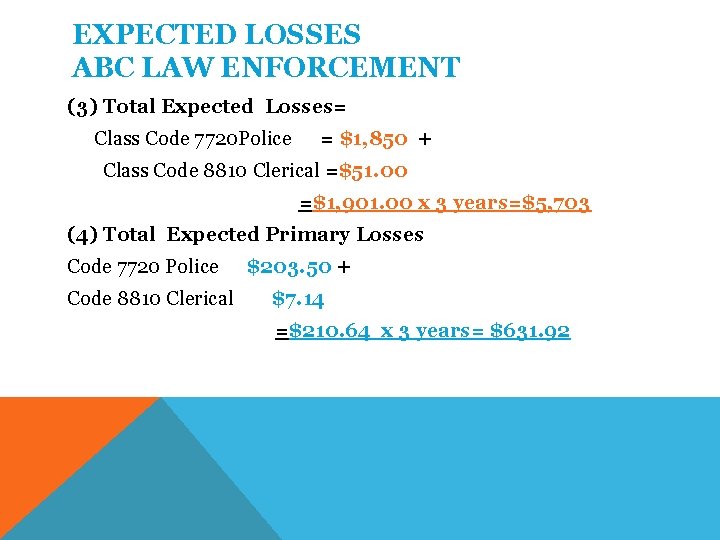
EXPECTED LOSSES ABC LAW ENFORCEMENT (3) Total Expected Losses= Class Code 7720 Police = $1, 850 + Class Code 8810 Clerical =$51. 00 =$1, 901. 00 x 3 years=$5, 703 (4) Total Expected Primary Losses Code 7720 Police Code 8810 Clerical $203. 50 + $7. 14 =$210. 64 x 3 years= $631. 92
E-MOD CALCULATION: ABC LAW ENFORCEMENT E-Mod Formula = Actual Primary Losses Expected Primary Losses Actual Primary Losses=$13, 300 Expected Primary Losses=$631. 92 $13, 300/$631. 92 = 21. 04? WHY IS THIS E-MOD SO HIGH?
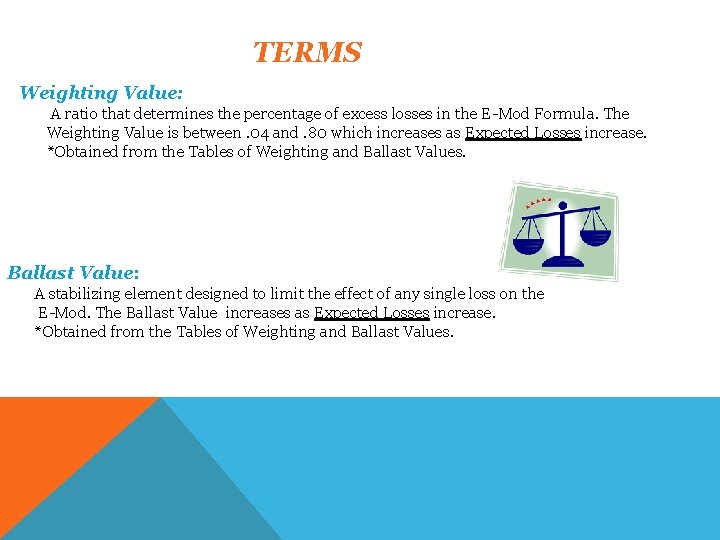
TERMS Weighting Value: A ratio that determines the percentage of excess losses in the E-Mod Formula. The Weighting Value is between. 04 and. 80 which increases as Expected Losses increase. *Obtained from the Tables of Weighting and Ballast Values. Ballast Value: A stabilizing element designed to limit the effect of any single loss on the E-Mod. The Ballast Value increases as Expected Losses increase. *Obtained from the Tables of Weighting and Ballast Values.
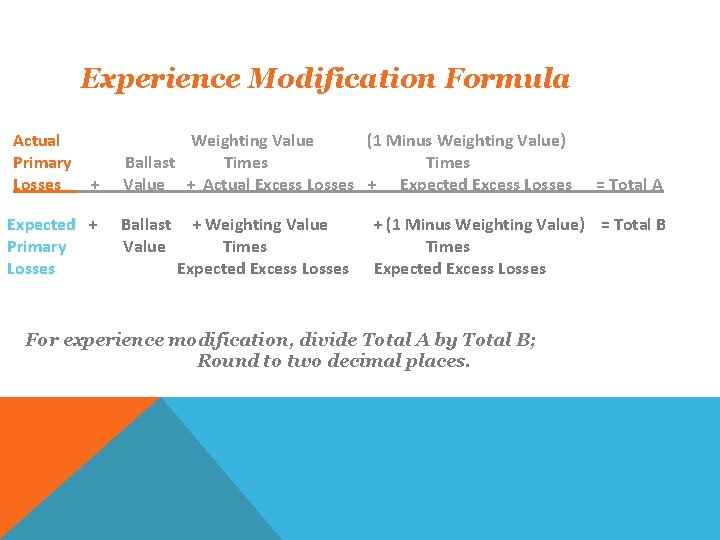
Experience Modification Formula Actual Primary Losses + Expected + Primary Losses Weighting Value (1 Minus Weighting Value) Ballast Times Value + Actual Excess Losses + Expected Excess Losses Ballast Value + Weighting Value Times Expected Excess Losses = Total A + (1 Minus Weighting Value) = Total B Times Expected Excess Losses For experience modification, divide Total A by Total B; Round to two decimal places.
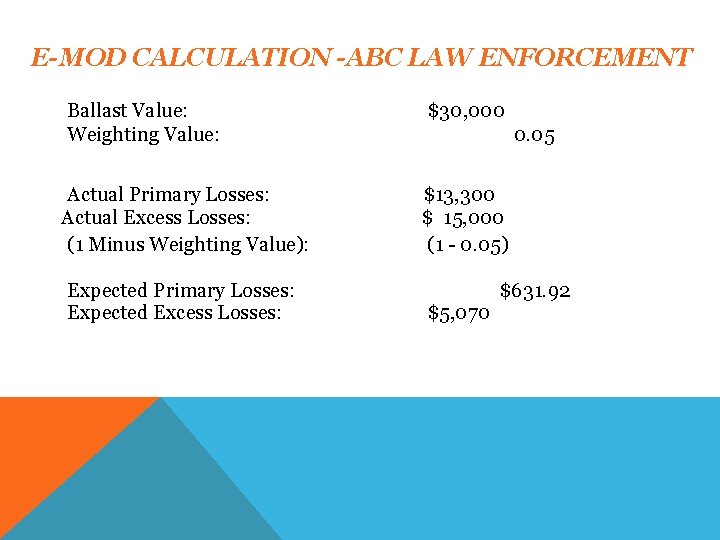
E-MOD CALCULATION -ABC LAW ENFORCEMENT Ballast Value: Weighting Value: $30, 000 Actual Primary Losses: Actual Excess Losses: (1 Minus Weighting Value): $13, 300 $ 15, 000 (1 - 0. 05) Expected Primary Losses: Expected Excess Losses: 0. 05 $5, 070 $631. 92
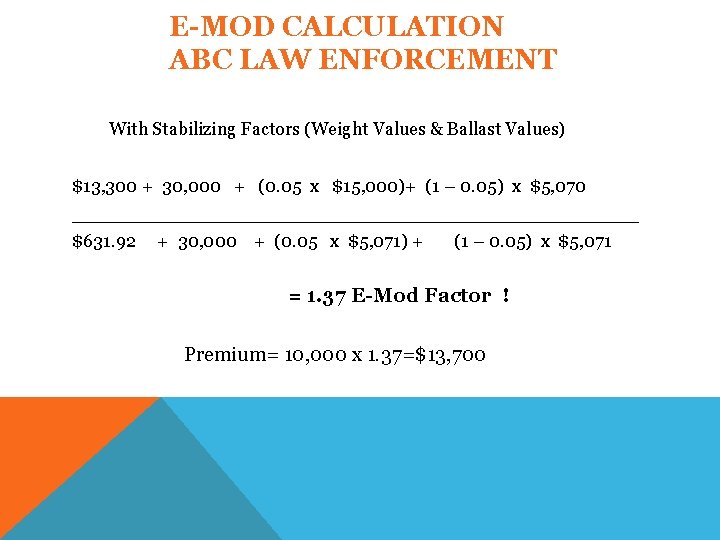
E-MOD CALCULATION ABC LAW ENFORCEMENT With Stabilizing Factors (Weight Values & Ballast Values) $13, 300 + 30, 000 + (0. 05 x $15, 000)+ (1 – 0. 05) x $5, 070 _________________________ $631. 92 + 30, 000 + (0. 05 x $5, 071) + (1 – 0. 05) x $5, 071 = 1. 37 E-Mod Factor ! Premium= 10, 000 x 1. 37=$13, 700
Limitations used in the E-Mod formula. • The Formula only counts 30% of Medical-Only Claims • It Also Caps Claims payments at the following limits: • $299, 500 Single Claims* • $599, 000 Multiple Claims* • * Effective 9 -1 -12
NCCI Changes to the E-Mod Split Point The Split Point separates claims into primary and excess portions. • Currently, this amount is $5, 000. • The Split Point will be changed from $5, 000 to $15, 000 over a 3 -year period. • The First Year will be $10, 000 • The Second Year will be $13, 500 • The Third Year will be $15, 000 • Subsequent year filings will adjust the split point based on inflation
Impact of Experience Rating Changes • Overall, rating changes will be premium neutral statewide (Will not increase the premium statewide) • Generally, employers with favorable loss experience should receive larger credits • Employers with less than favorable loss experience should received larger debits • For More Information, see NCCI Item E-1402, Circular CW-2011 -05, and CIF-2011 -14
Impact of Experience Rating Changes In 26 of the 38 states where the plan has been approved… – 62 percent would see their rates fall less than 5 percent. -Another 11 percent realized decreases between 5 percent and 10 percent. -Rates were unchanged for 4. 5 percent of risks. Less than one in four would see a rate increase. Source: Tony Di. Donato, director and senior actuary at the National Council on Compensation Insurance
When are Changes Effective? State Date Implemented Georgia 3 -1 -2013 North Carolina 4 -1 -2013 South Carolina Approved-Date undecided For Questions or additional information, please contact NCCI’s Customer Service Center at: 1 -800 -NCCI-123 Customer_service@ncci. com
Questions?