
What is an ecological footprint Sustainability and Human

What is an ecological footprint? Sustainability and Human Impact

Your relationship with the environment:

How do we measure these footprints?

How do we share earth's resources? • • • Some countries possess more Biocapacity than others. Canada is an example of this, possessing almost twice as much biocapacity as it uses. An Ecological reserve exists when the biocapacity of a region exceeds its population's Footprint. We call these countries "Ecological Creditors" If biocapacity was money, they would have extra to lend.
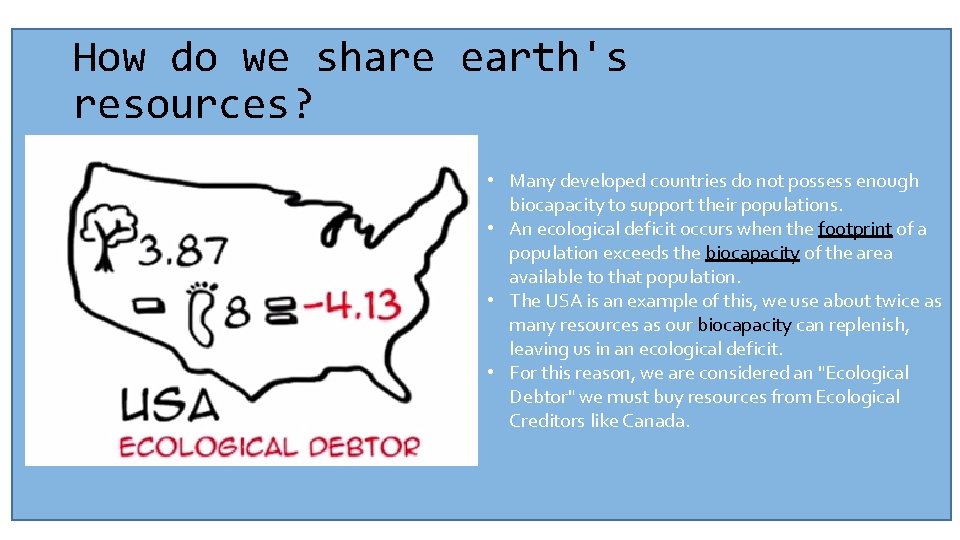
How do we share earth's resources? • Many developed countries do not possess enough biocapacity to support their populations. • An ecological deficit occurs when the footprint of a population exceeds the biocapacity of the area available to that population. • The USA is an example of this, we use about twice as many resources as our biocapacity can replenish, leaving us in an ecological deficit. • For this reason, we are considered an "Ecological Debtor" we must buy resources from Ecological Creditors like Canada.

Is there enough biocapacity to support the world's population? No! The world-average ecological footprint in 2016 was 2. 7 global hectares person with a worldaverage biocapacity of 1. 8 global hectares person this leads to an ecological deficit of 0. 9 global hectares person.
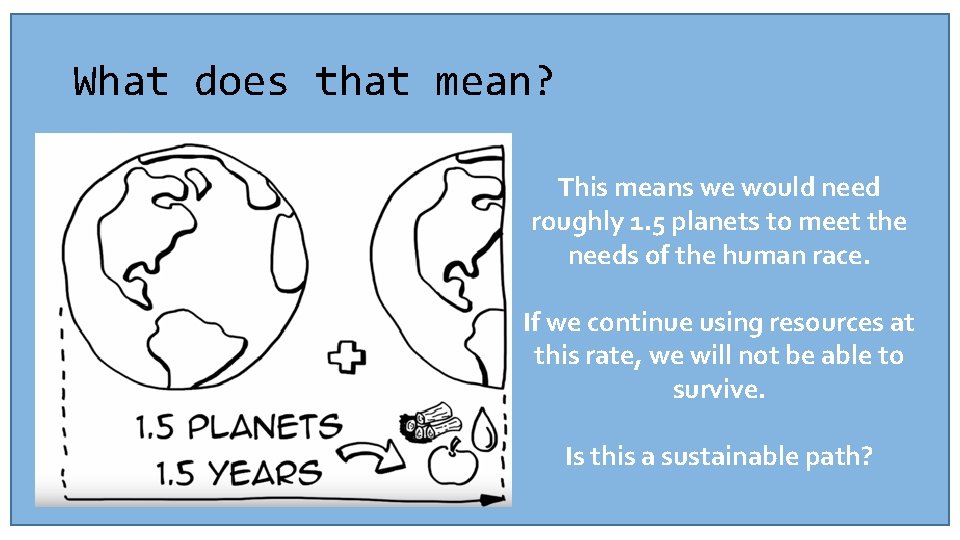
What does that mean? This means we would need roughly 1. 5 planets to meet the needs of the human race. If we continue using resources at this rate, we will not be able to survive. Is this a sustainable path?
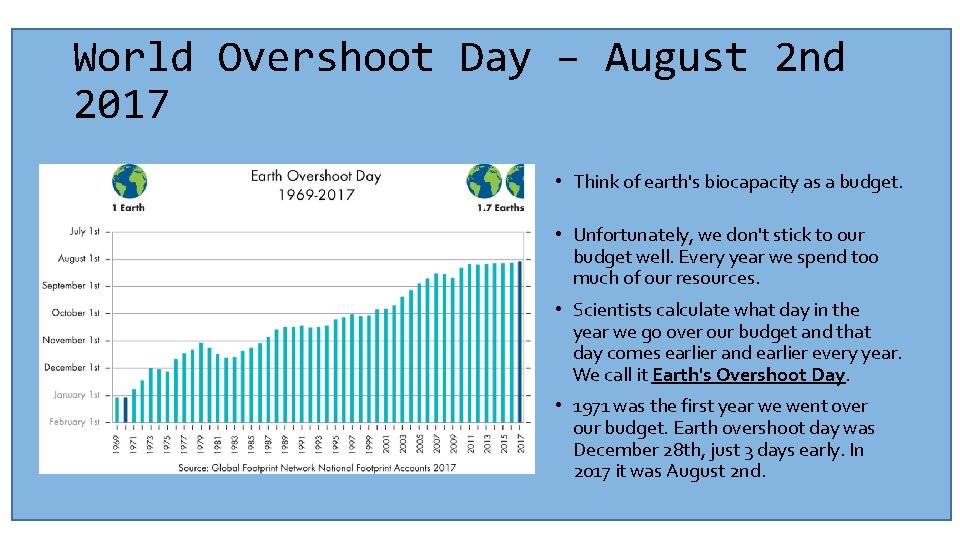
World Overshoot Day – August 2 nd 2017 • Think of earth's biocapacity as a budget. • Unfortunately, we don't stick to our budget well. Every year we spend too much of our resources. • Scientists calculate what day in the year we go over our budget and that day comes earlier and earlier every year. We call it Earth's Overshoot Day. • 1971 was the first year we went over our budget. Earth overshoot day was December 28 th, just 3 days early. In 2017 it was August 2 nd.

What is the pattern for countries that have a deficit or a reserve? • In general, high income countries have a greater Ecological foot print.
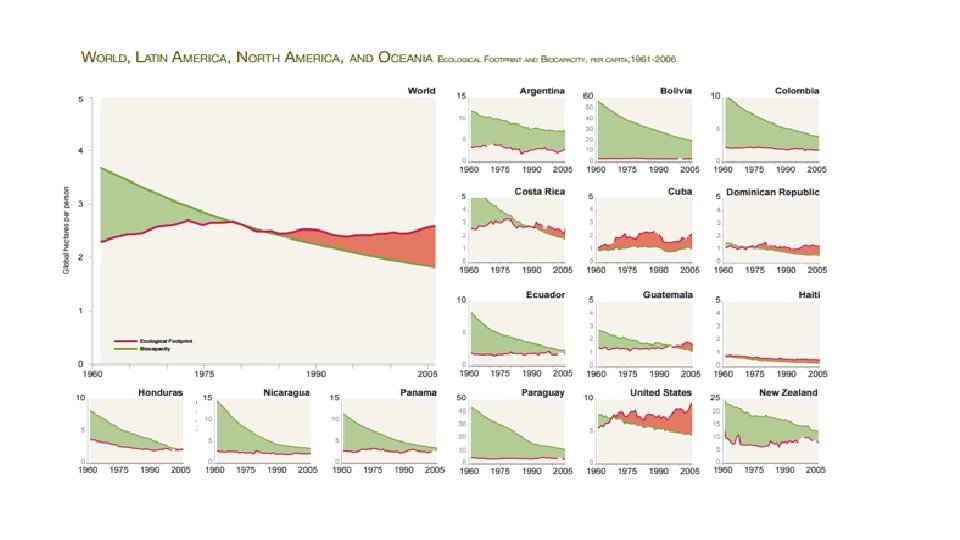
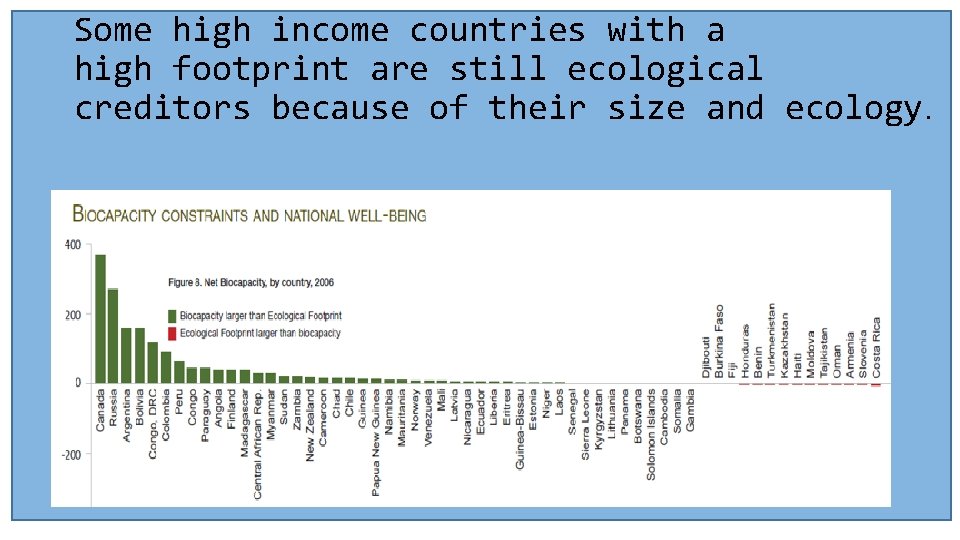
Some high income countries with a high footprint are still ecological creditors because of their size and ecology.
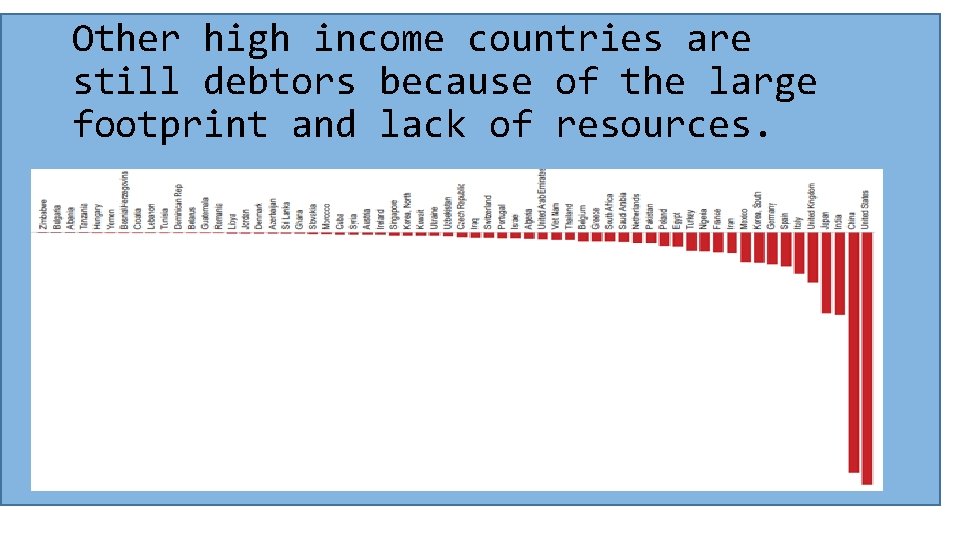
Other high income countries are still debtors because of the large footprint and lack of resources.
- Slides: 12