
What is an algorithm Description of a problem
What is an algorithm? • Description of a problem and expected input and output • Solution to the problem; method of providing required output for every valid input For example: our brain • Brain receives input, • processes information, • and computes outputs. What algorithm does the brain use? CSC 317 1
Marr’s (Psychologist, Computer Scientist, 1982) three levels of analysis: The three levels at which any machine carrying out an 1. Information processing task must be understood 1. Computational theory: goal of the computation; why is it important…? 2. Representation and algorithm: How can this computational theory be solved? In particular, what is the representation for the input and output, and what is the algorithm for the transformation? 3. Hardware implementation: How can the representation and algorithm be realized physically? CSC 317 2

What is an algorithm? • Description of a problem and expected input and output • Solution to the problem; method of providing required output for every valid input Correct algorithm solves the problem properly for every possible input Incorrect algorithm doesn’t stop for every input or provides wrong output CSC 317 3
What is an algorithm? • Description of a problem and expected input and output • Solution to the problem; method of providing required output for every valid input Correct algorithm solves the problem properly for every possible input Incorrect algorithm doesn’t stop for every input or provides wrong output CSC 317 4
What is an algorithm? • Description of a problem and expected input and output • Solution to the problem; method of providing required output for every valid input Is there a unique algorithm for solving each problem? Do we always require correct answer? CSC 317 5
Tradeoffs are… • Correctness • Efficiency (Why do we care? ) Computers are getting faster but… Big data (genome; image web search; social networks; etc) • Deterministic versus probabilistic. Modern algorithms often probabilistic… • “Hard” problems CSC 317 6
Steps in solving a problem? • • Determine input and output Define abstract mathematical model to represent the problem Find an algorithm to solve the problem High level description More detailed description (Pseudo code; data structures) Tests and proof of correctness Analysis of efficiency, run time, complexity… CSC 317 7
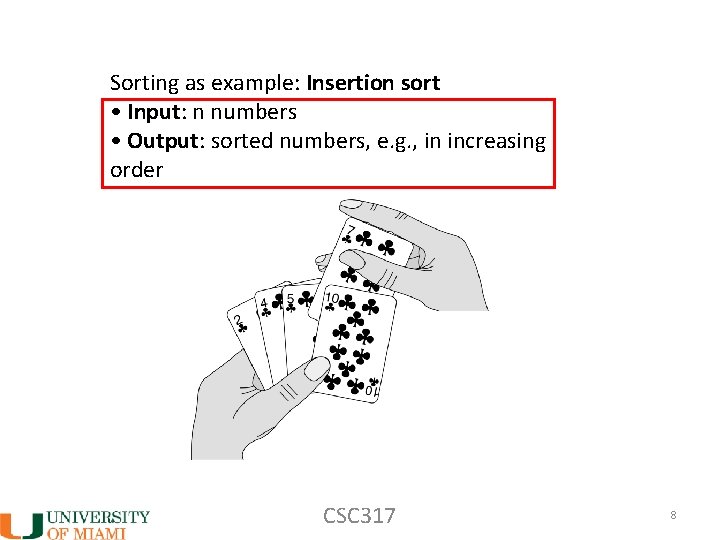
Sorting as example: Insertion sort • Input: n numbers • Output: sorted numbers, e. g. , in increasing order CSC 317 8
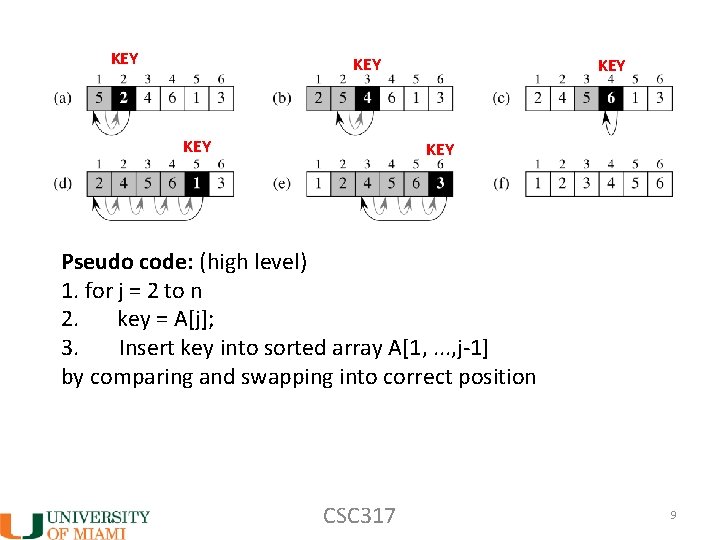
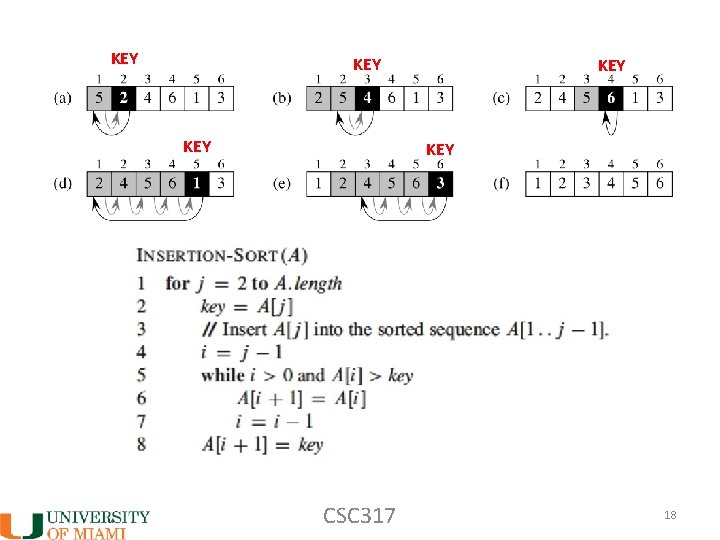
KEY KEY KEY Pseudo code: (high level) 1. for j = 2 to n 2. key = A[j]; 3. Insert key into sorted array A[1, . . . , j-1] by comparing and swapping into correct position CSC 317 9
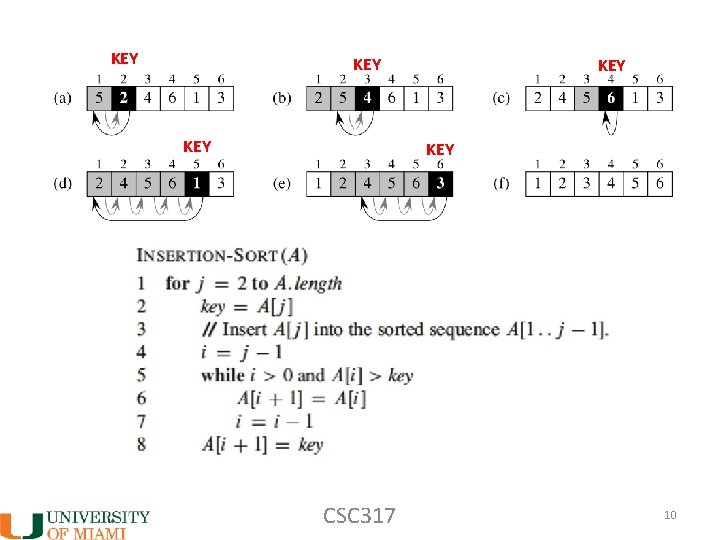
KEY KEY KEY CSC 317 10
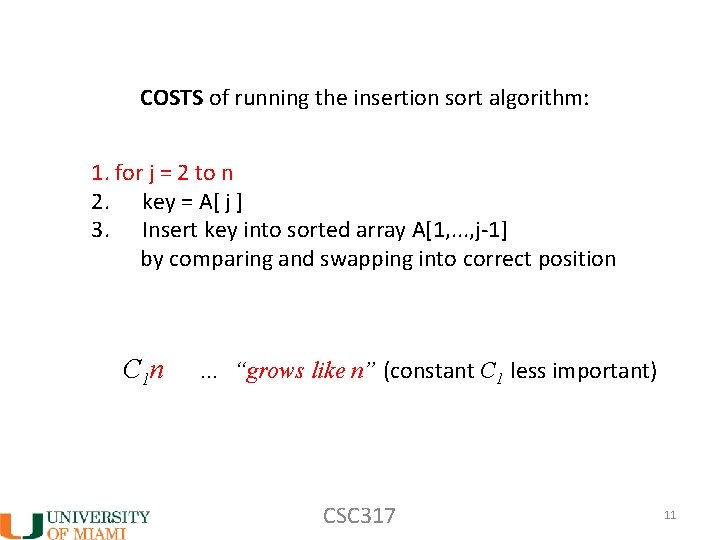
COSTS of running the insertion sort algorithm: 1. for j = 2 to n 2. key = A[ j ] 3. Insert key into sorted array A[1, . . . , j-1] by comparing and swapping into correct position C 1 n … “grows like n” (constant C 1 less important) CSC 317 11
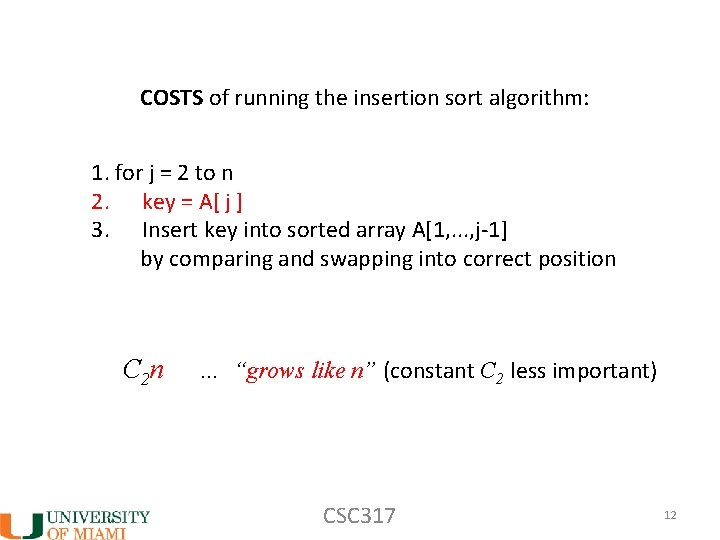
COSTS of running the insertion sort algorithm: 1. for j = 2 to n 2. key = A[ j ] 3. Insert key into sorted array A[1, . . . , j-1] by comparing and swapping into correct position C 2 n … “grows like n” (constant C 2 less important) CSC 317 12
COSTS of running the insertion sort algorithm: 1. for j = 2 to n 2. key = A[ j ] 3. Insert key into sorted array A[1, . . . , j-1] by comparing and swapping into correct position Best case, worst case? CSC 317 13
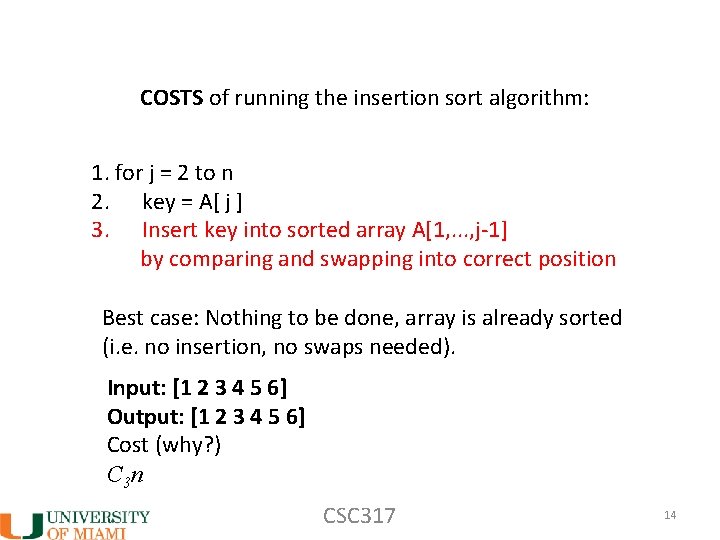
COSTS of running the insertion sort algorithm: 1. for j = 2 to n 2. key = A[ j ] 3. Insert key into sorted array A[1, . . . , j-1] by comparing and swapping into correct position Best case: Nothing to be done, array is already sorted (i. e. no insertion, no swaps needed). Input: [1 2 3 4 5 6] Output: [1 2 3 4 5 6] Cost (why? ) C 3 n CSC 317 14
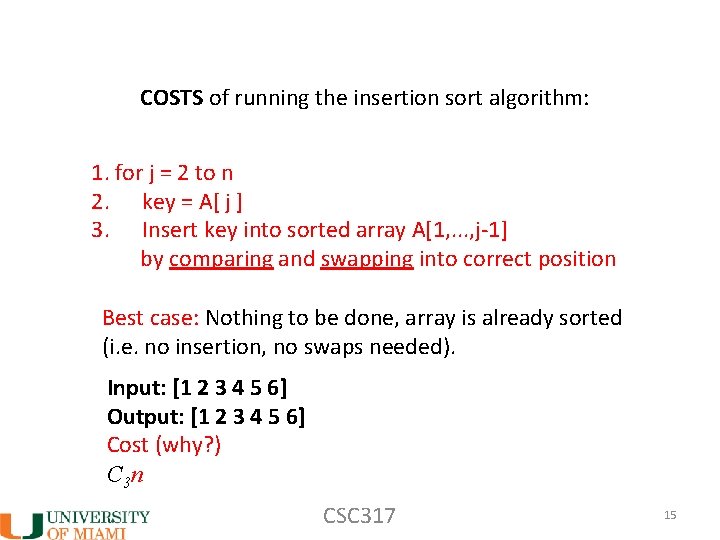
COSTS of running the insertion sort algorithm: 1. for j = 2 to n 2. key = A[ j ] 3. Insert key into sorted array A[1, . . . , j-1] by comparing and swapping into correct position Best case: Nothing to be done, array is already sorted (i. e. no insertion, no swaps needed). Input: [1 2 3 4 5 6] Output: [1 2 3 4 5 6] Cost (why? ) C 3 n CSC 317 15
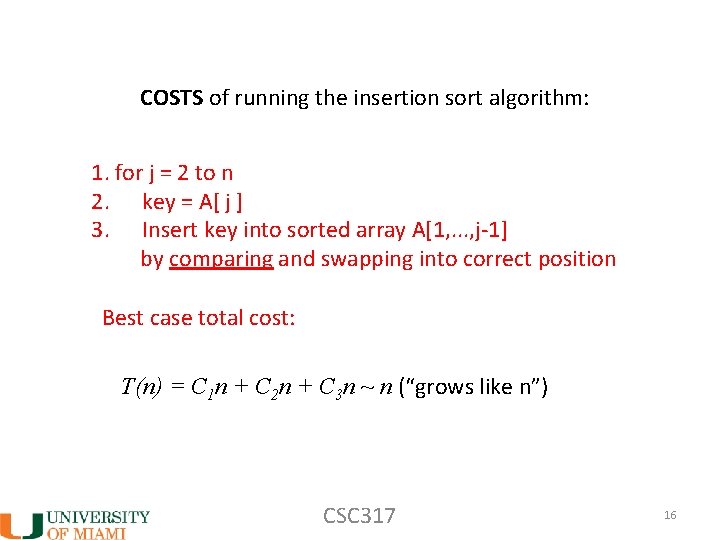
COSTS of running the insertion sort algorithm: 1. for j = 2 to n 2. key = A[ j ] 3. Insert key into sorted array A[1, . . . , j-1] by comparing and swapping into correct position Best case total cost: T(n) = C 1 n + C 2 n + C 3 n ~ n (“grows like n”) CSC 317 16
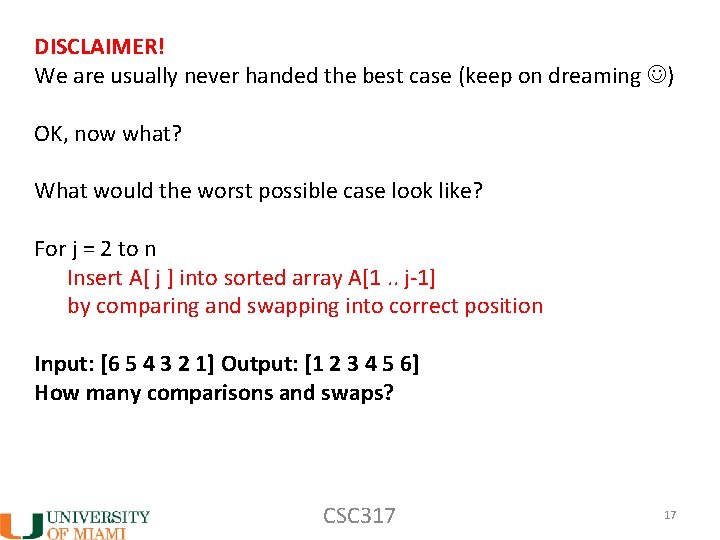
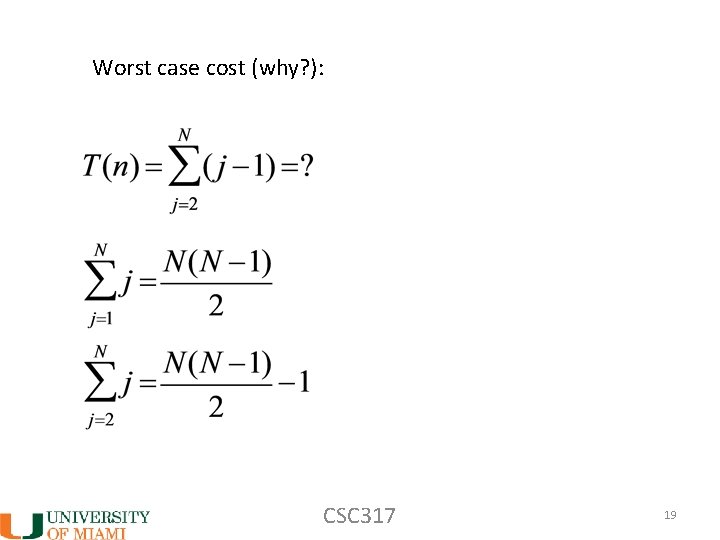
DISCLAIMER! We are usually never handed the best case (keep on dreaming ) OK, now what? What would the worst possible case look like? For j = 2 to n Insert A[ j ] into sorted array A[1. . j-1] by comparing and swapping into correct position Input: [6 5 4 3 2 1] Output: [1 2 3 4 5 6] How many comparisons and swaps? CSC 317 17
KEY KEY KEY CSC 317 18
Worst case cost (why? ): CSC 317 19
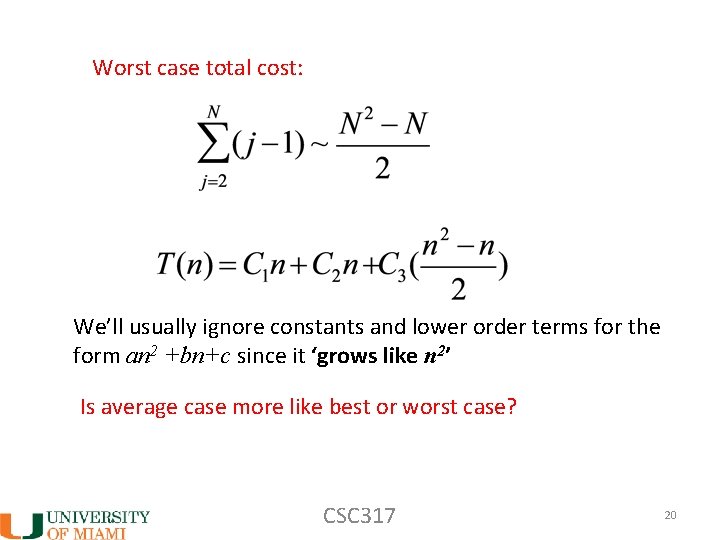
Worst case total cost: We’ll usually ignore constants and lower order terms for the form an 2 +bn+c since it ‘grows like n 2’ Is average case more like best or worst case? CSC 317 20
CONCLUSIONS • We only care about limiting step relative to input size n – ignore constant and lower order terms • We usually care about worst case scenario • Average case often roughly as bad as worst case • More on “grows like” later. . . CSC 317 21
- Slides: 21