
What is air pressure and how does it
- Slides: 18
What is air pressure and how does it affect us? Do Now: What happens to temperature as you go up into the atmosphere? HW: Atmosphere worksheet
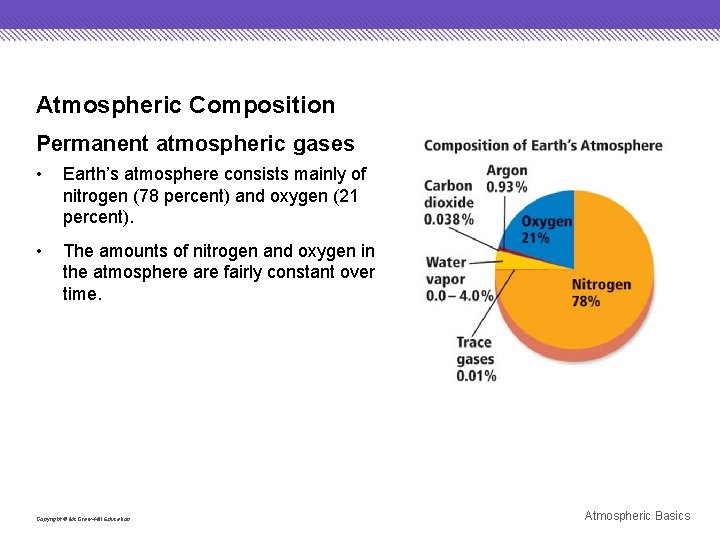
Atmospheric Composition Permanent atmospheric gases • Earth’s atmosphere consists mainly of nitrogen (78 percent) and oxygen (21 percent). • The amounts of nitrogen and oxygen in the atmosphere are fairly constant over time. Copyright © Mc. Graw-Hill Education Atmospheric Basics
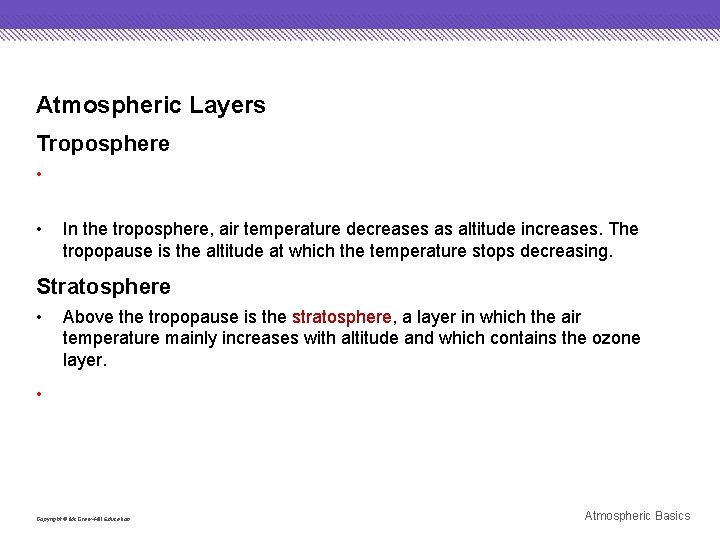
Atmospheric Layers Troposphere • The layer closest to Earth’s surface, the troposphere, contains most of the mass of the atmosphere and is where weather occurs. • In the troposphere, air temperature decreases as altitude increases. The tropopause is the altitude at which the temperature stops decreasing. Stratosphere • Above the tropopause is the stratosphere, a layer in which the air temperature mainly increases with altitude and which contains the ozone layer. • At the stratopause, air temperature stops increasing with altitude. Copyright © Mc. Graw-Hill Education Atmospheric Basics
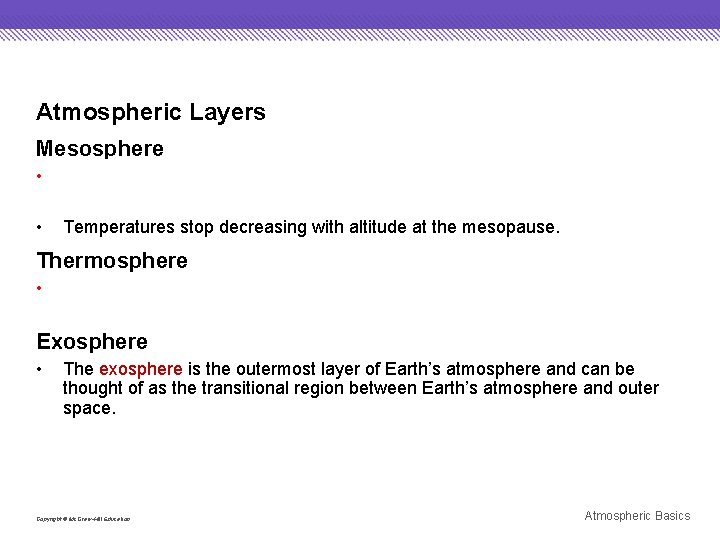
Atmospheric Layers Mesosphere • Above the stratopause is the mesosphere, in which air temperature decreases with altitude. • Temperatures stop decreasing with altitude at the mesopause. Thermosphere • The thermosphere is the layer above the mesopause and contains the ionosphere. Exosphere • The exosphere is the outermost layer of Earth’s atmosphere and can be thought of as the transitional region between Earth’s atmosphere and outer space. Copyright © Mc. Graw-Hill Education Atmospheric Basics
Energy Transfer in the Atmosphere Radiation • • Radiation is the transfer of thermal energy by electromagnetic waves. Thermal energy is transferred from the Sun to Earth by radiation. Conduction • Conduction is the transfer of thermal energy between objects when their atoms or molecules collide Convection • Convection is the transfer of thermal energy by the movement of heated material from one place to another. Copyright © Mc. Graw-Hill Education Atmospheric Basics
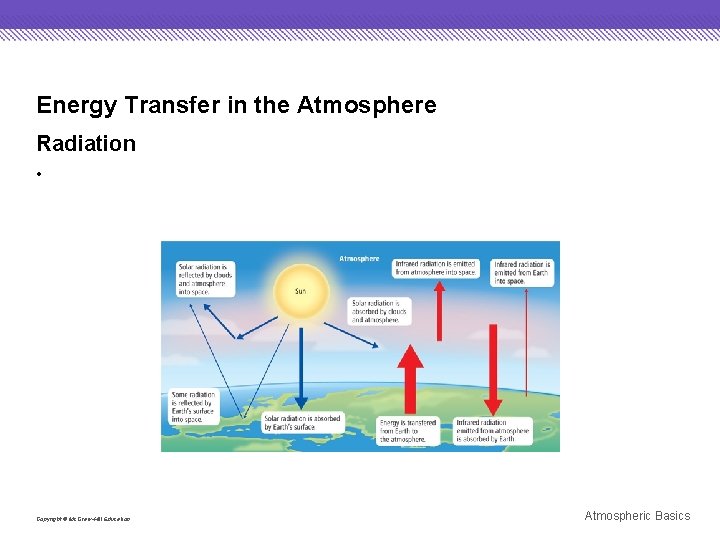
Energy Transfer in the Atmosphere Radiation • Incoming solar radiation is either reflected back into space or absorbed by Earth’s atmosphere or its surface. Copyright © Mc. Graw-Hill Education Atmospheric Basics
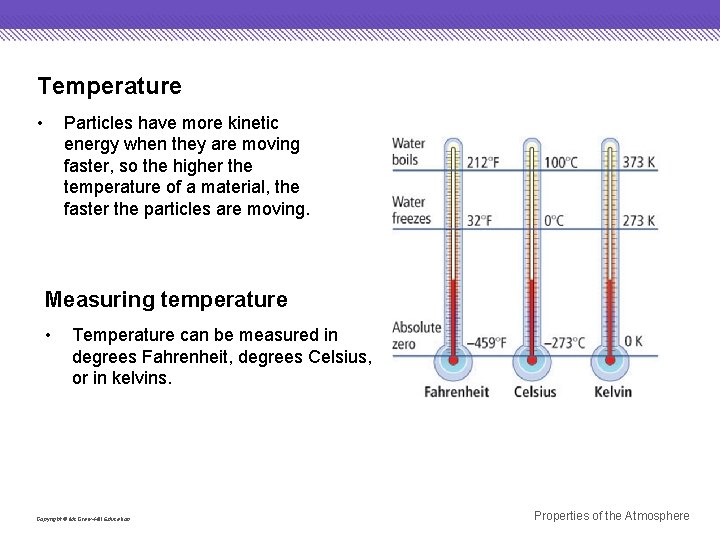
Temperature • Particles have more kinetic energy when they are moving faster, so the higher the temperature of a material, the faster the particles are moving. Measuring temperature • Temperature can be measured in degrees Fahrenheit, degrees Celsius, or in kelvins. Copyright © Mc. Graw-Hill Education Properties of the Atmosphere
Air Pressure • Air pressure is the pressure exerted on a surface by the weight of the atmosphere above the surface. • The units for pressure are N/m 2. • Air pressure is often measured in units of millibars (mb), where 1 mb equals 100 N/m 2. Copyright © Mc. Graw-Hill Education Properties of the Atmosphere
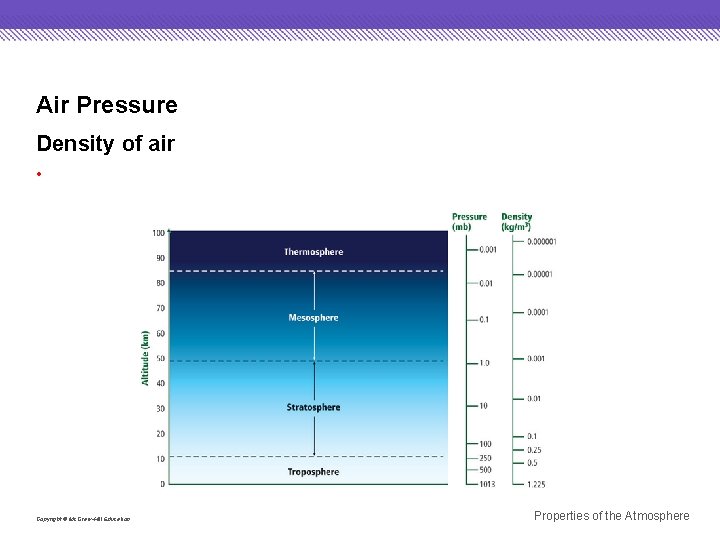
Air Pressure Density of air • The density and pressure of the layers of the atmosphere decrease as altitude increases. Copyright © Mc. Graw-Hill Education Properties of the Atmosphere
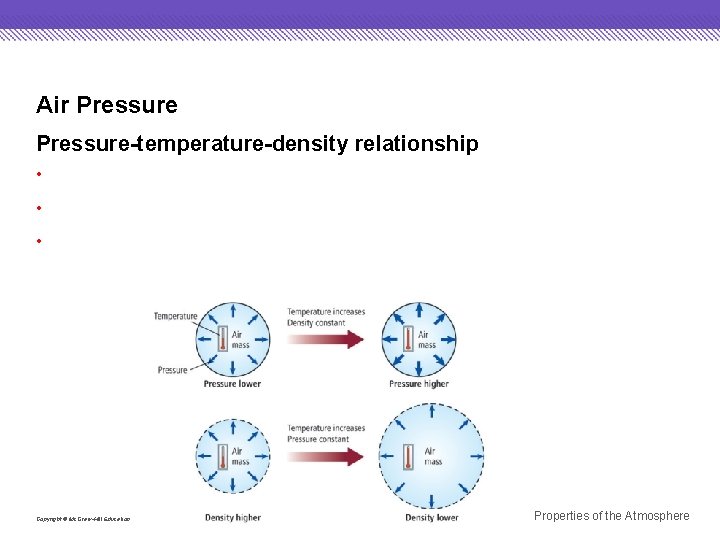
Air Pressure-temperature-density relationship • Temperature, pressure, and density are all related to one another. • If temperature increases, but density is constant, the pressure increases. • If the temperature increases and the pressure is constant, the density decreases. Copyright © Mc. Graw-Hill Education Properties of the Atmosphere
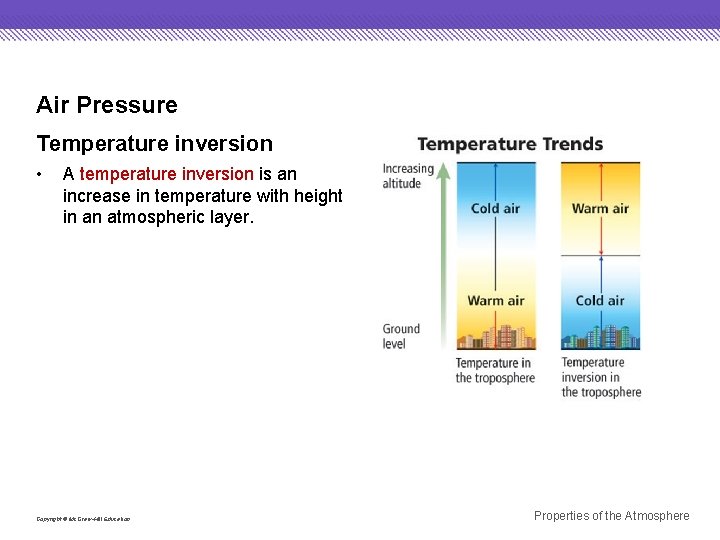
Air Pressure Temperature inversion • A temperature inversion is an increase in temperature with height in an atmospheric layer. Copyright © Mc. Graw-Hill Education Properties of the Atmosphere
Air Pressure Temperature inversion • If the land does not radiate thermal energy to the lower layers of the atmosphere, such as on a cold, clear, winter night when the air is calm, the lower layers of air become cooler than the air above them. • A temperature inversion can lead to fog or low-level clouds. • In some cities, a temperature inversion can worsen air-pollution problems. Copyright © Mc. Graw-Hill Education Properties of the Atmosphere
Air Pressure Wind • The movement of air is commonly known as wind. • In the lower atmosphere, air generally moves from regions of higher density and pressure to regions of lower density and pressure. • Near Earth’s surface, wind is constantly slowed by the friction that results from contact with surfaces including trees, buildings and hills. • Higher up from Earth’s surface, air encounters less friction and wind speeds increase. Copyright © Mc. Graw-Hill Education Properties of the Atmosphere
Humidity is the amount of water vapor in the atmosphere at a given location on Earth’s surface. Relative humidity • Saturation occurs when the amount of water vapor in a volume of air has reached the maximum amount possible for that temperature. • The amount of water vapor in a volume of air relative to the amount of water vapor needed for that volume of air to reach saturation is called relative humidity. Copyright © Mc. Graw-Hill Education Properties of the Atmosphere
Humidity Relative humidity • The dew point is the temperature to which air must be cooled at constant pressure to reach saturation. • The extra thermal energy contained in water vapor compared to liquid water is called latent heat. Copyright © Mc. Graw-Hill Education Properties of the Atmosphere
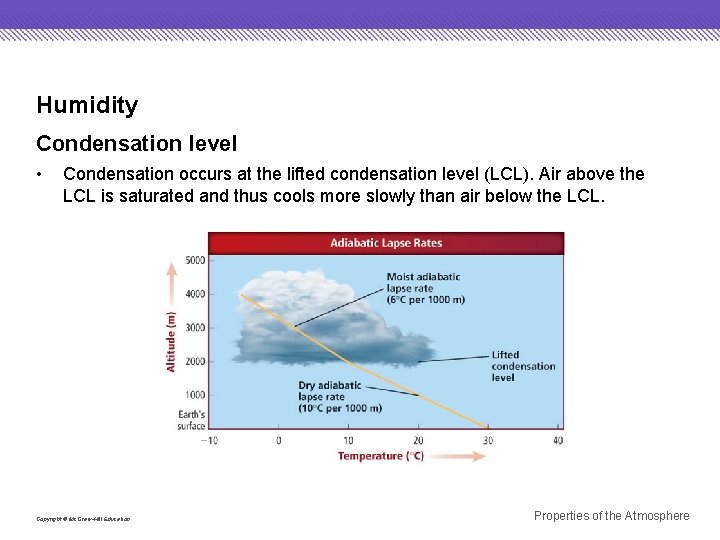
Humidity Condensation level • A process in which temperature changes without the addition or removal of thermal energy from a system is called an adiabatic process. • Adiabatic heating occurs when air is compressed, and adiabatic cooling occurs when air expands. Copyright © Mc. Graw-Hill Education Properties of the Atmosphere
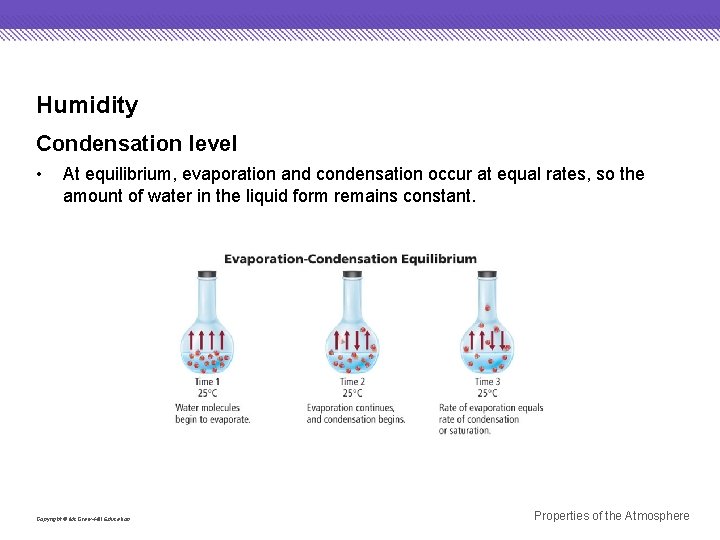
Humidity Condensation level • At equilibrium, evaporation and condensation occur at equal rates, so the amount of water in the liquid form remains constant. Copyright © Mc. Graw-Hill Education Properties of the Atmosphere
Humidity Condensation level • Condensation occurs at the lifted condensation level (LCL). Air above the LCL is saturated and thus cools more slowly than air below the LCL. Copyright © Mc. Graw-Hill Education Properties of the Atmosphere