
WHAT IS AGING MODULE III Course Objective At
WHAT IS AGING? MODULE III
Course Objective At this completion of this module the student will know the difference between healthy aging versus unhealthy aging process

Stages of Life • Infancy: Birth– 12 months • Toddler: Ages 1 -3 • Young Adulthood: Ages 19 -40 • Preschool: Ages 3 -6 years • Middle Adulthood: • School: Ages 6 -10 years • Late Adulthood: • Preadolescence: Ages 10 -13 Ages 65 years & older • Adolescence: Ages 13 -19 Ages 40 -65
Stages of Life What are some of the changes that occur with aging? • Aging causes many physical, psychological and social changes • Aging is a process of life, not a disease
Facts and Fallacy (Fiction) About the Aging Process The normal aging process: • Most older people are active and engaged in work, learning programs, volunteer activities and exercise regimens • Most older people live independent lives and do not need assistance
Facts and Fallacy (Fiction) About the Aging Process (cont’d) Fallacies about aging: • Older people are usually helpless, slow and inactive • Most older people are dependent on other • Most older people are forgetful and mentally challenged
Integumentary System – Skin • The skin is the largest organ in the body and protects the body against entry of bacteria • The skin prevents injury to internal organs & loss of too much water which is essential for life • The skin is also a sense organ that feels heat, cold,
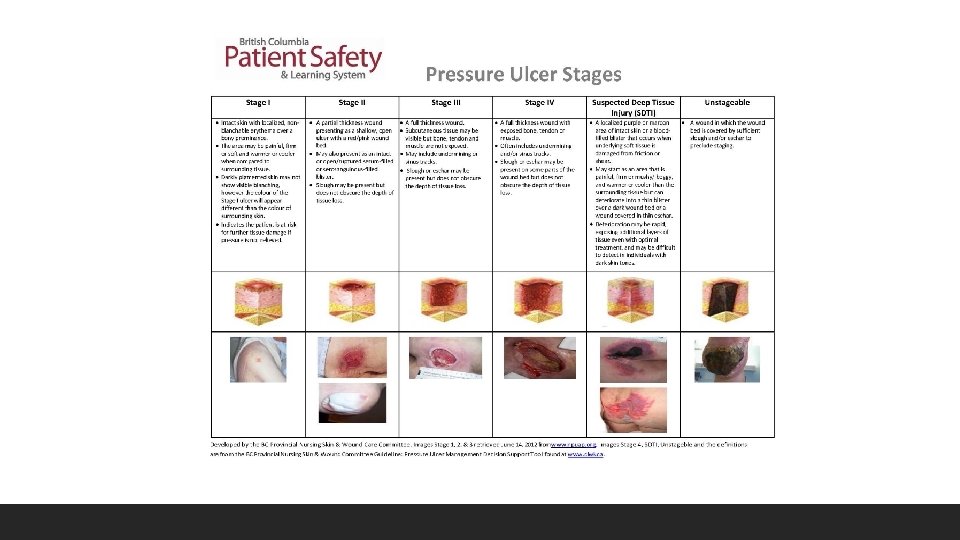
Integumentary System – Skin (cont’d) • Skin tissues will break down if there is decreased blood circulation to areas due to immobility • Patients whose skin is not cared for and whose positions are not change will break down • Patient’s skin can develop pressure ulcers that can
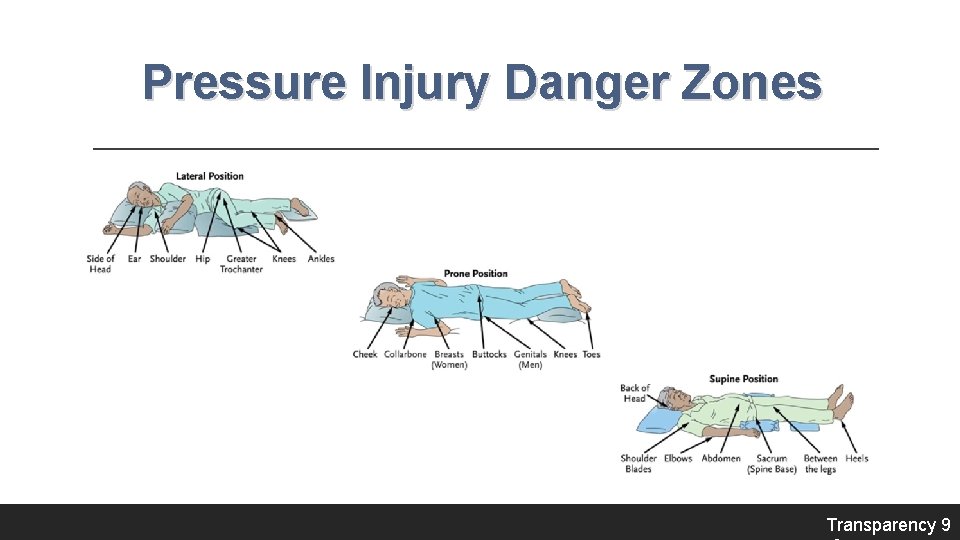
Pressure Injury Danger Zones Transparency 9
Changing in Skin as People Age • Skin of the elderly is thinner, drier, more fragile and is easily damage • Skin is less elastic, fatty layers beneath the skin is lost and person feel colder • Hair thins out and may turn grey
Changing in Skin as People Age (cont’d) • Wrinkles and brown spots appears • Nails are harder and more brittle • Dry, itchy skin may result from lack of oil from the sebaceous glands
Care Guidelines for Skin • Older adults perspire less and do not need to bathe as often. Most need a complete bath twice a week • Be gentle when caring for skin of older adults, skin may be fragile • Gently brush dry hair to stimulate distribution of oil,
Care Guidelines for Skin (cont’d) • Layer clothing and bed covers for additional warmth • Keep bed linen wrinkle free • Encourage fluids

Skin Observation and Reporting Observe and report the first signs of skin breakdown or changes: • Skin that appears pale, white, reddened or purple • Rash or any discoloration • Blisters, bruises • Broken skin

Skin Observation and Reporting • Redness or broken skin between toes or around toenails • Complaints of tingling, warmth or burning • Dry itching, flaky skin • Scalp changes • Cuts, boils, sores, wounds, abrasions or scrapes
Musculoskeletal System Muscles, bones, ligaments, tendons and cartilage give the body shape and structure. They all work together to make the body move. Bones protect organs Muscles provide movement of body parts Exercise: ◦ Improves and maintains physical and mental Health
Conditions Related to Musculoskeletal System • Arthritis o Osteoarthritis o Rheumatoid Arthritis • Osteoporosis • Muscular Dystrophy • Amyotrophic Lateral Sclerosis- ALS- Lou Gherig’s Disease
Changes that Occur in the Musculoskeletal System • The muscles weaken and lose tone • The body movements are slower • Bones lose density and become more brittle making them more susceptible to fractures • There is gradual loss of height
Guidelines for Care in the Musculoskeletal System: • Encourage regular movement and self care • Assist with range of motion exercises as needed • Encourage patients to perform as many ADL’ s as possible • Encourage clients to make decisions for themselves
Guidelines for Care in the Musculoskeletal System: (cont’d) • Encourage them to dress themselves with assistance • Encourage patients to walk and do other lite exercises to strengthen bones • Exercises to prevent osteoporosis (condition responsible for fragile bones)
What are the Factors that Lead to Falls? • Clutter in areas where patient has to ambulate • Poor lighting • Moving furniture's around instead of keeping them in the same places • Untied shoes without nonskid bottoms • Water on the floor • Uneven floors
Observing and Reporting in: Musculoskeletal System • Changes in ability to perform routine movements and activities • Pain during movement • Bruising • Changes or pains • Falls
Nervous System The nervous system is the control and message center of the body. It controls all the body functions. The nervous system has two main parts: • Central Nervous System • Peripheral nervous system
Conditions Related to the Nervous System • Cerebrovascular Accident (CVA) or Stroke • Transient Ischemic Attack (TIA) • Nervous System Sense Organs o Hearing Impairment • Parkinson's o Vision impairment – • Multiple Sclerosis Cataract and Glaucoma
Changes that Occur in the Nervous System • Aging affects the ability to think quickly and logically • Aging can also affect concentration and memory loss of recent events • Elderly patients usually have slower responses and reflexes • Sensitivity of nerve endings in the skin decreases
Guidelines for Care in the: Nervous System • Help with memory loss by suggesting patients to make or write notes about things they want to remember • Keeping a calendar close by is helpful • Allow time for decision – Avoid making sudden changes in schedule • Allow plenty of time for movement, never rush the
Guidelines for Care in the: Nervous System (cont’d) • Encourage reading, thinking, writing, and other mental activities • For changes in vision, provide good lighting • For changes in hearing caregivers must stand in front of patients and speak slowly and clearly, never shout,
Guidelines for Care in the: Nervous System (cont’d) • Know that changes in taste, smell and touch may be dangerous for older patients • Encourage use of aids and assistive devices • You may need to repeat words to help the client understand them clearly
Observing and Reporting: Nervous System • Shaking or trembling • Numbness or tingling • Difficulty swallowing • Memory loss of confusion • Changes in vision or hearing • Inability to move on one side of body • Increase fatigue with activity • Changes in behavior
Circulatory System • The circulatory system consists of the heart, blood and blood vessels • Circulatory system supplies food, oxygen and hormones to cells. It supplies body with infection fighting cells and removes waste products from cells • It controls body temperature
Conditions of the Circulatory System • Hypertension • Coronary Artery Disease • Myocardial Infarction- Heart Attack • Congestive Heart Failure • Peripheral Vascular Disease
Observing and Reporting in: Circulatory System • Changes in heart rate/ pulse • Pale bluish hands, feet or lips • Chest pain • Weight gain • Swelling, also called edema of ankles, feet, fingers or hands • Shortness of breath or changes in breathing patterns
Guidelines for Care for: Circulatory System • Moderate exercises such as walking, stretching, and even lifting light weights can be necessary and helpful t increase body strength and promote circulation • Assist patients with active or passive exercises as directed by care plan
Guidelines for Care for: Circulatory System (cont’d) • Encourage clients to rise slowly and to stand still for a few moments before walking to prevent dizziness that occurs with rapid movements
Guidelines for Care for: Circulatory System (cont’d) • Discourage vigorous activity or exercises for older patients who are in heart failure, example of heavy exercises are : carrying heavy objects • Assist with temperature regulation
Endocrine System The purpose of the endocrine system is to maintain homeostasis through hormone secretions, influence growth and development, maintain blood sugar and regulate levels of calcium and phosphate in the body
Endocrine System (cont’d) The endocrine system also regulates the body’s ability to reproduce and determines how quickly cells will burn the food to be used as energy
Endocrine System (cont’d) As the body ages the level of certain hormones decrease, insulin production may lessen and the body is not able to handle as much stress
Conditions of the Endocrine System • Diabetes • Hyperthyroidism • Hypothyroidism
Care for Endocrine System • Client’s may need to take Insulin to help regulate their sugar • Eliminate stressors
Observing and Reporting: Endocrine System • Changes in appetite • Sweet or fruity breath • Increased thirst • Hunger • Sluggishness or fatigue • Dry skin • Increase urination • Changes in sensation
Observing and Reporting: Endocrine System (cont’d) • Changes in normal behavior • Weight gain or loss • Weakness • Changes in mobility • Headaches • Blurred vision • Dizziness
Respiratory System • The respiratory system is made up of the larynx, trachea, lungs, bronchus • Respiration refers to the body taking in oxygen and removing carbon dioxide
Respiratory System (cont’d) • Changes may occur in the respiratory system as the body ages, the lung strength and lung capacity decreases, the oxygen in the blood decreases. Older adults may have a harder time coughing up mucus, some people
Conditions of the Respiratory System • Chronic Obstructive Pulmonary Disorder COPD • Bronchitis • Emphysema • Pneumonia • Asthma • Upper Respiratory Infection • Lung Cancer • Tuberculosis
Care for the Respiratory System • Assist with deep breathing exercises as order in care plan • Provide rest periods as needed when assisting patients with ADL’s • Assist with exercise activities, but discourage overdoing it – for any questions speak with supervisor • Avoid Smoking
Observing and Reporting: Respiratory System • Changes in respiratory rate • Changes in breathing patterns • Pain in chest • Pale or bluish lips, arms and legs • Coughing or wheezing • The need for frequent rest after activity • Sore throat or difficulty swallowing • Discolored Sputum/ Mucus
Urinary System • The urinary system is made up of the kidneys, ureters, urethra, bladder and meatus. • The purpose of the urinary system is to remove waste products created by the cells and to maintain water balance in the body
Conditions of the Urinary System • Urinary Tract Infection- UTI • Kidney Stones • Chronic Renal Failure
Changes that Occur in the Urinary System • Kidneys ability to filter blood decreases • The bladder’s muscle tone weakens • The bladder is unable to hold as much urine as it did when patients when younger
Changes that Occur in the Urinary System (cont’d) • The bladder may not empty completely making it susceptible to infections • Lost of control of bladder lead to urine incontinence that can cause dehydration and skin breakdown • Incontinence is not a normal part of aging
Guidelines for Care: Urinary System • Always report incontinence, it may be a sign of an illness. • Cleanliness and regular skin care important • Offer frequent trips to the bathroom for bladder retraining • Report s/s of urinary tract
Observing and Reporting: System • Pain or burning during urination • Weight loss or weight gain • Swelling in the upper or lower extremities • Changes in urine, such as cloudiness, odor or color • Swelling in the bladder or abdominal area
Observing and Reporting: System (cont’d) • Complaints that bladder feels painful • Urinary incontinence or dribbling • Pain in the kidneys or back/flank region • Inadequate fluid Intake • Confusion
Gastrointestinal System The gastrointestinal system is also called the digestive system, it is made up of the gastro intestinal tract and the necessary digestive organs. The gastrointestinal tract is the long passageway extending from the mouth to the anus, the opening of the rectum.
Gastrointestinal System (cont’d) Food passes thru the mouth through the pharynx, esophagus, stomach, small intestine, large intestine and out of the body as solid waste (feces or stool) the gastrointestinal system has the following functions: • Digestion • Absorption • Elimination
Conditions in the Gastrointestinal System • Constipation • Fecal Impaction • Hemorrhoids • Diarrhea • Gastrointestinal Reflux Disease – GERD – Heartburn • Peptic Ulcers • Ulcerative Colitis • Colorectal Cancer
Care for the Gastrointestinal System • Encourage fluids and nutritional appealing meals to help increase intake • Cut food into smaller pieces for patients who are having swallowing problems
Care for the Gastrointestinal System (cont’d) • Make sure teeth and dentures are in good shape • Preventing constipation by offering patients foods that are high in fiber • Preventing dehydration
Observing and Reporting: Gastrointestinal System • Difficulty swallowing or chewing • Fecal incontinence (inability to control bowels) • Abdominal pains and cramping • Diarrhea
Observing and Reporting: Gastrointestinal System (cont’d) • Nausea, vomiting • Constipation • Bloody, black or hard stools • Poor nutritional intake • Loss of appetite
Reproduction System • Made up of the reproduction organs which are different in both men and women. • Reproduction begins when a male’s and female’s sex cells join
Reproduction System (cont’d) • Changes to the reproduction system may include: o Menstruation ends o Sperm production decreases o Prostate gland enlarges which can interfere with urination o Sexual needs and desires do not change
Conditions of the Reproduction System • Vaginitis • Benign Prostate Hypertrophy- BPH • Sexually transmitted infections →◦ ◦ Chlamydia Syphilis Gonorrhea Genital herpes ◦ HPV
Care for the Reproduction System • Avoid Hot baths • There is a still a sexual need for older clients • Report behavior that make you uncomfortable
Observing and Reporting: Reproduction System • Discomfort or difficulty urinating • Discharge from penis or vagina • Swelling of genitals • Blood in urine or stool
Observing and Reporting: Reproduction System (cont’d) • Redness, rash or itchiness on genitals • Painful intercourse • Breast changes
Immune System • Immune system protects body from bacteria, viruses and microorganisms that are disease causing • Conditions of the immune System o HIV/ AIDS o Cancer o Opportunistic Infections
Changes in the Immune System • Immune system gradually weakens • Recovery time from infections is longer • Bone marrow activity decreases • Body’s response to vaccines decrease
Care for the Immune System • Handwashing often • Keep clients environment clean • An older adult fighting an infection may not experience fever • Stay Home when Sick
Observing and Reporting: Immune System • Recurring Infections • Increase Fatigue • Temperature
Physiological Changes • Some forgetfulness is a normal part of aging but constant memory lapses or forgetting basic information such as family members names are not normal changes of aging • Temporary Changes can be caused by infections, strokes, high fever, diabetes poor nutrition and drug interactions
Mental Function in Change in Aging Definitions COGNITIONS- The ability to think logically and clearly. COGNITIVE IMPAIRMENT- When there is some loss of the ability to think logically and clearly DEMENTIA- a general term that refers to serious mental changes such as thinking , reasoning, remembering, and communicating
Normal vs Not Normal Mental Function in Changes Normal Changes: Forgetfulness: some forgetfulness of recent events is a normal. Not a Normal Part of Aging: Dementia: is not a normal part of aging. Alzheimer’s disease is the most common cause of dementia. Alzheimer’s disease is a progressive, degenerative and irreversible disease.
Stages of Alzheimer’s • Mild Alzheimer’s Disease - Early Stages o Reality orientation is a good idea at this stage • Moderate Alzheimer’s Disease (middle stage) • Severe Alzheimer’s Disease (late stage) o Encourage the client to be as independent as possible in all stages of Alzheimer’s.
Helpful Attitudes in Caring for a Client with Alzheimer’s Disease • Don’t take things personally • Be empathetic (treat clients with respect and dignity) • Work with symptoms and behaviors noted • Work as a team
Helpful Attitudes in Caring for a Client with Alzheimer’s Disease (cont’d) • Be aware of difficulties associated with caregiving • Work with family members • Remember the goals of the care plan
Communication with an Alzheimer’s Client Always approach from the front. Do not startle the client. Be aware of body language. • Make sure your body language is not anxious, rushed or hurried o Smile, look friendly and happy o Determine how close the client want’s you to be
Communication with an Alzheimer’s Client (cont’d) • Communicate in a calm, environment with little background noise and distractions. Speak slowly, using lower tone of voice o Repeat yourself using the same words and phrases, as often as needed. • Break complex task into smaller , simpler ones
Assisting with Activities of Daily Living Bathing: 1. Schedule bathing when the client is least agitated 2. Take a walk to the bathroom with the client rather than asking directly about a bath 3. Give client a wash cloth to hold. This can distract the client while you finish the bath
Assisting with Activities of Daily Living (cont’d) Bathing: 4. Always follow safety precautions 5. Be flexible about when to bathe a client 6. Be relaxed and allow the client to enjoy the bath. Offer encouragement and praise
Assisting with Activities of Daily Living (cont’d) Dressing: 1. Show the client some clothing. This brings up the idea of dressing 2. Encourage the client to pick clothes to wear. Simply by just giving a few appropriate choices 3. Lay out clothing in the order in which they are to be put on. Choose clothing that are simple to put on.
Assisting with Activities of Daily Living (cont’d) Elimination: 1. Encourage fluids. Never withhold or discourage fluids because of a problem with incontinence. 2. Mark the bathroom with a sign or a picture as a reminder of where it is and to use the toilet. 3. Take the client to the bathroom after drinking fluids. Take the client to the bathroom before and after
Assisting with Activities of Daily Living (cont’d) Nutrition: 1. Serve meals at regular, consistent times each day. Remind the client that it’s mealtime. 2. Provide adequate lighting 3. Keep eating simple 4. Do not serving steaming or very hot foods or drinks
Assisting with Activities of Daily Living (cont’d) Nutrition (cont’d): 6. Provide adequate fluids to prevent dehydration. 7. If the client has to be fed do so slowly. Allow the client to swallow before introducing the next bite or drink. Make sure the client chews. Observe/ Report difficulty swallowing. Other: Observe for/ and report signs of pain
Interventions for Common Difficult Behaviors AGITATION- A client who is restless, troubled, excited is said to be agitated. TRIGGERS- a situation that lead to agitation. 1. Try to eliminate triggers. Keep a routine. Avoid frustration. Redirect the client’s attention. 2. Reduce noise and distraction 3. Remain calm. Use a calm soothing voice. 4. Watch your own body language
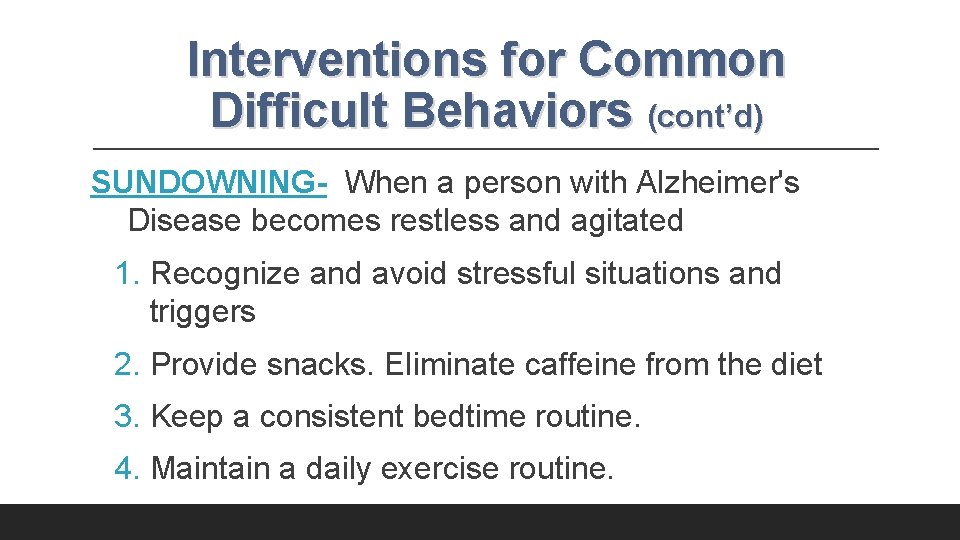
Interventions for Common Difficult Behaviors (cont’d) SUNDOWNING- When a person with Alzheimer's Disease becomes restless and agitated 1. Recognize and avoid stressful situations and triggers 2. Provide snacks. Eliminate caffeine from the diet 3. Keep a consistent bedtime routine. 4. Maintain a daily exercise routine.
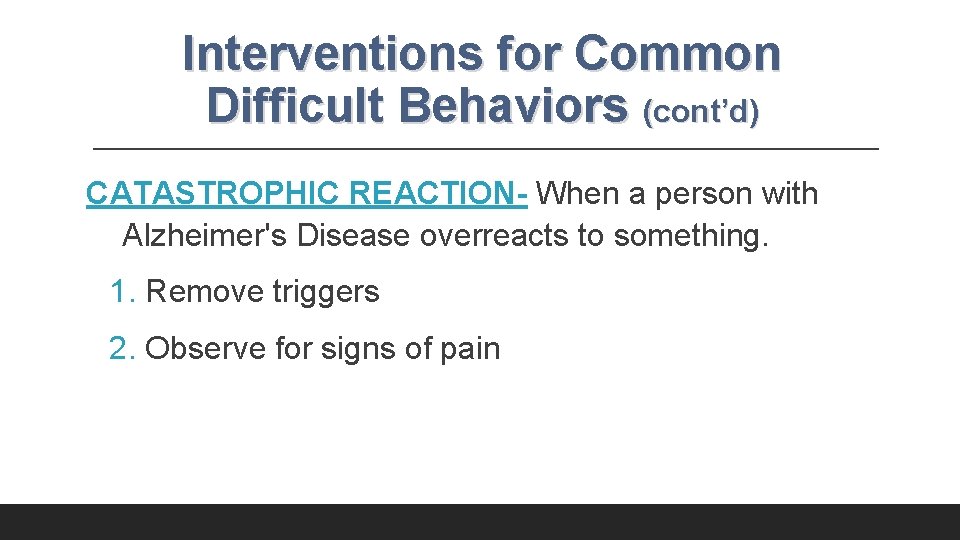
Interventions for Common Difficult Behaviors (cont’d) CATASTROPHIC REACTION- When a person with Alzheimer's Disease overreacts to something. 1. Remove triggers 2. Observe for signs of pain
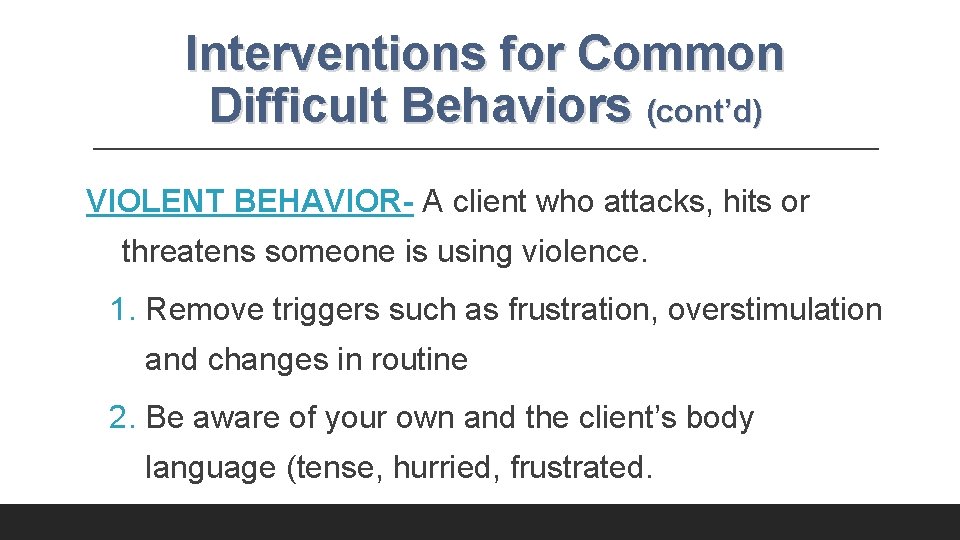
Interventions for Common Difficult Behaviors (cont’d) VIOLENT BEHAVIOR- A client who attacks, hits or threatens someone is using violence. 1. Remove triggers such as frustration, overstimulation and changes in routine 2. Be aware of your own and the client’s body language (tense, hurried, frustrated.
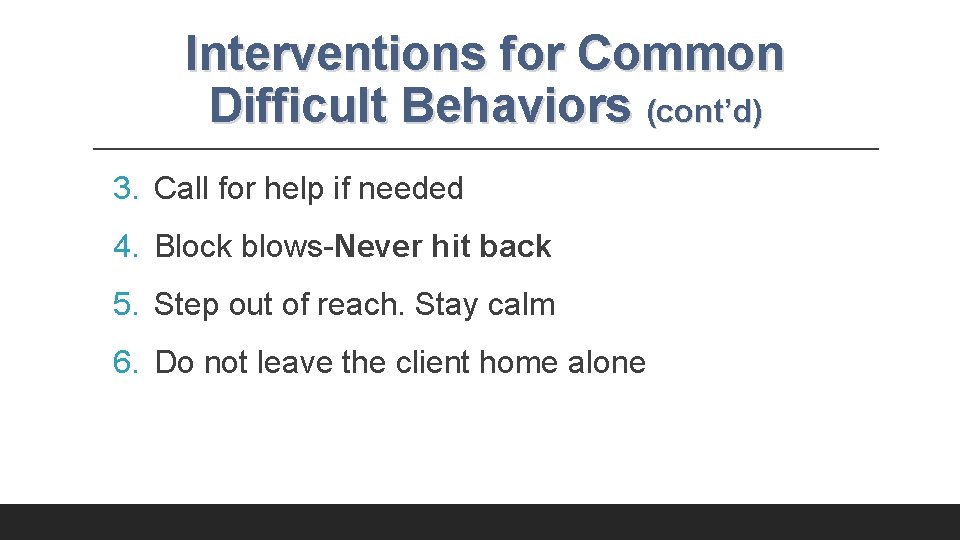
Interventions for Common Difficult Behaviors (cont’d) 3. Call for help if needed 4. Block blows-Never hit back 5. Step out of reach. Stay calm 6. Do not leave the client home alone
Pacing and Wandering PACING- a client who walks back and forth in the same area. WANDERING- a client who walks aimlessly around the house or neighborhood.
Causes for Pacing and Wandering • Restless • Hunger • Disorientation • Incontinence or the need to use the bathroom • Constipation
Causes for Pacing and Wandering • Pain • Forgetting how or where to sit down • Too much daytime napping • Need for exercise

Guidelines for Patients Who Pace and Wander • Eliminate causes when possible • Redirect attention • Mark rooms with signs or pictures • Report if client wanders away from protected area and does not return “Elopes”
Hallucinations or Delusions HALLUCINATIONS - sees, hears, smells, tastes or feels things that are note there DELUSIONS - believing things that are not true. What to do: 1. Ignore harmless hallucinations or delusions 2. Reassure client 3. Don’t argue 4. Redirect
Inappropriate Sexual Behavior Inappropriate sexual behavior may include removing clothing, touching one’s genital in public, or trying to touch others. Should your client do this: • Keep calm • Try to deter the cause • Offer other forms of stimulation (ie. a soft doll)
Sleep Disturbance/Suspicion Sleep Disturbances: 1. Make sure client gets moderate exercises 2. Spend some time in natural sunlight if possible 3. Discourage sleeping during the day if possible Suspicion: 1. Don’t argue with the client. Arguing increases defensiveness. 2. Offer reassurance and support
Questions and Concerns
- Slides: 99