
What is acceleration Acceleration describe all situations in
What is acceleration ? • Acceleration describe all situations in which speed is changing. • This includes increasing and decreasing speeds. • To calculate acceleration you need to divide the change of speed by the change of time. • Ex: a= ∆ v ∆t
Acceleration • When acceleration is uniform, this is called constant acceleration. • When acceleration varies over a period of time, this is called average acceleration.
Sample Problem • You are on a motorcycle that speeds up from rest (0 m/s) to 9. 0 (m/s) in 2 seconds. What is your average acceleration. a= ∆ v ∆t a = 9. 0 m/s 2. 0 s 2 A= 4. 5 m/s/s or 4. 5 m/s
Sample Problem 2 • This is great for people who are buying cars. You can see how powerful the car is when it can accelerate from 0 to 100 km/h in 6. 0 s. a= ∆ v ∆t A= 100 km/h 6. 0 s A= 17 km/h/s That means that after every second, the car is moving 17 km/h faster than it was the second before.
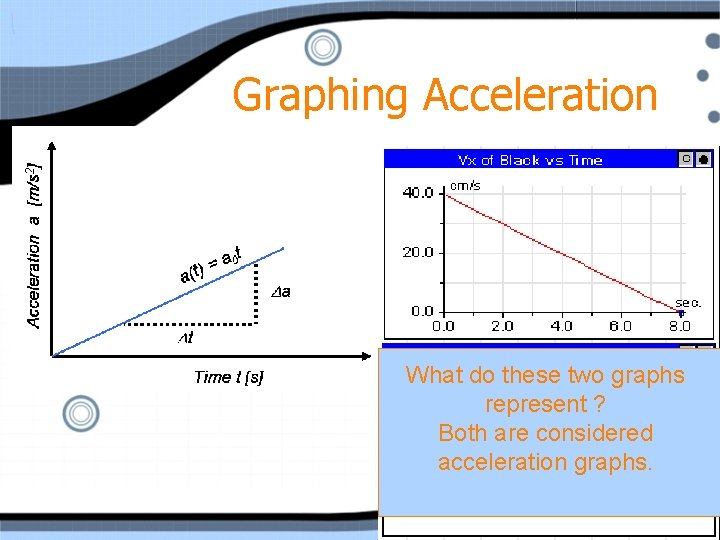
Graphing Acceleration What do these two graphs represent ? Both are considered acceleration graphs.
Acceleration Graphs • The first graph represents an object speeding up from rest. • Positive Acceleration • The second graph represents an object slowing down to a stop. • Negative Acceleration
Try These… • 1. In a race, a car traveling at 100 km/h comes to a stop in 5. 0 s. What is the average acceleration? • 2. A 2008 Porsche accelerates from 0 to 100 km/h in 3. 8 s. What is the average acceleration.
- Slides: 7