
What is a workaround A rushed improvised response
- Slides: 1
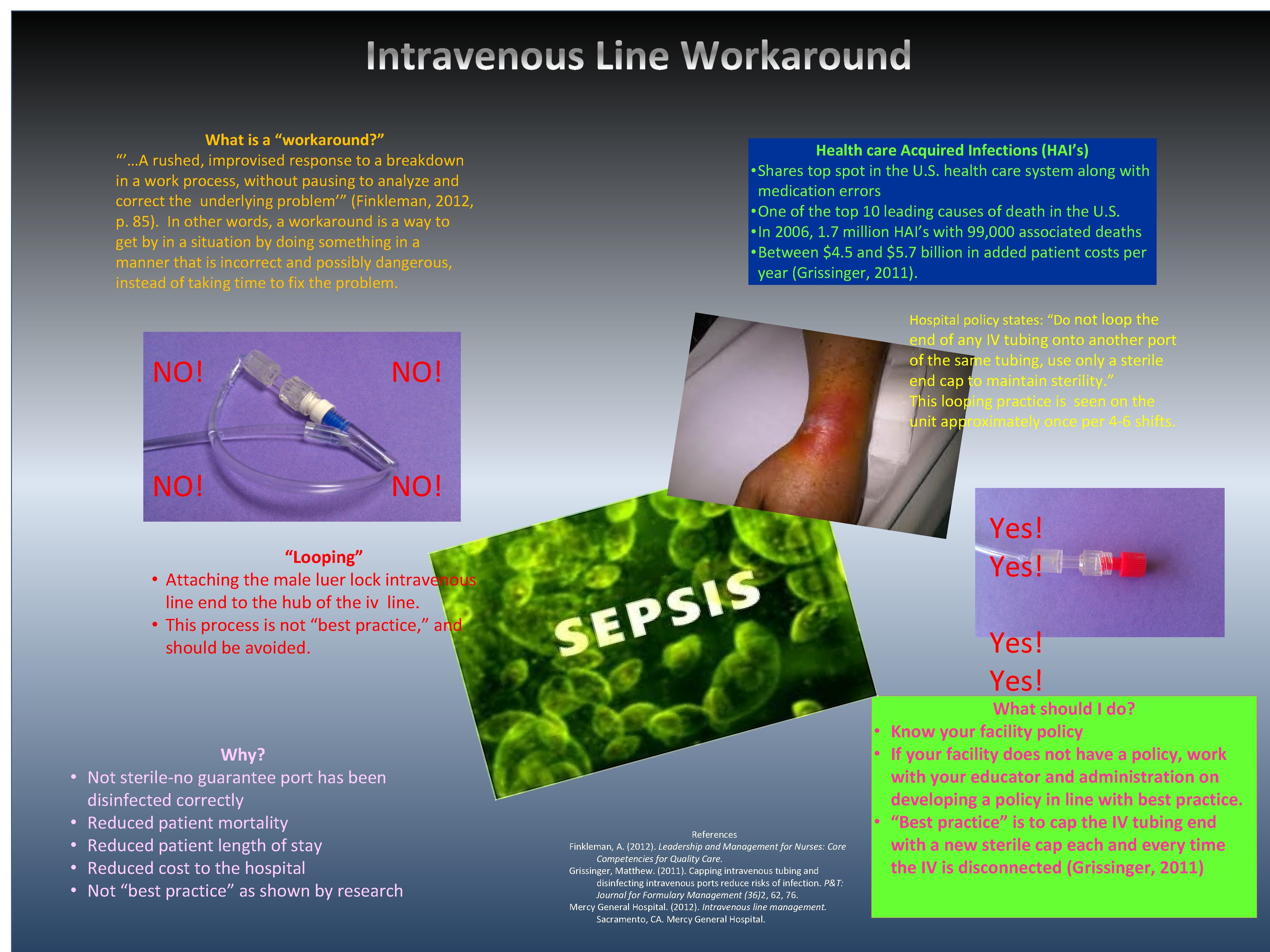
What is a “workaround? ” “’…A rushed, improvised response to a breakdown in a work process, without pausing to analyze and correct the underlying problem’” (Finkleman, 2012, p. 85). In other words, a workaround is a way to get by in a situation by doing something in a manner that is incorrect and possibly dangerous, instead of taking time to fix the problem. Health care Acquired Infections (HAI’s) • Shares top spot in the U. S. health care system along with medication errors • One of the top 10 leading causes of death in the U. S. • In 2006, 1. 7 million HAI’s with 99, 000 associated deaths • Between $4. 5 and $5. 7 billion in added patient costs per year (Grissinger, 2011). Hospital policy states: “Do not loop the NO! NO! end of any IV tubing onto another port of the same tubing, use only a sterile end cap to maintain sterility. ” This looping practice is seen on the unit approximately once per 4 -6 shifts. Yes! “Looping” • Attaching the male luer lock intravenous line end to the hub of the iv line. • This process is not “best practice, ” and should be avoided. • • • Why? Not sterile-no guarantee port has been disinfected correctly Reduced patient mortality Reduced patient length of stay Reduced cost to the hospital Not “best practice” as shown by research Yes! References Finkleman, A. (2012). Leadership and Management for Nurses: Core Competencies for Quality Care. Grissinger, Matthew. (2011). Capping intravenous tubing and disinfecting intravenous ports reduce risks of infection. P&T: Journal for Formulary Management (36)2, 62, 76. Mercy General Hospital. (2012). Intravenous line management. Sacramento, CA. Mercy General Hospital. What should I do? • Know your facility policy • If your facility does not have a policy, work with your educator and administration on developing a policy in line with best practice. • “Best practice” is to cap the IV tubing end with a new sterile cap each and every time the IV is disconnected (Grissinger, 2011)