
What is a virtual circuit network Telecommunication networks
- Slides: 35
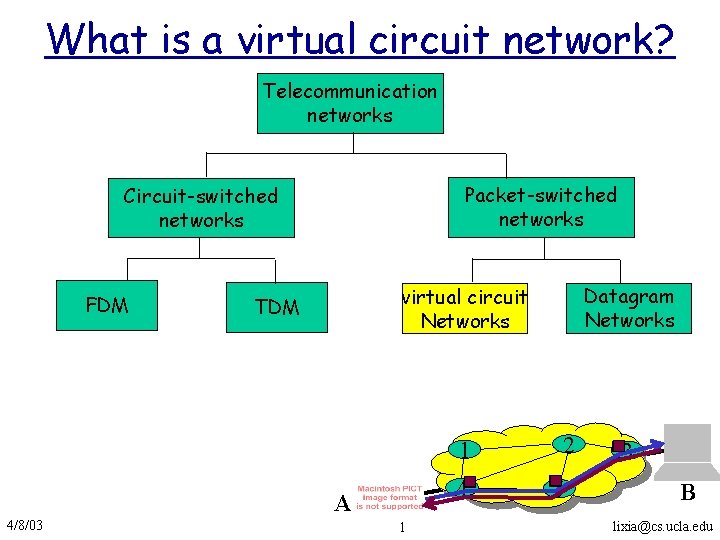
What is a virtual circuit network? Telecommunication networks Packet-switched networks Circuit-switched networks FDM 1 4 A 4/8/03 Datagram Networks virtual circuit Networks TDM 1 2 5 3 B lixia@cs. ucla. edu
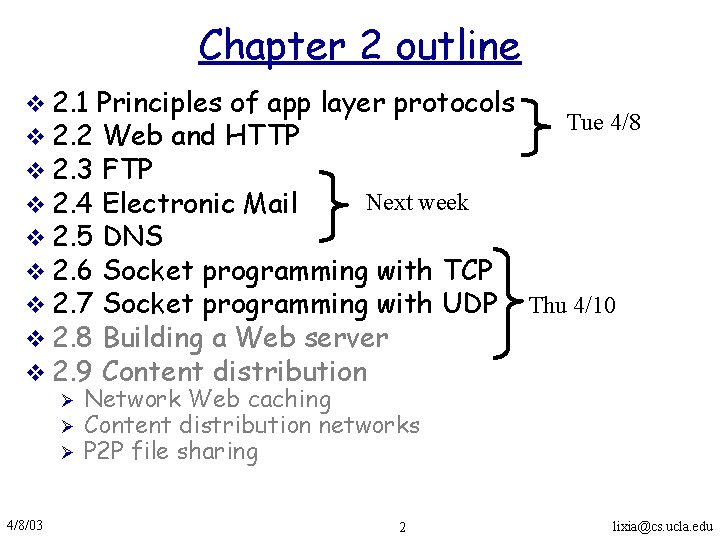
Chapter 2 outline v 2. 1 Principles of app layer protocols Tue 4/8 v 2. 2 Web and HTTP v 2. 3 FTP Next week v 2. 4 Electronic Mail v 2. 5 DNS v 2. 6 Socket programming with TCP v 2. 7 Socket programming with UDP Thu 4/10 v 2. 8 Building a Web server v 2. 9 Content distribution Ø Network Web caching Ø Content distribution networks Ø P 2 P file sharing 4/8/03 2 lixia@cs. ucla. edu
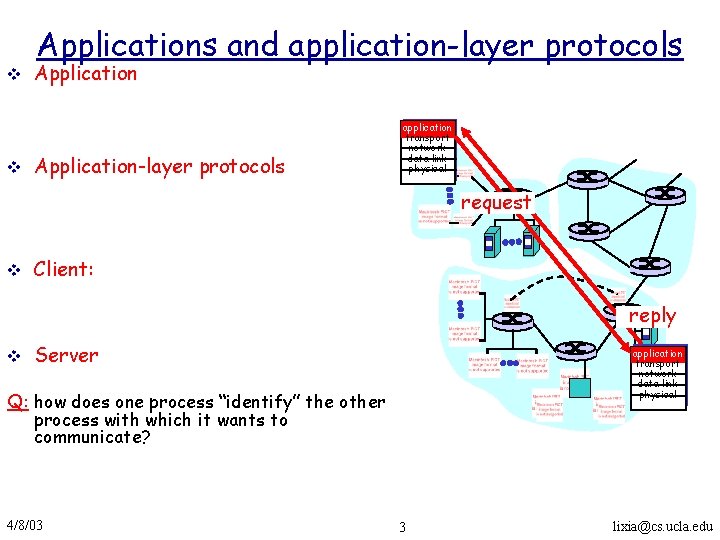
Applications and application-layer protocols v Application-layer protocols application transport network data link physical request v Client: reply v Server application transport network data link physical Q: how does one process “identify” the other process with which it wants to communicate? 4/8/03 3 lixia@cs. ucla. edu
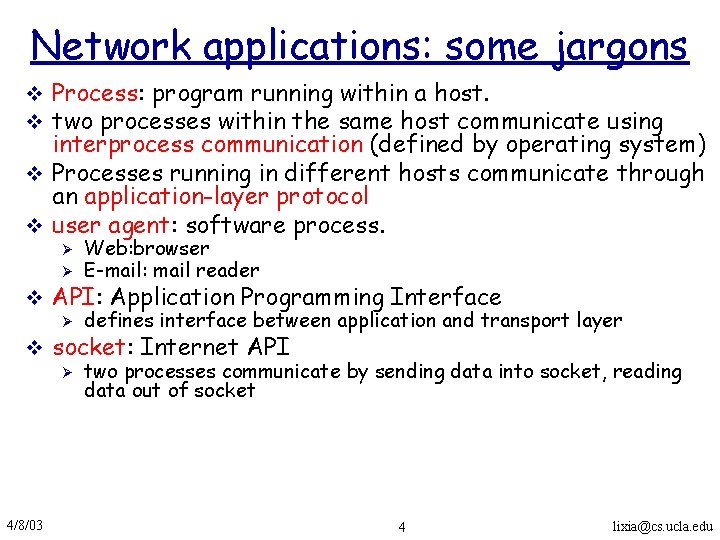
Network applications: some jargons v Process: program running within a host. v two processes within the same host communicate using interprocess communication (defined by operating system) v Processes running in different hosts communicate through an application-layer protocol v user agent: software process. Ø Ø Web: browser E-mail: mail reader v API: Application Programming Interface Ø defines interface between application and transport layer v socket: Internet API Ø two processes communicate by sending data into socket, reading data out of socket 4/8/03 4 lixia@cs. ucla. edu
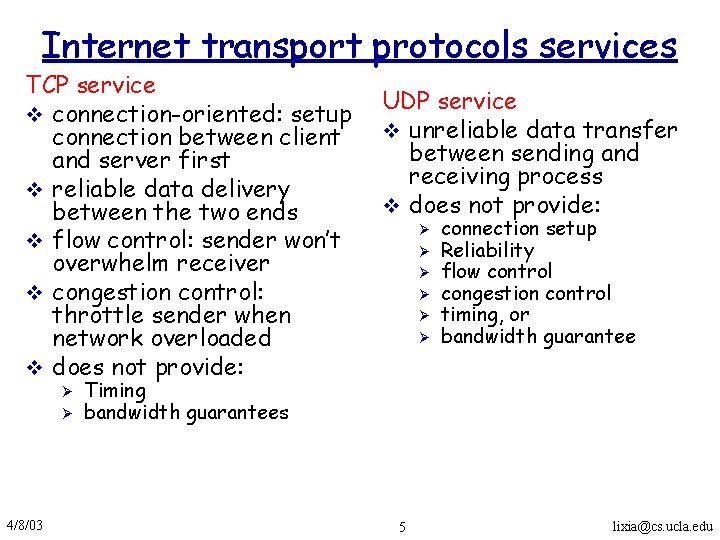
Internet transport protocols services TCP service v connection-oriented: setup connection between client and server first v reliable data delivery between the two ends v flow control: sender won’t overwhelm receiver v congestion control: throttle sender when network overloaded v does not provide: Ø Ø 4/8/03 UDP service v unreliable data transfer between sending and receiving process v does not provide: Ø Ø Ø connection setup Reliability flow control congestion control timing, or bandwidth guarantee Timing bandwidth guarantees 5 lixia@cs. ucla. edu
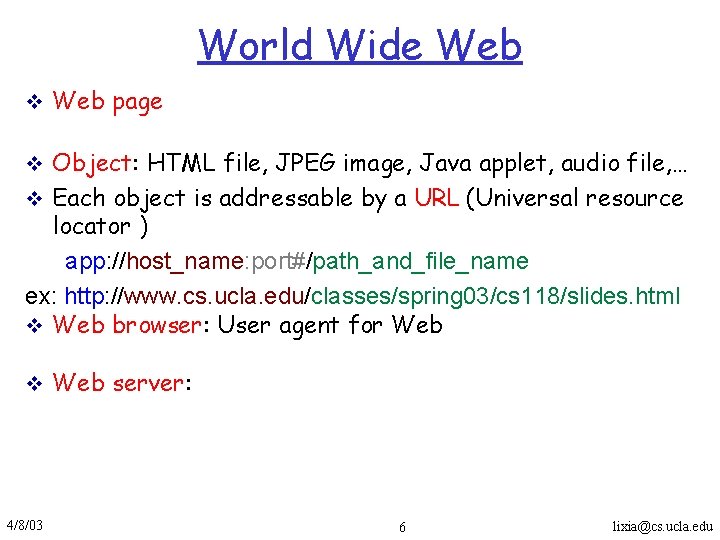
World Wide Web v Web page v Object: HTML file, JPEG image, Java applet, audio file, … v Each object is addressable by a URL (Universal resource locator ) app: //host_name: port#/path_and_file_name ex: http: //www. cs. ucla. edu/classes/spring 03/cs 118/slides. html v Web browser: User agent for Web v Web server: 4/8/03 6 lixia@cs. ucla. edu
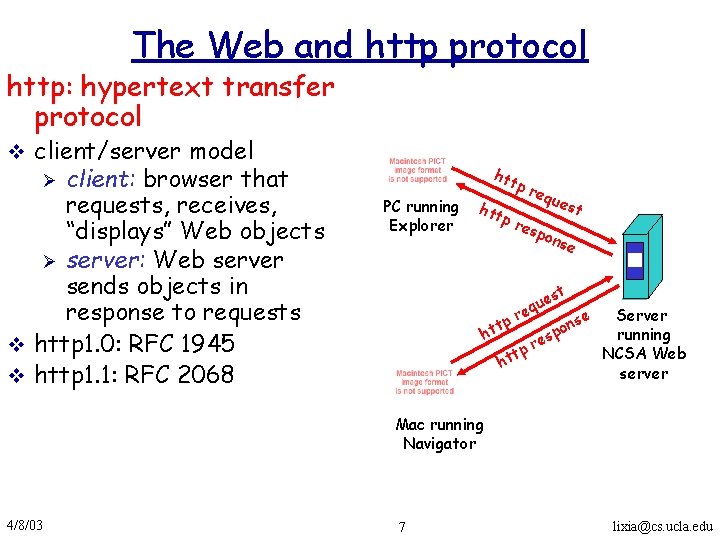
The Web and http protocol http: hypertext transfer protocol v client/server model client: browser that requests, receives, “displays” Web objects Ø server: Web server sends objects in response to requests v http 1. 0: RFC 1945 v http 1. 1: RFC 2068 htt Ø PC running Explorer htt pr equ pr est esp tp ht e t es u q re ttp h ons re n spo se Server running NCSA Web server Mac running Navigator 4/8/03 7 lixia@cs. ucla. edu
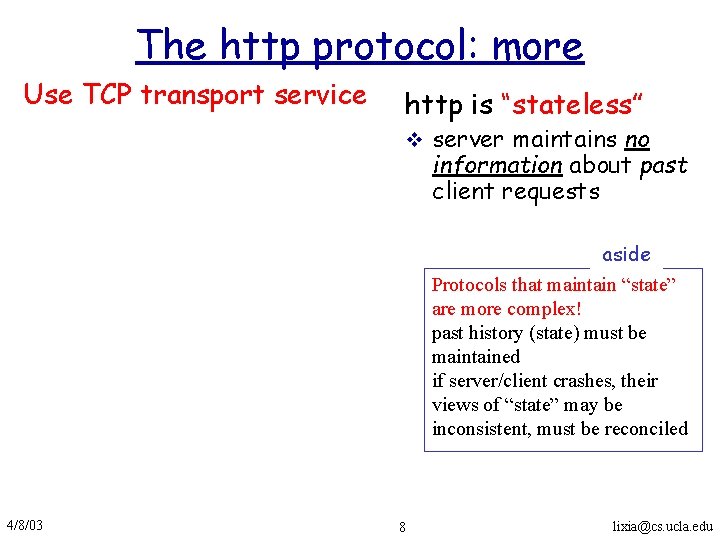
The http protocol: more Use TCP transport service http is “stateless” v server maintains no information about past client requests aside Protocols that maintain “state” are more complex! past history (state) must be maintained if server/client crashes, their views of “state” may be inconsistent, must be reconciled 4/8/03 8 lixia@cs. ucla. edu
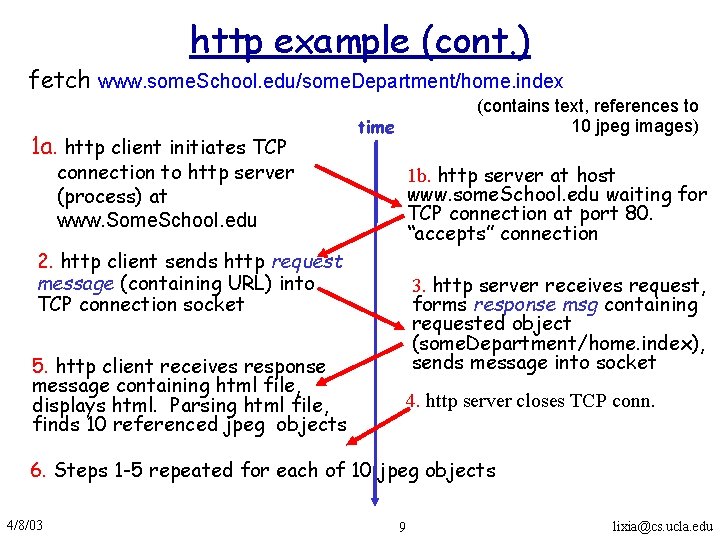
http example (cont. ) fetch www. some. School. edu/some. Department/home. index 1 a. http client initiates TCP (contains text, references to 10 jpeg images) time connection to http server (process) at www. Some. School. edu 1 b. http server at host www. some. School. edu waiting for TCP connection at port 80. “accepts” connection 2. http client sends http request message (containing URL) into TCP connection socket 3. http server receives request, forms response msg containing requested object (some. Department/home. index), sends message into socket 5. http client receives response message containing html file, displays html. Parsing html file, finds 10 referenced jpeg objects 4. http server closes TCP conn. 6. Steps 1 -5 repeated for each of 10 jpeg objects 4/8/03 9 lixia@cs. ucla. edu
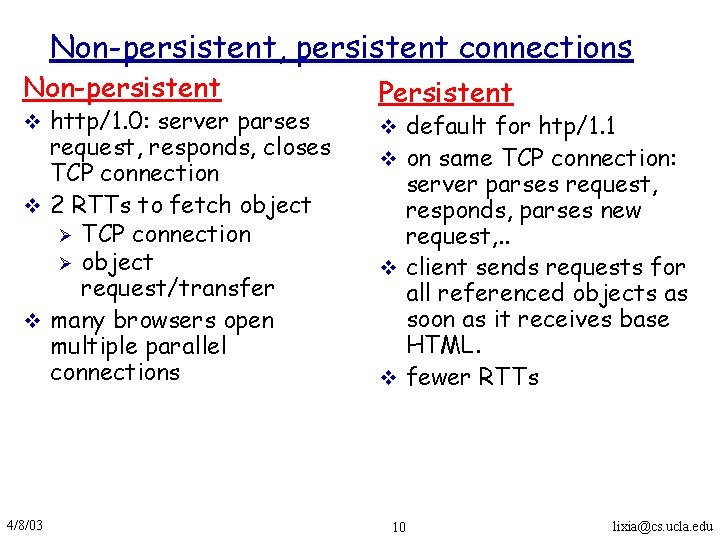
Non-persistent, persistent connections Non-persistent v http/1. 0: server parses request, responds, closes TCP connection v 2 RTTs to fetch object Ø TCP connection Ø object request/transfer v many browsers open multiple parallel connections 4/8/03 Persistent v default for htp/1. 1 v on same TCP connection: server parses request, responds, parses new request, . . v client sends requests for all referenced objects as soon as it receives base HTML. v fewer RTTs 10 lixia@cs. ucla. edu
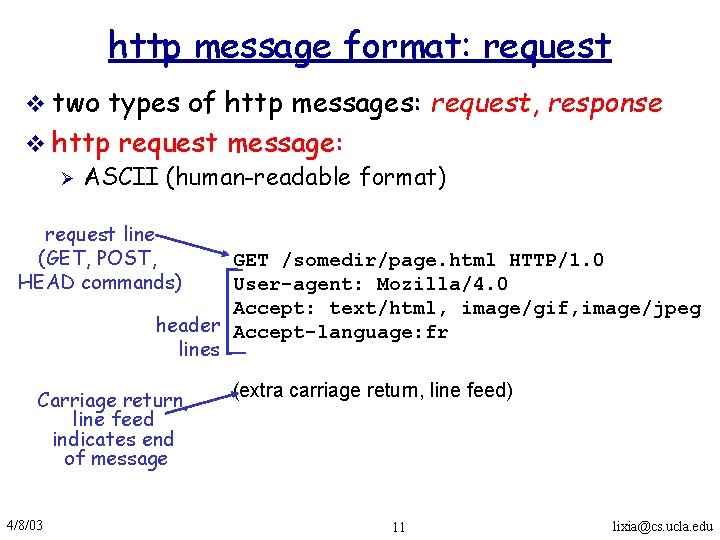
http message format: request v two types of http messages: request, response v http request message: Ø ASCII (human-readable format) request line (GET, POST, HEAD commands) GET /somedir/page. html HTTP/1. 0 User-agent: Mozilla/4. 0 Accept: text/html, image/gif, image/jpeg header Accept-language: fr lines Carriage return, line feed indicates end of message 4/8/03 (extra carriage return, line feed) 11 lixia@cs. ucla. edu
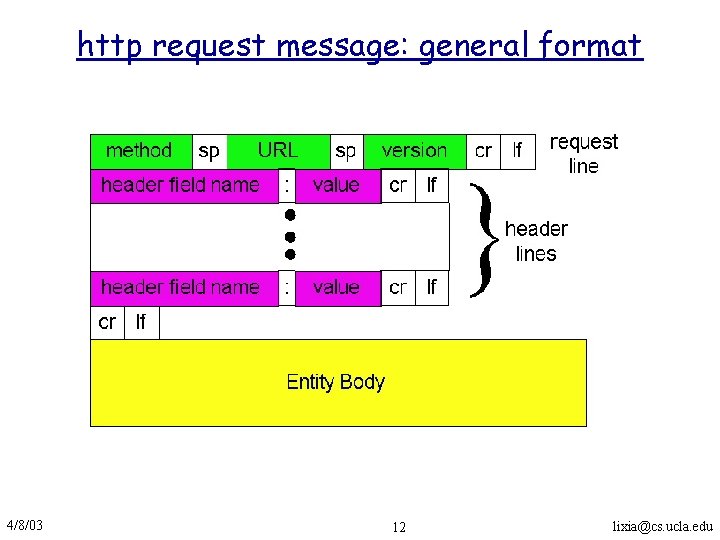
http request message: general format 4/8/03 12 lixia@cs. ucla. edu
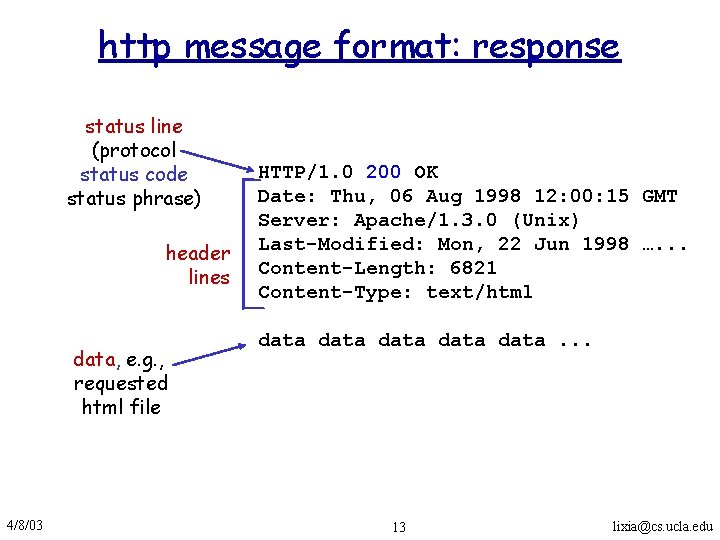
http message format: response status line (protocol status code status phrase) header lines data, e. g. , requested html file 4/8/03 HTTP/1. 0 200 OK Date: Thu, 06 Aug 1998 12: 00: 15 GMT Server: Apache/1. 3. 0 (Unix) Last-Modified: Mon, 22 Jun 1998 …. . . Content-Length: 6821 Content-Type: text/html data data. . . 13 lixia@cs. ucla. edu
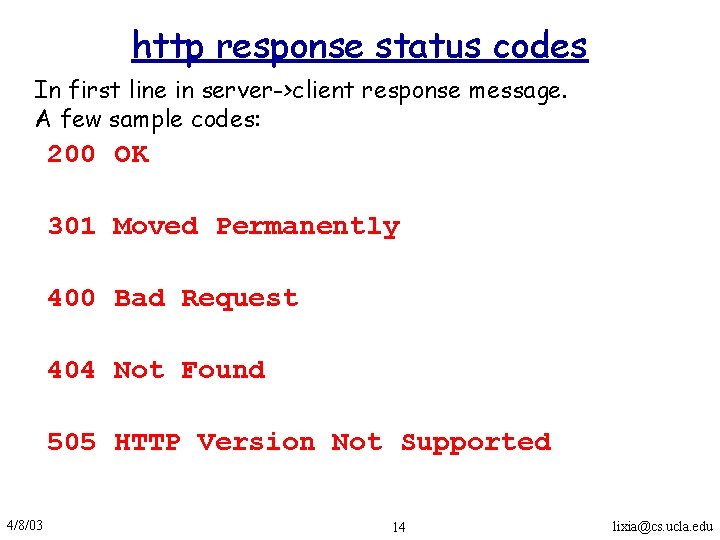
http response status codes In first line in server->client response message. A few sample codes: 200 OK 301 Moved Permanently 400 Bad Request 404 Not Found 505 HTTP Version Not Supported 4/8/03 14 lixia@cs. ucla. edu
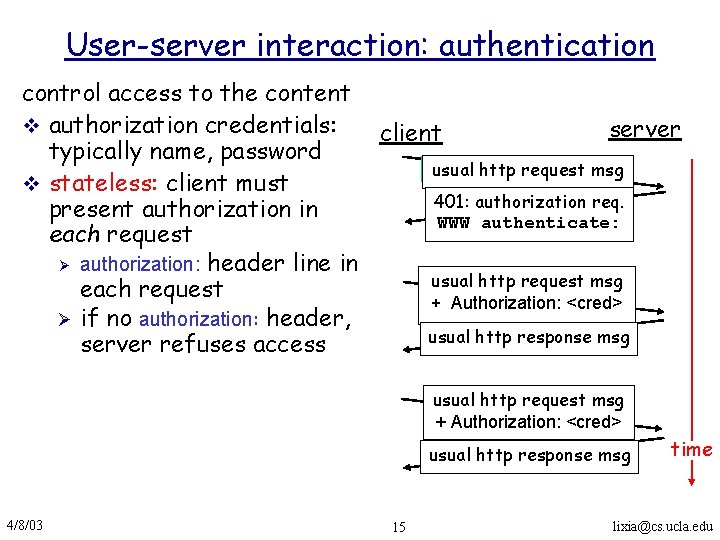
User-server interaction: authentication control access to the content v authorization credentials: server client typically name, password usual http request msg v stateless: client must 401: authorization req. present authorization in WWW authenticate: each request Ø authorization: header line in usual http request msg each request + Authorization: <cred> Ø if no authorization: header, usual http response msg server refuses access usual http request msg + Authorization: <cred> usual http response msg 4/8/03 15 time lixia@cs. ucla. edu
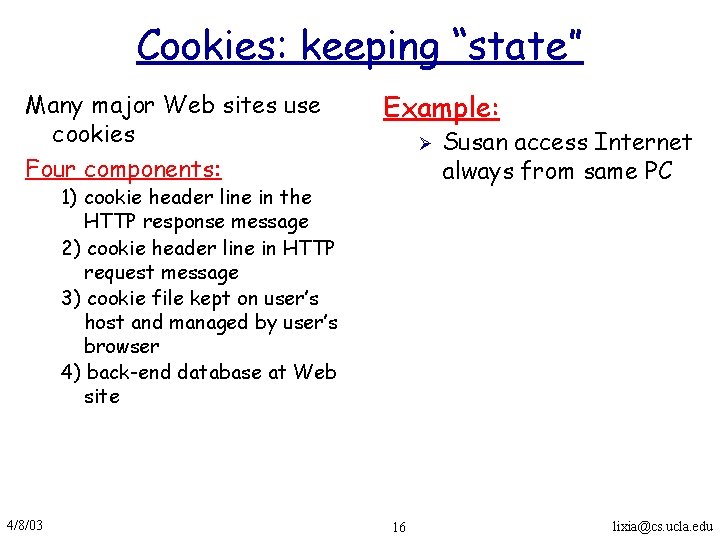
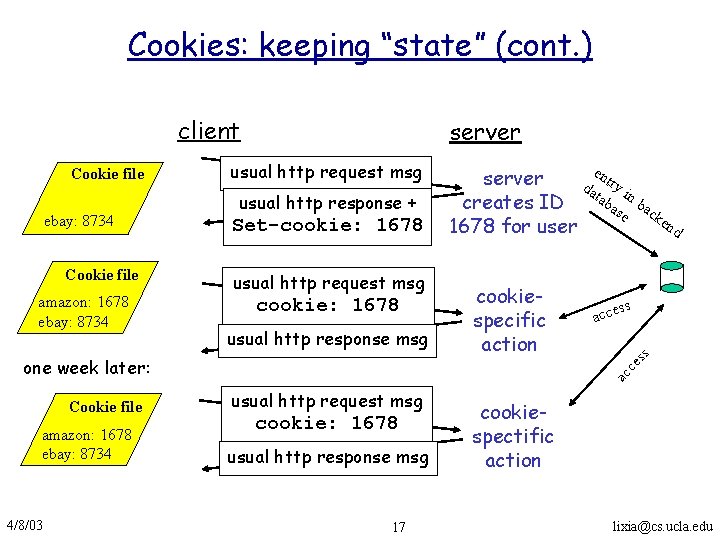
Cookies: keeping “state” Many major Web sites use cookies Four components: Example: Ø 1) cookie header line in the HTTP response message 2) cookie header line in HTTP request message 3) cookie file kept on user’s host and managed by user’s browser 4) back-end database at Web site 4/8/03 16 Susan access Internet always from same PC lixia@cs. ucla. edu
Cookies: keeping “state” (cont. ) client ebay: 8734 Cookie file amazon: 1678 ebay: 8734 usual http request msg usual http response + Set-cookie: 1678 usual http request msg cookie: 1678 usual http response msg Cookie file amazon: 1678 ebay: 8734 4/8/03 cookiespecific action ss acce ac ce one week later: e n server da try i tab n b creates ID as ac e ke nd 1678 for user ss Cookie file server usual http request msg cookie: 1678 usual http response msg 17 cookiespectific action lixia@cs. ucla. edu
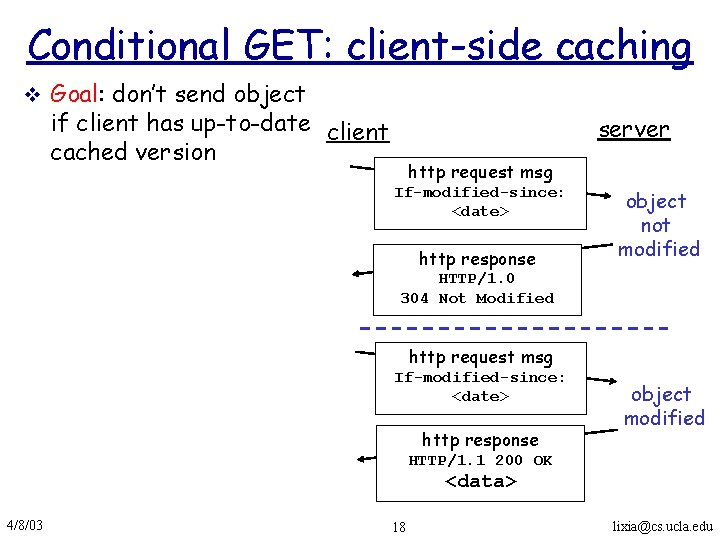
Conditional GET: client-side caching v Goal: don’t send object if client has up-to-date client cached version server http request msg If-modified-since: <date> http response object not modified HTTP/1. 0 304 Not Modified http request msg If-modified-since: <date> http response object modified HTTP/1. 1 200 OK <data> 4/8/03 18 lixia@cs. ucla. edu
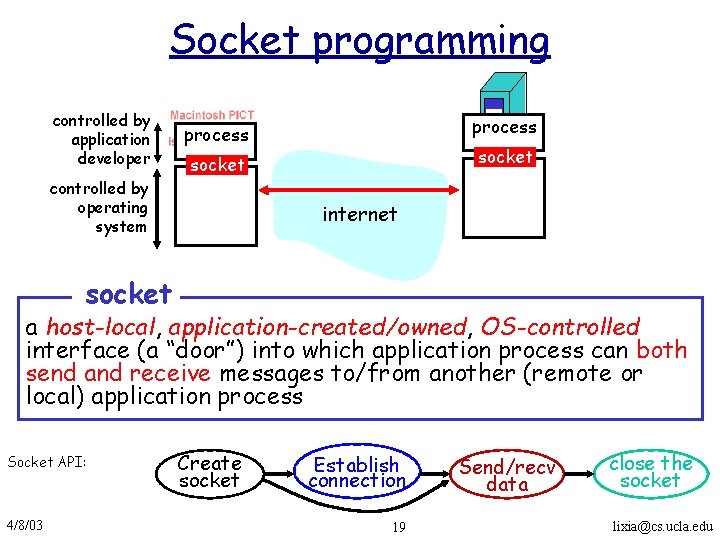
Socket programming controlled by application developer controlled by operating system process socket internet socket a host-local, application-created/owned, OS-controlled interface (a “door”) into which application process can both send and receive messages to/from another (remote or local) application process Socket API: 4/8/03 Create socket Establish connection 19 Send/recv data close the socket lixia@cs. ucla. edu
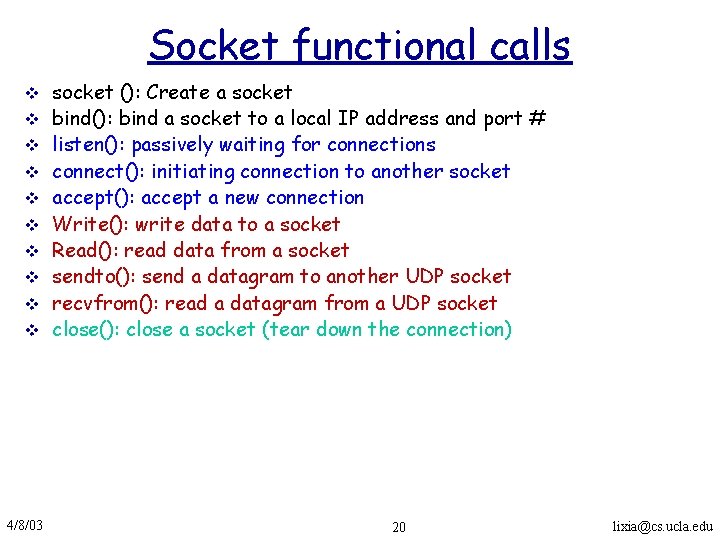
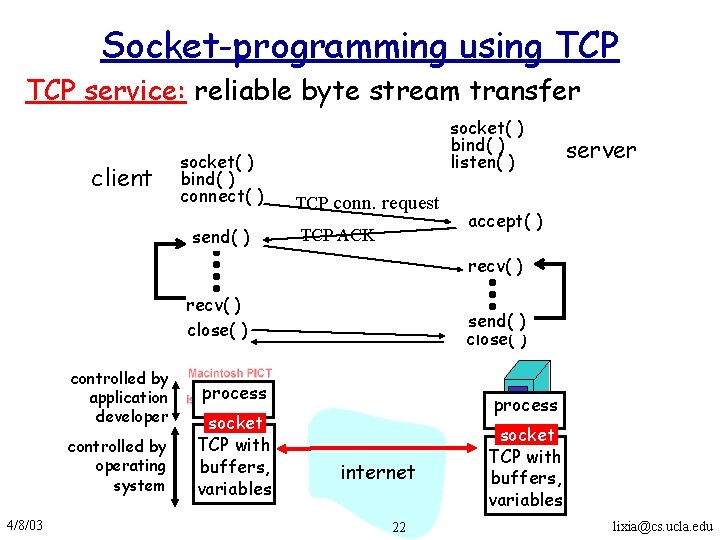
Socket functional calls v socket (): Create a socket v bind(): bind a socket to a local IP address and port # v listen(): passively waiting for connections v connect(): initiating connection to another socket v accept(): accept a new connection v Write(): write data to a socket v Read(): read data from a socket v sendto(): send a datagram to another UDP socket v recvfrom(): read a datagram from a UDP socket v close(): close a socket (tear down the connection) 4/8/03 20 lixia@cs. ucla. edu
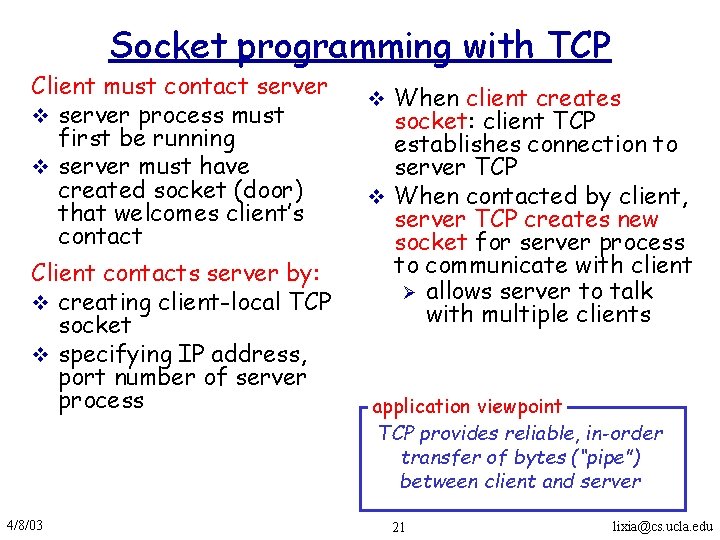
Socket programming with TCP Client must contact server v server process must first be running v server must have created socket (door) that welcomes client’s contact Client contacts server by: v creating client-local TCP socket v specifying IP address, port number of server process 4/8/03 v When client creates socket: client TCP establishes connection to server TCP v When contacted by client, server TCP creates new socket for server process to communicate with client Ø allows server to talk with multiple clients application viewpoint TCP provides reliable, in-order transfer of bytes (“pipe”) between client and server 21 lixia@cs. ucla. edu
Socket-programming using TCP service: reliable byte stream transfer client socket( ) bind( ) connect( ) send( ) socket( ) bind( ) listen( ) TCP conn. request TCP ACK server accept( ) recv( ) close( ) controlled by application developer controlled by operating system 4/8/03 send( ) close( ) process socket TCP with buffers, variables process internet 22 socket TCP with buffers, variables lixia@cs. ucla. edu
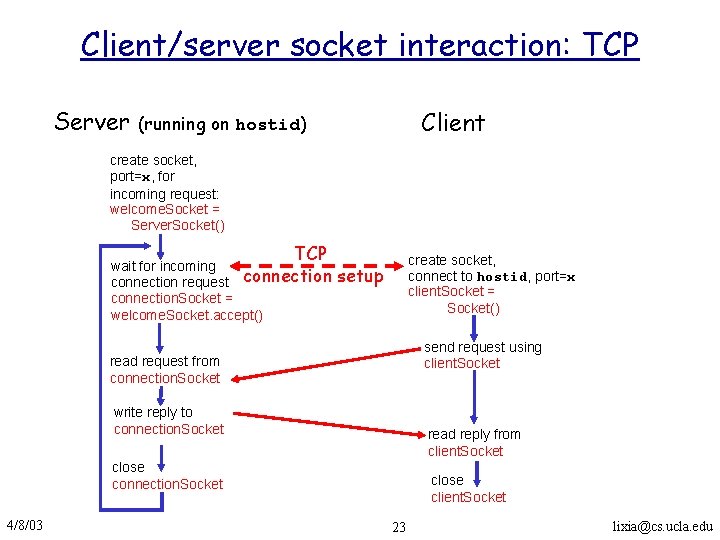
Client/server socket interaction: TCP Server Client (running on hostid) create socket, port=x, for incoming request: welcome. Socket = Server. Socket() TCP wait for incoming connection request connection. Socket = welcome. Socket. accept() create socket, connect to hostid, port=x client. Socket = Socket() setup send request using client. Socket read request from connection. Socket write reply to connection. Socket read reply from client. Socket close connection. Socket 4/8/03 close client. Socket 23 lixia@cs. ucla. edu
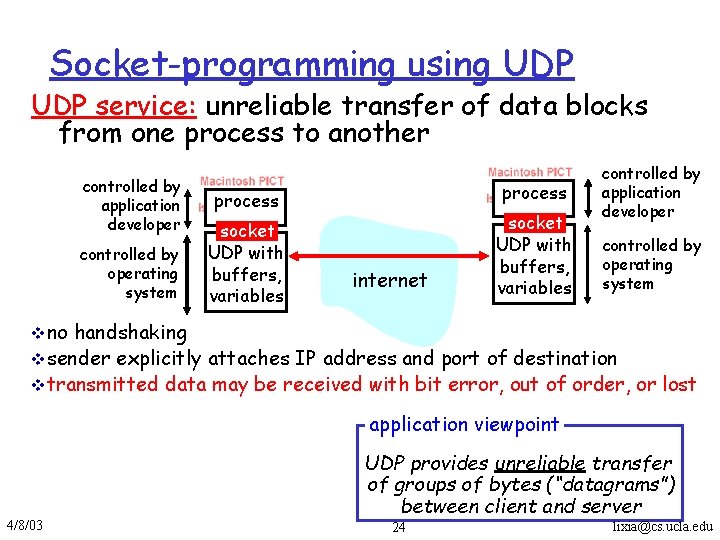
Socket-programming using UDP service: unreliable transfer of data blocks from one process to another controlled by application developer controlled by operating system process socket UDP with buffers, variables internet socket UDP with buffers, variables controlled by application developer controlled by operating system vno handshaking vsender explicitly attaches IP address and port of destination vtransmitted data may be received with bit error, out of order, or lost application viewpoint 4/8/03 UDP provides unreliable transfer of groups of bytes (“datagrams”) between client and server 24 lixia@cs. ucla. edu
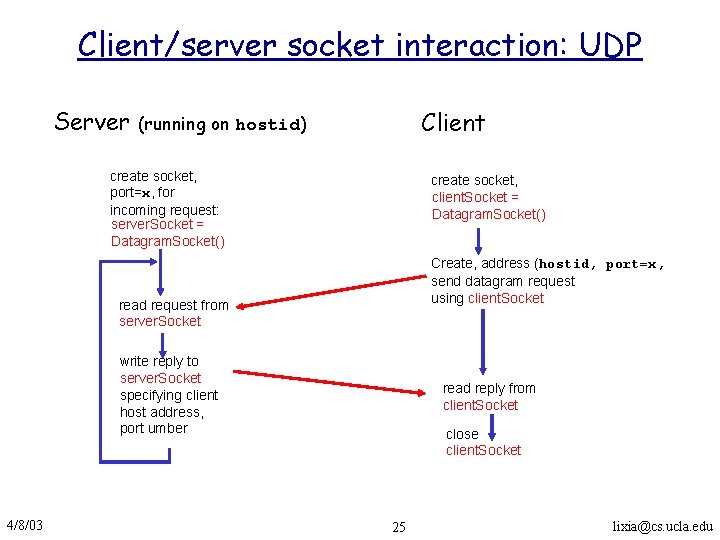
Client/server socket interaction: UDP Server Client (running on hostid) create socket, port=x, for incoming request: server. Socket = Datagram. Socket() create socket, client. Socket = Datagram. Socket() Create, address (hostid, port=x, send datagram request using client. Socket read request from server. Socket write reply to server. Socket specifying client host address, port umber 4/8/03 read reply from client. Socket close client. Socket 25 lixia@cs. ucla. edu
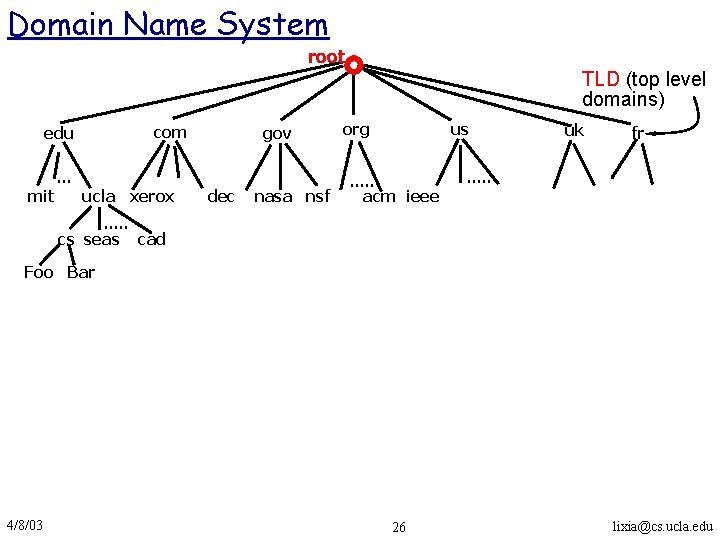
Domain Name System root TLD (top level domains) com edu gov . . . mit ucla xerox dec nasa nsf org us . . . acm ieee uk fr . . cs seas cad Foo Bar 4/8/03 26 lixia@cs. ucla. edu
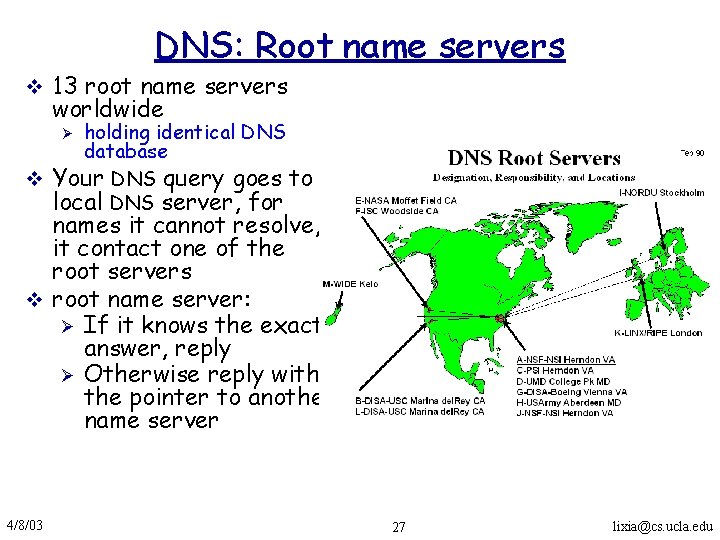
DNS: Root name servers v 13 root name servers worldwide holding identical DNS database v Your DNS query goes to local DNS server, for Ø a names it cannot resolve, it contact one of the root servers v root name server: Ø If it knows the exact answer, reply Ø Otherwise reply with the pointer to another name server 4/8/03 27 lixia@cs. ucla. edu
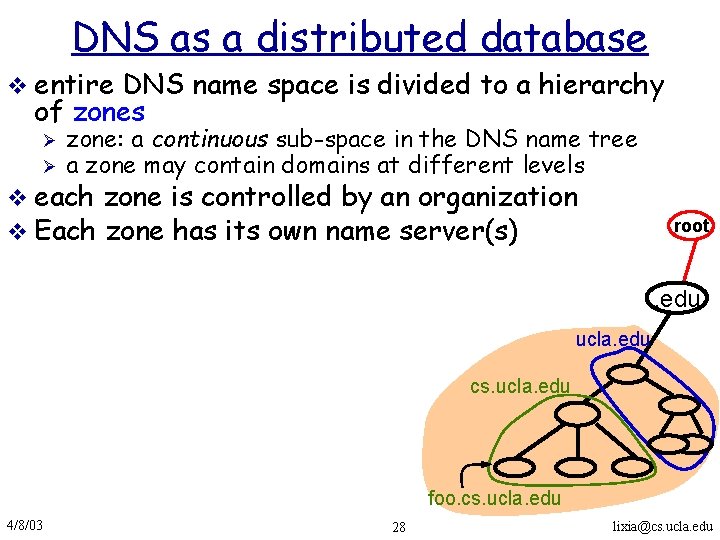
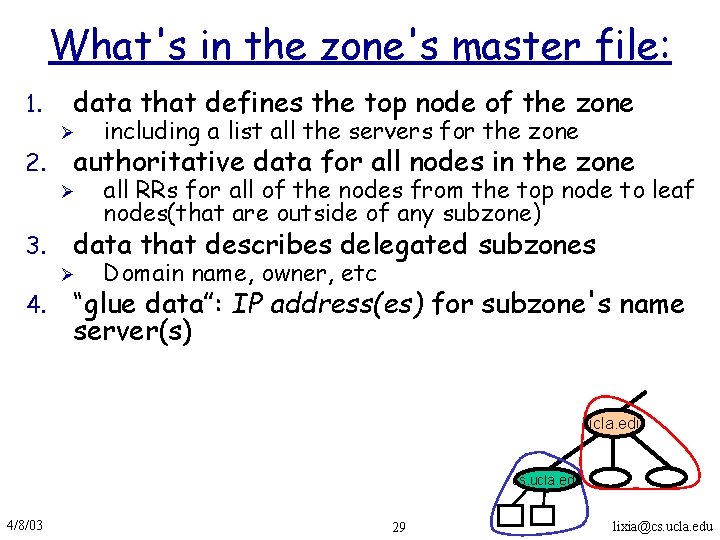
DNS as a distributed database v entire DNS name space is divided to a hierarchy of zones Ø Ø zone: a continuous sub-space in the DNS name tree a zone may contain domains at different levels v each zone is controlled by an organization v Each zone has its own name server(s) root . edu ucla. edu cs. ucla. edu foo. cs. ucla. edu 4/8/03 28 lixia@cs. ucla. edu
What's in the zone's master file: 1. 2. 3. data that defines the top node of the zone Ø including a list all the servers for the zone Ø all RRs for all of the nodes from the top node to leaf nodes(that are outside of any subzone) authoritative data for all nodes in the zone data that describes delegated subzones Ø 4. Domain name, owner, etc “glue data”: IP address(es) for subzone's name server(s) ucla. edu cs. ucla. edu 4/8/03 29 lixia@cs. ucla. edu
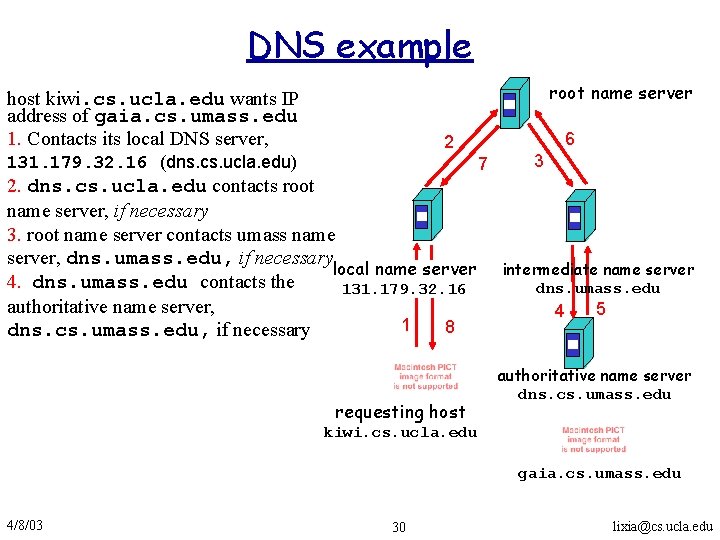
DNS example root name server host kiwi. cs. ucla. edu wants IP address of gaia. cs. umass. edu 1. Contacts its local DNS server, 6 2 131. 179. 32. 16 (dns. cs. ucla. edu) 2. dns. cs. ucla. edu contacts root name server, if necessary 3. root name server contacts umass name server, dns. umass. edu, if necessary local name server 4. dns. umass. edu contacts the 131. 179. 32. 16 authoritative name server, 1 8 dns. cs. umass. edu, if necessary requesting host 7 3 intermediate name server dns. umass. edu 4 5 authoritative name server dns. cs. umass. edu kiwi. cs. ucla. edu gaia. cs. umass. edu 4/8/03 30 lixia@cs. ucla. edu
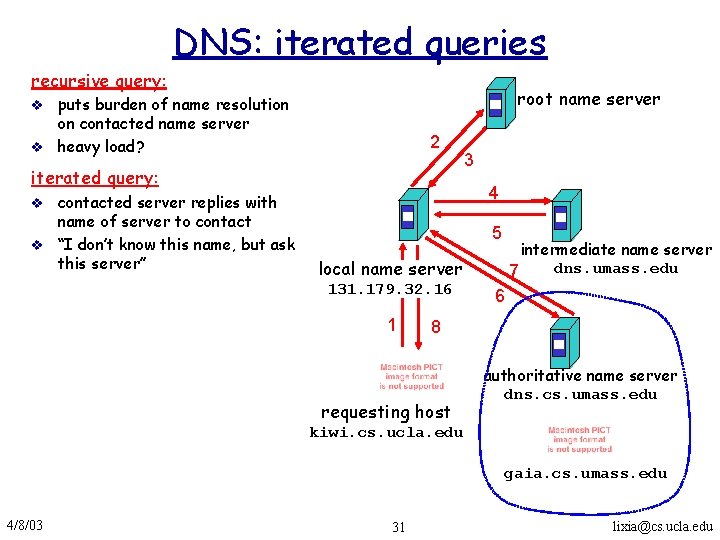
DNS: iterated queries recursive query: root name server puts burden of name resolution on contacted name server v heavy load? v 2 iterated query: contacted server replies with name of server to contact v “I don’t know this name, but ask this server” 3 4 v 5 intermediate name server dns. umass. edu 7 local name server 131. 179. 32. 16 1 6 8 requesting host authoritative name server dns. cs. umass. edu kiwi. cs. ucla. edu gaia. cs. umass. edu 4/8/03 31 lixia@cs. ucla. edu
DNS Performance v Virtual each and all Internet applications invoke DNS lookup v use both replication and caching to improve performance Ø Each domain has one or more secondary servers Ø servers cache recent query results § buffer recently resolved names and addresses till their “time-to-live” expires 4/8/03 32 lixia@cs. ucla. edu
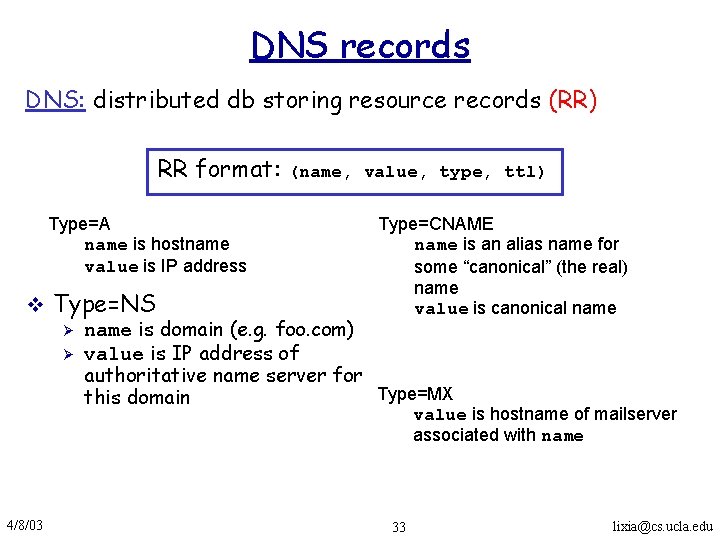
DNS records DNS: distributed db storing resource records (RR) RR format: Type=A name is hostname value is IP address (name, value, type, ttl) Type=CNAME name is an alias name for some “canonical” (the real) name value is canonical name v Type=NS Ø name is domain (e. g. foo. com) Ø value is IP address of authoritative name server for Type=MX this domain value is hostname of mailserver associated with name 4/8/03 33 lixia@cs. ucla. edu
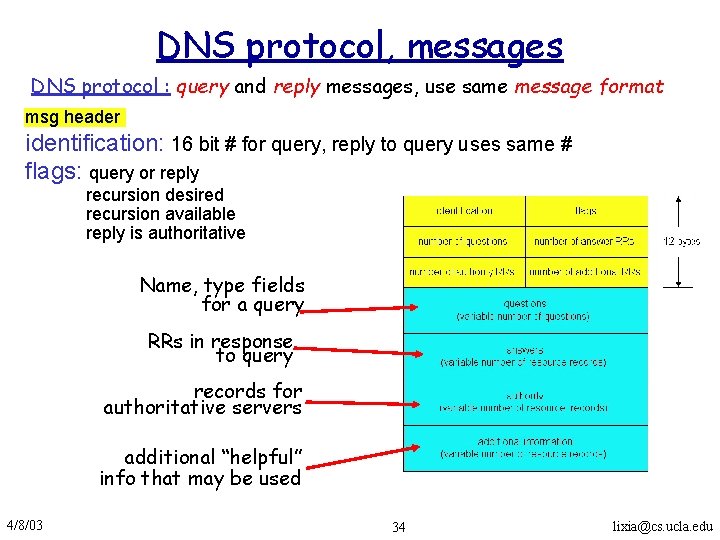
DNS protocol, messages DNS protocol : query and reply messages, use same message format msg header identification: 16 bit # for query, reply to query uses same # flags: query or reply recursion desired recursion available reply is authoritative Name, type fields for a query RRs in response to query records for authoritative servers additional “helpful” info that may be used 4/8/03 34 lixia@cs. ucla. edu
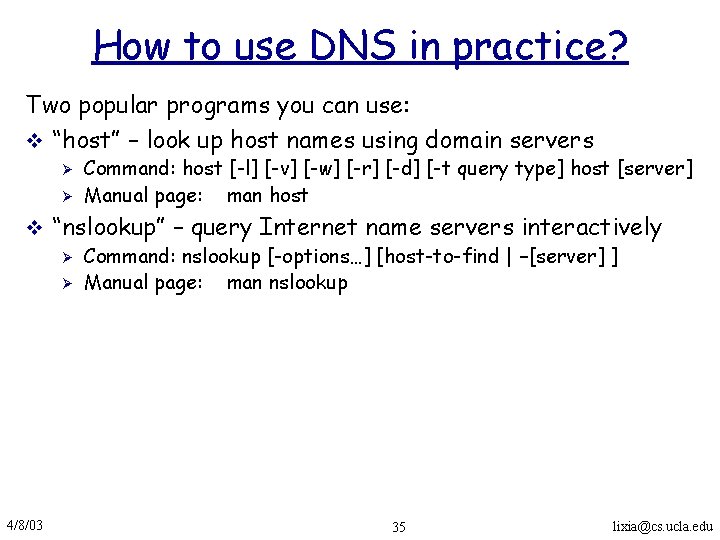
How to use DNS in practice? Two popular programs you can use: v “host” – look up host names using domain servers Ø Ø Command: host [-l] [-v] [-w] [-r] [-d] [-t query type] host [server] Manual page: man host v “nslookup” – query Internet name servers interactively Ø Command: nslookup [-options…] [host-to-find | –[server] ] Ø Manual page: man nslookup 4/8/03 35 lixia@cs. ucla. edu