
What is a verb The verb is king

What is a verb?
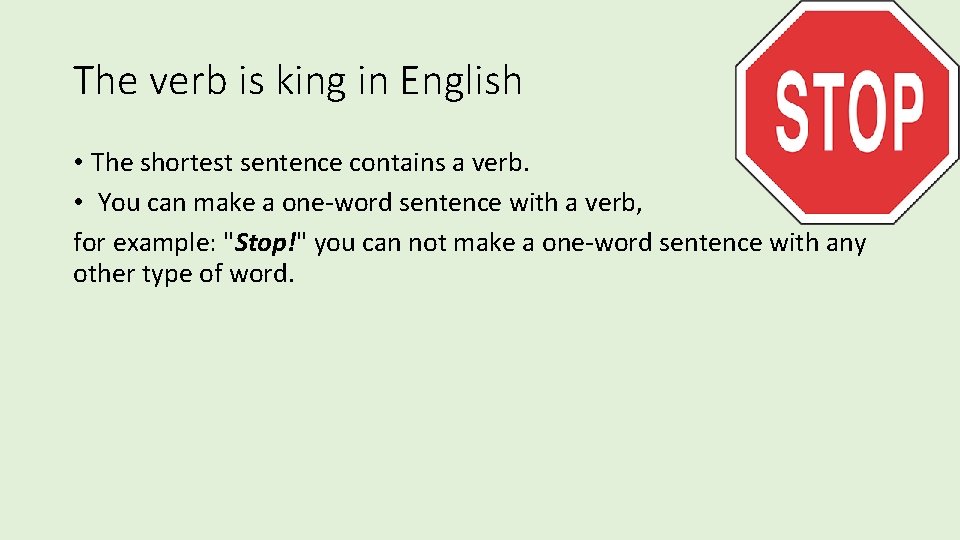
The verb is king in English • The shortest sentence contains a verb. • You can make a one-word sentence with a verb, for example: "Stop!" you can not make a one-word sentence with any other type of word.

Verbs “action ” and “state” • Verbs are sometimes described as "action words". This is partly true. (1). Many verbs give the idea of action, of "doing" something. For example, words like run, fight, do and work all convey action. (2. )But some verbs do not give the idea of action; they give the idea of existence, of state, of "being". For example, verbs like be, exist, seem and belong all convey state.
Verbs tell us what a subject does or is • A verb always has a subject. ("John speaks English" John is the subject and speaks is the verb. ) • In simple terms, therefore, we can say that verbs are words that tell use what a subject does or is; • they describe: • Action (Ram plays football. ) • Sate (Anthony seems kind. )
almost all verbs change in form There is something very special about verbs in English. • Most other words (adjectives, adverbs, prepositions ) do not change in form (although nouns can have singular and plural forms). Singular n. 单数形式. adj. 奇特的; 非凡的; 突出的 Plural n. 复数; 复数形式. adj. 复数的 • But almost all verbs change in form. For example, the verb work has five forms: to work, works, worked, working
Verb Classification
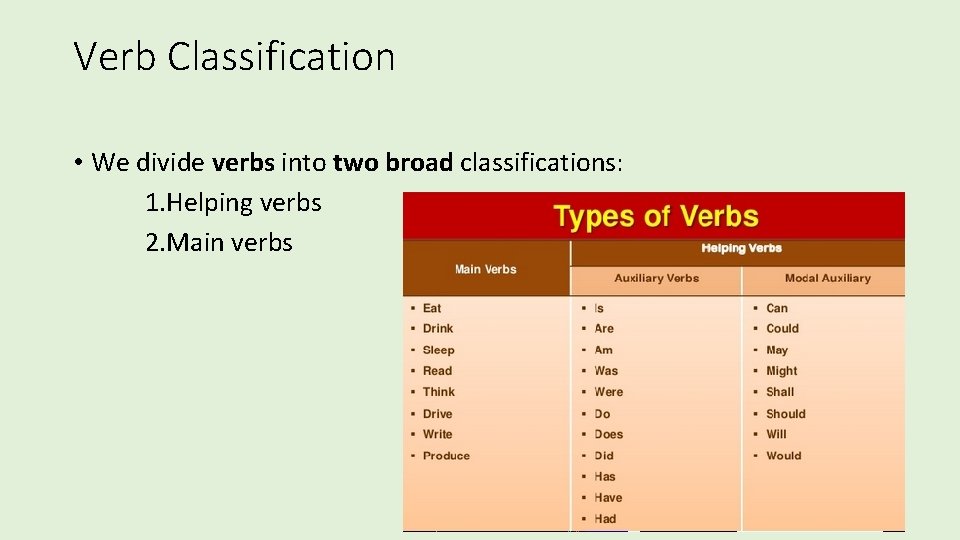
Verb Classification • We divide verbs into two broad classifications: 1. Helping verbs 2. Main verbs
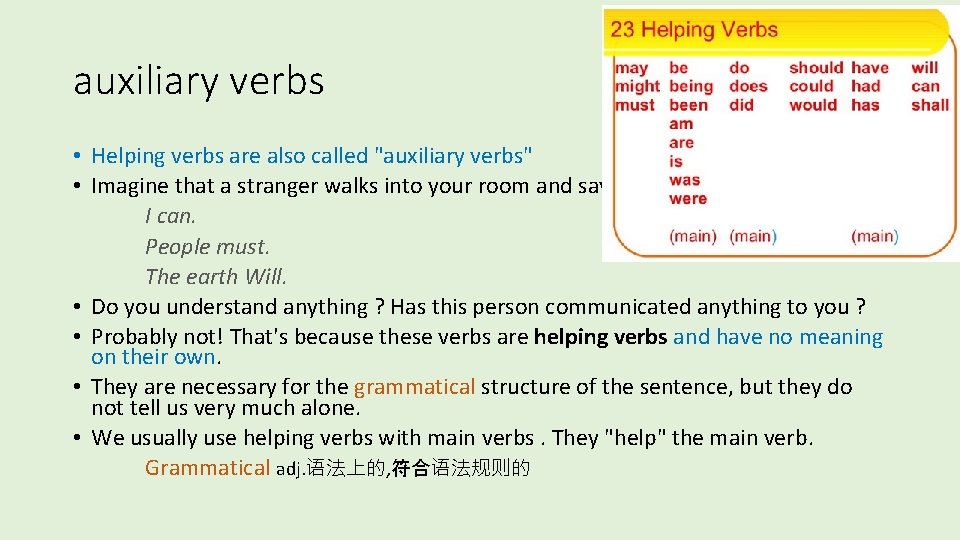
auxiliary verbs • Helping verbs are also called "auxiliary verbs" • Imagine that a stranger walks into your room and says: I can. People must. The earth Will. • Do you understand anything ? Has this person communicated anything to you ? • Probably not! That's because these verbs are helping verbs and have no meaning on their own. • They are necessary for the grammatical structure of the sentence, but they do not tell us very much alone. • We usually use helping verbs with main verbs. They "help" the main verb. Grammatical adj. 语法上的, 符合语法规则的
lexical verbs • Main verbs are also called "lexical verbs" • Now imagine that the same stranger walks into your room and says: I teach. People eat. The Earth rotates. (旋转) • Do you understand something ? Has this person communicated something to you? • Probably yes! Not a lot, but something. • That's because these verbs are main verbs and have meaning on their own. Lexical adj. 词汇的; 词典的
Verb Classification Helping verbs
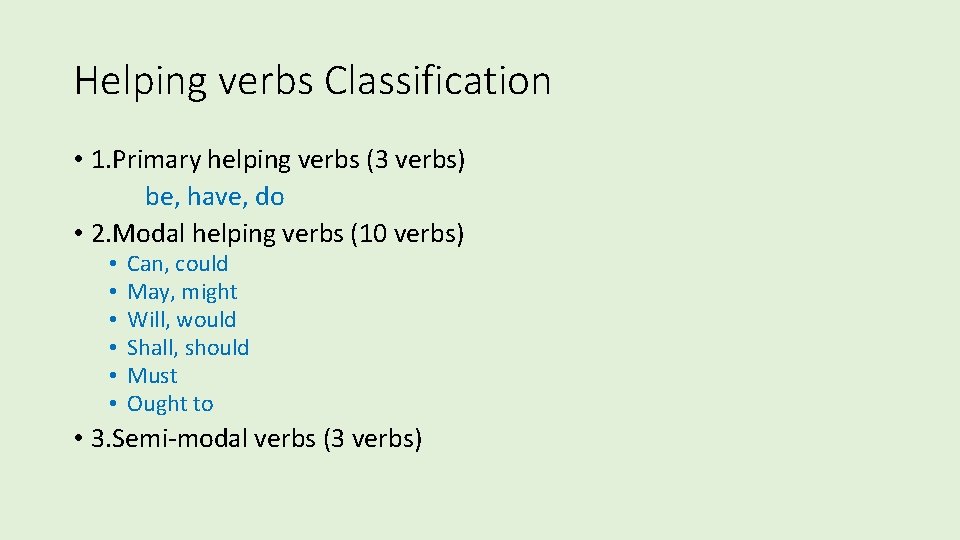
Helping verbs Classification • 1. Primary helping verbs (3 verbs) be, have, do • 2. Modal helping verbs (10 verbs) • • • Can, could May, might Will, would Shall, should Must Ought to • 3. Semi-modal verbs (3 verbs)
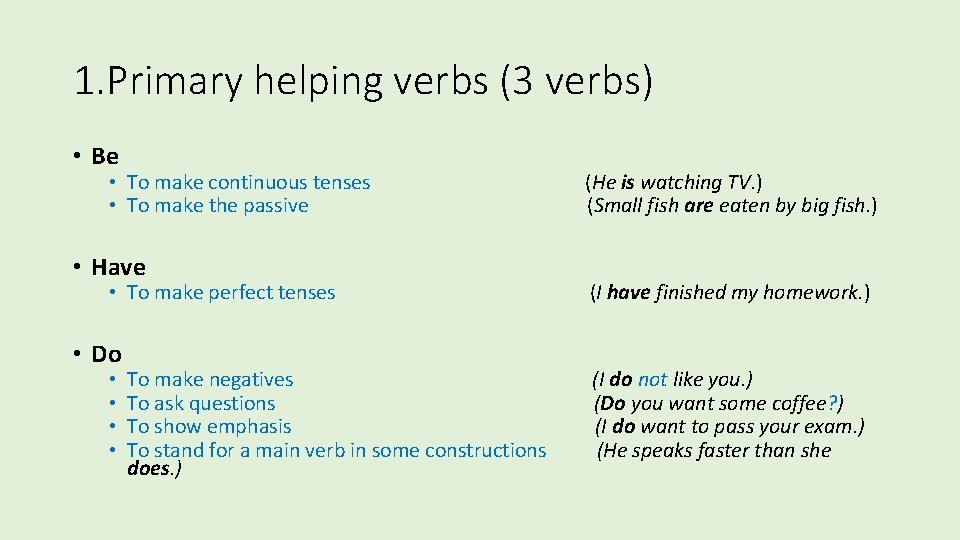
1. Primary helping verbs (3 verbs) • Be • To make continuous tenses • To make the passive • Have • To make perfect tenses • Do • • To make negatives To ask questions To show emphasis To stand for a main verb in some constructions does. ) (He is watching TV. ) (Small fish are eaten by big fish. ) (I have finished my homework. ) (I do not like you. ) (Do you want some coffee? ) (I do want to pass your exam. ) (He speaks faster than she
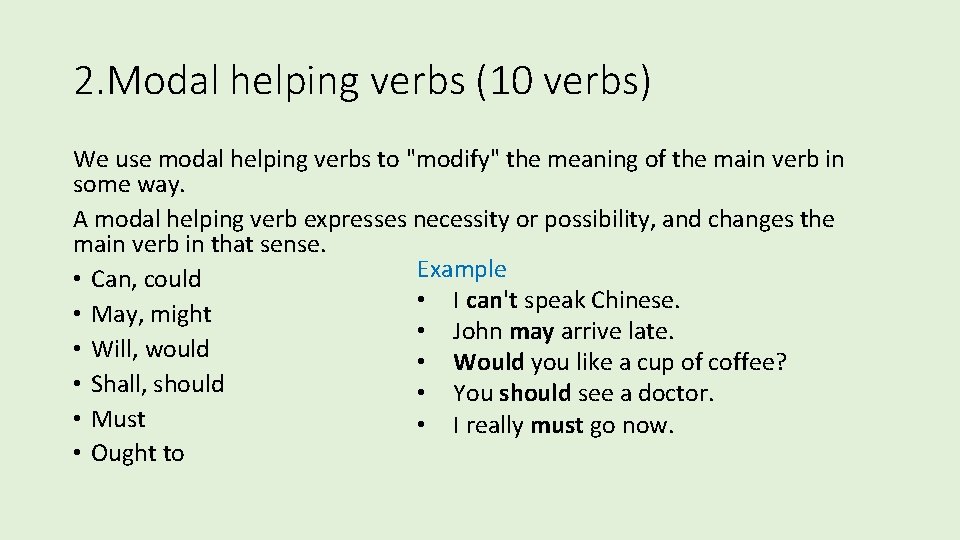
2. Modal helping verbs (10 verbs) We use modal helping verbs to "modify" the meaning of the main verb in some way. A modal helping verb expresses necessity or possibility, and changes the main verb in that sense. Example • Can, could • I can't speak Chinese. • May, might • John may arrive late. • Will, would • Would you like a cup of coffee? • Shall, should • You should see a doctor. • Must • I really must go now. • Ought to
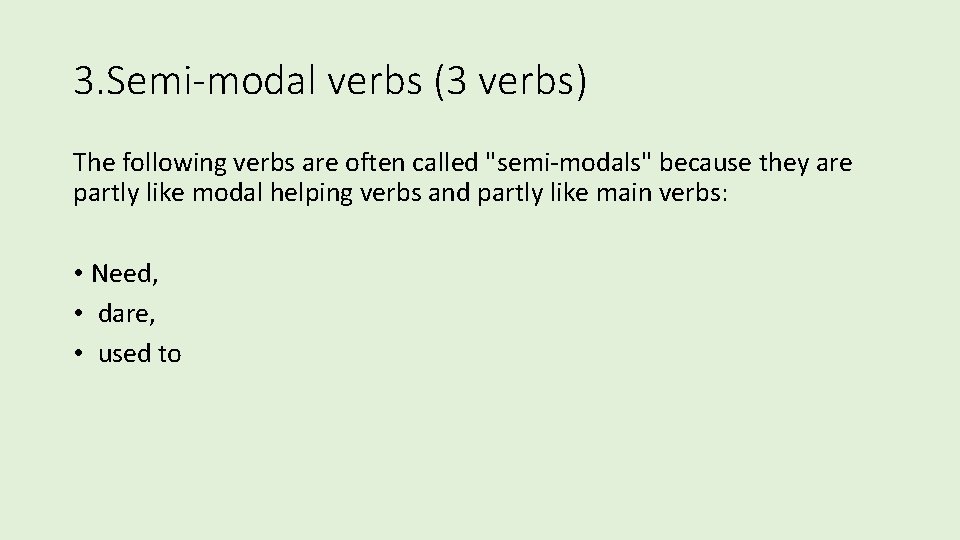
3. Semi-modal verbs (3 verbs) The following verbs are often called "semi-modals" because they are partly like modal helping verbs and partly like main verbs: • Need, • dare, • used to
Verb Classification Main verbs
The Action Verb Explode! Scream! Sneeze! Type! Kick! • What are these words doing? • They are expressing action, something that a person, animal, force of nature, of thing can do. • As a result, we call these words action verbs.
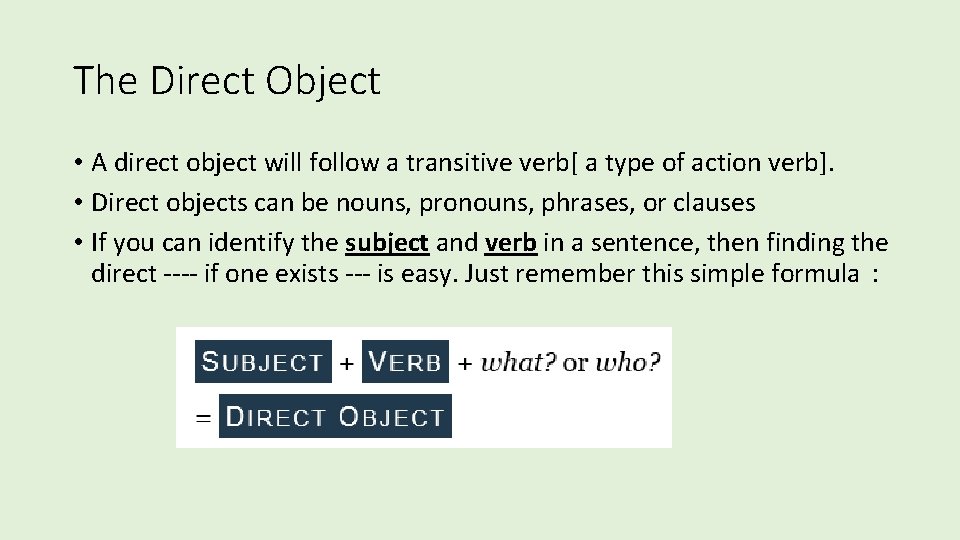
The Direct Object • A direct object will follow a transitive verb[ a type of action verb]. • Direct objects can be nouns, pronouns, phrases, or clauses • If you can identify the subject and verb in a sentence, then finding the direct ---- if one exists --- is easy. Just remember this simple formula:
Main verbs Classification • 1. Transitive and intransitive verbs • 2. Linking verbs • 3. Dynamic and stative verbs • 4. Regular and irregular verbs
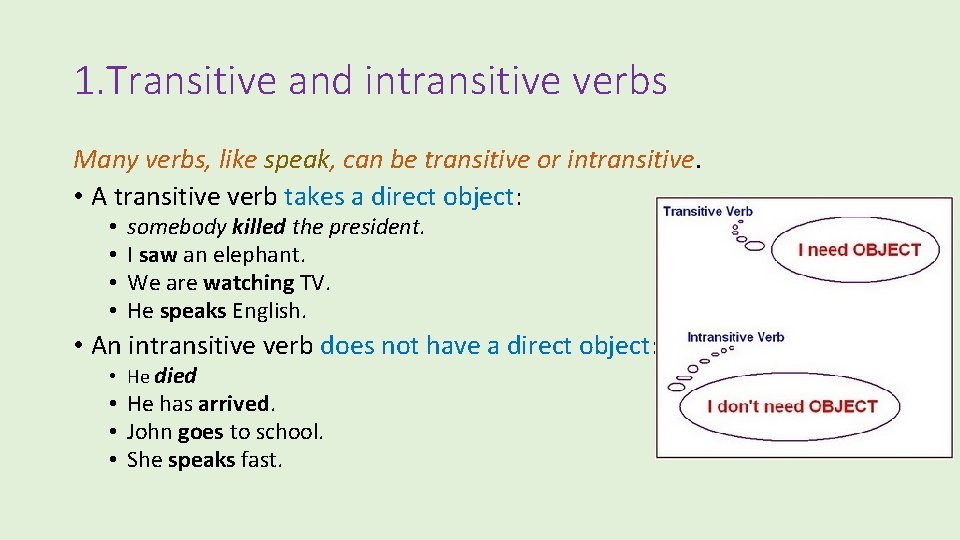
1. Transitive and intransitive verbs Many verbs, like speak, can be transitive or intransitive. • A transitive verb takes a direct object: • • somebody killed the president. I saw an elephant. We are watching TV. He speaks English. • An intransitive verb does not have a direct object: • He died • He has arrived. • John goes to school. • She speaks fast.
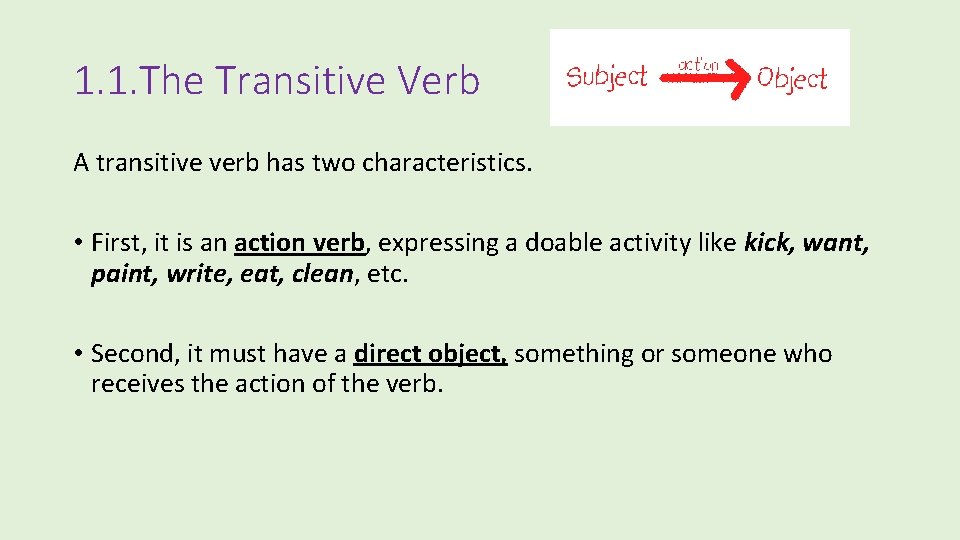
1. 1. The Transitive Verb A transitive verb has two characteristics. • First, it is an action verb, expressing a doable activity like kick, want, paint, write, eat, clean, etc. • Second, it must have a direct object, something or someone who receives the action of the verb.
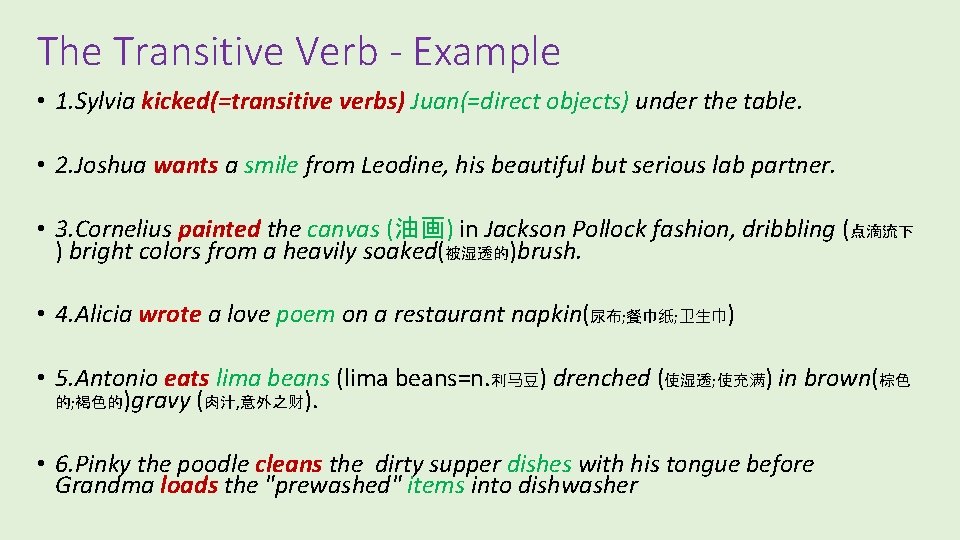
The Transitive Verb - Example • 1. Sylvia kicked(=transitive verbs) Juan(=direct objects) under the table. • 2. Joshua wants a smile from Leodine, his beautiful but serious lab partner. • 3. Cornelius painted the canvas (油画) in Jackson Pollock fashion, dribbling (点滴流下 ) bright colors from a heavily soaked(被湿透的)brush. • 4. Alicia wrote a love poem on a restaurant napkin(尿布; 餐巾纸; 卫生巾) • 5. Antonio eats lima beans (lima beans=n. 利马豆) drenched (使湿透; 使充满) in brown(棕色 的; 褐色的)gravy (肉汁, 意外之财). • 6. Pinky the poodle cleans the dirty supper dishes with his tongue before Grandma loads the "prewashed" items into dishwasher
1. 2. intransitive verbs An intransitive verb has two characteristics. • First, it is an action verb, expressing a doable activity like arrive, go, lie, sneeze, sit, die, etc. • Second, unlike a transitive verb, it will not have a direct object receiving the action
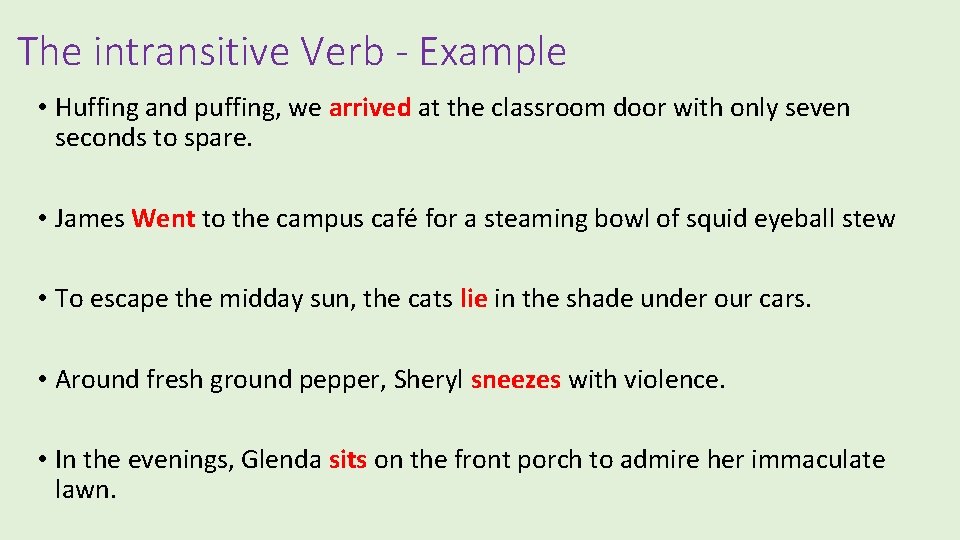
The intransitive Verb - Example • Huffing and puffing, we arrived at the classroom door with only seven seconds to spare. • James Went to the campus café for a steaming bowl of squid eyeball stew • To escape the midday sun, the cats lie in the shade under our cars. • Around fresh ground pepper, Sheryl sneezes with violence. • In the evenings, Glenda sits on the front porch to admire her immaculate lawn.
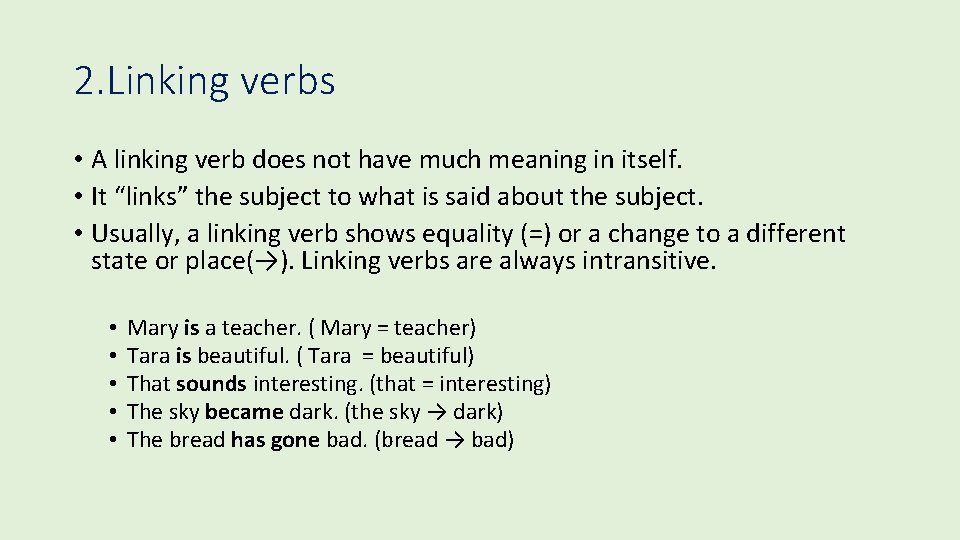
2. Linking verbs • A linking verb does not have much meaning in itself. • It “links” the subject to what is said about the subject. • Usually, a linking verb shows equality (=) or a change to a different state or place(→). Linking verbs are always intransitive. • • • Mary is a teacher. ( Mary = teacher) Tara is beautiful. ( Tara = beautiful) That sounds interesting. (that = interesting) The sky became dark. (the sky → dark) The bread has gone bad. (bread → bad)
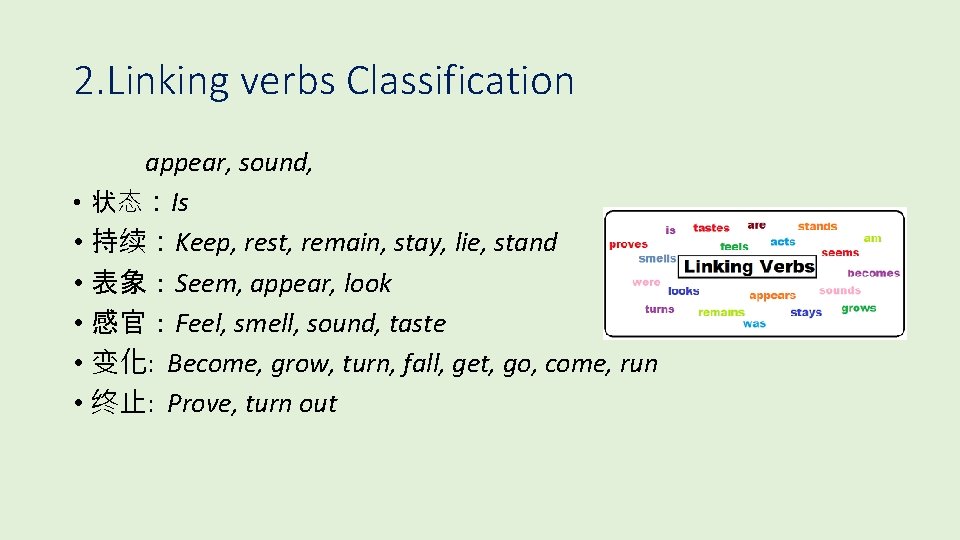
2. Linking verbs Classification appear, sound, • 状态:Is • 持续:Keep, rest, remain, stay, lie, stand • 表象:Seem, appear, look • 感官:Feel, smell, sound, taste • 变化: Become, grow, turn, fall, get, go, come, run • 终止: Prove, turn out
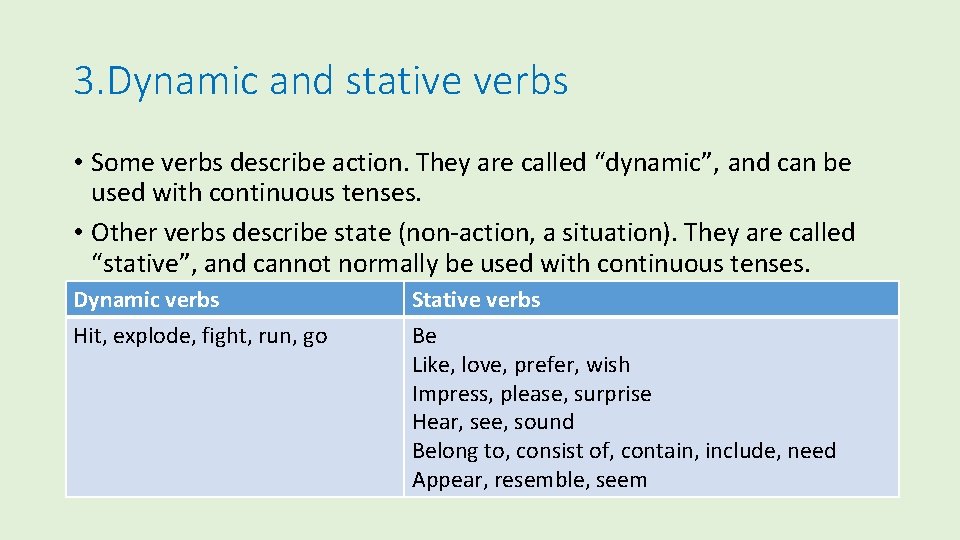
3. Dynamic and stative verbs • Some verbs describe action. They are called “dynamic”, and can be used with continuous tenses. • Other verbs describe state (non-action, a situation). They are called “stative”, and cannot normally be used with continuous tenses. Dynamic verbs Hit, explode, fight, run, go Stative verbs Be Like, love, prefer, wish Impress, please, surprise Hear, see, sound Belong to, consist of, contain, include, need Appear, resemble, seem
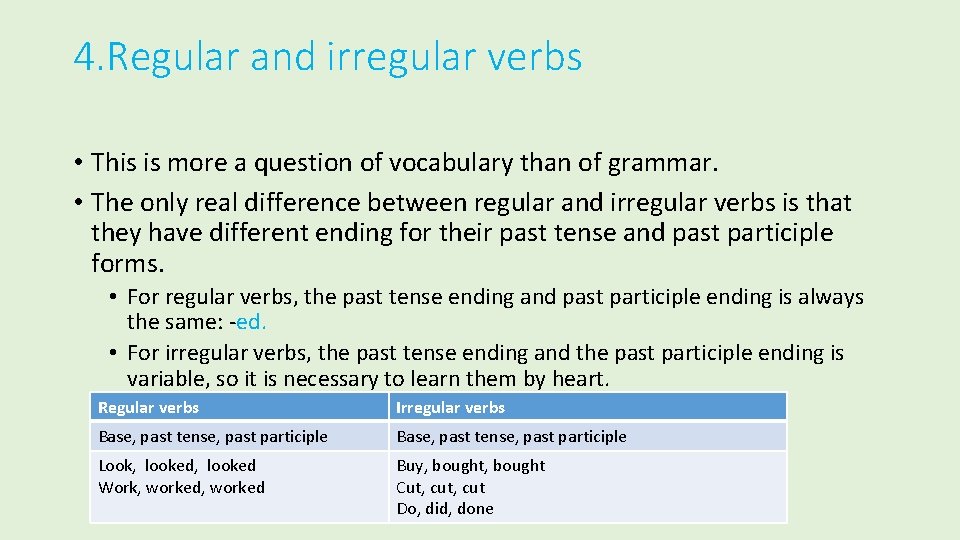
4. Regular and irregular verbs • This is more a question of vocabulary than of grammar. • The only real difference between regular and irregular verbs is that they have different ending for their past tense and past participle forms. • For regular verbs, the past tense ending and past participle ending is always the same: -ed. • For irregular verbs, the past tense ending and the past participle ending is variable, so it is necessary to learn them by heart. Regular verbs Irregular verbs Base, past tense, past participle Look, looked Work, worked Buy, bought Cut, cut Do, did, done
4. 1. Regular Verbs • English regular verbs change their form very little. • The past tense and past participle of regular verbs end in –ed. Work, worked
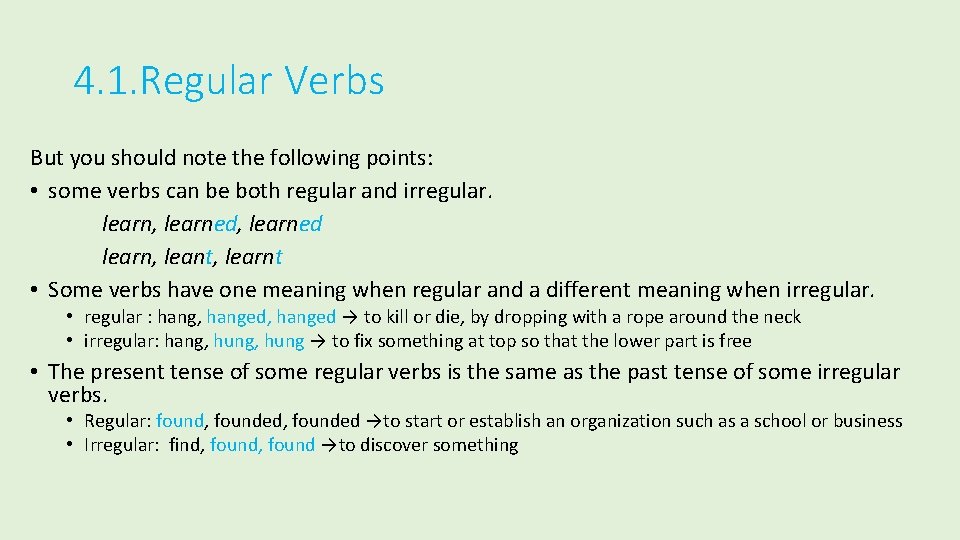
4. 1. Regular Verbs But you should note the following points: • some verbs can be both regular and irregular. learn, learned learn, leant, learnt • Some verbs have one meaning when regular and a different meaning when irregular. • regular : hang, hanged → to kill or die, by dropping with a rope around the neck • irregular: hang, hung → to fix something at top so that the lower part is free • The present tense of some regular verbs is the same as the past tense of some irregular verbs. • Regular: found, founded →to start or establish an organization such as a school or business • Irregular: find, found →to discover something
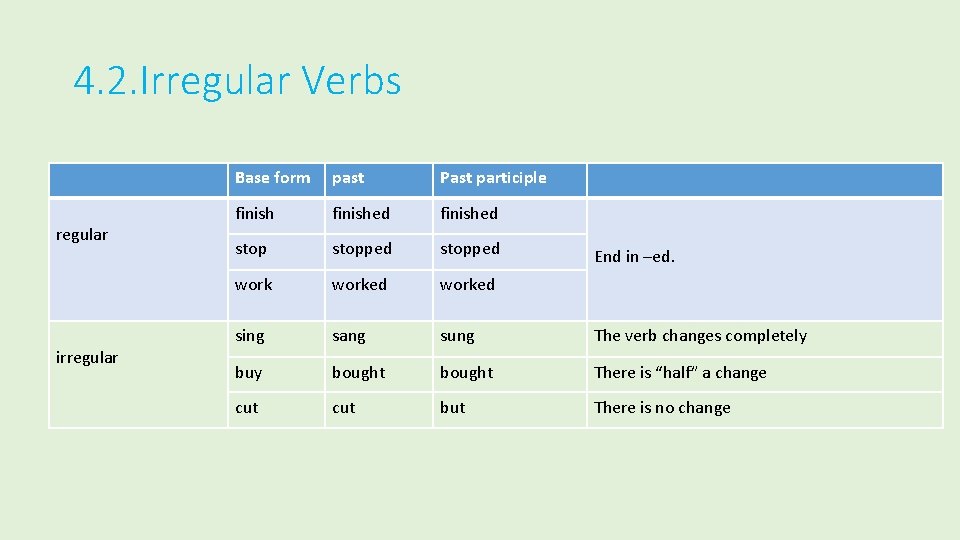
4. 2. Irregular Verbs regular irregular Base form past Past participle finished stopped worked sing sang sung The verb changes completely buy bought There is “half” a change cut but There is no change End in –ed.
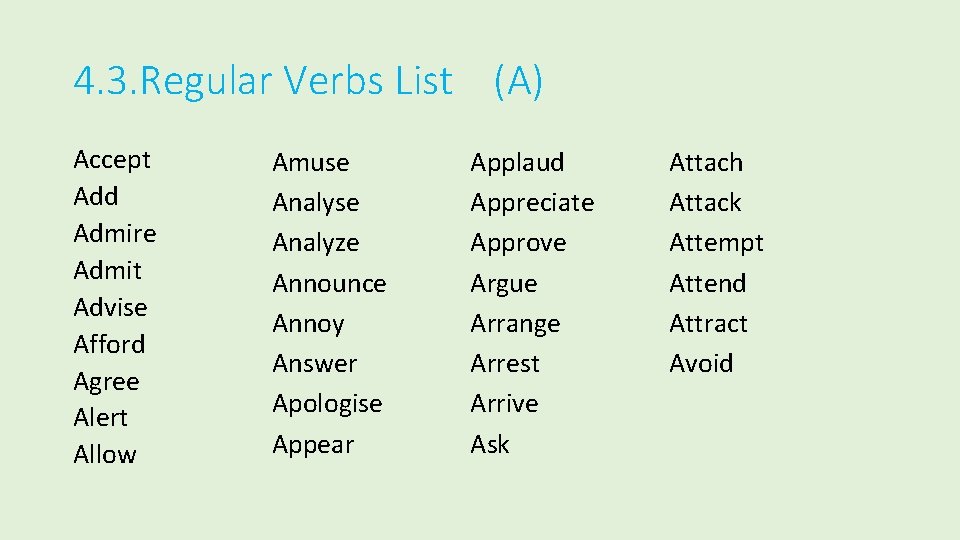
4. 3. Regular Verbs List (A) Accept Add Admire Admit Advise Afford Agree Alert Allow Amuse Analyze Announce Annoy Answer Apologise Appear Applaud Appreciate Approve Argue Arrange Arrest Arrive Ask Attach Attack Attempt Attend Attract Avoid
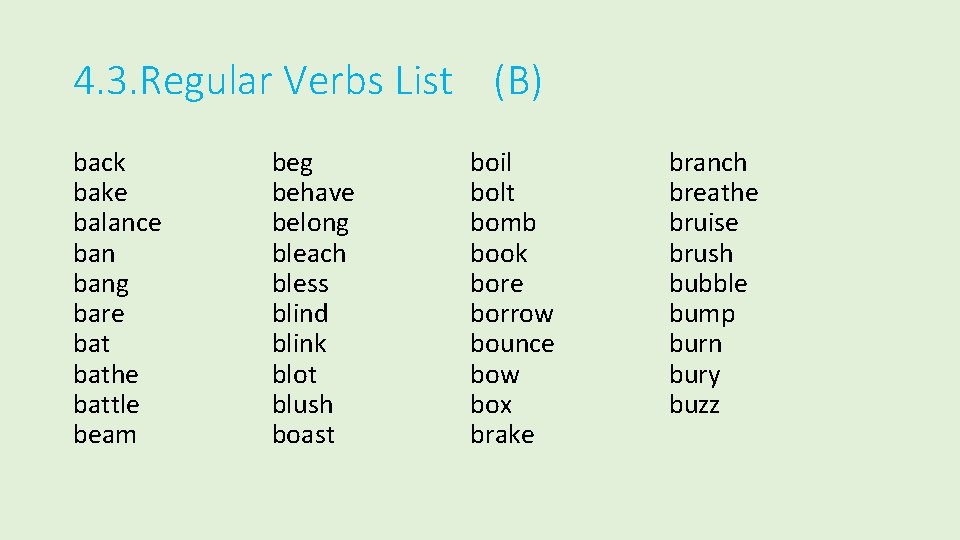
4. 3. Regular Verbs List (B) back bake balance bang bare bathe battle beam beg behave belong bleach bless blind blink blot blush boast boil bolt bomb book bore borrow bounce bow box brake branch breathe bruise brush bubble bump burn bury buzz
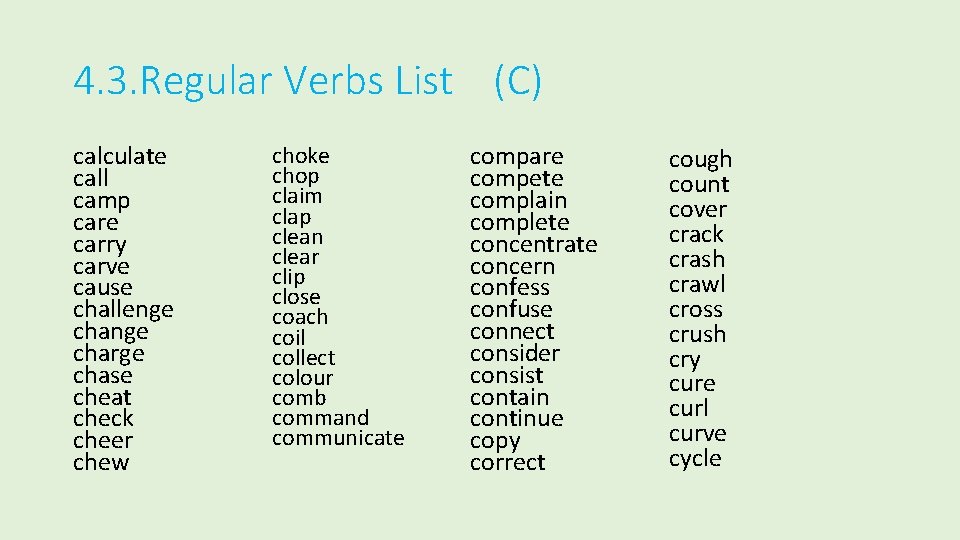
4. 3. Regular Verbs List (C) calculate call camp care carry carve cause challenge charge chase cheat check cheer chew choke chop claim clap clean clear clip close coach coil collect colour comb command communicate compare compete complain complete concentrate concern confess confuse connect consider consist contain continue copy correct cough count cover crack crash crawl cross crush cry cure curl curve cycle
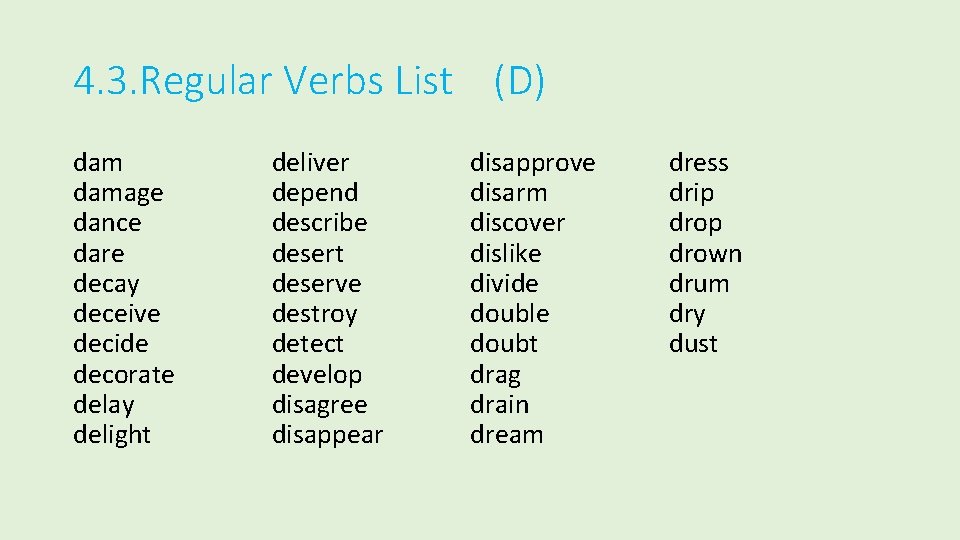
4. 3. Regular Verbs List (D) damage dance dare decay deceive decide decorate delay delight deliver depend describe desert deserve destroy detect develop disagree disappear disapprove disarm discover dislike divide double doubt drag drain dream dress drip drown drum dry dust
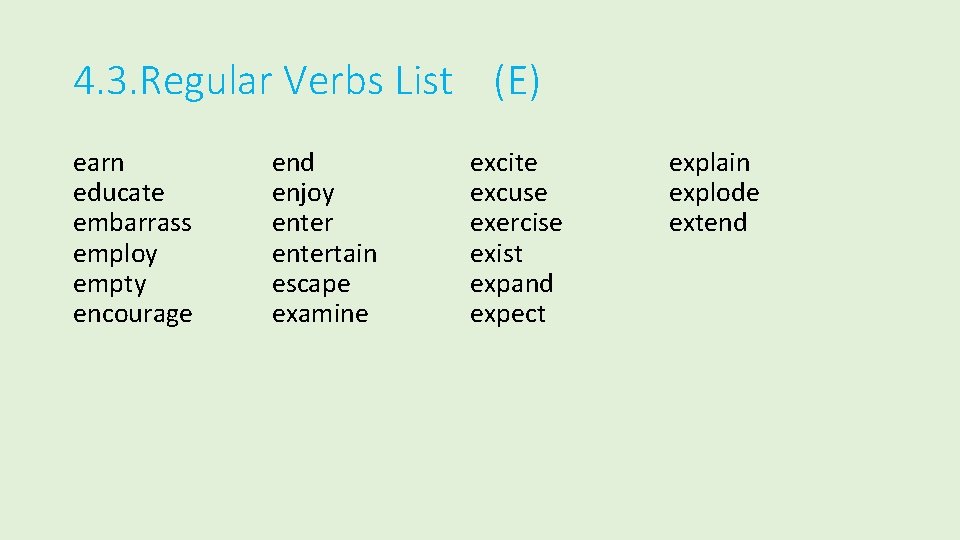
4. 3. Regular Verbs List (E) earn educate embarrass employ empty encourage end enjoy entertain escape examine excite excuse exercise exist expand expect explain explode extend
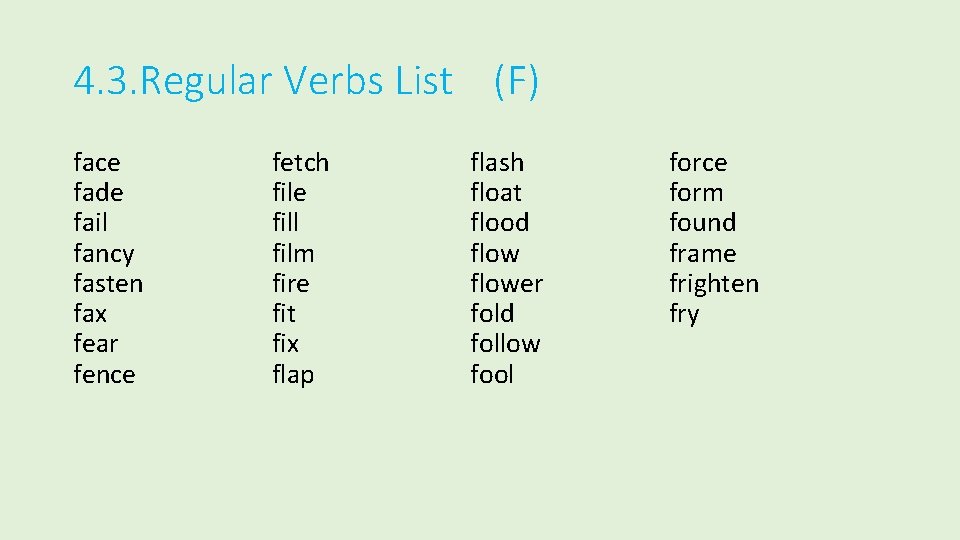
4. 3. Regular Verbs List (F) face fade fail fancy fasten fax fear fence fetch file fill film fire fit fix flap flash float flood flower fold follow fool force form found frame frighten fry
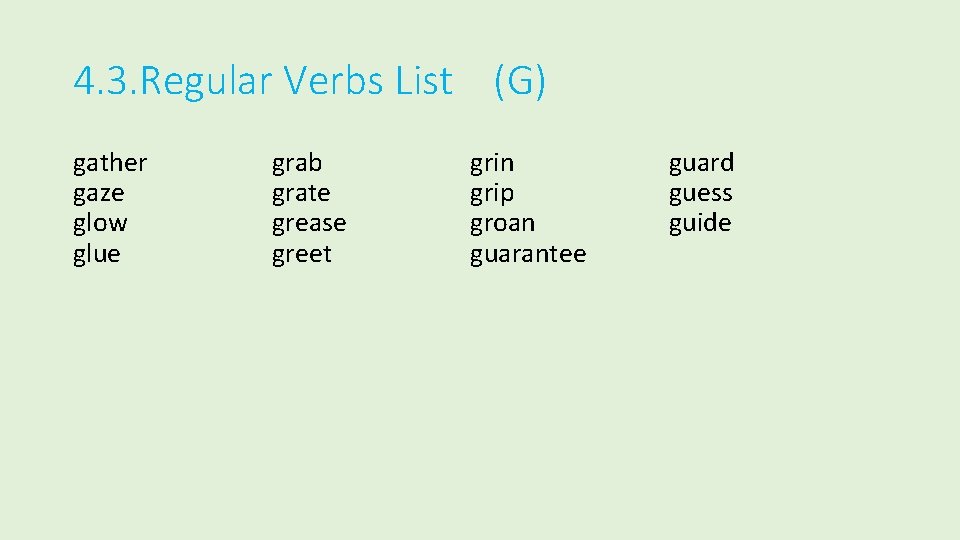
4. 3. Regular Verbs List (G) gather gaze glow glue grab grate grease greet grin grip groan guarantee guard guess guide
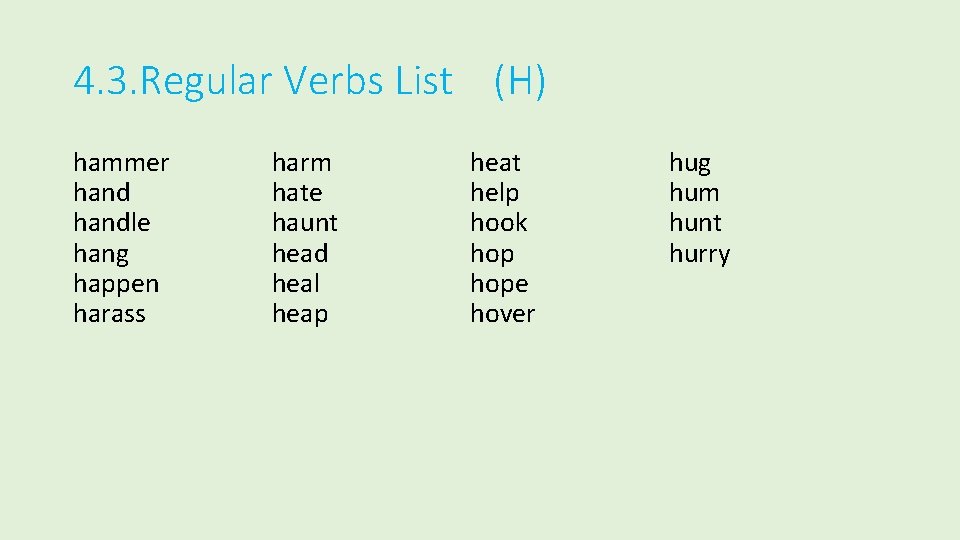
4. 3. Regular Verbs List (H) hammer handle hang happen harass harm hate haunt head heal heap heat help hook hope hover hug hum hunt hurry
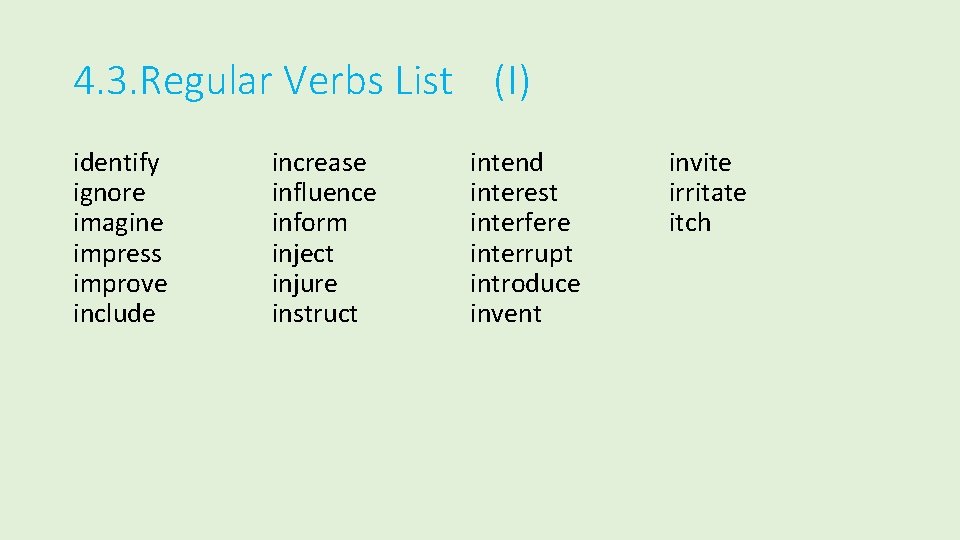
4. 3. Regular Verbs List (I) identify ignore imagine impress improve include increase influence inform inject injure instruct intend interest interfere interrupt introduce invent invite irritate itch
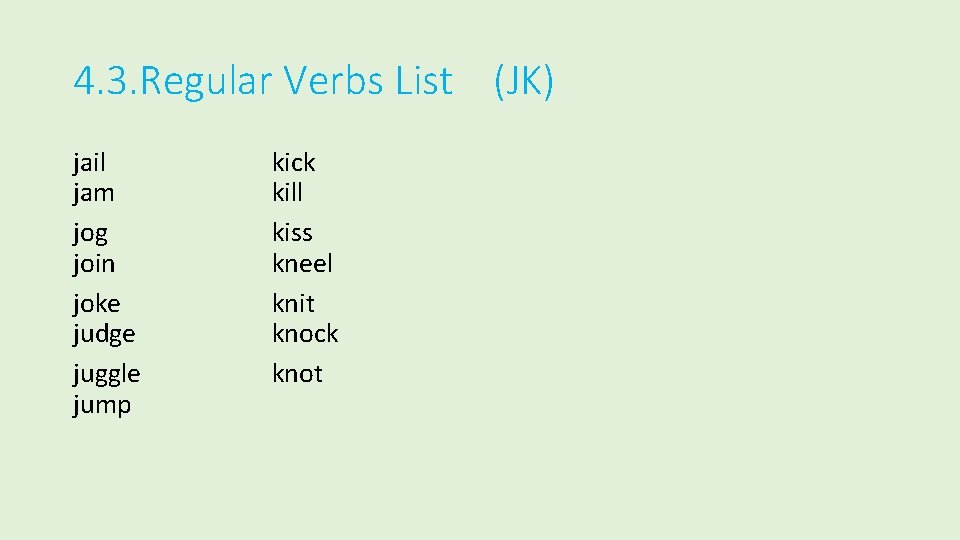
4. 3. Regular Verbs List (JK) jail jam jog join joke judge juggle jump kick kill kiss kneel knit knock knot
4. 3. Regular Verbs List (L) identify ignore imagine impress improve include increase influence inform inject injure instruct intend interest interfere interrupt introduce invent invite irritate itch
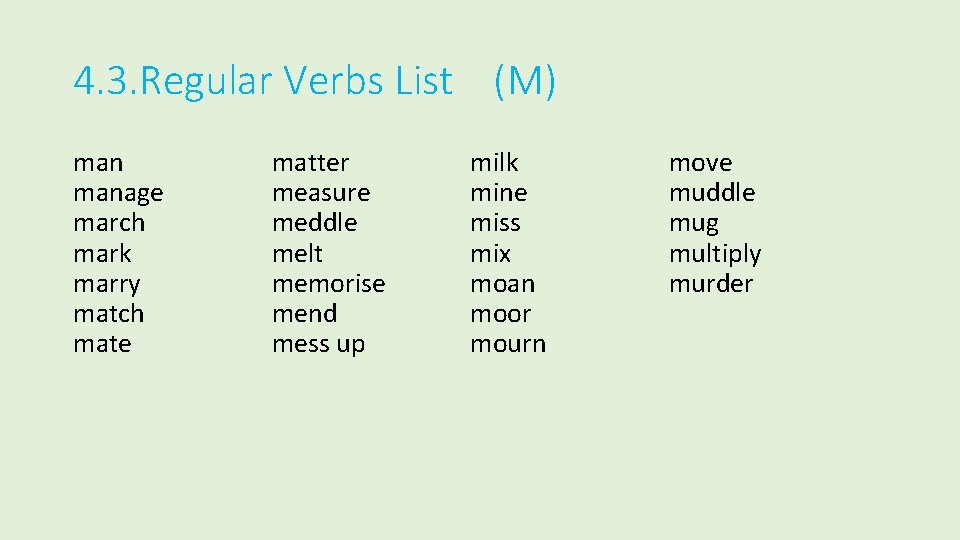
4. 3. Regular Verbs List (M) manage march mark marry match mate matter measure meddle melt memorise mend mess up milk mine miss mix moan moor mourn move muddle mug multiply murder
4. 3. Regular Verbs List (N) nail name need nest nod note notice number
4. 3. Regular Verbs List (O) obey object observe obtain occur offend offer open order overflow owe own
4. 3. Regular Verbs List (PQ) pack paddle paint park part pass paste pat pause peck pedal peep perform permit phone pick pinch pine place plant play please plug point poke polish pop possess post pour practise (Br. E) practice (Am. E) pray preach precede prefer prepare presenqueuet preserve press pretend prevent prick print produce program promise protect provide pull pump punch puncture punish push question queue
4. 3. Regular Verbs List (R) race radiate rain raise reach realise receive recognise record reduce reflect refuse regret reign reject rejoice relax release rely remain remember remind remove repair repeat replace reply report reproduce request rescue retire return rhyme rinse risk rob rock roll rot rub ruin rule rush
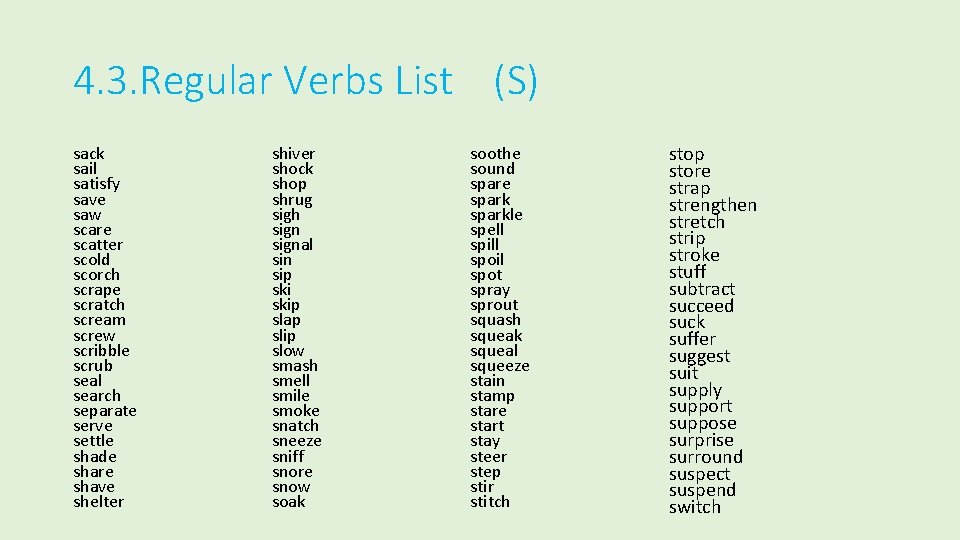
4. 3. Regular Verbs List (S) sack sail satisfy save saw scare scatter scold scorch scrape scratch scream screw scribble scrub seal search separate serve settle shade share shave shelter shiver shock shop shrug sigh signal sin sip skip slap slip slow smash smell smile smoke snatch sneeze sniff snore snow soak soothe sound spare sparkle spell spill spoil spot spray sprout squash squeak squeal squeeze stain stamp stare start stay steer step stir stitch stop store strap strengthen stretch strip stroke stuff subtract succeed suck suffer suggest suit supply support suppose surprise surround suspect suspend switch
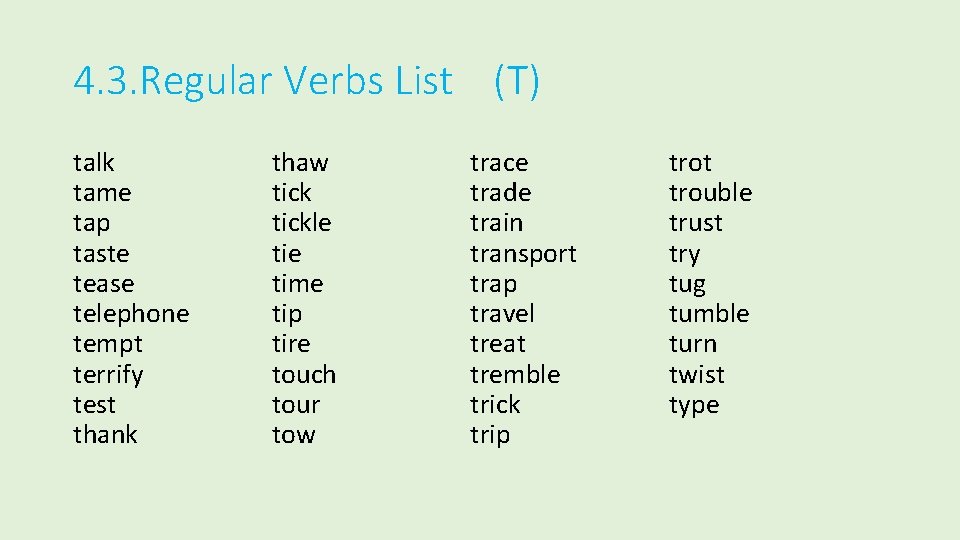
4. 3. Regular Verbs List (T) talk tame tap taste tease telephone tempt terrify test thank thaw tickle time tip tire touch tour tow trace trade train transport trap travel treat tremble trick trip trot trouble trust try tug tumble turn twist type
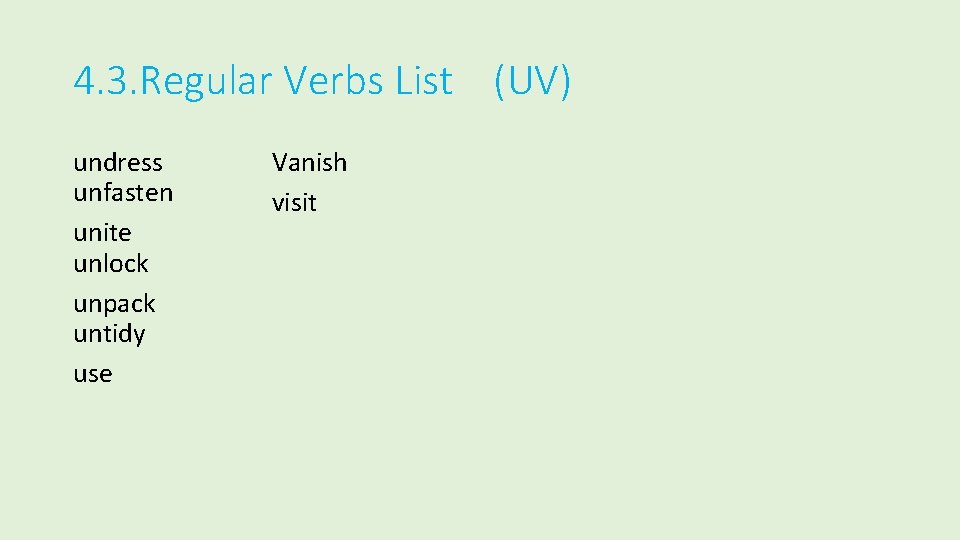
4. 3. Regular Verbs List (UV) undress unfasten unite unlock unpack untidy use Vanish visit
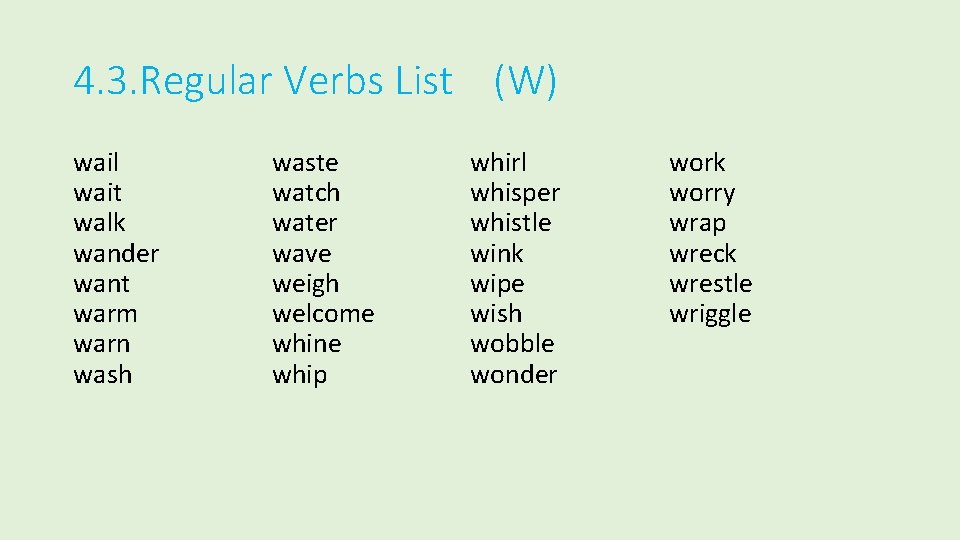
4. 3. Regular Verbs List (W) wail wait walk wander want warm warn wash waste watch water wave weigh welcome whine whip whirl whisper whistle wink wipe wish wobble wonder work worry wrap wreck wrestle wriggle
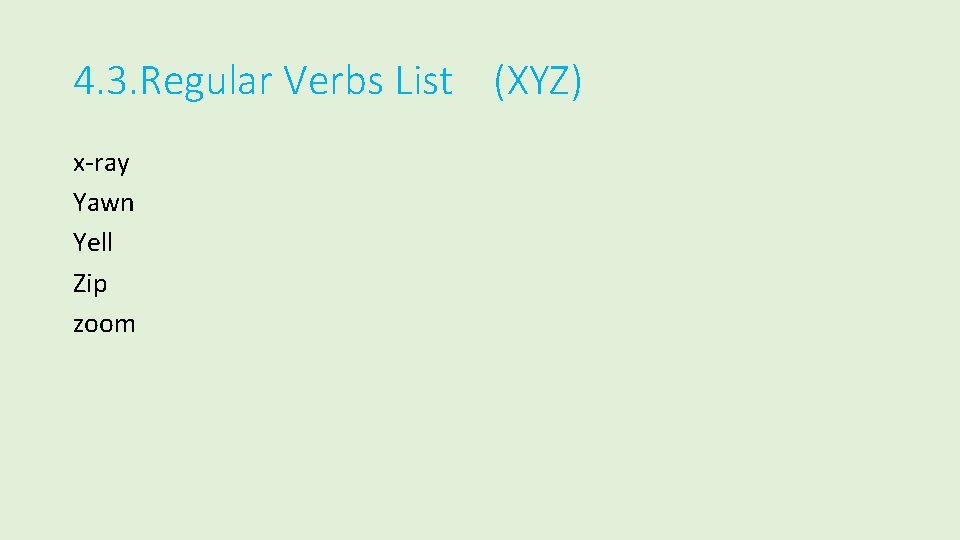
4. 3. Regular Verbs List (XYZ) x-ray Yawn Yell Zip zoom
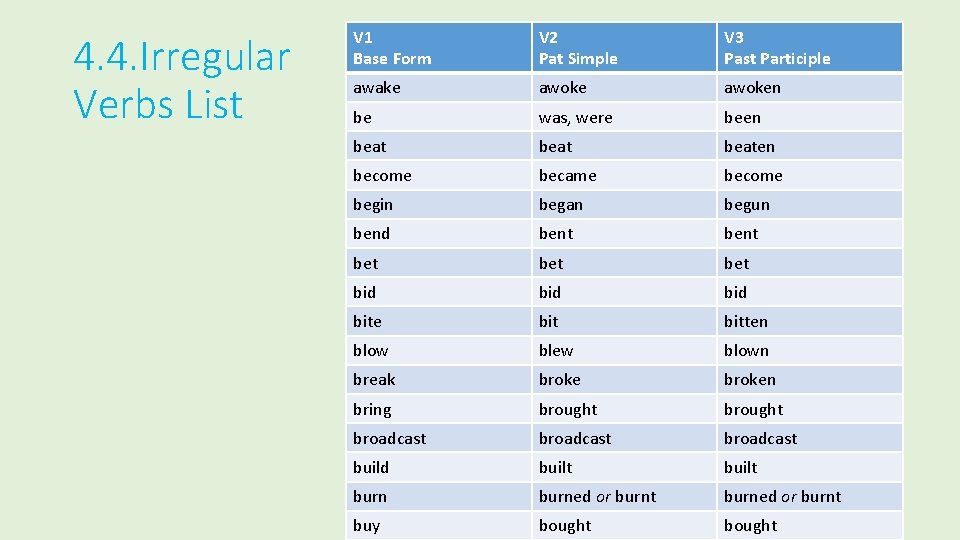
4. 4. Irregular Verbs List V 1 Base Form V 2 Pat Simple V 3 Past Participle awake awoken be was, were been beaten become became become begin began begun bend bent bet bet bid bid bite bitten blow blew blown break broken bring brought broadcast build built burned or burnt buy bought
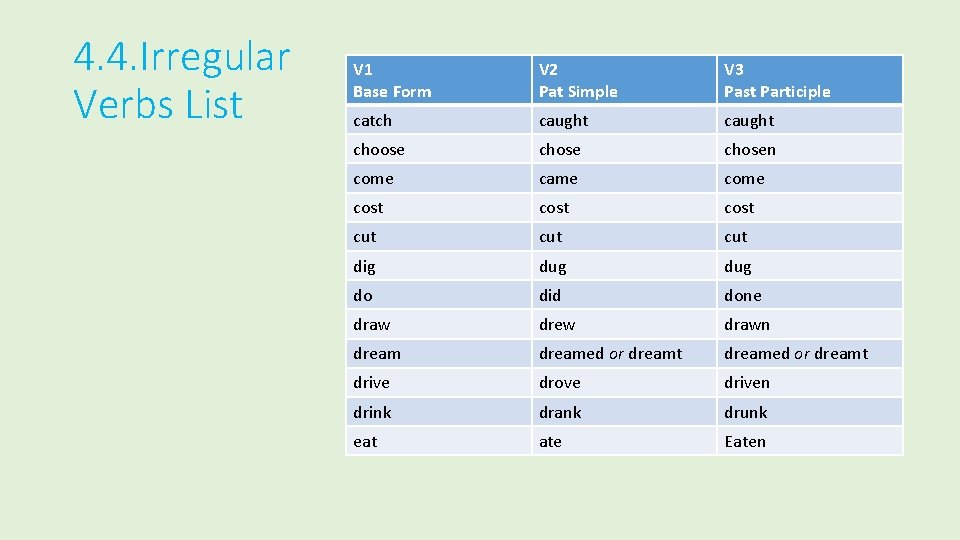
4. 4. Irregular Verbs List V 1 Base Form V 2 Pat Simple V 3 Past Participle catch caught choose chosen come came cost cut cut dig dug do did done draw drew drawn dreamed or dreamt drive drove driven drink drank drunk eat ate Eaten
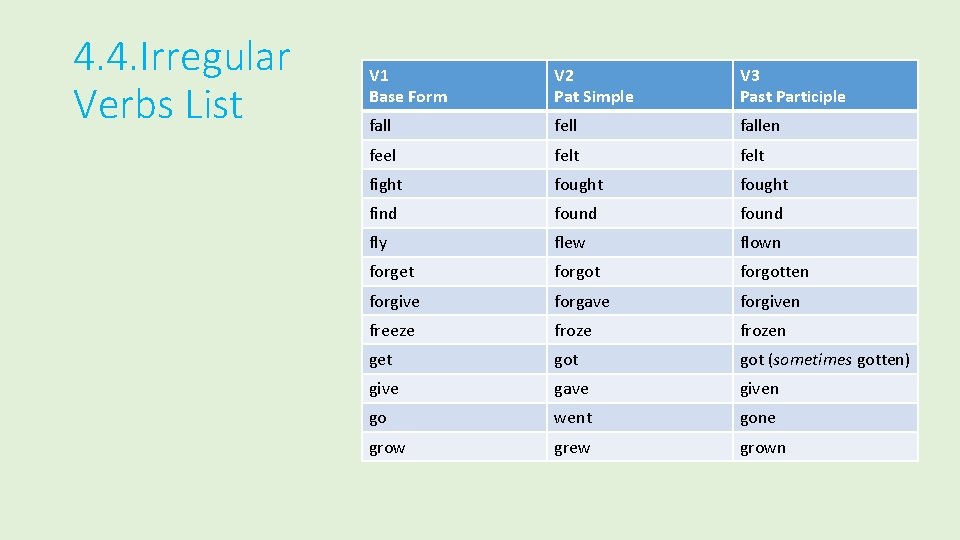
4. 4. Irregular Verbs List V 1 Base Form V 2 Pat Simple V 3 Past Participle fall fell fallen feel felt fight fought find found fly flew flown forget forgotten forgive forgave forgiven freeze frozen get got (sometimes gotten) give gave given go went gone grow grew grown
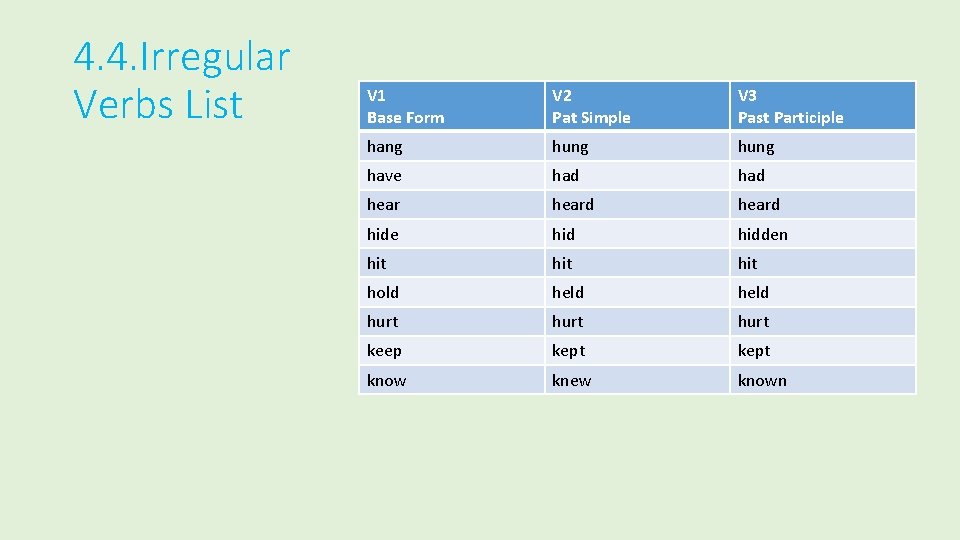
4. 4. Irregular Verbs List V 1 Base Form V 2 Pat Simple V 3 Past Participle hang hung have had heard hide hidden hit hit hold held hurt keep kept know knew known
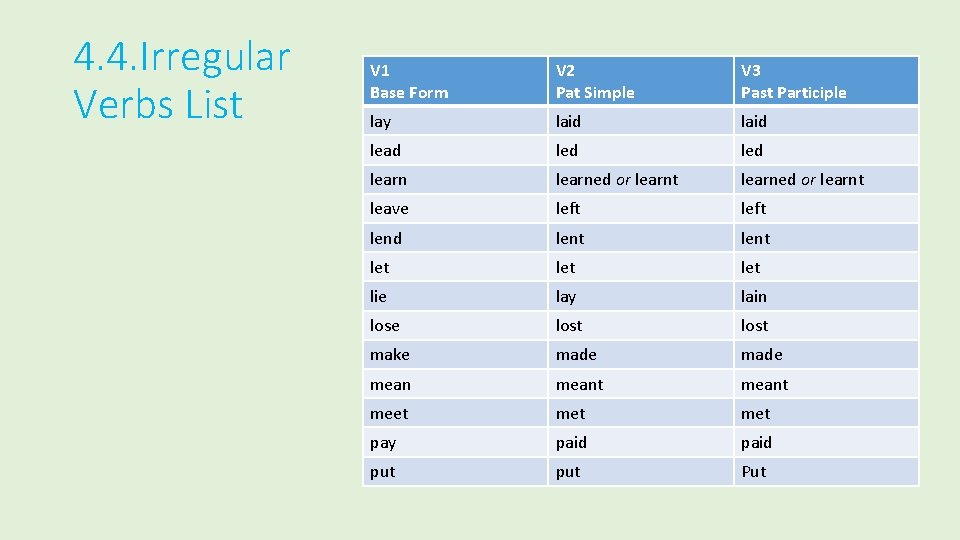
4. 4. Irregular Verbs List V 1 Base Form V 2 Pat Simple V 3 Past Participle lay laid lead led learned or learnt leave left lend lent let let lie lay lain lose lost make made meant meet met pay paid put Put
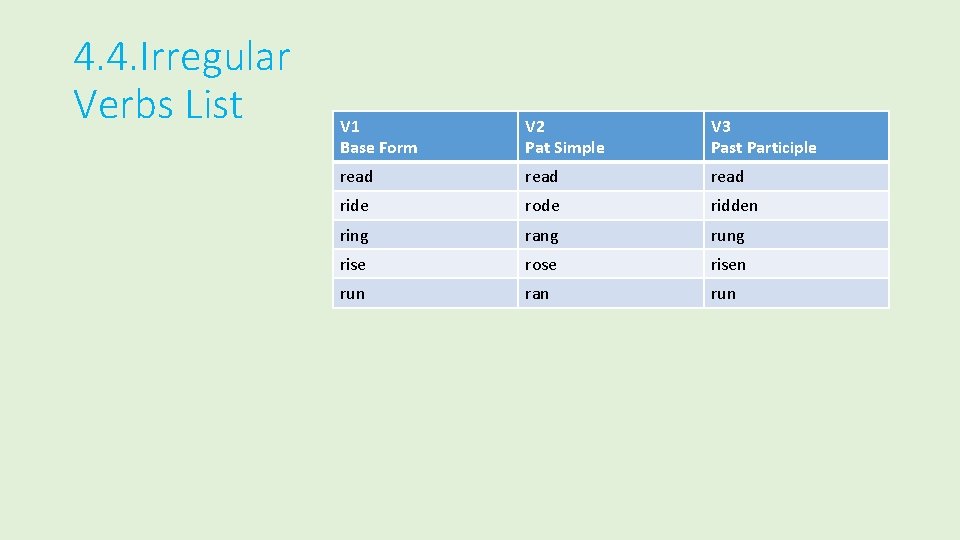
4. 4. Irregular Verbs List V 1 Base Form V 2 Pat Simple V 3 Past Participle read ride rode ridden ring rang rung rise rose risen run ran run
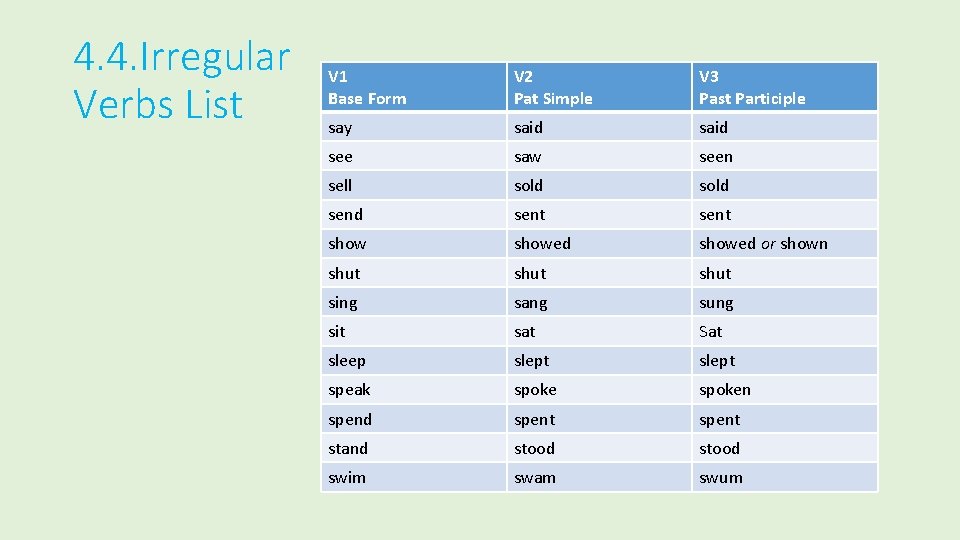
4. 4. Irregular Verbs List V 1 Base Form V 2 Pat Simple V 3 Past Participle say said see saw seen sell sold send sent showed or shown shut sing sang sung sit sat Sat sleep slept speak spoken spend spent stand stood swim swam swum
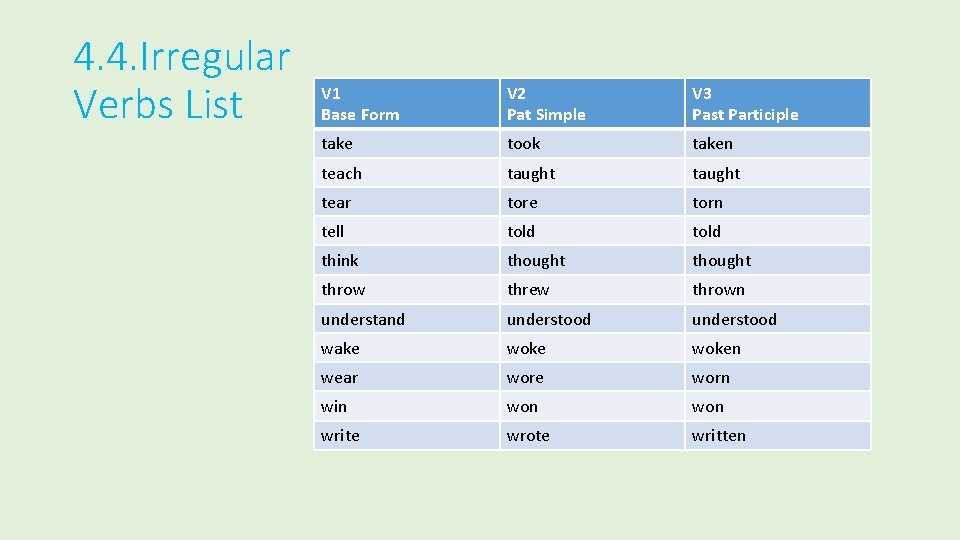
4. 4. Irregular Verbs List V 1 Base Form V 2 Pat Simple V 3 Past Participle take took taken teach taught tear tore torn tell told think thought throw threw thrown understand understood wake woken wear wore worn win won write wrote written
- Slides: 59