
What is a Verb Introduction and Overview What
What is a Verb? Introduction and Overview
What is a verb? Talk with your classmate. Can you define or give an example of a verb?
Why learn about verbs? The verb is the core (center, foundation) for the English sentence. We cannot have a sentence without a verb. When trying to decide if a sentence is complete and correct, we usually look for the verb first.
Verbs are so important, we can even have sentence that is only one word—the verb!

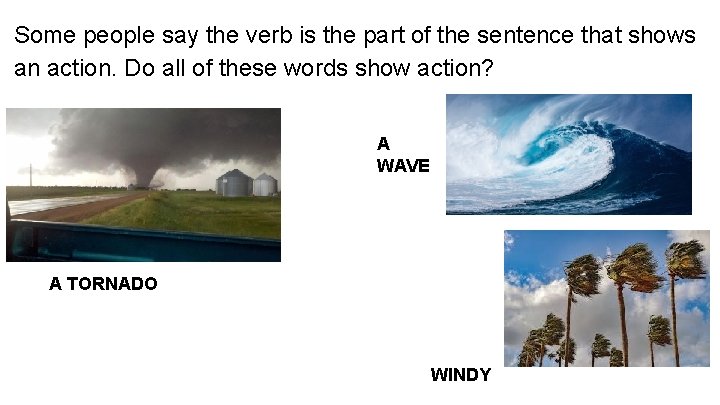
Some people say the verb is the part of the sentence that shows an action. Do all of these words show action? A WAVE A TORNADO WINDY
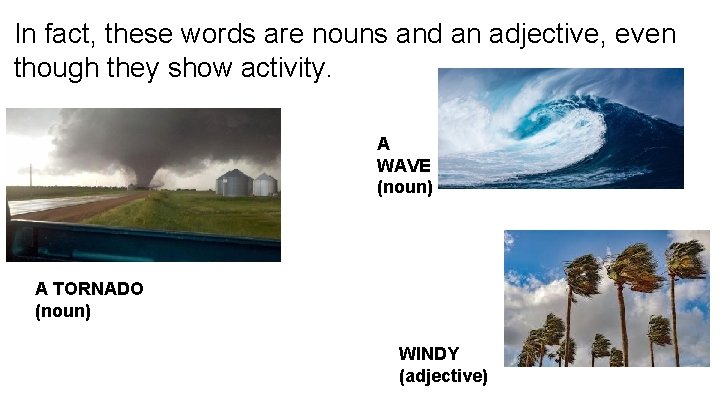
In fact, these words are nouns and an adjective, even though they show activity. A WAVE (noun) A TORNADO (noun) WINDY (adjective)
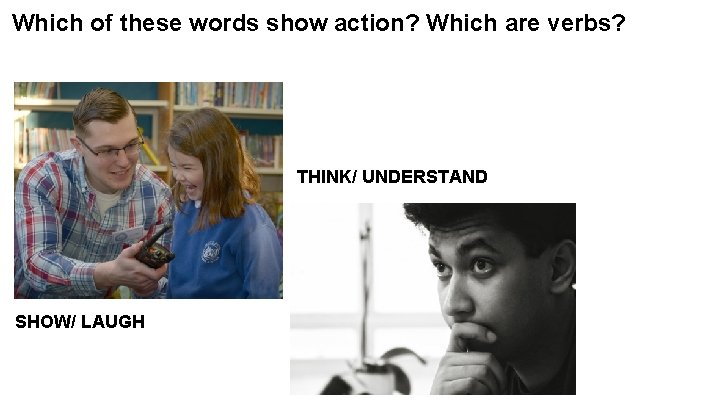
Which of these words show action? Which are verbs? THINK/ UNDERSTAND SHOW/ LAUGH
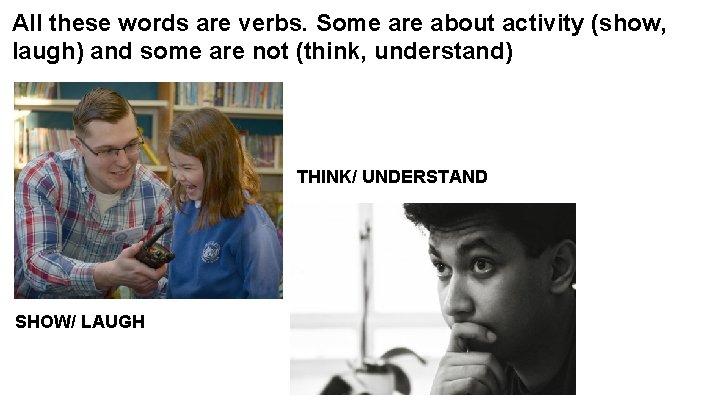
All these words are verbs. Some are about activity (show, laugh) and some are not (think, understand) THINK/ UNDERSTAND SHOW/ LAUGH
So what makes a word a VERB?
A verb shows TENSE (time) PAST--flew PRESENT-flies FUTURE-will fly
A verb shows ASPECT Simple-flew, flies Continuous-is flying, was flying Perfect-has flown, had flown
One way to decide if a word is a verb is to look at the changes you can make to the word. Can you add - ed for past? Does the word change to show past tense? Which of these words can show past tense by changing form or adding -ed? Tornado Windy Think Understand Show Laugh Wave Fly
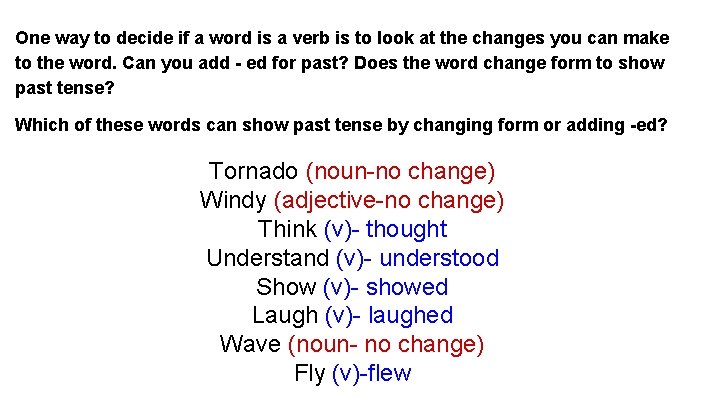
One way to decide if a word is a verb is to look at the changes you can make to the word. Can you add - ed for past? Does the word change form to show past tense? Which of these words can show past tense by changing form or adding -ed? Tornado (noun-no change) Windy (adjective-no change) Think (v)- thought Understand (v)- understood Show (v)- showed Laugh (v)- laughed Wave (noun- no change) Fly (v)-flew
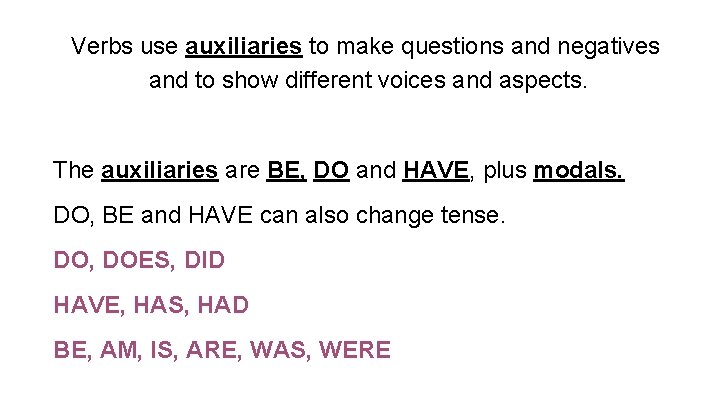
Verbs use auxiliaries to make questions and negatives and to show different voices and aspects. The auxiliaries are BE, DO and HAVE, plus modals. DO, BE and HAVE can also change tense. DO, DOES, DID HAVE, HAS, HAD BE, AM, IS, ARE, WAS, WERE
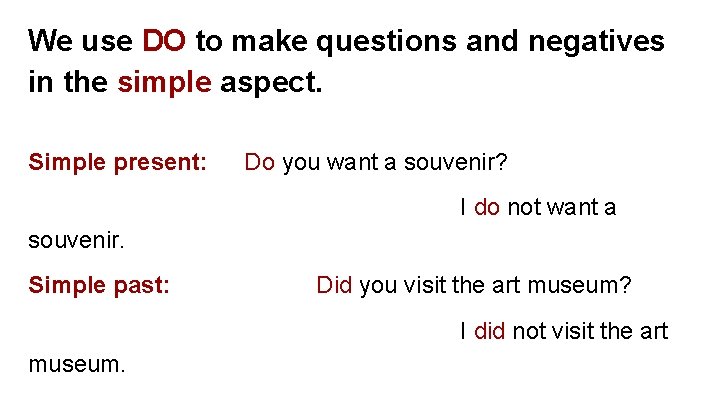
We use DO to make questions and negatives in the simple aspect. Simple present: Do you want a souvenir? I do not want a souvenir. Simple past: Did you visit the art museum? I did not visit the art museum.
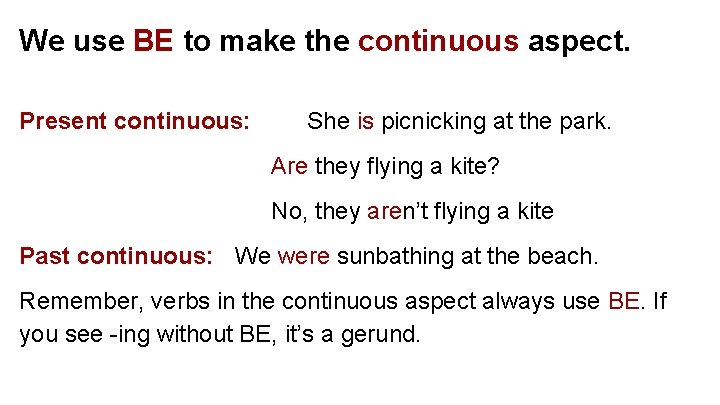
We use BE to make the continuous aspect. Present continuous: She is picnicking at the park. Are they flying a kite? No, they aren’t flying a kite Past continuous: We were sunbathing at the beach. Remember, verbs in the continuous aspect always use BE. If you see -ing without BE, it’s a gerund.
We use HAVE to make the perfect aspect. Present perfect: Have you visited downtown San Diego? That family has immigrated to El Cajon. Past perfect: We had already seen the zoo.
Now that you know what a verb is, try finding the verb in these sentences. 1. The weather today is cool and breezy. 1. East County, San Diego offers activities like hiking, camping, and mountainbiking. 1. Last week, we went to the zoo and the park. 1. Immigrants contribute many cultural benefits to our community. 1. Julian, CA, has a variety of restaurants
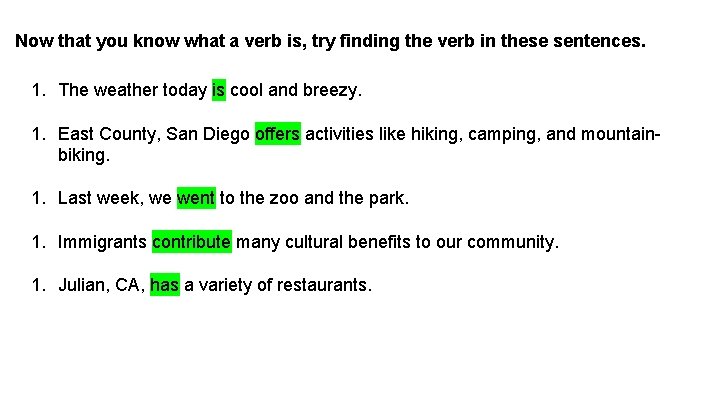
Now that you know what a verb is, try finding the verb in these sentences. 1. The weather today is cool and breezy. 1. East County, San Diego offers activities like hiking, camping, and mountainbiking. 1. Last week, we went to the zoo and the park. 1. Immigrants contribute many cultural benefits to our community. 1. Julian, CA, has a variety of restaurants.
Congratulations! Now that you are familiar with verbs, you are ready to learn more about clauses, sentence patterns and verb tenses!
- Slides: 21