
What is a verb Discussion What is a
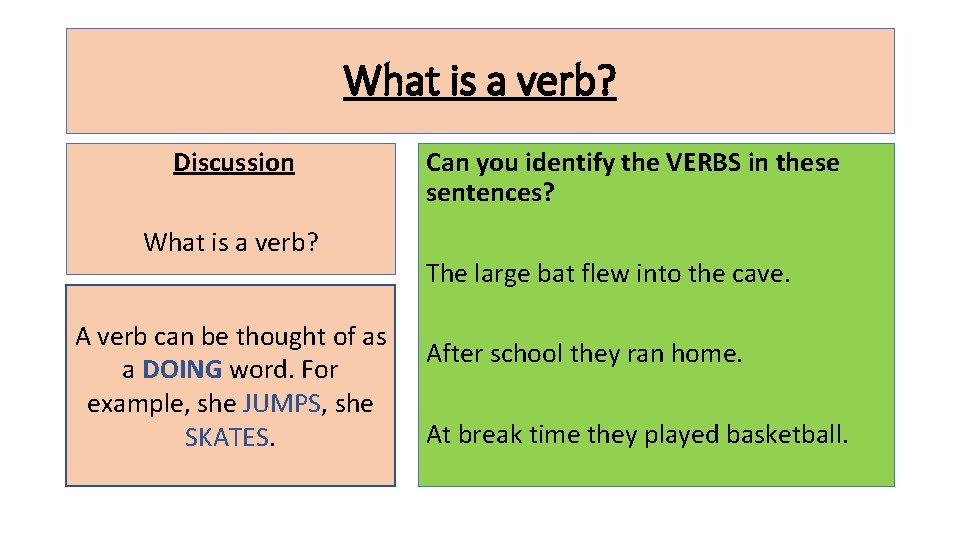
What is a verb? Discussion What is a verb? A verb can be thought of as a DOING word. For example, she JUMPS, she SKATES. Can you identify the VERBS in these sentences? The large bat flew into the cave. After school they ran home. At break time they played basketball.
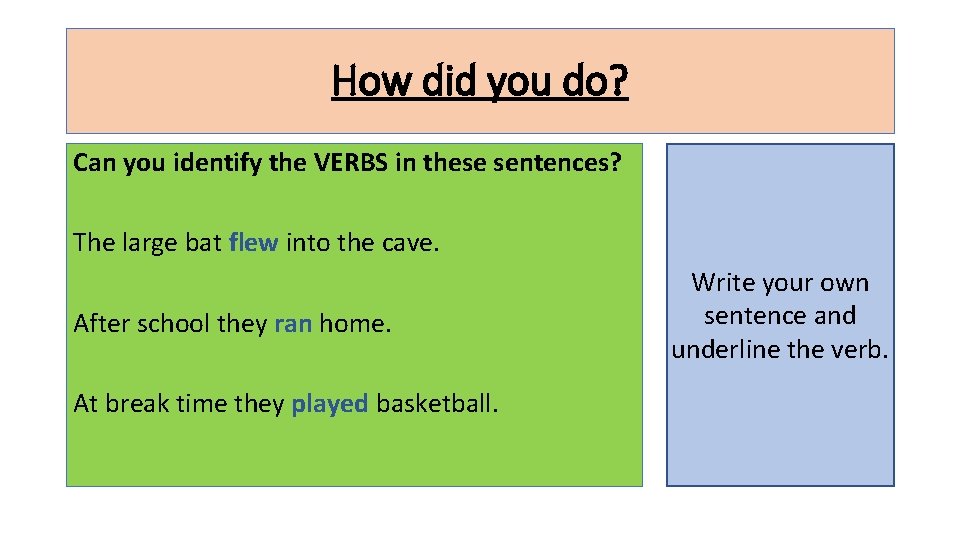
How did you do? Can you identify the VERBS in these sentences? The large bat flew into the cave. After school they ran home. At break time they played basketball. Write your own sentence and underline the verb.
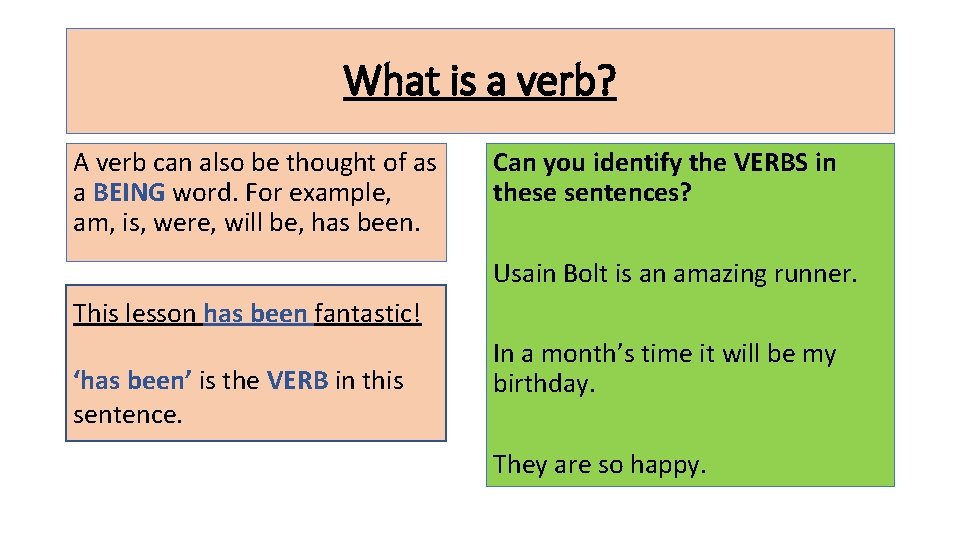
What is a verb? A verb can also be thought of as a BEING word. For example, am, is, were, will be, has been. Can you identify the VERBS in these sentences? Usain Bolt is an amazing runner. This lesson has been fantastic! ‘has been’ is the VERB in this sentence. In a month’s time it will be my birthday. They are so happy.
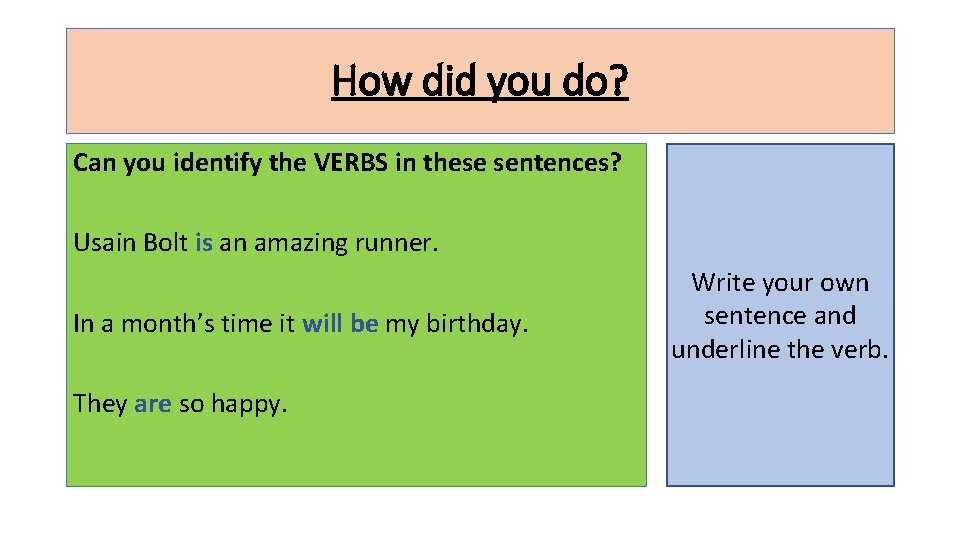
How did you do? Can you identify the VERBS in these sentences? Usain Bolt is an amazing runner. In a month’s time it will be my birthday. They are so happy. Write your own sentence and underline the verb.
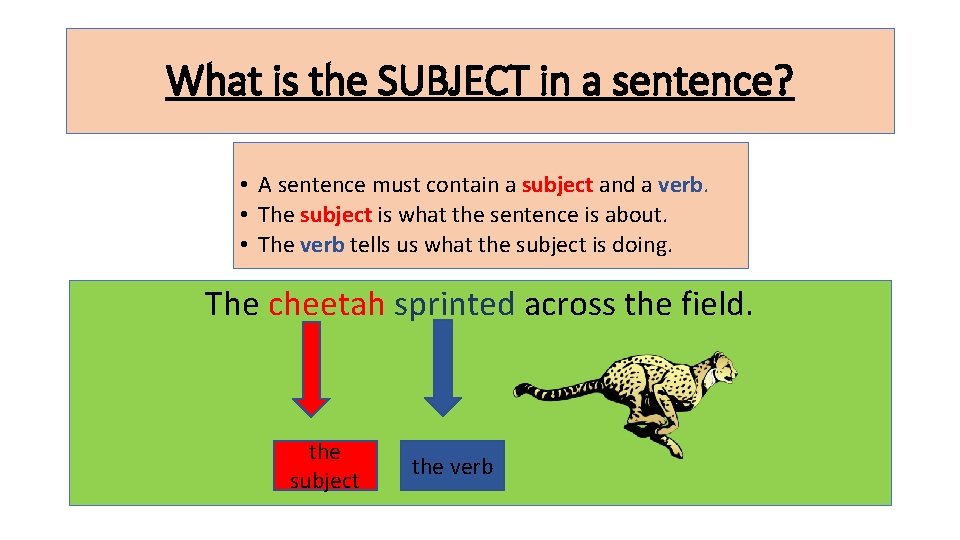
What is the SUBJECT in a sentence? • A sentence must contain a subject and a verb. • The subject is what the sentence is about. • The verb tells us what the subject is doing. The cheetah sprinted across the field. the subject the verb
Can you identify subjects and verbs? The girl scored a brilliant goal. The elephant raised his trunk. Can you identify the subject and the verb in these sentences? Sadly, the sledge crashed into a tree. Out of nowhere, a helicopter appeared in the sky. Suddenly, a crack opened in the ground.
How did you get on? The girl scored a brilliant goal. The elephant raised his trunk. Sadly, the sledge crashed into a tree. Out of nowhere, a helicopter appeared in the sky. Suddenly, a crack opened in the ground
Singular and Plural • Nouns can be singular (just one) or plural (more than one). • Usually the plural form is made by adding –s or –es e. g. cat – cats, box – boxes. Other Rules • Words that end in –f change to – ves e. g. calf – calves. • Words that end in –y change the –y to – i and add –es e. g. lady – ladies. • Words that end in – o add –es e. g. potato – potatoes.
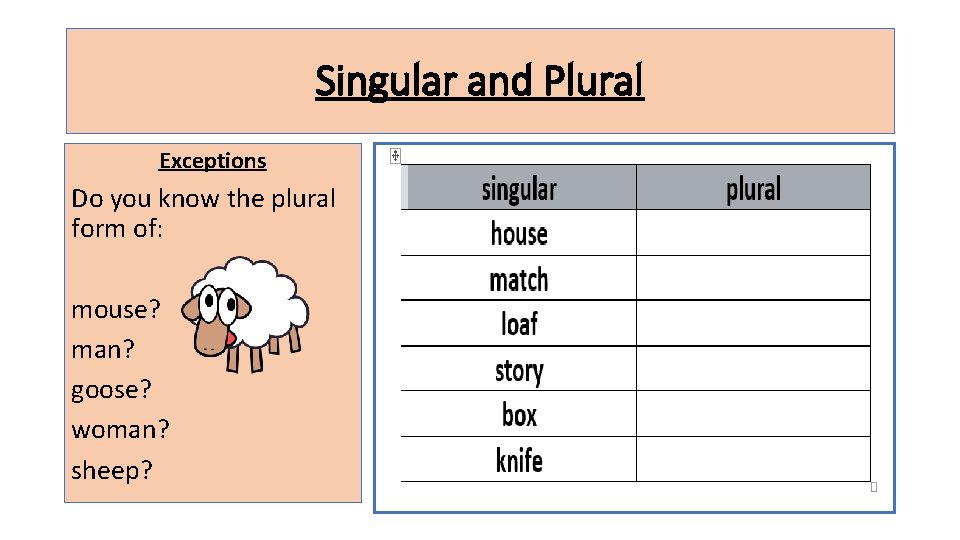
Singular and Plural Exceptions Do you know the plural form of: mouse? man? goose? woman? sheep?
Subject – verb agreement Now that we can identify subjects and verbs, we are ready to learn about ‘SUBJECT-VERB AGREEMENT’. Subjects and verbs must AGREE with one another in number.
Subject – verb agreement 1. The boy has walked to school. 2. The boys have walked to school. In the first sentence, the subject (boy) is singular so the verb will be singular - so we write ‘has’. In the second sentence, the subject (boys) is plural so the verb will be plural - so we write ‘have’.
Subject – verb agreement Discussion The house is being built quickly. The houses are being built quickly. Compare each pair of sentences. What is different? My cousin is visiting tomorrow. My cousins are visiting tomorrow. Can you explain why? At the water hole the giraffe is drinking. At the water hole the giraffes are drinking.
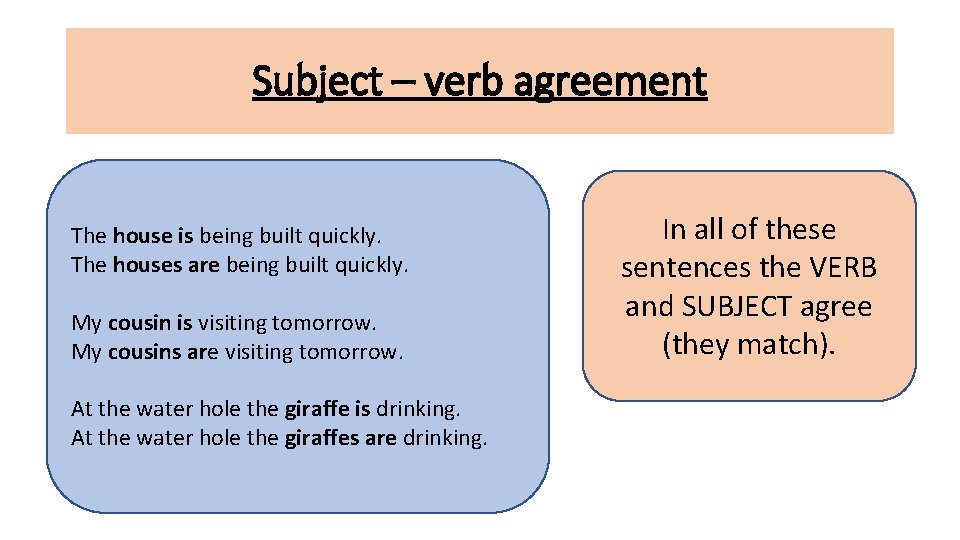
Subject – verb agreement The house is being built quickly. The houses are being built quickly. My cousin is visiting tomorrow. My cousins are visiting tomorrow. At the water hole the giraffe is drinking. At the water hole the giraffes are drinking. In all of these sentences the VERB and SUBJECT agree (they match).
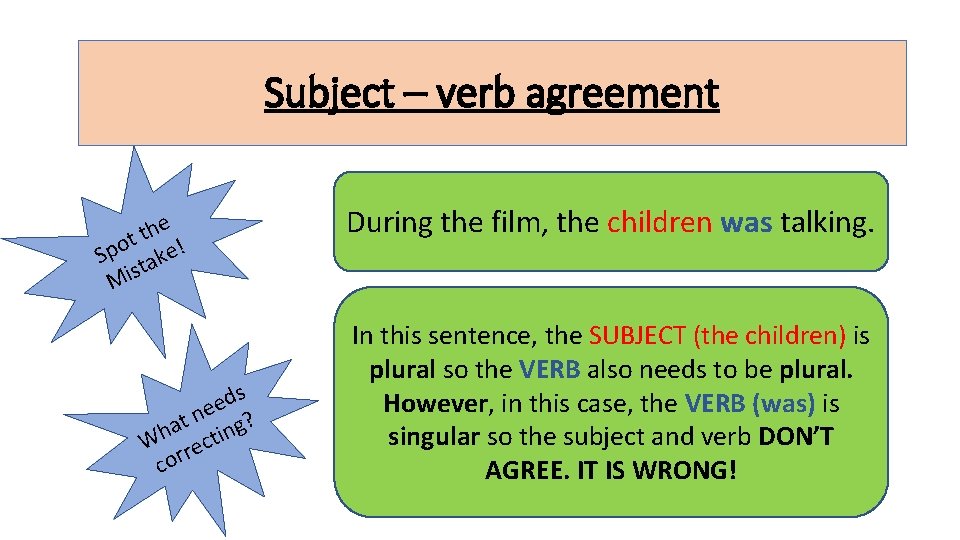
Subject – verb agreement e h t t o p S take! Mis s d e e ? n t a ting h W rec cor During the film, the children was talking. In this sentence, the SUBJECT (the children) is plural so the VERB also needs to be plural. However, in this case, the VERB (was) is singular so the subject and verb DON’T AGREE. IT IS WRONG!
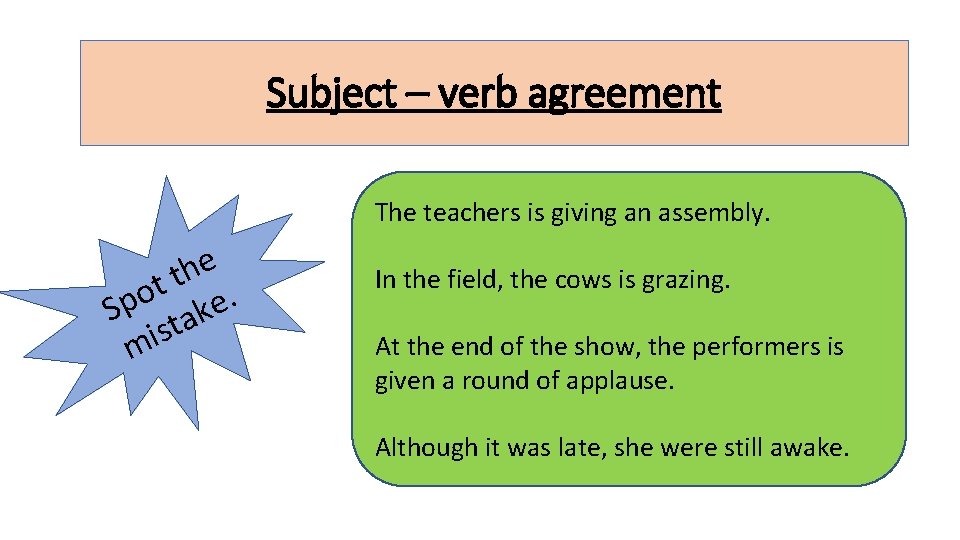
Subject – verb agreement The teachers is giving an assembly. e h t t o Sp take. s i m In the field, the cows is grazing. At the end of the show, the performers is given a round of applause. Although it was late, she were still awake.
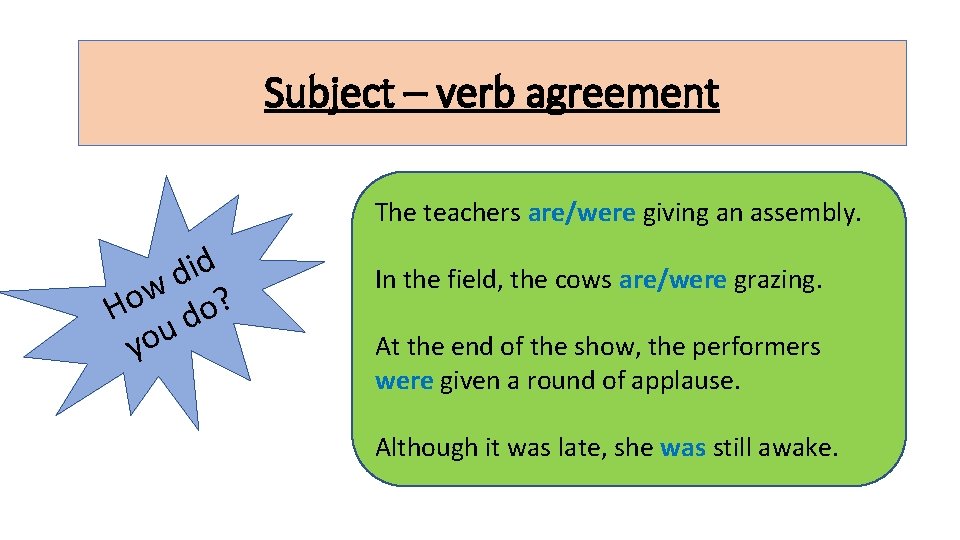
Subject – verb agreement The teachers are/were giving an assembly. id d w ? o H o d u o y In the field, the cows are/were grazing. At the end of the show, the performers were given a round of applause. Although it was late, she was still awake.
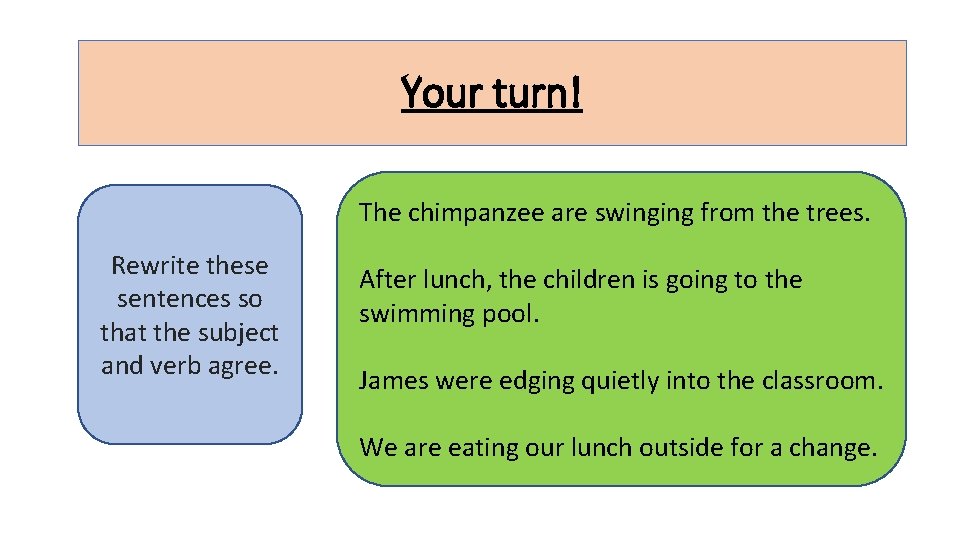
Your turn! The chimpanzee are swinging from the trees. Rewrite these sentences so that the subject and verb agree. After lunch, the children is going to the swimming pool. James were edging quietly into the classroom. We are eating our lunch outside for a change.
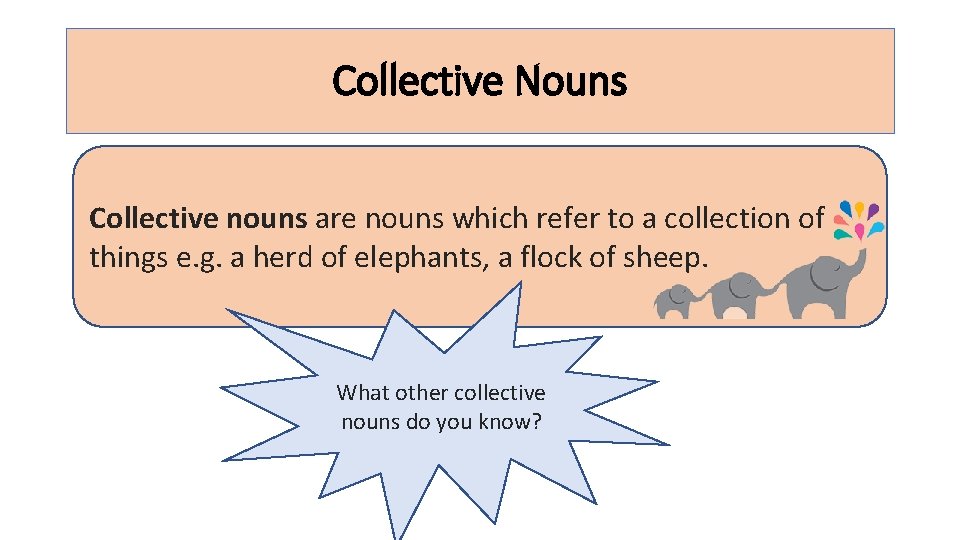
Collective Nouns Collective nouns are nouns which refer to a collection of things e. g. a herd of elephants, a flock of sheep. What other collective nouns do you know?
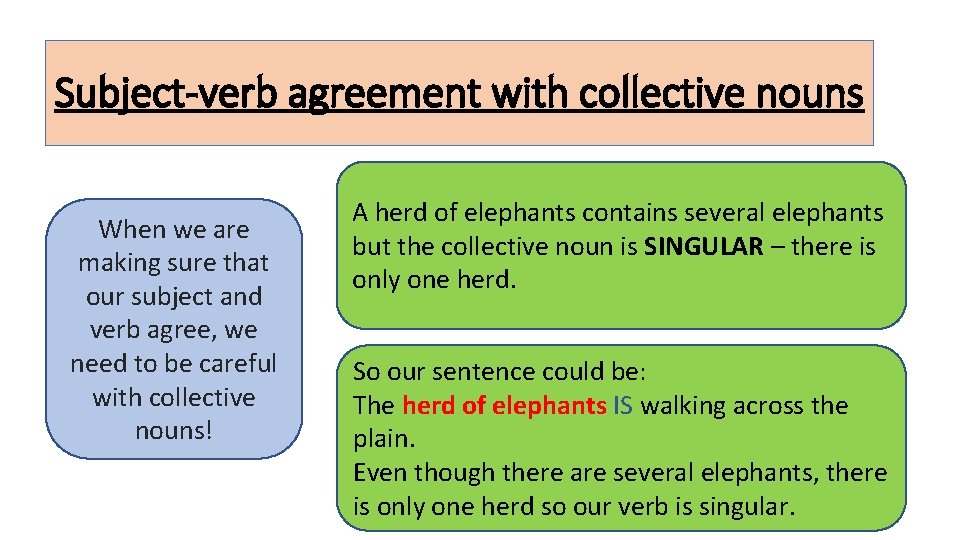
Subject-verb agreement with collective nouns When we are making sure that our subject and verb agree, we need to be careful with collective nouns! A herd of elephants contains several elephants but the collective noun is SINGULAR – there is only one herd. So our sentence could be: The herd of elephants IS walking across the plain. Even though there are several elephants, there is only one herd so our verb is singular.
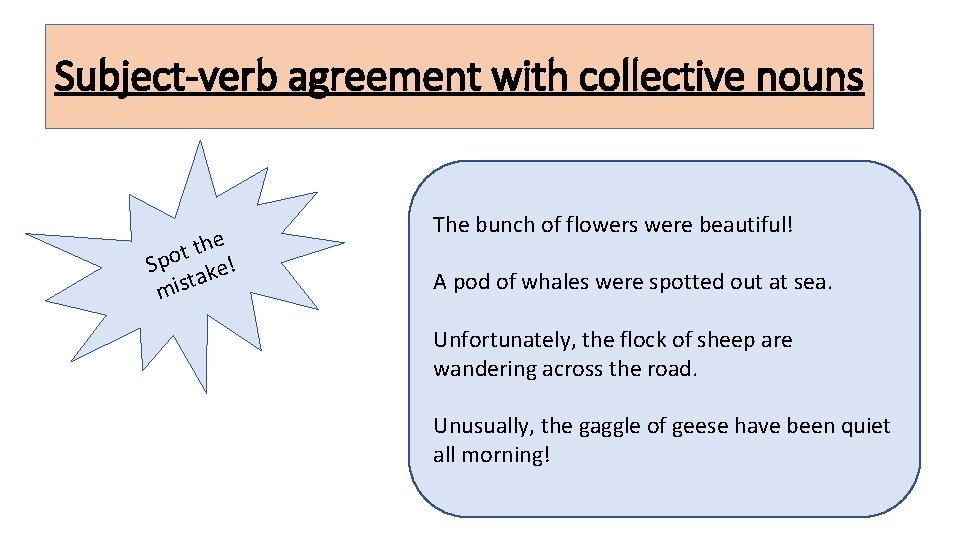
Subject-verb agreement with collective nouns he t t Spo ke! ta mis The bunch of flowers were beautiful! A pod of whales were spotted out at sea. Unfortunately, the flock of sheep are wandering across the road. Unusually, the gaggle of geese have been quiet all morning!
- Slides: 20