
What is a transparent comprehensive and effective budget
What is a transparent, comprehensive and effective budget classification from the perspective of the Government and of the Parliament? Chiara Goretti, Senato della Repubblica, Italy 7° Cesee Zagreb, 30 th June 2011
Outline - Definitions and perspectives Classifications for budgeting Classifications for analytical purposes The Italian budget Conclusions
The Budget Classifications Classify: arrange a group in classes or categories according to shared qualities or characteristics Budget classification is the grouping of revenues and expenditure according to specific characteristics Two different perspectives: - Represents the dimension of budget authorization/ appropriation (unique); - defined in budget laws; - Relevant mainly on the expenditure side; - Analytical purposes (the more, the most useful)

THE CLASSIFICATIONS FOR BUDGETING

Classifications for budgeting Budget classification is an indicator of the relationship : - between parliament and executive - allocation of resources and accountability to citizens - Managers’ accountability - administrative efficiency Provides a normative framework for both decision-making and accountability One of the tools to pursue quality of spending
Legislature-executive Budgetary specification: principle under which appropriations must be use for the specific purpose laid down in the budget Historical role of parliaments in controlling budgets “…limitations gradually draw closer, and the legislature ties the hands of the executive more and more. These are precisely the steps by which financial history, from the beginning of the century, has gradually developed. Budgetary specification has developed from a vote en bloc by ministry to a vote by section of a ministry; finally, it has come to a vote by chapter, where it now stands, showing the tendency to descend as far down as to the vote by paragraph and by article in accordance with [legislative] suggestion”. (The Budget, Renè Stourm) Classifying expenditures correctly is important for policy formulation and resources allocation Helps the proper allocation of scarce resources supported by the clear definition of spending priorities
Efficiency and managerial responsibility Budget appropriation could be based on: • organization - agencies • inputs • programs However, increasingly focus is on classification system capable of linking funding to results rather than inputs. Budget classification is today one of the fundamental building blocks of a sound management system
Program budgeting and performance focus Classification by programs is a basic information tool used by most contemporary performance budgeting systems intended to introduce clarity about the objectives being pursued through public expenditure New wave focusing on the need to improve the effectiveness and cost efficiency of public spending • • • relaxation of inputs program budgeting managerial accountability accrual accounting performance indicators and information on results

THE CLASSIFICATIONS FOR ANALYTICAL PURPOSES
Functional Classification: COFOG The Classification of the functions of government (COFOG), developed in 1999 by the OECD and published by the UN Statistical Division as a standard classifying the purposes of government activities. 3 levels of detail: • Divisions describe the broad objectives of government • groups • classes both define the means by which these broad objectives are achieved These functions are designed to be general enough to apply to the government of different countries. The value is that different countries can be compared.
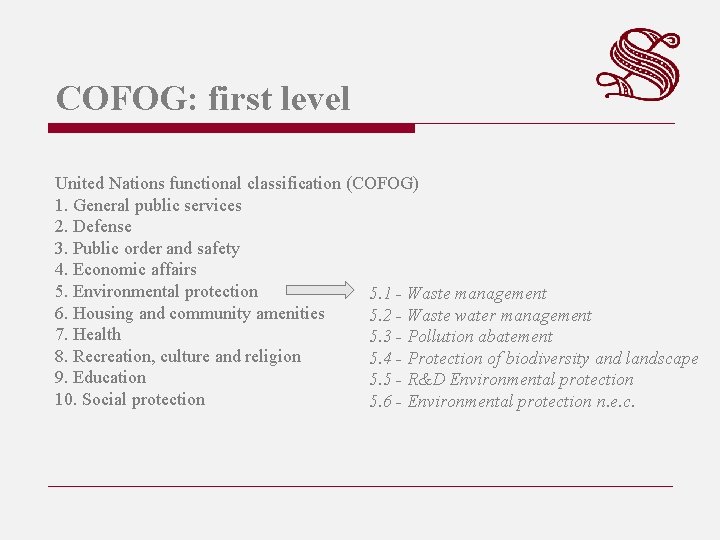
COFOG: first level United Nations functional classification (COFOG) 1. General public services 2. Defense 3. Public order and safety 4. Economic affairs 5. Environmental protection 5. 1 - Waste management 6. Housing and community amenities 5. 2 - Waste water management 7. Health 5. 3 - Pollution abatement 8. Recreation, culture and religion 5. 4 - Protection of biodiversity and landscape 9. Education 5. 5 - R&D Environmental protection 10. Social protection 5. 6 - Environmental protection n. e. c.
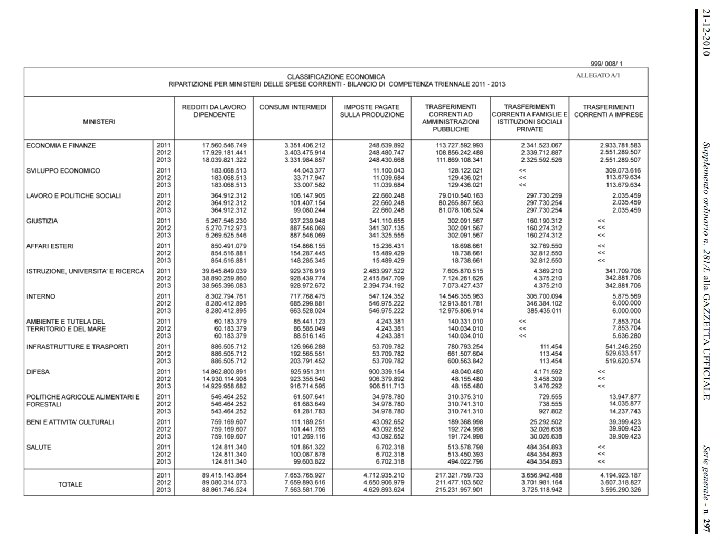
The Economic Classification: ESA 95 Any type of budget classification should be capable of being broken down into relevant inputs for analysis purposes. European System of Accounts ESA 95 economic classification identifies different categories of inputs. Economic classification is relevant for the macroeconomic stabilization function and for statistical reasons
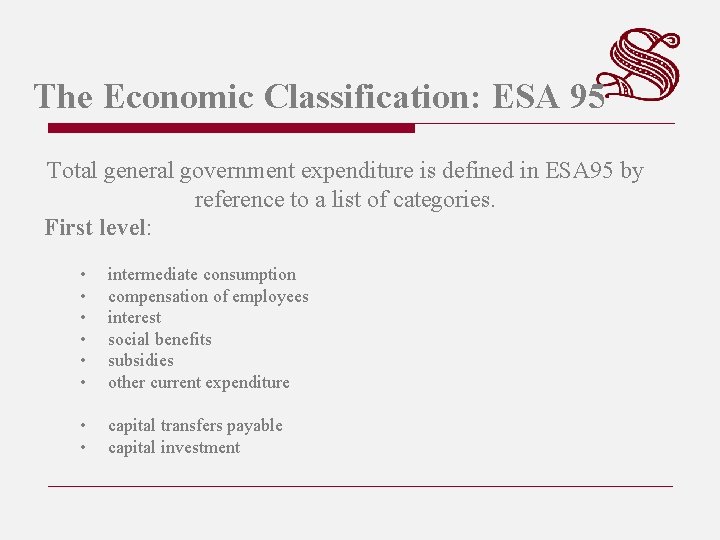
The Economic Classification: ESA 95 Total general government expenditure is defined in ESA 95 by reference to a list of categories. First level: • • • intermediate consumption compensation of employees interest social benefits subsidies other current expenditure • • capital transfers payable capital investment

THE ITALIAN BUDGET
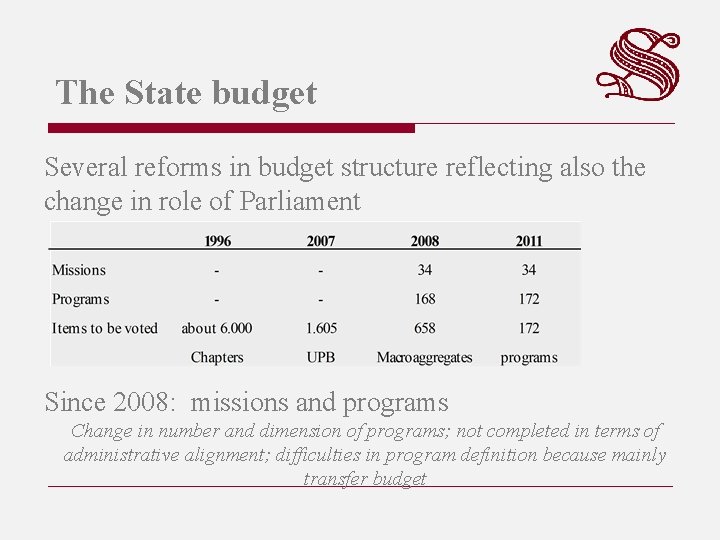
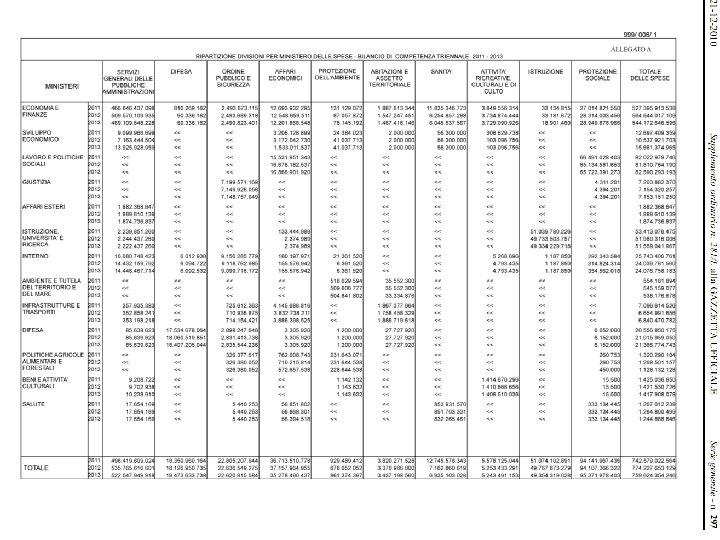
The State budget Several reforms in budget structure reflecting also the change in role of Parliament Since 2008: missions and programs Change in number and dimension of programs; not completed in terms of administrative alignment; difficulties in program definition because mainly transfer budget
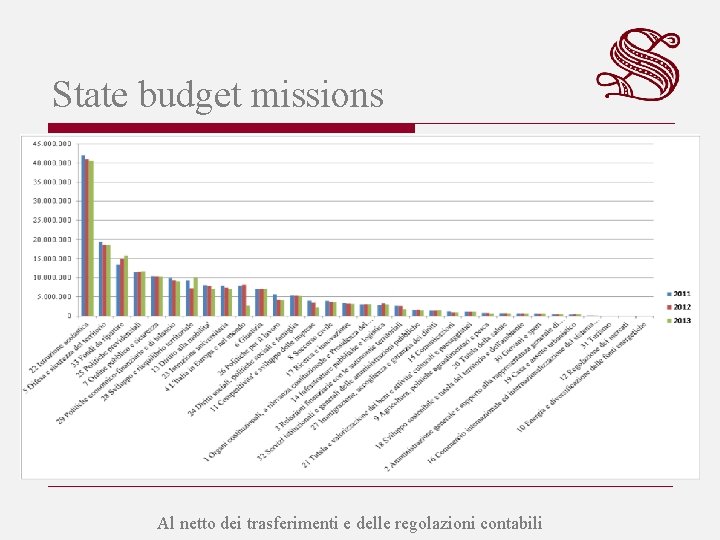
State budget missions Al netto dei trasferimenti e delle regolazioni contabili
Conclusions - Transparency: program definition, alignment with administrative organization; - appropriation or legislation supremacy; - Transparency: connections with economic and functional classification; - Budget classification is one of the tools (medium-term planning; managerial responsibility, performance indicators, accrual);

THANK YOU FOR YOUR ATTENTION
- Slides: 20