
What is a transient student What is a



- Slides: 35
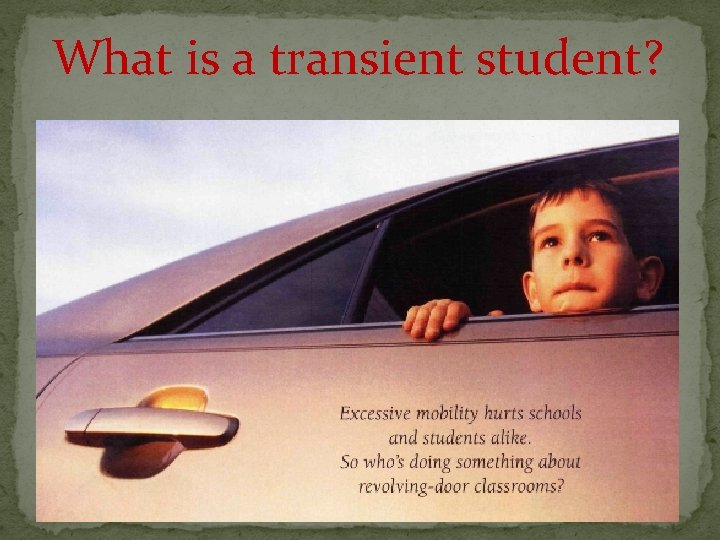
What is a transient student?
What is a transient student? • Excessive mobility within a school year • passing especially quickly into and out of existence • short in its duration or stay • suggests a quick vanishing and an airy or fragile quality
What Turnover Issues Exist with Transient Students? �Disruption to the school environment. �Disruption to teacher’s lessons. �Overall classroom learning for all students. �Mobile student’s level of engagement in learning. �Proper placement of the student.
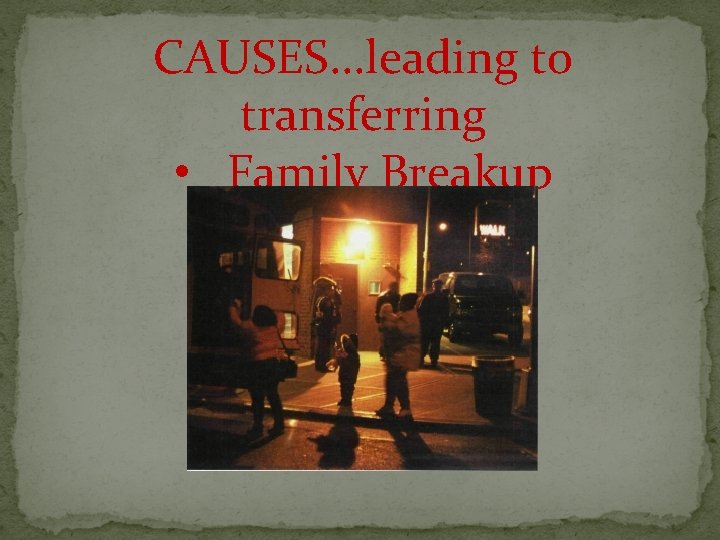
CAUSES. . . leading to transferring • Family Breakup
Children of Migrant Workers Federal Migrant Education Program Project ESTRELLA Department of Education
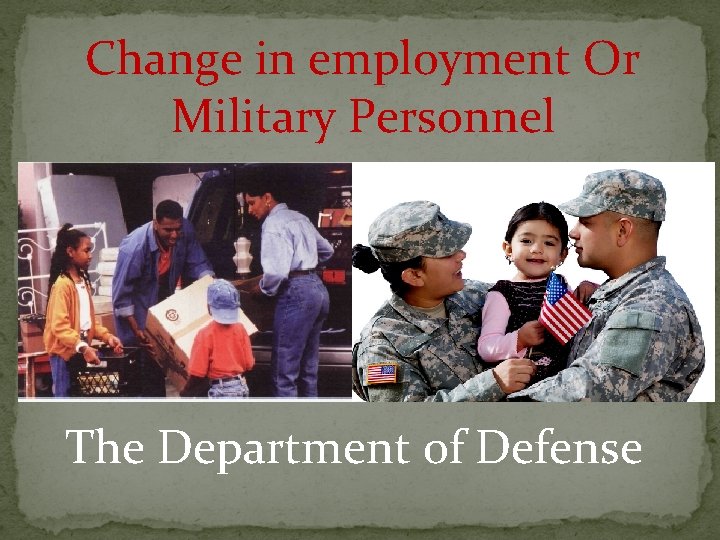
Change in employment Or Military Personnel The Department of Defense
Residential Instability Hope VI Project
Homelessness Mc. Kinney Vento Homeless Assistance Act
What does the data say about transient students? Student mobility data can vary from district to district based on a number of different factors. Generally, the issue is widespread across the nation. 2010 Government Accountability Office analysis 13% of students nationally change schools four or more times between kindergarten and eighth grade.
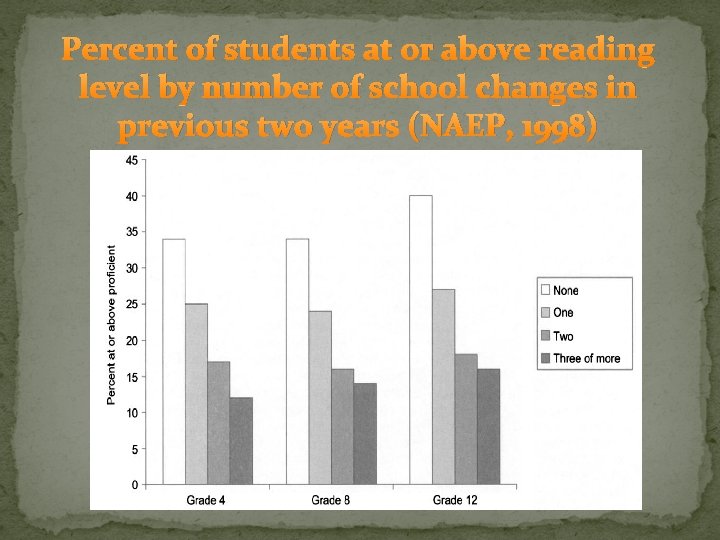
More data. . . 1998 National Assessment of Educational Progress (NAEP) study Percent of students changing schools once within 2 years: 34% of 4 th graders 21% of 8 th graders 10% of 12 th graders
Percent of students at or above reading level by number of school changes in previous two years (NAEP, 1998)
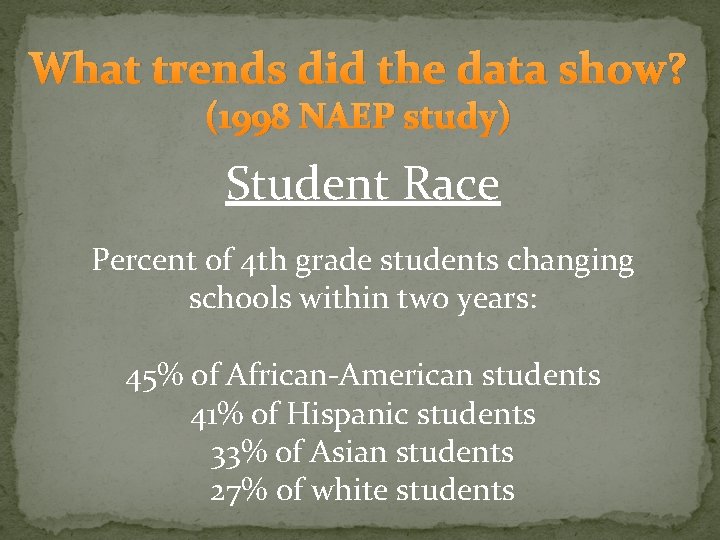
What trends did the data show? (1998 NAEP study) Student Race Percent of 4 th grade students changing schools within two years: 45% of African-American students 41% of Hispanic students 33% of Asian students 27% of white students
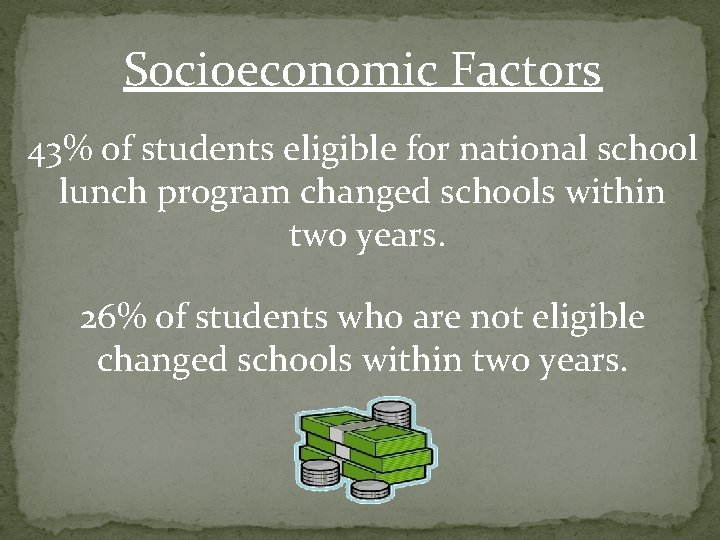
Socioeconomic Factors 43% of students eligible for national school lunch program changed schools within two years. 26% of students who are not eligible changed schools within two years.
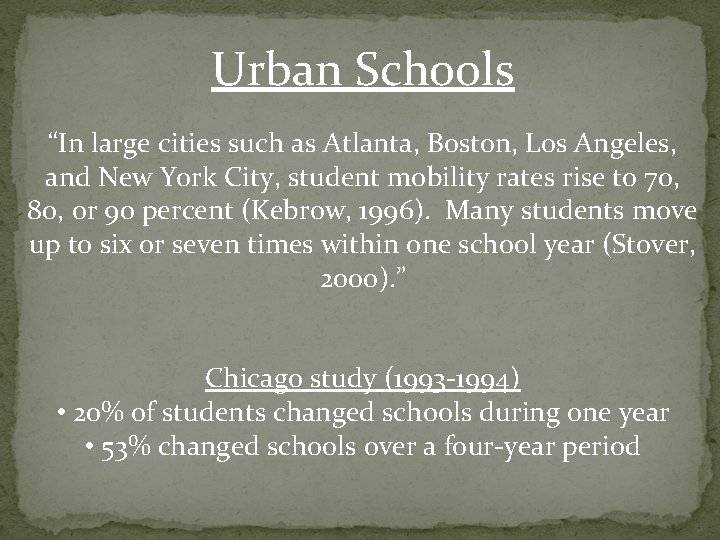
Urban Schools “In large cities such as Atlanta, Boston, Los Angeles, and New York City, student mobility rates rise to 70, 80, or 90 percent (Kebrow, 1996). Many students move up to six or seven times within one school year (Stover, 2000). ” Chicago study (1993 -1994) • 20% of students changed schools during one year • 53% changed schools over a four-year period
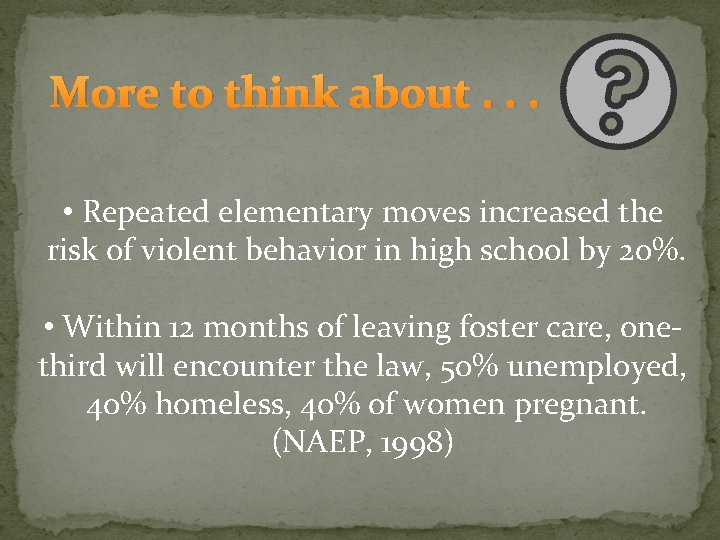
More to think about. . . • Repeated elementary moves increased the risk of violent behavior in high school by 20%. • Within 12 months of leaving foster care, onethird will encounter the law, 50% unemployed, 40% homeless, 40% of women pregnant. (NAEP, 1998)
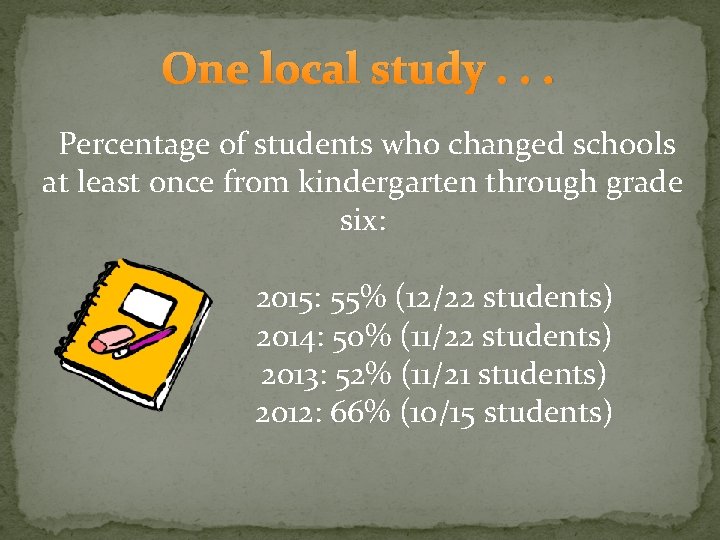
One local study. . . Percentage of students who changed schools at least once from kindergarten through grade six: 2015: 55% (12/22 students) 2014: 50% (11/22 students) 2013: 52% (11/21 students) 2012: 66% (10/15 students)
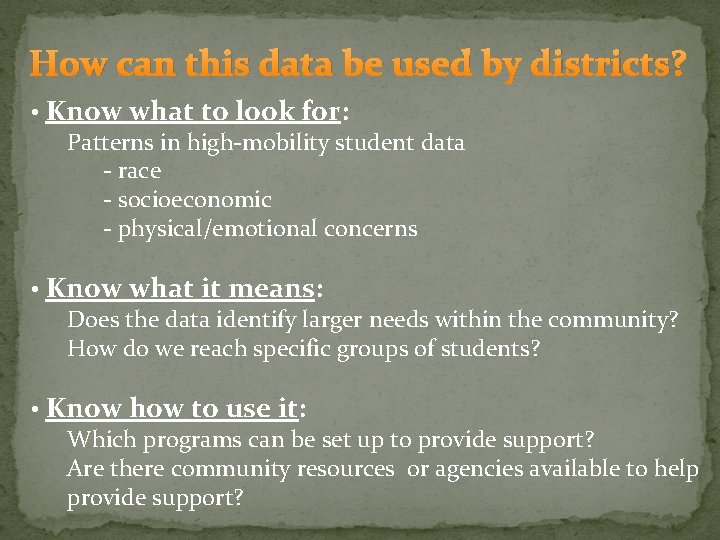
How can this data be used by districts? • Know what to look for: Patterns in high-mobility student data - race - socioeconomic - physical/emotional concerns • Know what it means: Does the data identify larger needs within the community? How do we reach specific groups of students? • Know how to use it: Which programs can be set up to provide support? Are there community resources or agencies available to help provide support?
Reflect on your response to the following: If you only had a day, a week, or a month to work with a child: What would you want to leave with him or her?
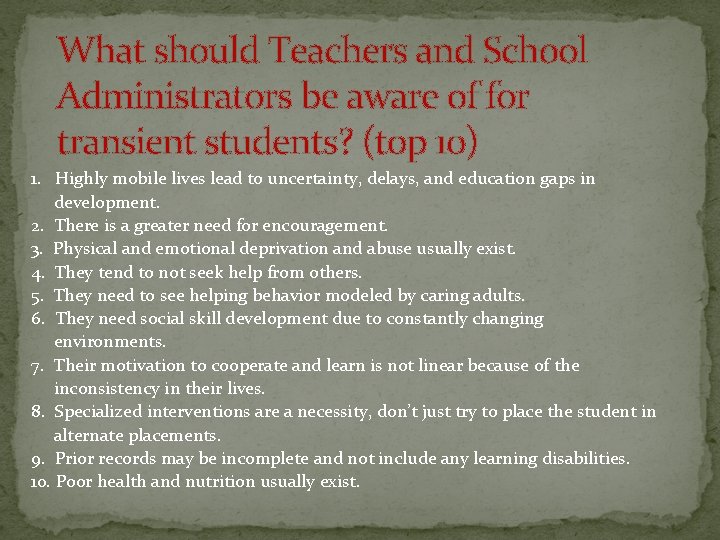
What should Teachers and School Administrators be aware of for transient students? (top 10) 1. Highly mobile lives lead to uncertainty, delays, and education gaps in development. 2. There is a greater need for encouragement. 3. Physical and emotional deprivation and abuse usually exist. 4. They tend to not seek help from others. 5. They need to see helping behavior modeled by caring adults. 6. They need social skill development due to constantly changing environments. 7. Their motivation to cooperate and learn is not linear because of the inconsistency in their lives. 8. Specialized interventions are a necessity, don’t just try to place the student in alternate placements. 9. Prior records may be incomplete and not include any learning disabilities. 10. Poor health and nutrition usually exist.
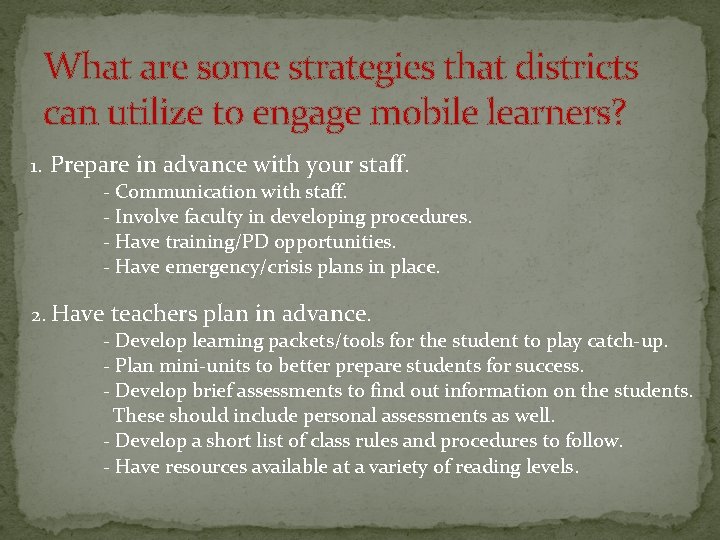
What are some strategies that districts can utilize to engage mobile learners? 1. Prepare in advance with your staff. - Communication with staff. - Involve faculty in developing procedures. - Have training/PD opportunities. - Have emergency/crisis plans in place. 2. Have teachers plan in advance. - Develop learning packets/tools for the student to play catch-up. - Plan mini-units to better prepare students for success. - Develop brief assessments to find out information on the students. These should include personal assessments as well. - Develop a short list of class rules and procedures to follow. - Have resources available at a variety of reading levels.
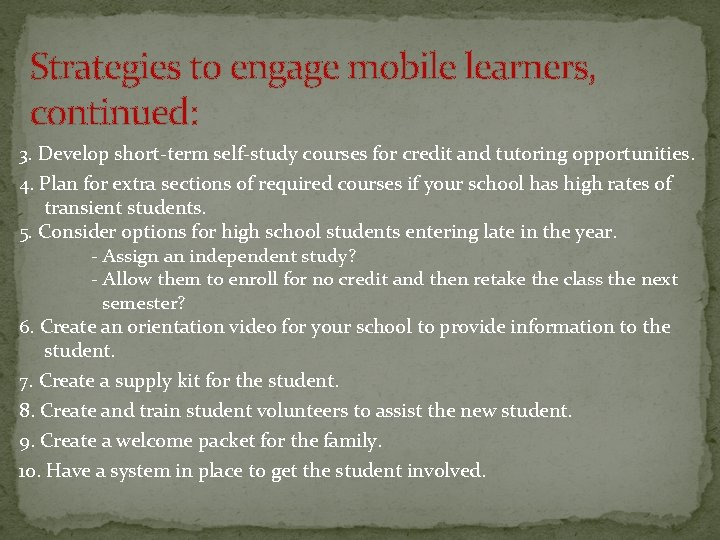
Strategies to engage mobile learners, continued: 3. Develop short-term self-study courses for credit and tutoring opportunities. 4. Plan for extra sections of required courses if your school has high rates of transient students. 5. Consider options for high school students entering late in the year. - Assign an independent study? - Allow them to enroll for no credit and then retake the class the next semester? 6. Create an orientation video for your school to provide information to the student. 7. Create a supply kit for the student. 8. Create and train student volunteers to assist the new student. 9. Create a welcome packet for the family. 10. Have a system in place to get the student involved.
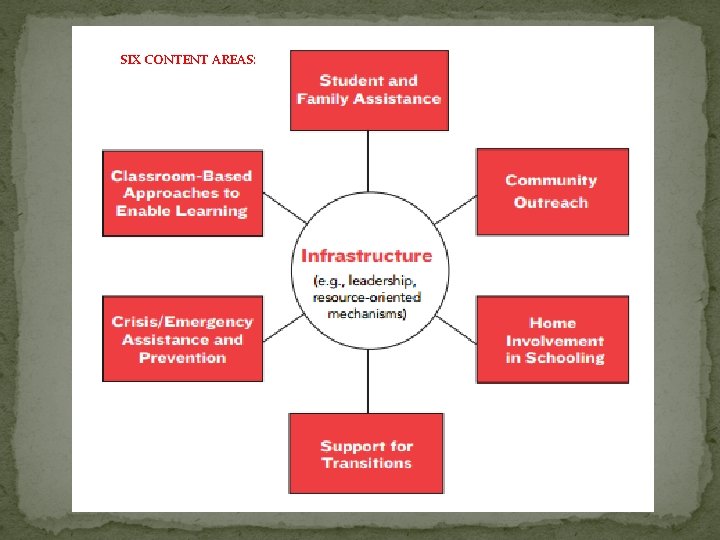
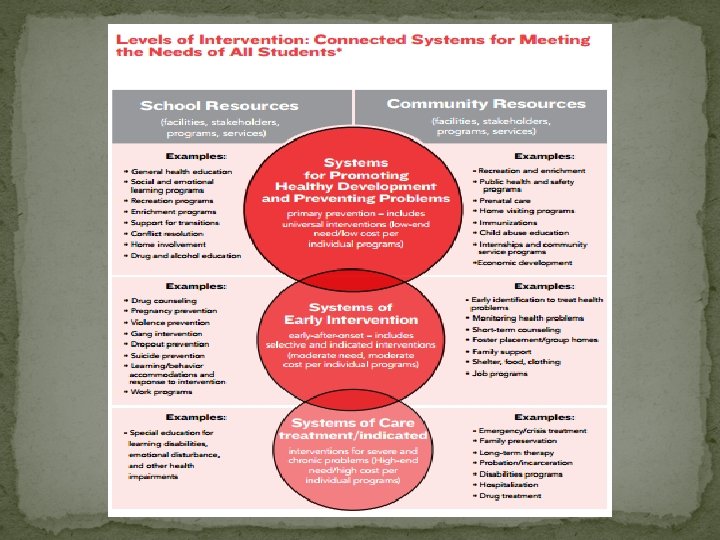
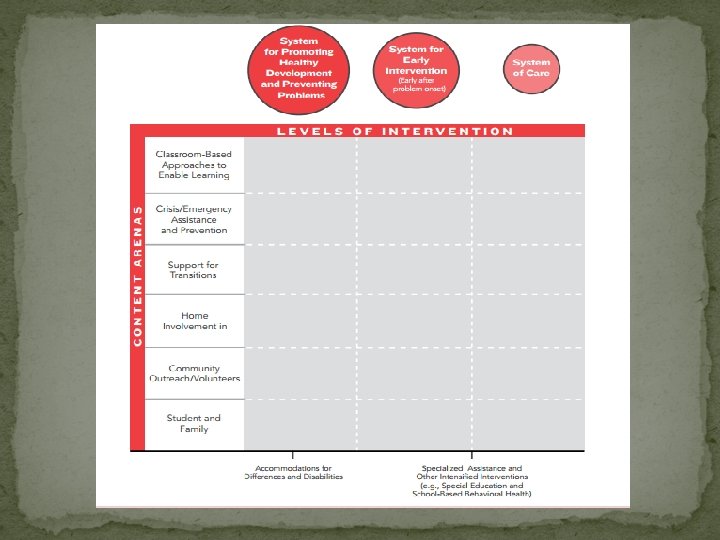
SIX CONTENT AREAS:
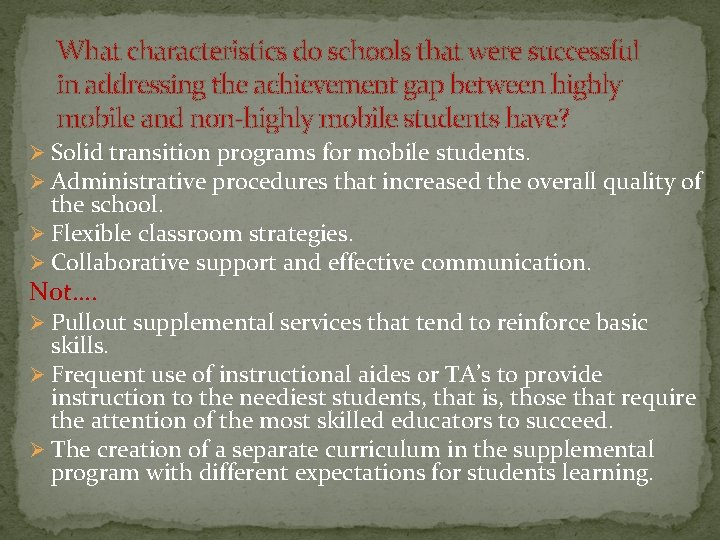
What characteristics do schools that were successful in addressing the achievement gap between highly mobile and non-highly mobile students have? Ø Solid transition programs for mobile students. Ø Administrative procedures that increased the overall quality of the school. Ø Flexible classroom strategies. Ø Collaborative support and effective communication. Not…. Ø Pullout supplemental services that tend to reinforce basic skills. Ø Frequent use of instructional aides or TA’s to provide instruction to the neediest students, that is, those that require the attention of the most skilled educators to succeed. Ø The creation of a separate curriculum in the supplemental program with different expectations for students learning.
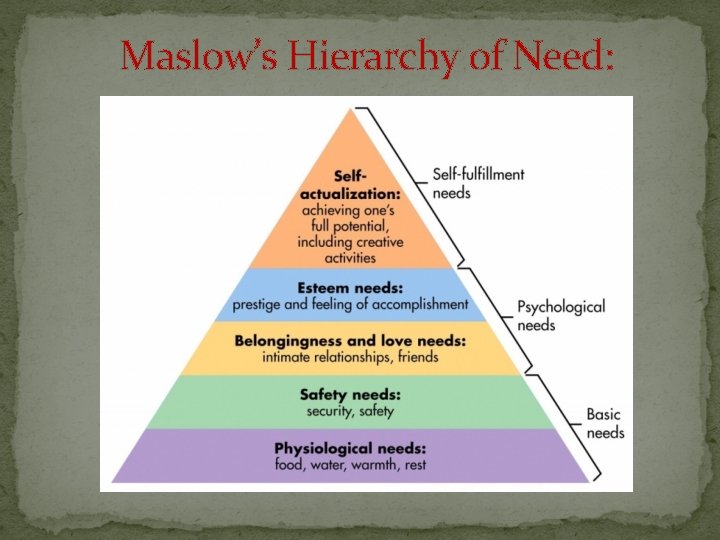
Maslow’s Hierarchy of Need:
Techniques For Educators Working with Transient Students �Whether they have a week, a month, or a year with a child, teachers play a pivotal role in the lives of their students. �Successful teachers are able to merge the academic, social, and personal needs of their highly mobile students, …and thru assessment, planning, and instruction, they maximize learning with their students.
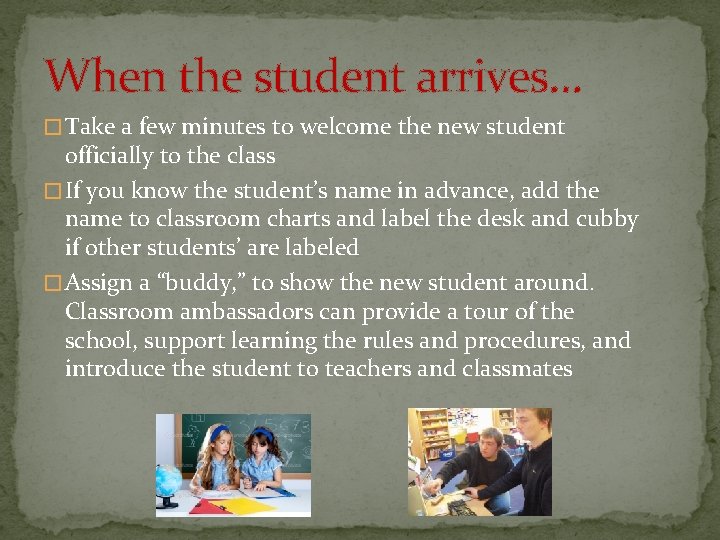
When the student arrives… � Take a few minutes to welcome the new student officially to the class � If you know the student’s name in advance, add the name to classroom charts and label the desk and cubby if other students’ are labeled � Assign a “buddy, ” to show the new student around. Classroom ambassadors can provide a tour of the school, support learning the rules and procedures, and introduce the student to teachers and classmates
When the student arrives… � Review any student records that arrive with the student that provide information about previous learning � Assess student interests to hook them into learning. Ask them! � Use the entry of a new student as a logical break to review rules and procedures with the whole class. Effective classroom management creates more time for instruction and learning � Model, model, and model what students should know and be able to do
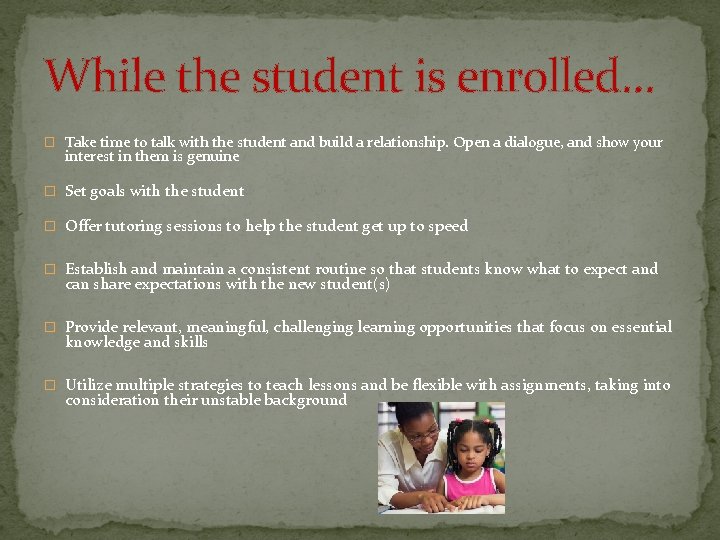
While the student is enrolled… � Take time to talk with the student and build a relationship. Open a dialogue, and show your interest in them is genuine � Set goals with the student � Offer tutoring sessions to help the student get up to speed � Establish and maintain a consistent routine so that students know what to expect and can share expectations with the new student(s) � Provide relevant, meaningful, challenging learning opportunities that focus on essential knowledge and skills � Utilize multiple strategies to teach lessons and be flexible with assignments, taking into consideration their unstable background
When the student leaves… �If you have prior knowledge that the student is leaving, create a portfolio showing his/her student work and the knowledge and skills the student has learned so that the next teacher will have an understanding of where the student is academically �Send the portfolio of student’s work with the student �Send a short letter introducing the student to his/her new teachers. If you know the student is leaving, give the letter to the child and include a copy with the student’s school records that will be sent
Disruptions to teachers/staff �The constant introduction of new students into a classroom throughout the year can cause massive disruption to lesson plans and overall student interaction �A new student may also cause social disruption among the students already acclimated to their peers, thus requiring disciplinary action, rather than academic lessons �In schools with high mobility rates, teachers must possess the flexibility to integrate remedial lessons into the curriculum, rather than proceeding with new concepts
Administrators & Transient Students �For administrators, highly mobile students can create fluctuation of enrollment counts, thereby causing budgetary shortfalls �In schools with high mobility rates, the impact of lower-achieving students may be detrimental to the academic performance of the school as a whole �Transients affect administrators as long-term planning and adoption of innovative teaching practices/techniques take longer to implement in schools with higher mobility rates �Investigate how a district’s Title I funds can be used effectively in highly mobile schools �Public Policy – Can more be done by administrators to advocate for transient students?
Concluding thoughts on transient students � Are we doing the very best we can for them? Given their volatile backgrounds… � Student mobility is an unavoidable reality of the American school system, having the most detrimental effects upon the academic achievement of our most vulnerable students. � As the data shows, changing schools frequently is associated with lower academic achievement, and results in a much greater chance of student dropouts. � Highly mobile children face multiple challenges in their lives. They are vulnerable to abrupt, unplanned changes in their home and family lives, and in their school settings. As educators we are responsible for all of our students, they are depending on us to learn.