
What is a theory 1 a set of
- Slides: 6
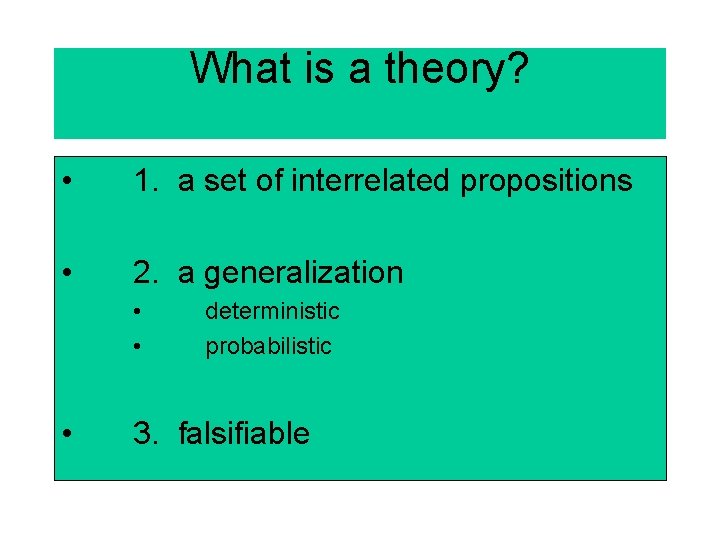
What is a theory? • 1. a set of interrelated propositions • 2. a generalization • • • deterministic probabilistic 3. falsifiable
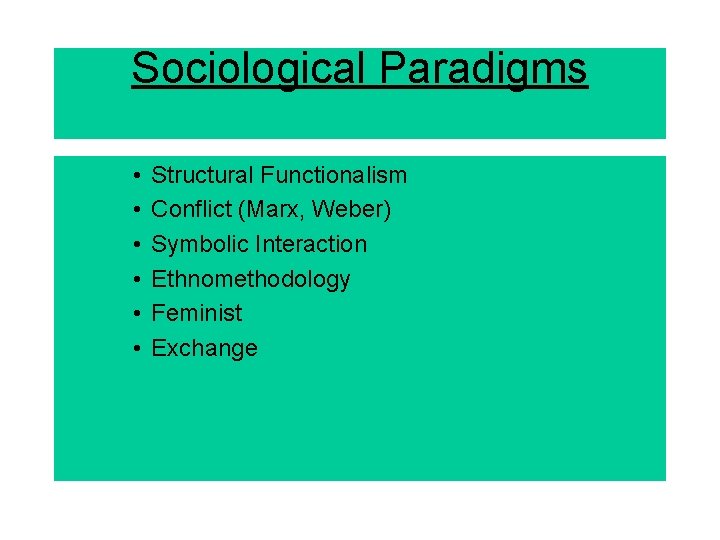
Sociological Paradigms • • • Structural Functionalism Conflict (Marx, Weber) Symbolic Interaction Ethnomethodology Feminist Exchange
Deduction vs. Induction
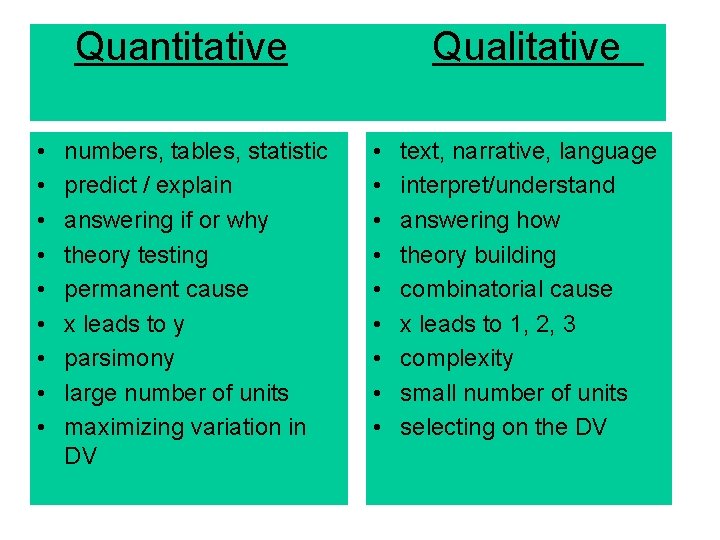
Quantitative • • • numbers, tables, statistic predict / explain answering if or why theory testing permanent cause x leads to y parsimony large number of units maximizing variation in DV Qualitative • • • text, narrative, language interpret/understand answering how theory building combinatorial cause x leads to 1, 2, 3 complexity small number of units selecting on the DV
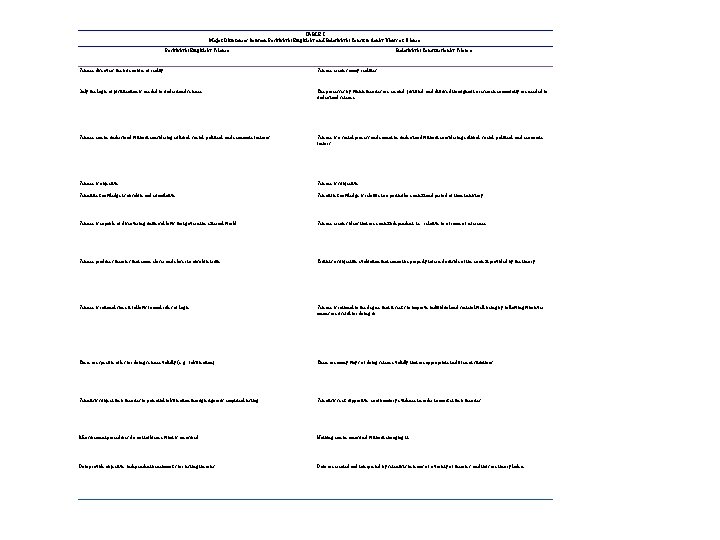
TABLE 1 Major Differences between Positivistic/Empiricist and Relativistic/Constructionist Views of Science Positivistic/Empiricist Science Relativistic/Constructionist Science discovers the true nature of reality. Science creates many realities. Only the logic of justification is needed to understand science. The processes by which theories are created, justified, and diffused throughout a research community are needed to understand science. Science can be understood without considering cultural, social, political, and economic factoras. Science is a social process and cannot be understood without considering cultural, social, political, and economic factors. Science is objective. Science is subjective. Scientific knowledge is absolute and cumulative. Scientific knowledge is relative to a particular context and period of time in history. Science is capable of discovering universal laws that govern the external world. Science creates ideas that are context-dependent, i. e. , relative to a frame of reference. Science produces theories that come closer and closer to absolute truth. Truth is a subjective evaluation that cannot be properly inferred outside of the context provided by theory. Science is rational since it follows formal rules of logic, Science is rational to the degree that it seeks to improve individual and societal well being by following whatever means are useful for doing so. There are specific rules for doing science validly (e. g. . falsification), There are many ways of doing science validly that are appropriate in different situations. Scientists subject their theories to potential falsification through rigorous empirical testing. Scientists seek supportive, confirmatory evidence in order to market their theories. Measurement procedures do not influence what is measured. Nothing can be measured without changing it. Data provide objective, independent benchmarks for testing theories, Data are created and interpreted by scientists in terms of a variety of theories, and thus are theory laden.