
What is a System on a Chip Integration


- Slides: 26
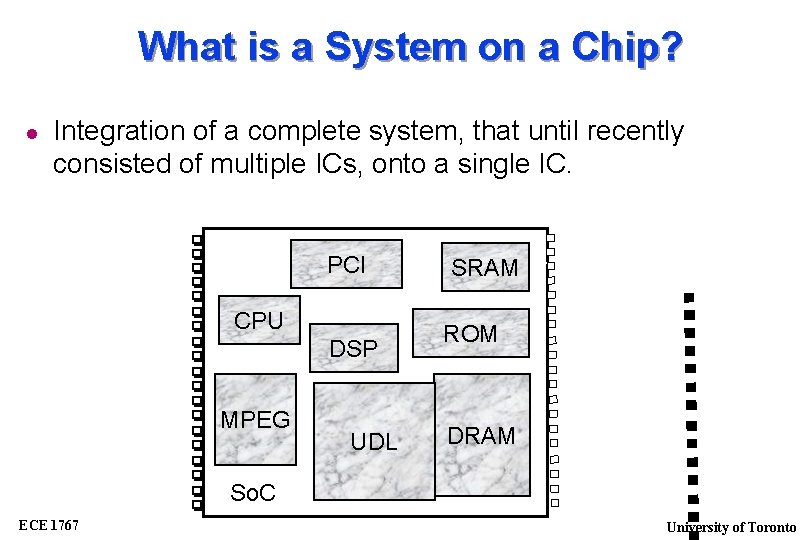
What is a System on a Chip? Integration of a complete system, that until recently consisted of multiple ICs, onto a single IC. PCI CPU DSP MPEG UDL SRAM ROM DRAM So. C ECE 1767 University of Toronto
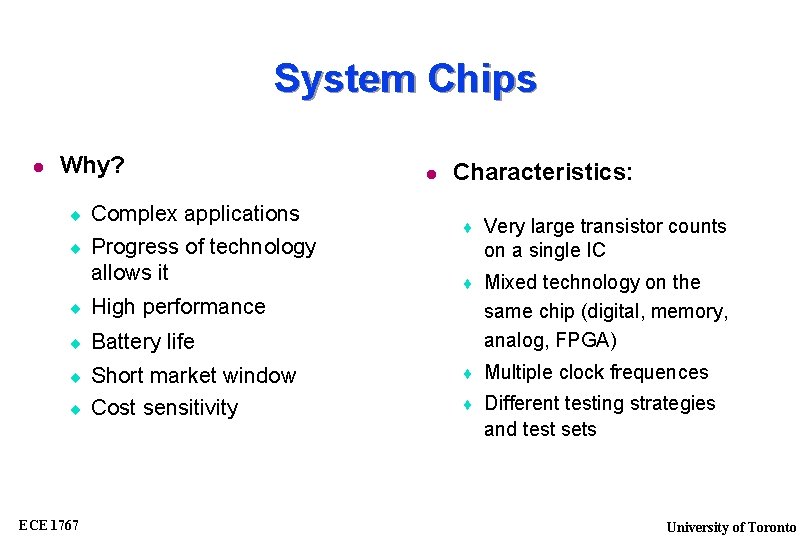
System Chips Why? Complex applications Progress of technology allows it High performance Battery life Short market window Cost sensitivity ECE 1767 Characteristics: Very large transistor counts on a single IC Mixed technology on the same chip (digital, memory, analog, FPGA) Multiple clock frequences Different testing strategies and test sets University of Toronto
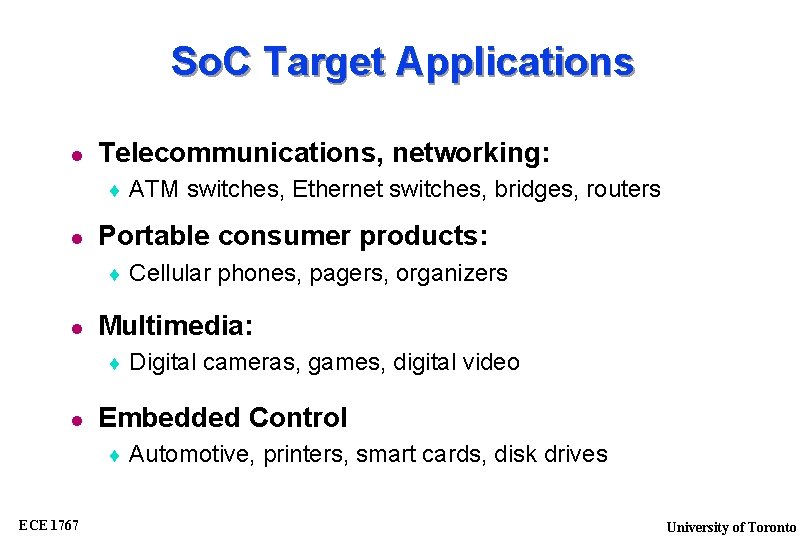
So. C Target Applications Telecommunications, networking: Portable consumer products: Digital cameras, games, digital video Embedded Control ECE 1767 Cellular phones, pagers, organizers Multimedia: ATM switches, Ethernet switches, bridges, routers Automotive, printers, smart cards, disk drives University of Toronto
What are embedded cores? Core: Pre-designed, pre-verified complex functional blocks also termed IP, megacells, system-level macros, virtual components Processor Cores: ARM, MIPS, IBM Power. PC, BIST logic DSP Cores: TI, Pine, Oak Peripherals: DMA Controller, MMU Interface: PCI, USB Multimedia: JPEG Compression, MPEG decoder Networking: Ethernet Controller, ATM switches ECE 1767 University of Toronto
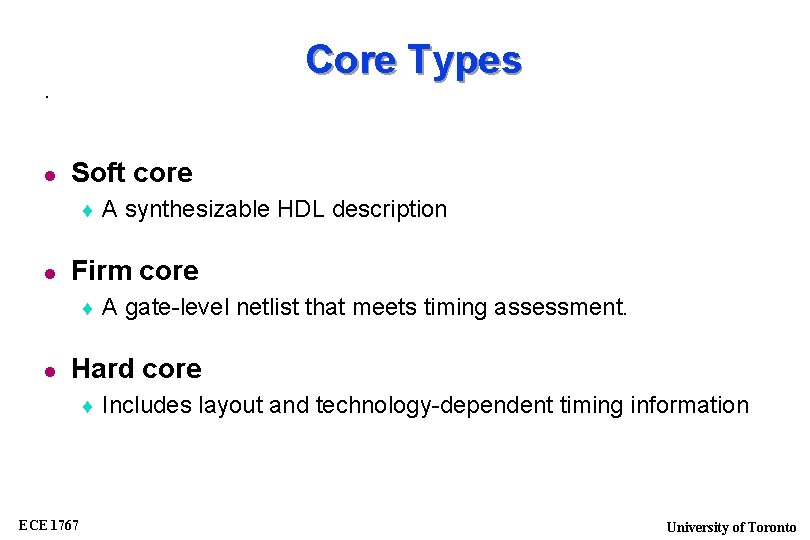
Core Types . Soft core Firm core A synthesizable HDL description A gate-level netlist that meets timing assessment. Hard core ECE 1767 Includes layout and technology-dependent timing information University of Toronto
Core Concerns Cost-of-Test and Time-to-Market concerns have lead to a Core-Based Design approach. Goal is to supply easy-to-integrate cores to the system-ona-chip market. Core design and core integration are major issues. System-on-Board vs. System-on-Chip: Analogy: Reuse of pre-designed components on a system Difference: So. C components are only manufactured and tested in the final system ECE 1767 University of Toronto
Core Test Challenges? Distributed Design and Test Development Test Access to Embedded Cores So. C-Level Test Optimization On top of: Traditional Challenges: Trade-off test quality, test development time, IC cost, test application cost New Deep-Submicron Design Challenges: by 2005 it is predicted 100 nm technology, clock > 3. 5 GHz, supply 0. 9 -1. 2 V” New Deep-Submicron Test Challenges: new defects such as noise, crosstalk, soft errors ECE 1767 University of Toronto
Core Test Challenges? Distributed development: test knowledge transfer includes test methods, protocols and pattern data, core-internal DFT. Core-based design and test is spread over company and time Test Access to Embedded Cores: often # cores terminals > # IC pins. Need to test cores as stand-alone units: provide core access from IC pins and isolate cores when testing from other modules So. C-Level Test Optimization: So. C consists of simple and complex cores, UDL, interconnect logic. So. C test should address all of this: Test quality, cost, bandwidth and area Trade-off between test vector count, application time, area and power ECE 1767 University of Toronto
Core Test Challenges? There is no direct access to the core cell ports from the primary inputs and primary outputs of the chip. Creation of peripheral access often involves an additional DFT effort. Core integration Use of multiple cores within one design with different DFT strategies Core Testing Strategy: Decouple embedded core level test from system chip test Identify adequate core test methodology Create mechanism for core test access Identify and implement system-chip level test methodology ECE 1767 University of Toronto
Internal Core Test The core integrator has little knowledge of the adopted core’s structural content. Core builder won’t know which test method to adopt, the type of fault, or desired level of fault coverage. The organization responsible for testing the overall chip should define the DFT and Test strategy. If intellectual property (IP) is not an issue, a standard DFT approach can be used. ECE 1767 Several versions of a core may be available, each using different parameters or a different DFT strategy. Nondisclosure agreements (NDA’s) may be adequate. University of Toronto
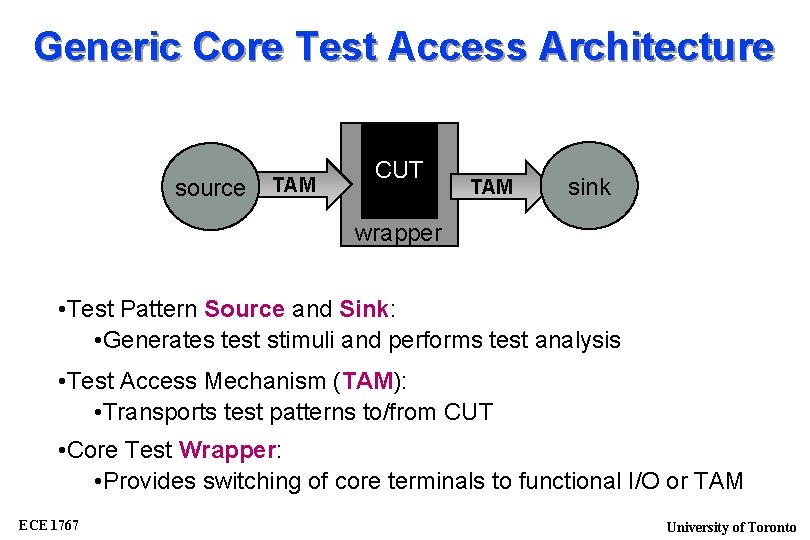
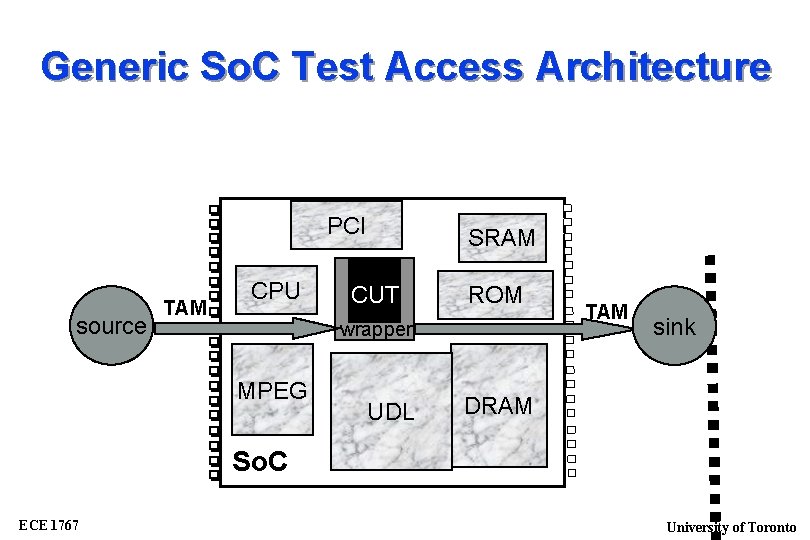
Generic Core Test Access Architecture source TAM CUT TAM sink wrapper • Test Pattern Source and Sink: • Generates test stimuli and performs test analysis • Test Access Mechanism (TAM): • Transports test patterns to/from CUT • Core Test Wrapper: • Provides switching of core terminals to functional I/O or TAM ECE 1767 University of Toronto
Generic So. C Test Access Architecture PCI source TAM CPU SRAM CUT ROM wrapper MPEG UDL TAM sink DRAM So. C ECE 1767 University of Toronto
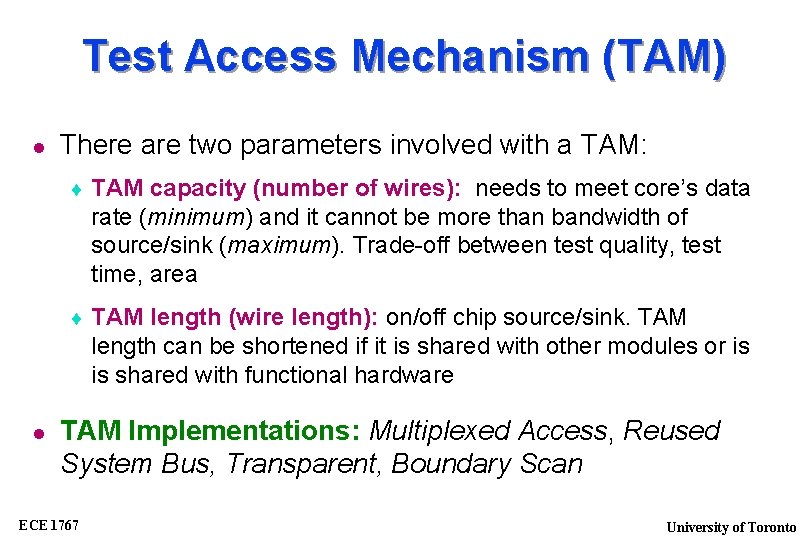
Test Access Mechanism (TAM) There are two parameters involved with a TAM: TAM capacity (number of wires): needs to meet core’s data rate (minimum) and it cannot be more than bandwidth of source/sink (maximum). Trade-off between test quality, test time, area TAM length (wire length): on/off chip source/sink. TAM length can be shortened if it is shared with other modules or is is shared with functional hardware TAM Implementations: Multiplexed Access, Reused System Bus, Transparent, Boundary Scan ECE 1767 University of Toronto
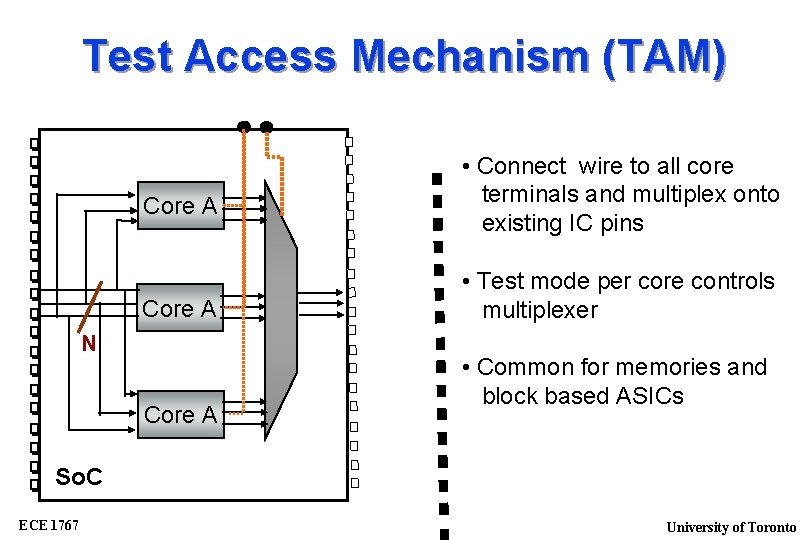
Test Access Mechanism (TAM) Core A N Core A • Connect wire to all core terminals and multiplex onto existing IC pins • Test mode per core controls multiplexer • Common for memories and block based ASICs So. C ECE 1767 University of Toronto
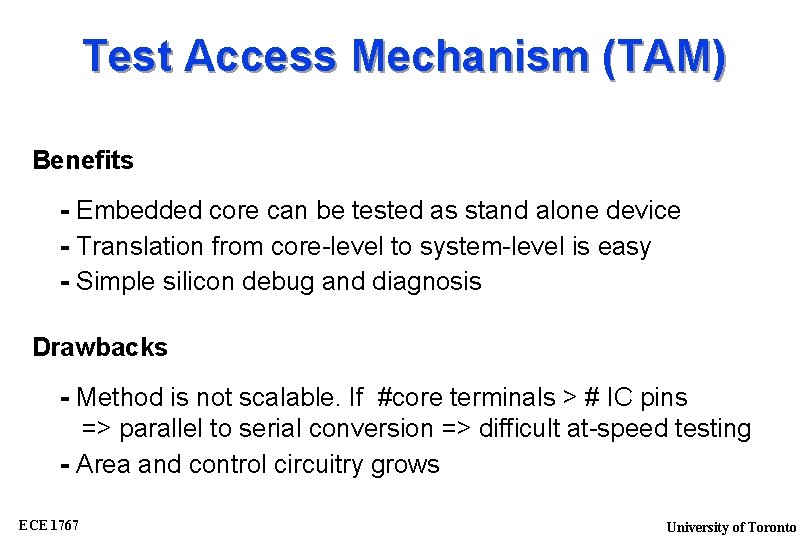
Test Access Mechanism (TAM) Benefits - Embedded core can be tested as stand alone device - Translation from core-level to system-level is easy - Simple silicon debug and diagnosis Drawbacks - Method is not scalable. If #core terminals > # IC pins => parallel to serial conversion => difficult at-speed testing - Area and control circuitry grows ECE 1767 University of Toronto
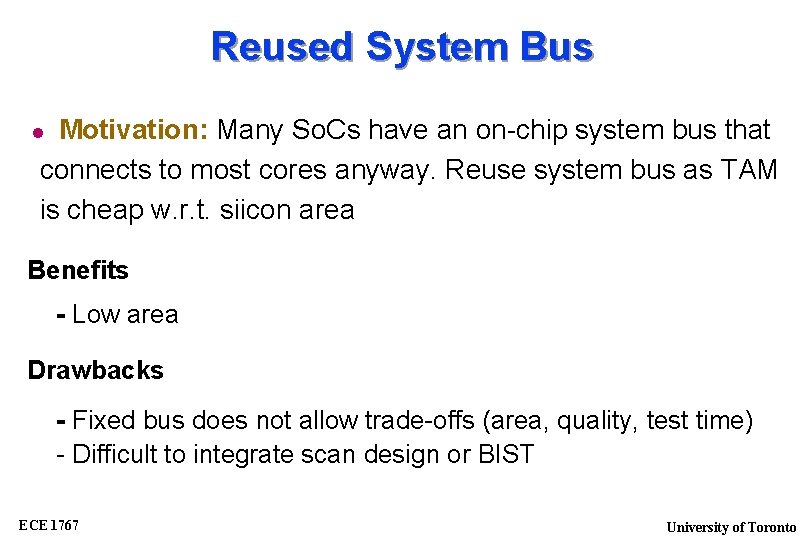
Reused System Bus Motivation: Many So. Cs have an on-chip system bus that connects to most cores anyway. Reuse system bus as TAM is cheap w. r. t. siicon area Benefits - Low area Drawbacks - Fixed bus does not allow trade-offs (area, quality, test time) - Difficult to integrate scan design or BIST ECE 1767 University of Toronto
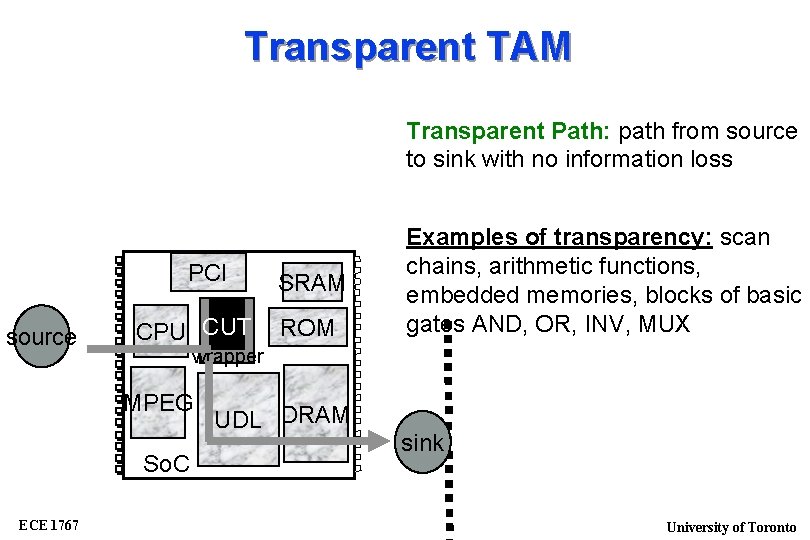
Transparent TAM Transparent Path: path from source to sink with no information loss PCI source CPU CUT ROM wrapper MPEG So. C ECE 1767 SRAM Examples of transparency: scan chains, arithmetic functions, embedded memories, blocks of basic gates AND, OR, INV, MUX UDL DRAM sink University of Toronto
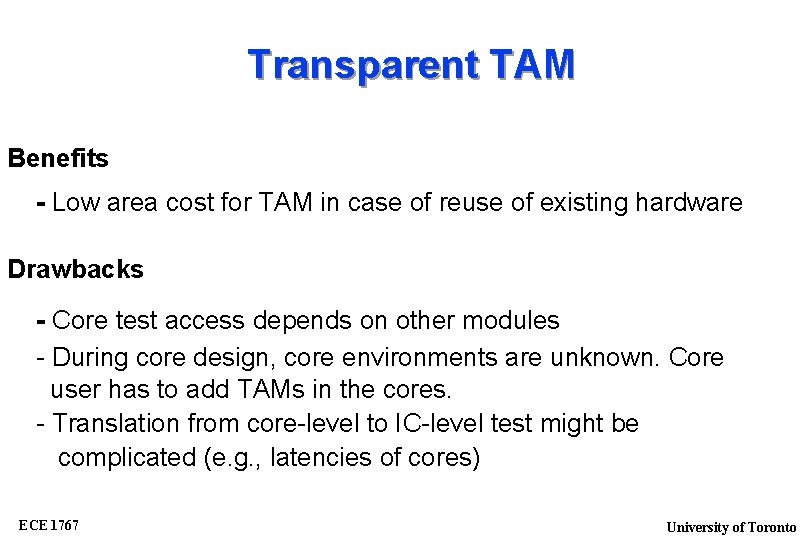
Transparent TAM Benefits - Low area cost for TAM in case of reuse of existing hardware Drawbacks - Core test access depends on other modules - During core design, core environments are unknown. Core user has to add TAMs in the cores. - Translation from core-level to IC-level test might be complicated (e. g. , latencies of cores) ECE 1767 University of Toronto
Boundary Scan Methods Isolation ring Boundary scan chain Internal (parallel) scan for sequential cores Higher test application time. Partial isolation ring ECE 1767 Place some core I/O’s in a boundary scan chain. University of Toronto
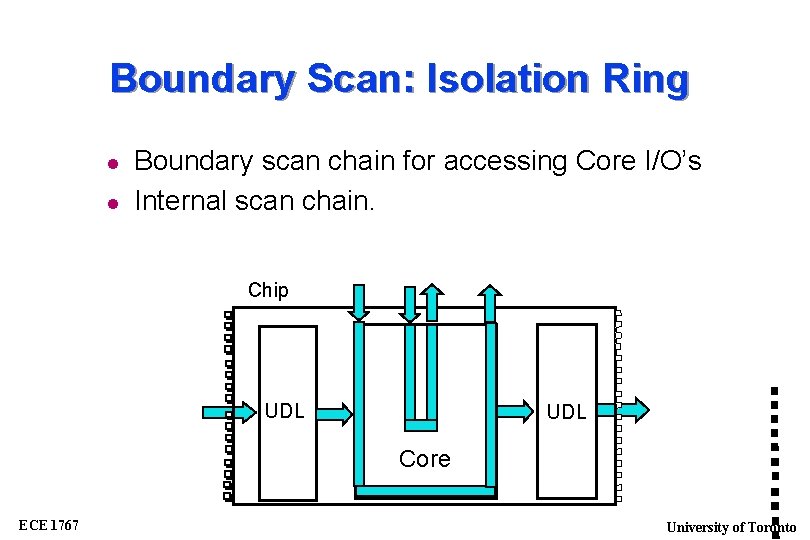
Boundary Scan: Isolation Ring Boundary scan chain for accessing Core I/O’s Internal scan chain. Chip UDL Core ECE 1767 University of Toronto
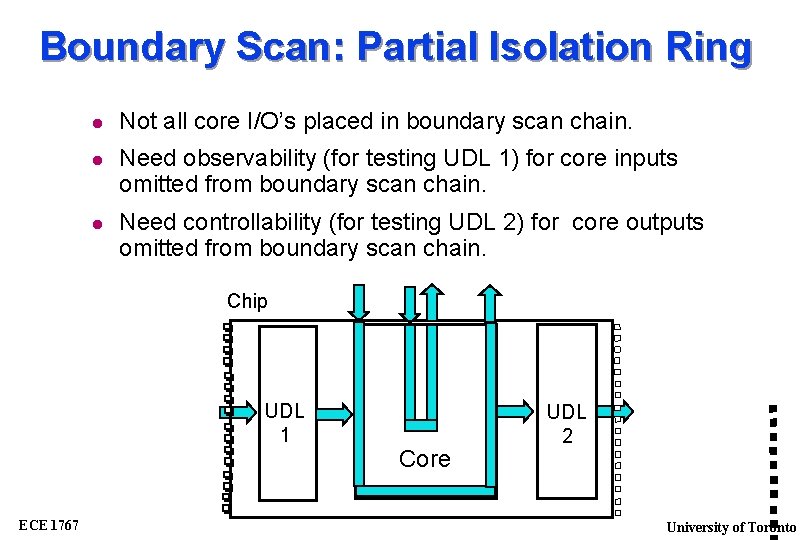
Boundary Scan: Partial Isolation Ring Not all core I/O’s placed in boundary scan chain. Need observability (for testing UDL 1) for core inputs omitted from boundary scan chain. Need controllability (for testing UDL 2) for core outputs omitted from boundary scan chain. Chip UDL 1 ECE 1767 Core UDL 2 University of Toronto
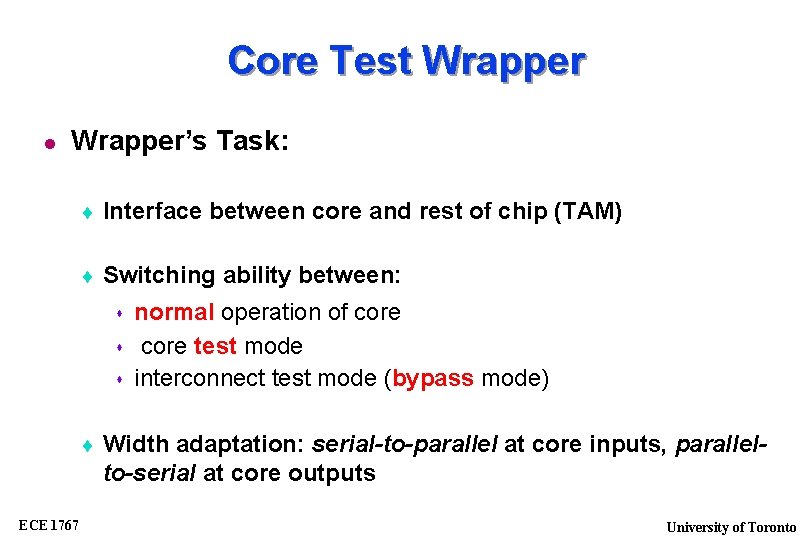
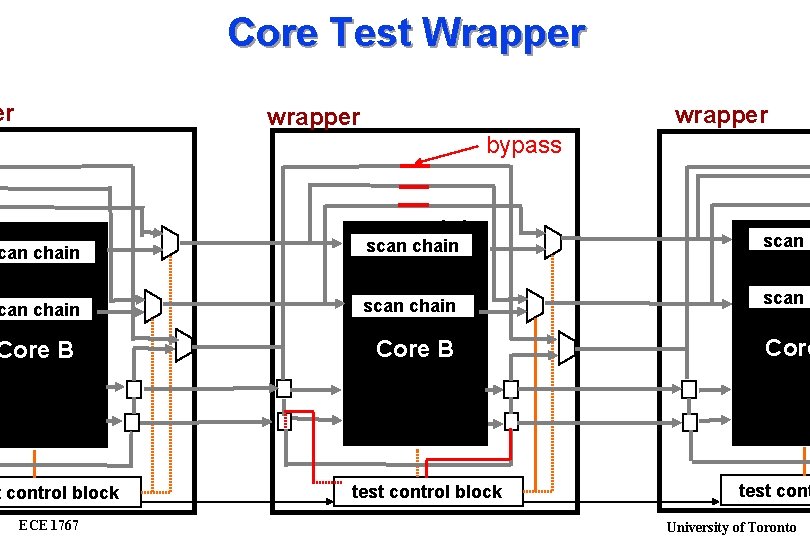
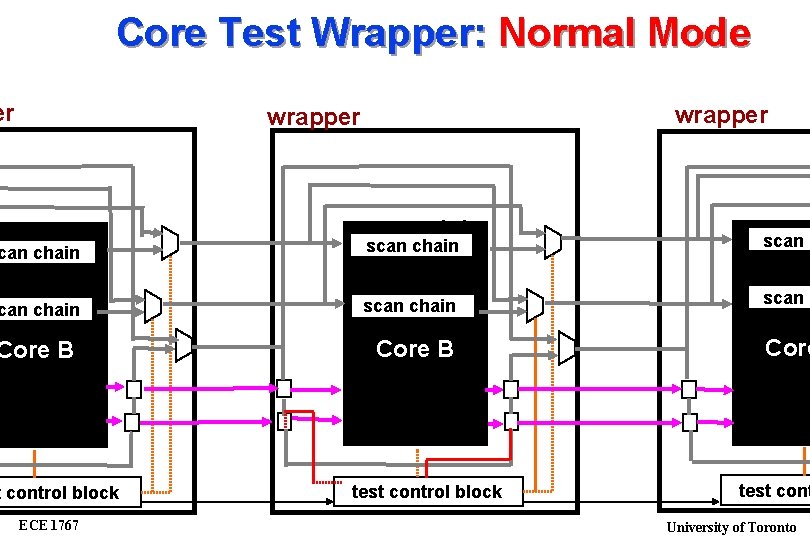
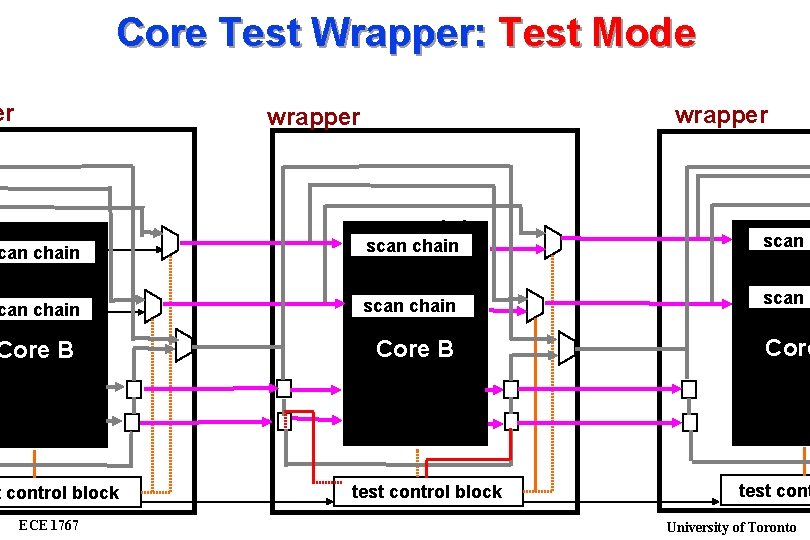
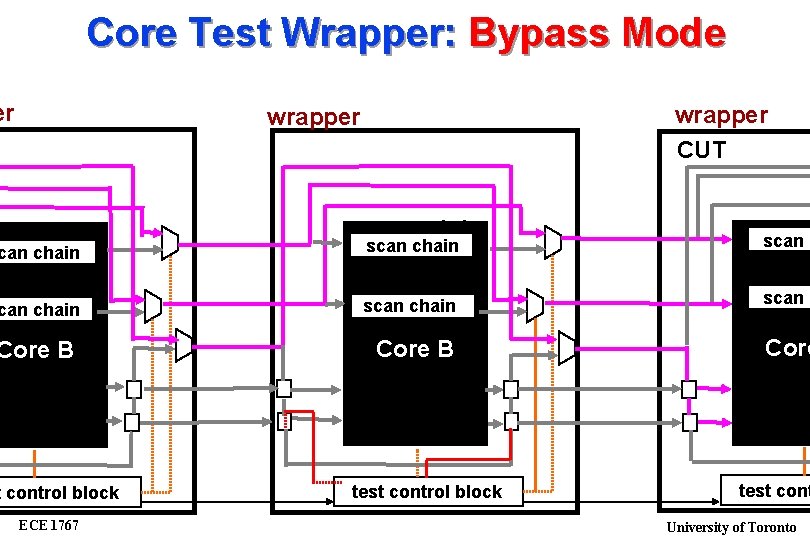
Core Test Wrapper’s Task: Interface between core and rest of chip (TAM) Switching ability between: ECE 1767 normal operation of core test mode interconnect test mode (bypass mode) Width adaptation: serial-to-parallel at core inputs, parallelto-serial at core outputs University of Toronto
Core Test Wrapper er wrapper bypass can chain scan c can chain scan c Core B Core t control block ECE 1767 test control block test cont University of Toronto
Core Test Wrapper: Normal Mode er wrapper can chain scan c can chain scan c Core B Core t control block ECE 1767 test control block test cont University of Toronto
Core Test Wrapper: Test Mode er wrapper can chain scan c can chain scan c Core B Core t control block ECE 1767 test control block test cont University of Toronto
Core Test Wrapper: Bypass Mode er wrapper CUT wrapper can chain scan c can chain scan c Core B Core t control block ECE 1767 test control block test cont University of Toronto