
What is a Sonnet Understanding the forms meter

- Slides: 8
What is a Sonnet? Understanding the forms, meter, rhyme, and other aspects of the sonnet.
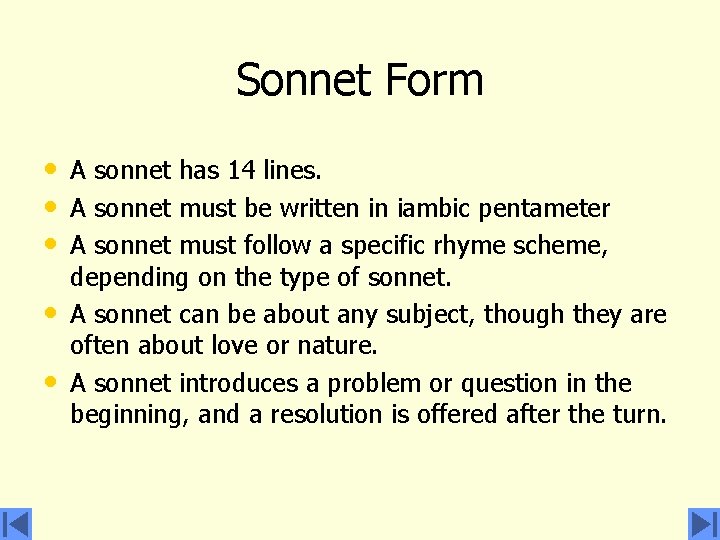
Sonnet Form • A sonnet has 14 lines. • A sonnet must be written in iambic pentameter • A sonnet must follow a specific rhyme scheme, • • depending on the type of sonnet. A sonnet can be about any subject, though they are often about love or nature. A sonnet introduces a problem or question in the beginning, and a resolution is offered after the turn.
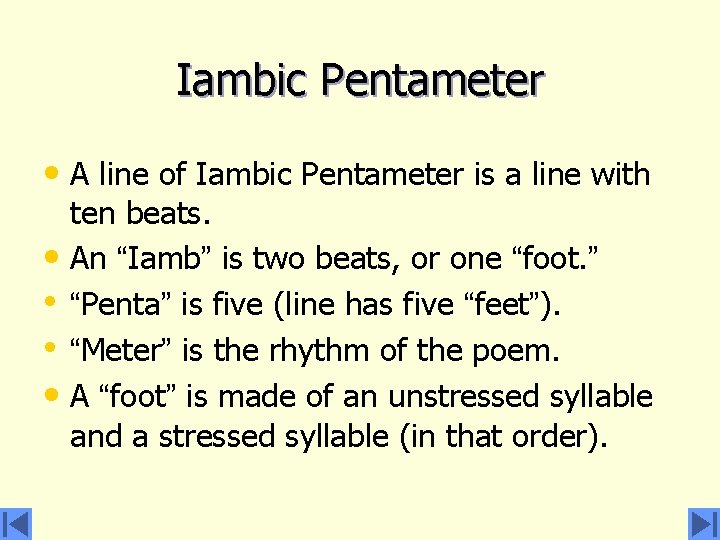
Iambic Pentameter • A line of Iambic Pentameter is a line with ten beats. • An “Iamb” is two beats, or one “foot. ” • “Penta” is five (line has five “feet”). • “Meter” is the rhythm of the poem. • A “foot” is made of an unstressed syllable and a stressed syllable (in that order).
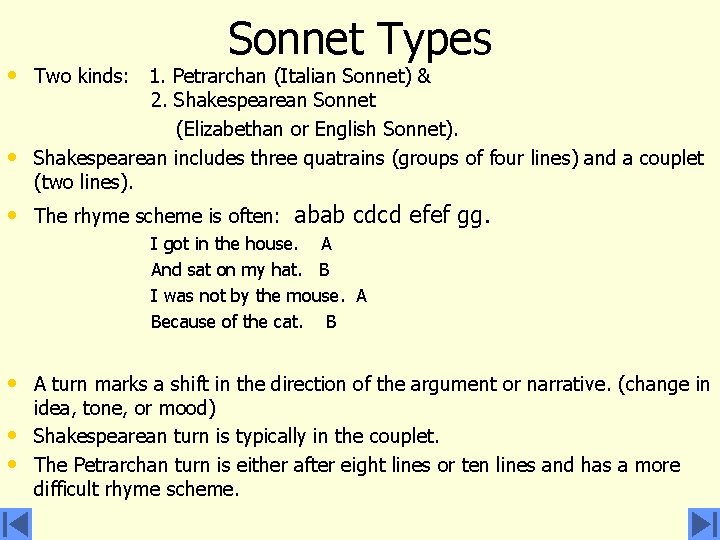
Sonnet Types • Two kinds: 1. Petrarchan (Italian Sonnet) & • 2. Shakespearean Sonnet (Elizabethan or English Sonnet). Shakespearean includes three quatrains (groups of four lines) and a couplet (two lines). • The rhyme scheme is often: abab cdcd efef gg. I got in the house. A And sat on my hat. B I was not by the mouse. A Because of the cat. B • A turn marks a shift in the direction of the argument or narrative. (change in • • idea, tone, or mood) Shakespearean turn is typically in the couplet. The Petrarchan turn is either after eight lines or ten lines and has a more difficult rhyme scheme.
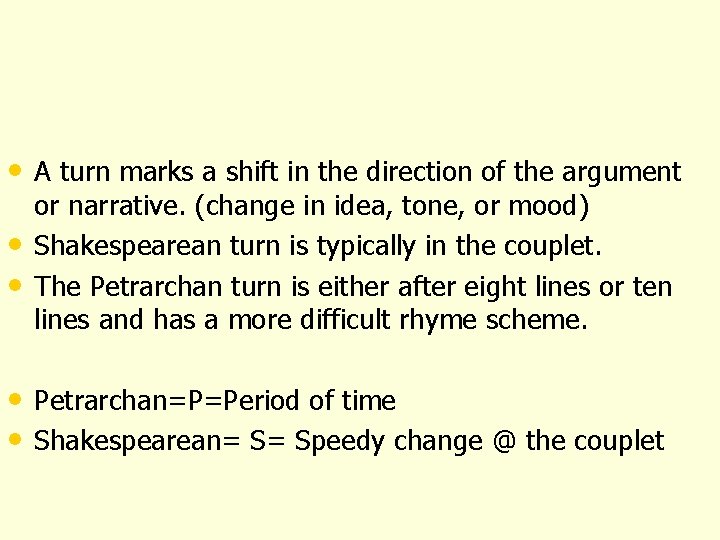
• A turn marks a shift in the direction of the argument • • or narrative. (change in idea, tone, or mood) Shakespearean turn is typically in the couplet. The Petrarchan turn is either after eight lines or ten lines and has a more difficult rhyme scheme. • Petrarchan=P=Period of time • Shakespearean= S= Speedy change @ the couplet
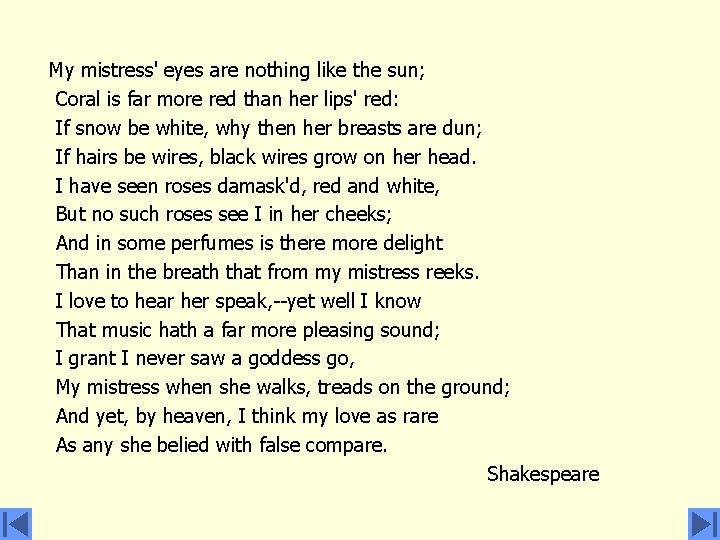
My mistress' eyes are nothing like the sun; Coral is far more red than her lips' red: If snow be white, why then her breasts are dun; If hairs be wires, black wires grow on her head. I have seen roses damask'd, red and white, But no such roses see I in her cheeks; And in some perfumes is there more delight Than in the breath that from my mistress reeks. I love to hear her speak, --yet well I know That music hath a far more pleasing sound; I grant I never saw a goddess go, My mistress when she walks, treads on the ground; And yet, by heaven, I think my love as rare As any she belied with false compare. Shakespeare
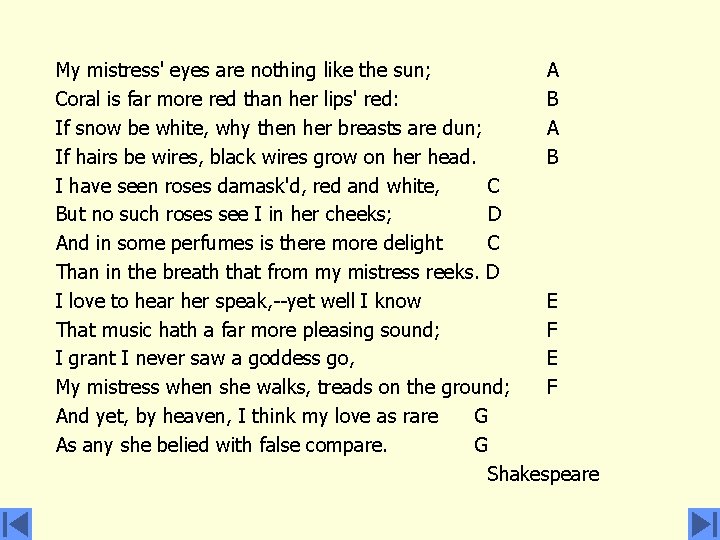
My mistress' eyes are nothing like the sun; A Coral is far more red than her lips' red: B If snow be white, why then her breasts are dun; A If hairs be wires, black wires grow on her head. B I have seen roses damask'd, red and white, C But no such roses see I in her cheeks; D And in some perfumes is there more delight C Than in the breath that from my mistress reeks. D I love to hear her speak, --yet well I know E That music hath a far more pleasing sound; F I grant I never saw a goddess go, E My mistress when she walks, treads on the ground; F And yet, by heaven, I think my love as rare G As any she belied with false compare. G Shakespeare
Take a post