
What is a Social Institution a group of


- Slides: 29
What is a Social Institution? -a group of social positions, connected by social relations, performing a social role, e. g. universities, government, families.
What is Social Institution? Ø Any institution in a society that works to socialize the group of people in it.
Characteristics of an Institution Palispis (1996) Ø Institutions are purposive. Ø Relatively permanent in content. Ø Institutions are structured. Ø Institutions are a unified structure. Ø Institutions are necessarily value-laden.
Functions of an Institutions 1. Institutions simplify social behavior for the individual person. 2. Provide ready-made forms of social relations and social roles for individual. 3. Act as agencies of coordination and stability for the total culture. 4. Control behavior.
Major Social Institutions ØThe Family ØEducation ØReligion ØEconomic ØPolitical ØRecreational
The Family
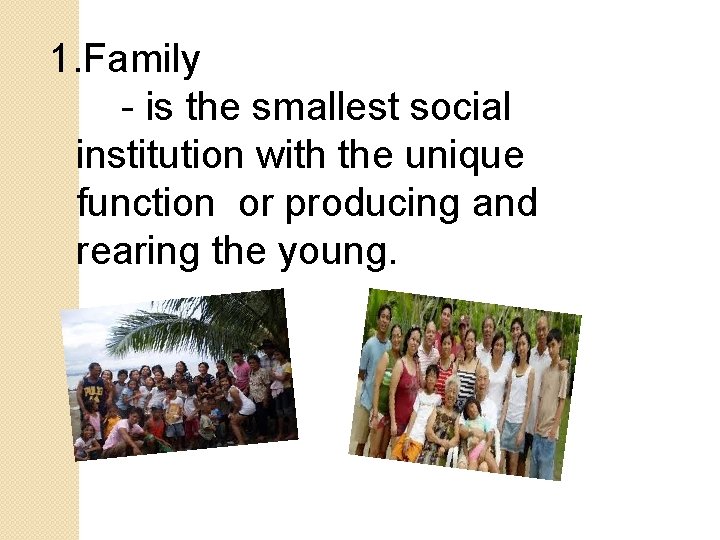
1. Family - is the smallest social institution with the unique function or producing and rearing the young.
The Family Ø The smallest social institution with the unique function or producing and rearing the young. Ø It is the basic unit of Pakistani society and the educational system where the child begins to learn. Ø The basic agent of socialization because it is here where the individual develops values, behaviors, and ways of life through interaction with members of the family (Vega, 2004).
Characteristic of the Pakistani Family Ø The family is closely knit and has strong family ties. Ø The Pakistani family is usually extended one and therefore, big. Ø In the Pakistani family, kinship ties are extended to include the sponsors.
Functions of the Family 1. Reproduction of the race and rearing of the young. 2. Cultural transmission or enculturation. 3. Socialization of the child. 4. Providing affection and a sense of security. 5. Providing the environment for personality development and the growth of self-concept in relation to others. 6. Providing social status.
Kinds of Family
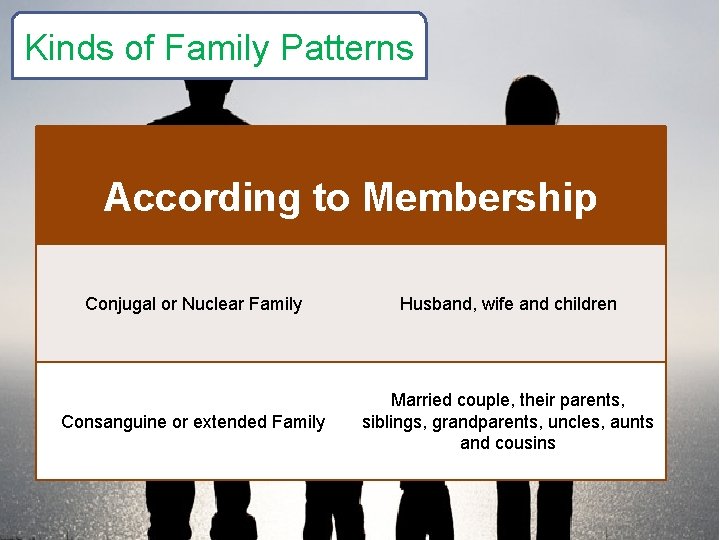
Kinds of Family Patterns According to Membership Conjugal or Nuclear Family Husband, wife and children Consanguine or extended Family Married couple, their parents, siblings, grandparents, uncles, aunts and cousins
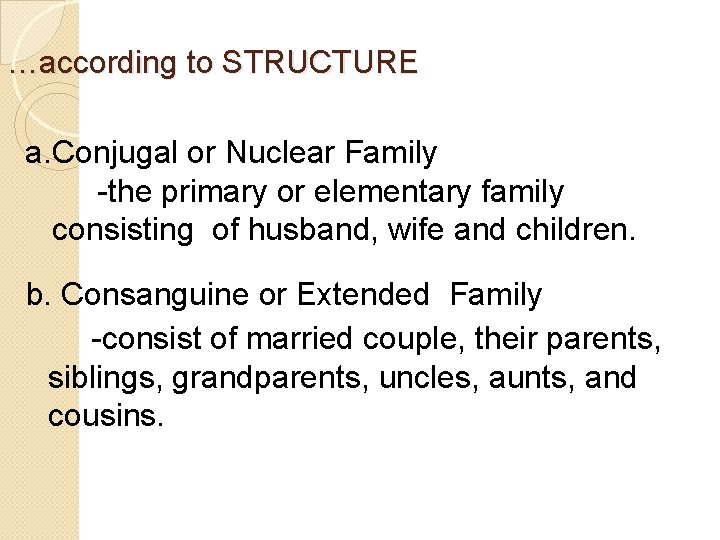
…according to STRUCTURE a. Conjugal or Nuclear Family -the primary or elementary family consisting of husband, wife and children. b. Consanguine or Extended Family -consist of married couple, their parents, siblings, grandparents, uncles, aunts, and cousins.
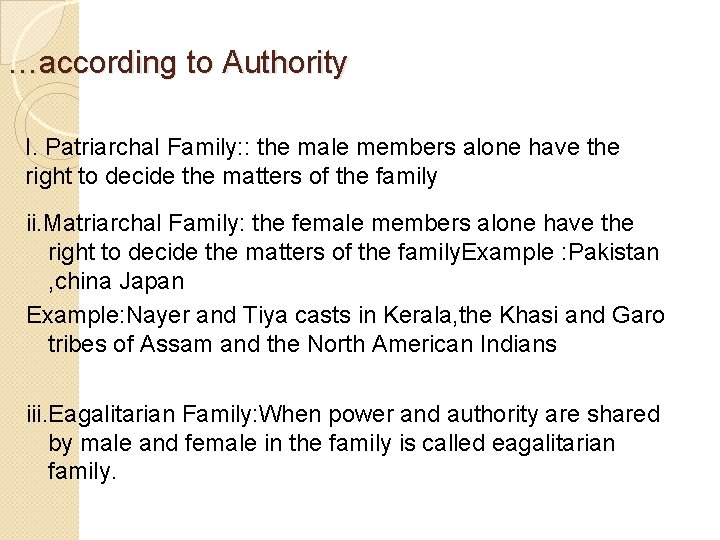
…according to Authority I. Patriarchal Family: : the male members alone have the right to decide the matters of the family ii. Matriarchal Family: the female members alone have the right to decide the matters of the family. Example : Pakistan , china Japan Example: Nayer and Tiya casts in Kerala, the Khasi and Garo tribes of Assam and the North American Indians iii. Eagalitarian Family: When power and authority are shared by male and female in the family is called eagalitarian family.
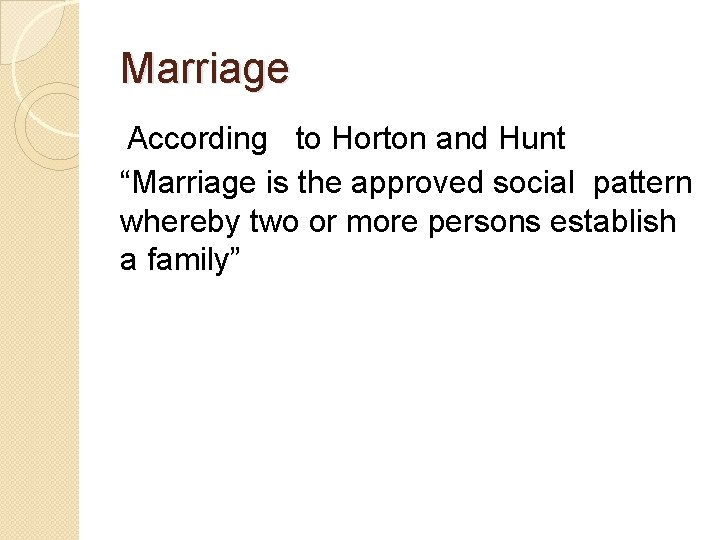
Marriage According to Horton and Hunt “Marriage is the approved social pattern whereby two or more persons establish a family”
…according to term of MARRIAGE a. Polyandry -one woman is married to two or more men at the same time. b. Polygamy -one man is married to two or more women at the same time. c. Cenogamy - two or more men mate with two or more women in group marriage.
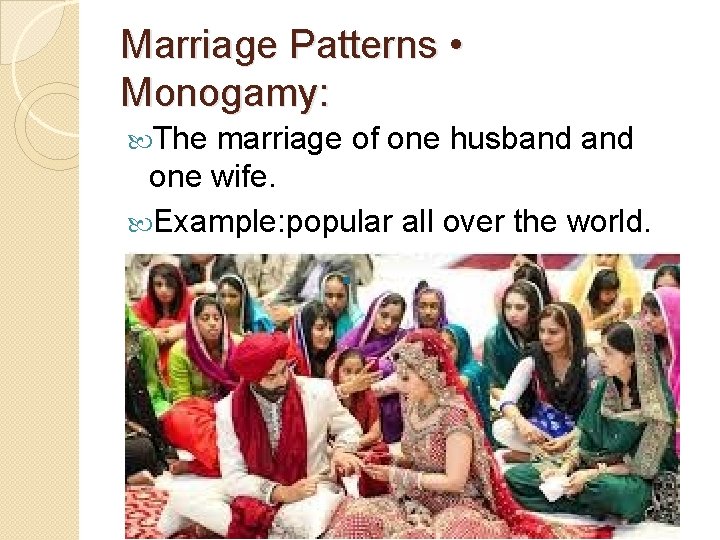
Marriage Patterns • Monogamy: The marriage of one husband one wife. Example: popular all over the world.
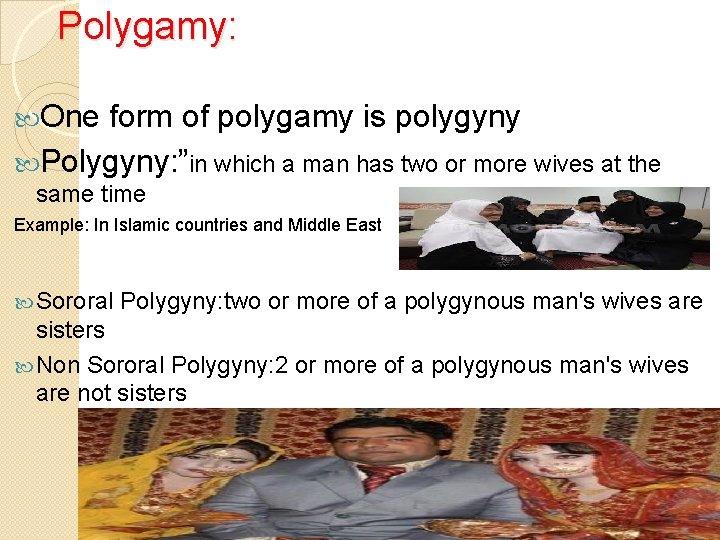
Polygamy: One form of polygamy is polygyny Polygyny: ”in which a man has two or more wives at the same time Example: In Islamic countries and Middle East Sororal Polygyny: two or more of a polygynous man's wives are sisters Non Sororal Polygyny: 2 or more of a polygynous man's wives are not sisters
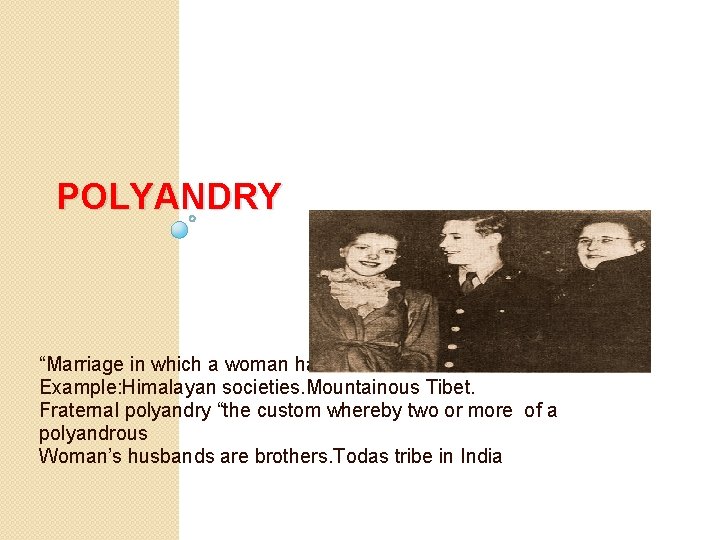
POLYANDRY “Marriage in which a woman has more than one husband. ” Example: Himalayan societies. Mountainous Tibet. Fraternal polyandry “the custom whereby two or more of a polyandrous Woman’s husbands are brothers. Todas tribe in India
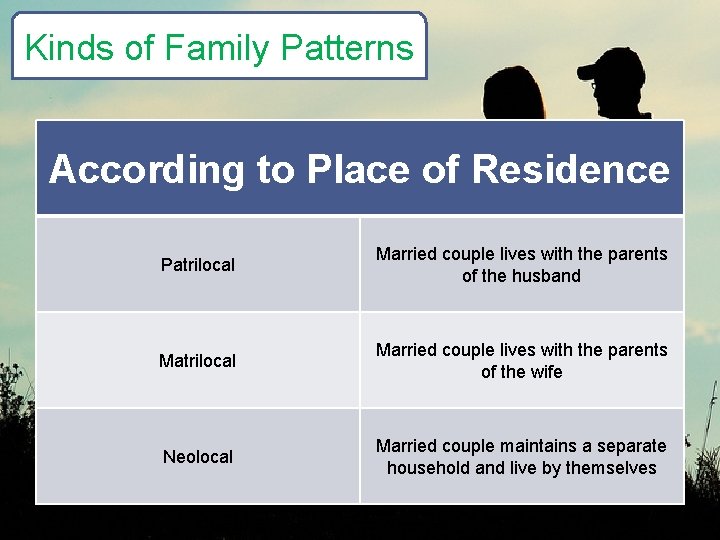
Kinds of Family Patterns According to Place of Residence Patrilocal Married couple lives with the parents of the husband Matrilocal Married couple lives with the parents of the wife Neolocal Married couple maintains a separate household and live by themselves
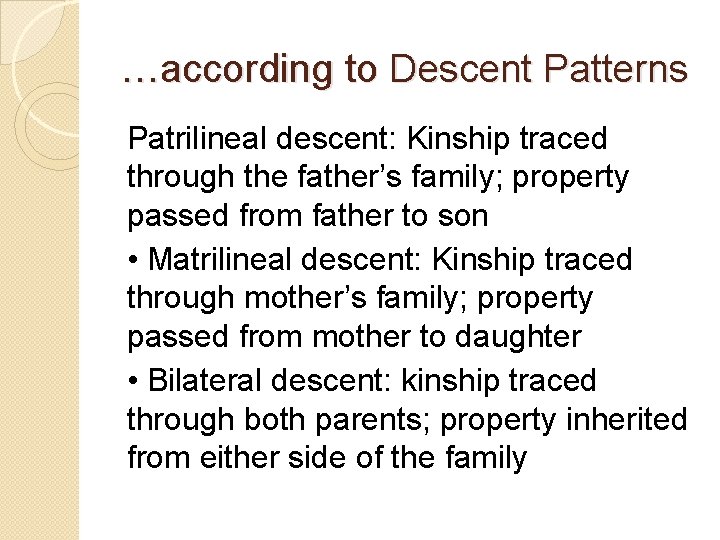
…according to Descent Patterns Patrilineal descent: Kinship traced through the father’s family; property passed from father to son • Matrilineal descent: Kinship traced through mother’s family; property passed from mother to daughter • Bilateral descent: kinship traced through both parents; property inherited from either side of the family
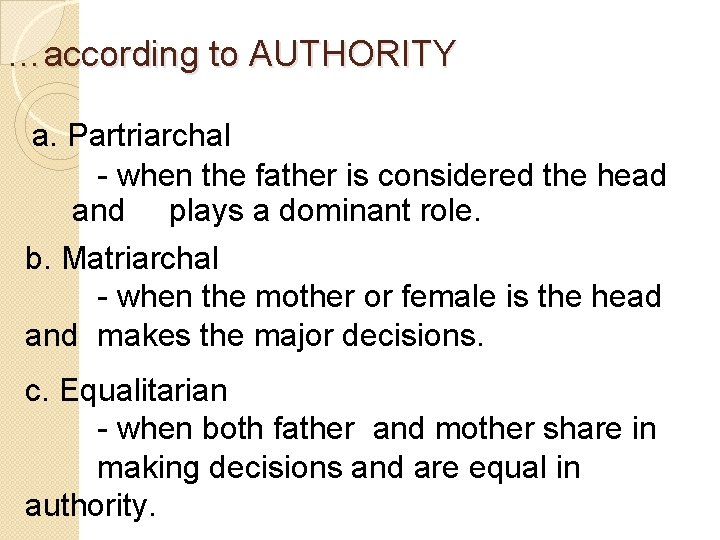
…according to AUTHORITY a. Partriarchal - when the father is considered the head and plays a dominant role. b. Matriarchal - when the mother or female is the head and makes the major decisions. c. Equalitarian - when both father and mother share in making decisions and are equal in authority.
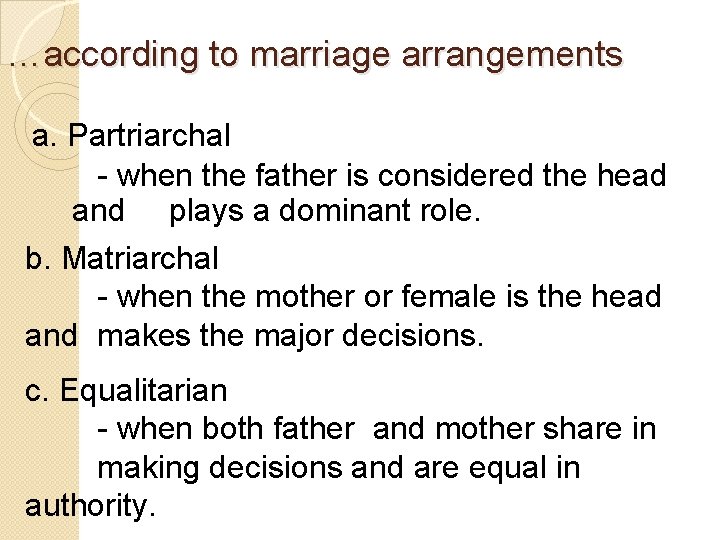
…according to marriage arrangements a. Partriarchal - when the father is considered the head and plays a dominant role. b. Matriarchal - when the mother or female is the head and makes the major decisions. c. Equalitarian - when both father and mother share in making decisions and are equal in authority.
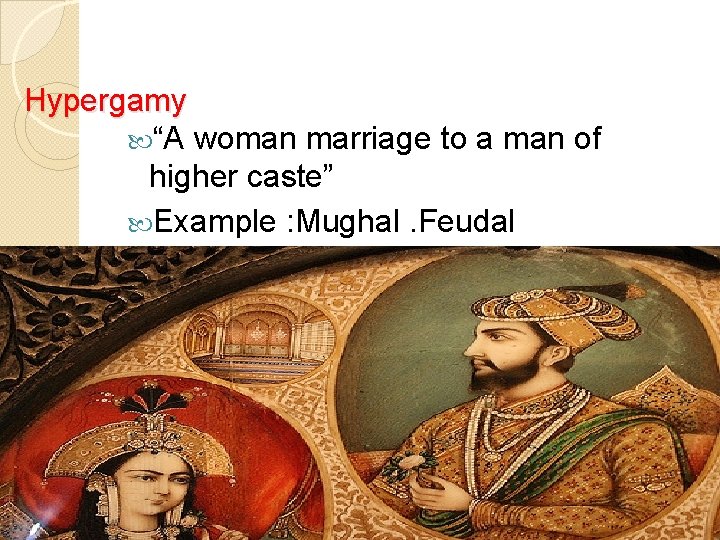
Hypergamy “A woman marriage to a man of higher caste” Example : Mughal. Feudal
Endogamy A marriage is occur(arranged) in family relatives, caste, religion, tribe and sect. Example : Pakistani and Indian villages
Exogamy A marriage is occur(arranged) out of family relatives, caste, religion, tribe and sect Example : Pakistani cities. Indian cities
Group Marriage A form of marriage involving two or more men and two or more women as marriage partners at the same time Example: western cultures, such as the Aweikoma of southern Brazil.