
WHAT IS A REVOLUTION Fundamental Change change in
- Slides: 57
WHAT IS A REVOLUTION? • Fundamental • Change change in way political system operates in the basis on which rulers come to power, their authority and their mission in office • How do these revolutions stack up? Are they just a change of rulers? • Glorious Revolution 1688 • American Revolution 1776 • French Revolution 1789 • Haitian Revolution 1791 • Russian Revolution 1917
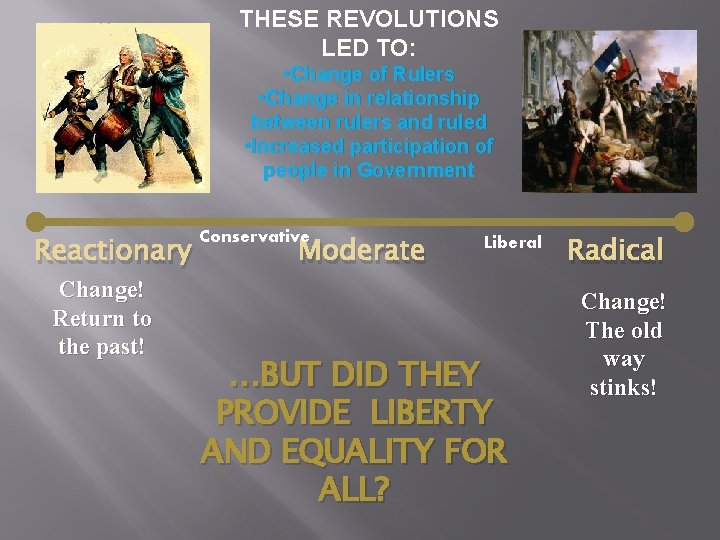
THESE REVOLUTIONS LED TO: • Change of Rulers • Change in relationship between rulers and ruled • Increased participation of people in Government Reactionary Change! Return to the past! Conservative Moderate Liberal …BUT DID THEY PROVIDE LIBERTY AND EQUALITY FOR ALL? Radical Change! The old way stinks!
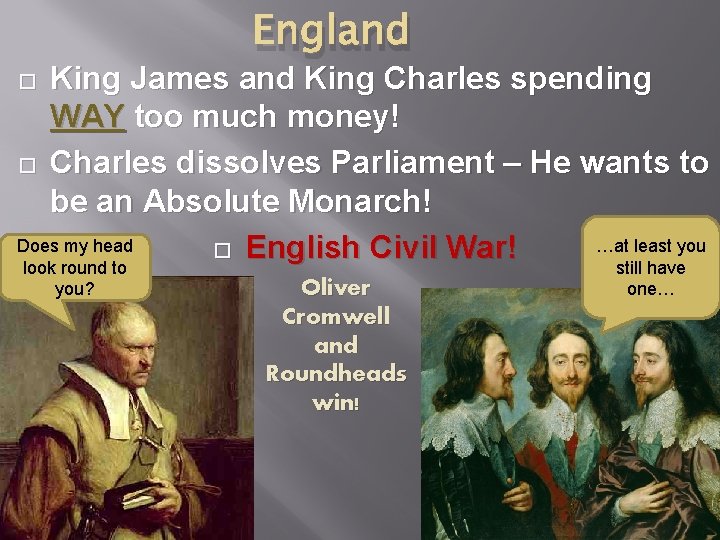
England King James and King Charles spending WAY too much money! Charles dissolves Parliament – He wants to be an Absolute Monarch! Does my head …at least you English Civil War! still have look round to you? Oliver Cromwell and Roundheads win! one…
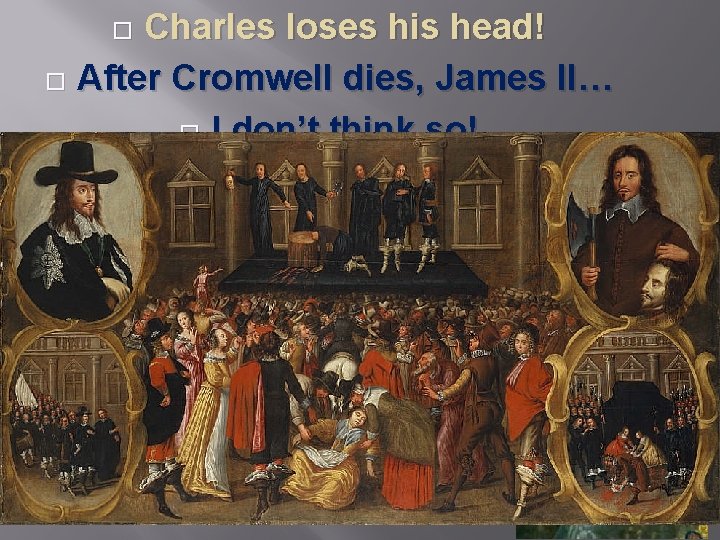
Charles loses his head! After Cromwell dies, James II… I don’t think so! William and Mary (of Orange) invitation
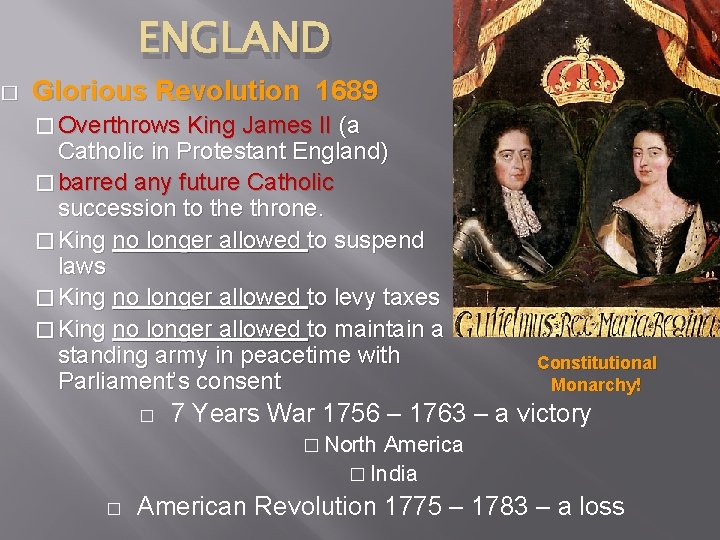
� ENGLAND Glorious Revolution 1689 � Overthrows King James II (a Catholic in Protestant England) � barred any future Catholic succession to the throne. � King no longer allowed to suspend laws � King no longer allowed to levy taxes � King no longer allowed to maintain a standing army in peacetime with Parliament’s consent � Constitutional Monarchy! 7 Years War 1756 – 1763 – a victory � North America � India � American Revolution 1775 – 1783 – a loss
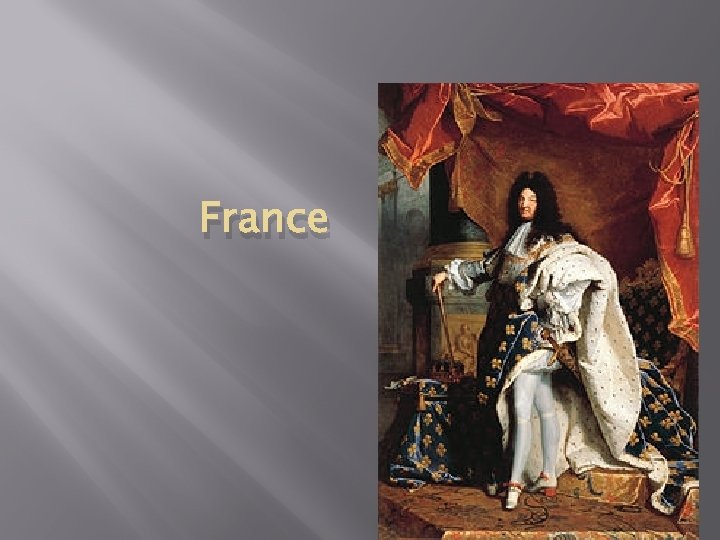
France
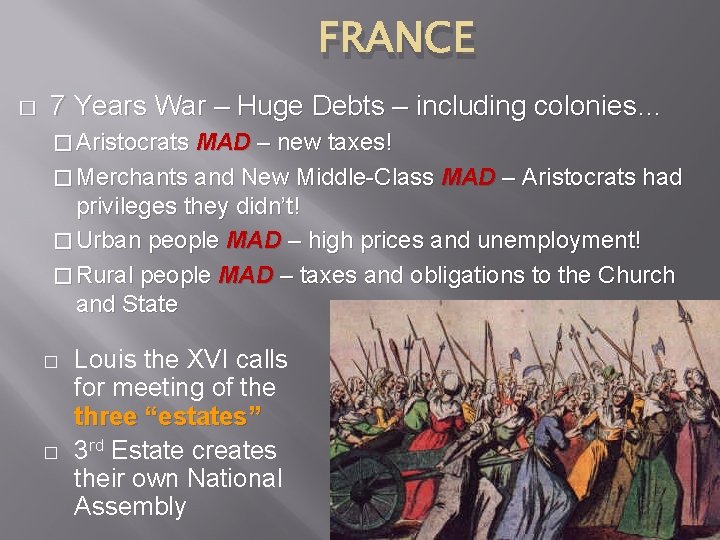
FRANCE � 7 Years War – Huge Debts – including colonies… � Aristocrats MAD – new taxes! � Merchants and New Middle-Class MAD – Aristocrats had privileges they didn’t! � Urban people MAD – high prices and unemployment! � Rural people MAD – taxes and obligations to the Church and State � � Louis the XVI calls for meeting of the three “estates” 3 rd Estate creates their own National Assembly
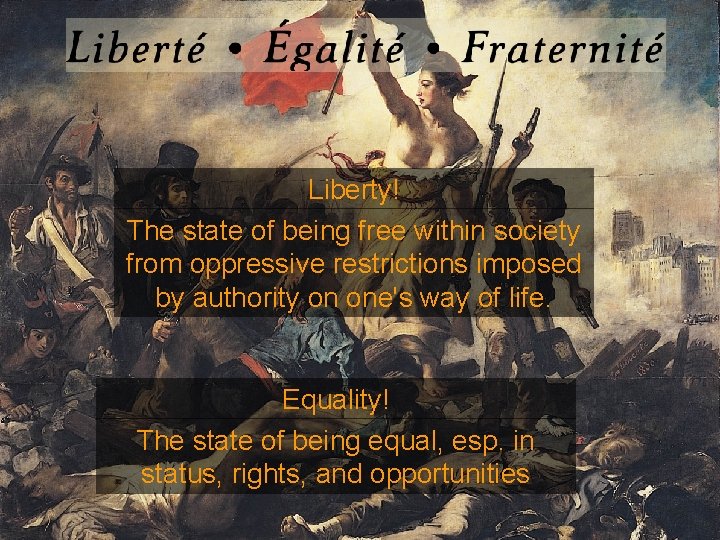
Liberty! The state of being free within society from oppressive restrictions imposed by authority on one's way of life. Equality! The state of being equal, esp. in status, rights, and opportunities
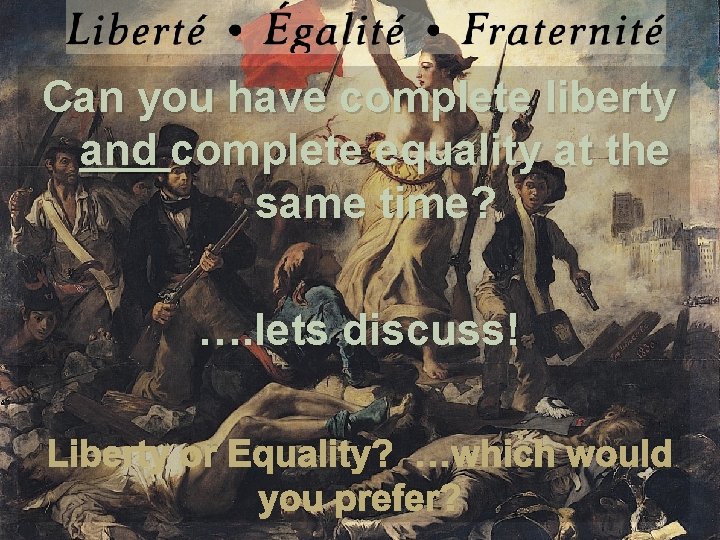
Can you have complete liberty and complete equality at the same time? …. lets discuss! Liberty or Equality? …which would you prefer?
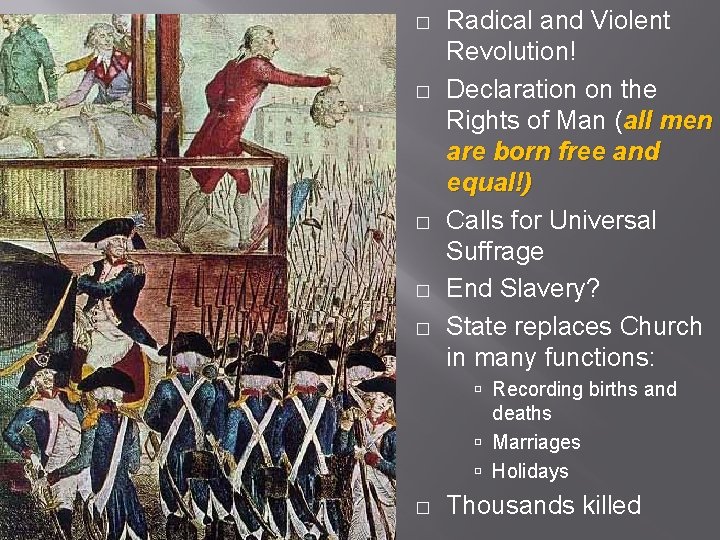
� � � Radical and Violent Revolution! Declaration on the Rights of Man (all men are born free and equal!) Calls for Universal Suffrage End Slavery? State replaces Church in many functions: Recording births and deaths Marriages Holidays � Thousands killed
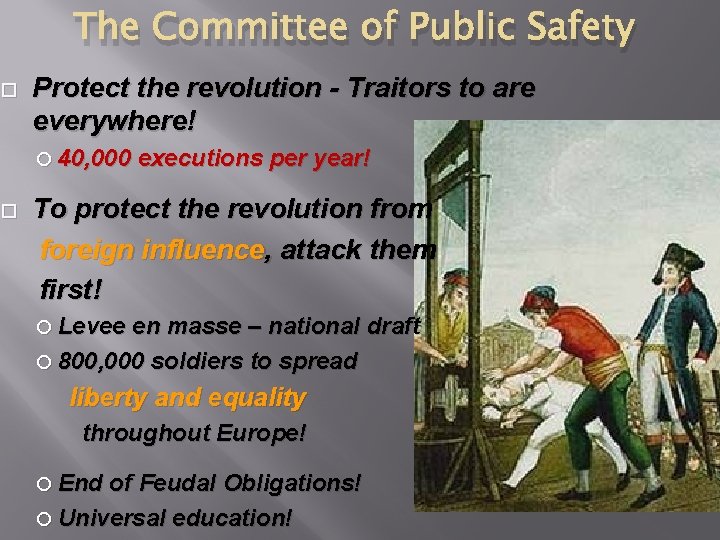
The Committee of Public Safety Protect the revolution - Traitors to are everywhere! 40, 000 executions per year! To protect the revolution from foreign influence, attack them first! Levee en masse – national draft 800, 000 soldiers to spread liberty and equality throughout Europe! End of Feudal Obligations! Universal education!
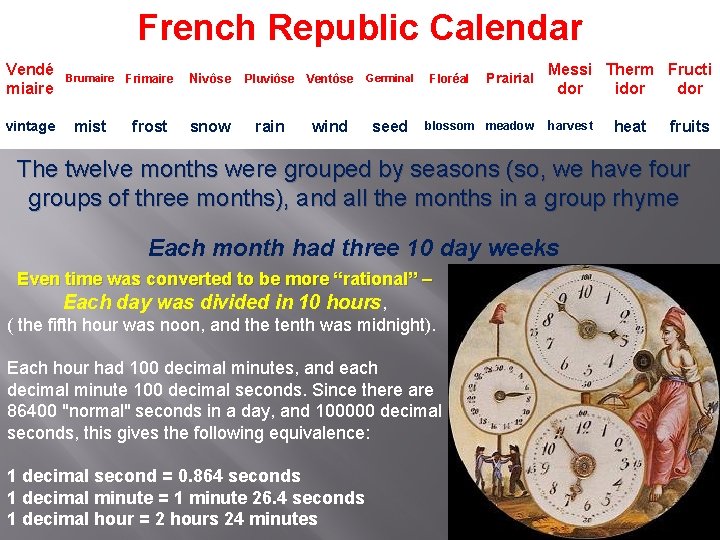
French Republic Calendar Vendé miaire Brumaire Frimaire Nivôse Pluviôse Ventôse Germinal vintage mist frost snow rain wind seed Floréal Prairial blossom meadow Messi Therm Fructi dor idor harvest heat fruits The twelve months were grouped by seasons (so, we have four groups of three months), and all the months in a group rhyme Each month had three 10 day weeks Even time was converted to be more “rational” – Each day was divided in 10 hours, ( the fifth hour was noon, and the tenth was midnight). Each hour had 100 decimal minutes, and each decimal minute 100 decimal seconds. Since there are 86400 "normal" seconds in a day, and 100000 decimal seconds, this gives the following equivalence: 1 decimal second = 0. 864 seconds 1 decimal minute = 1 minute 26. 4 seconds 1 decimal hour = 2 hours 24 minutes
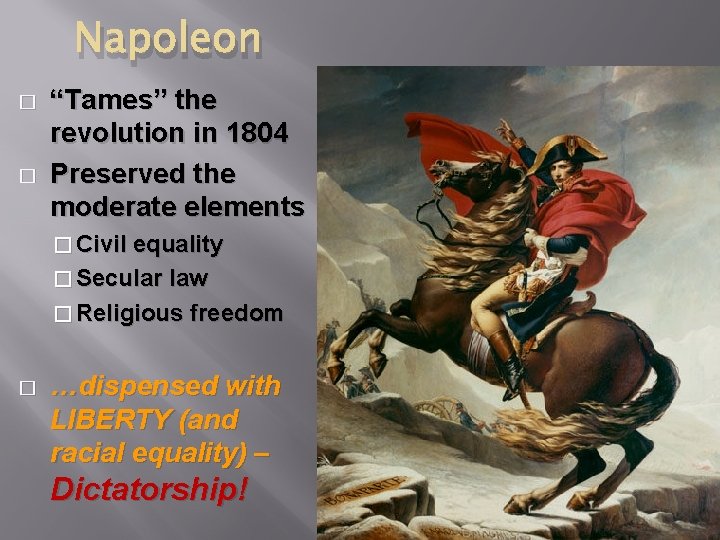
Napoleon � � “Tames” the revolution in 1804 Preserved the moderate elements � Civil equality � Secular law � Religious freedom � …dispensed with LIBERTY (and racial equality) – Dictatorship!
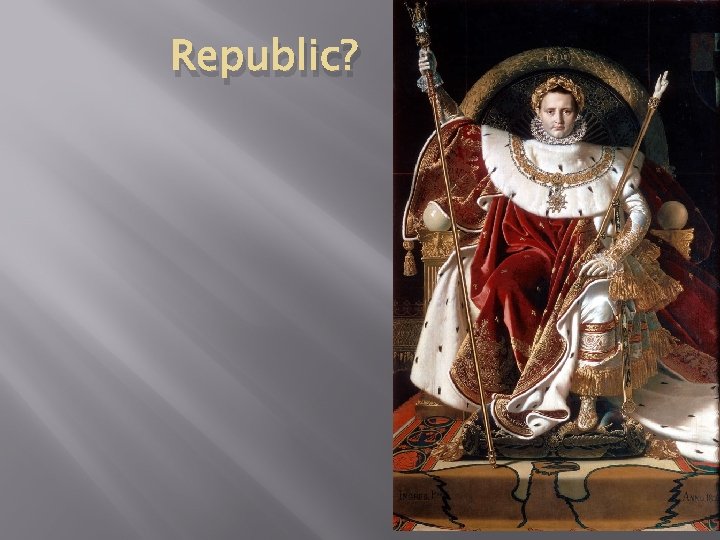
Republic?
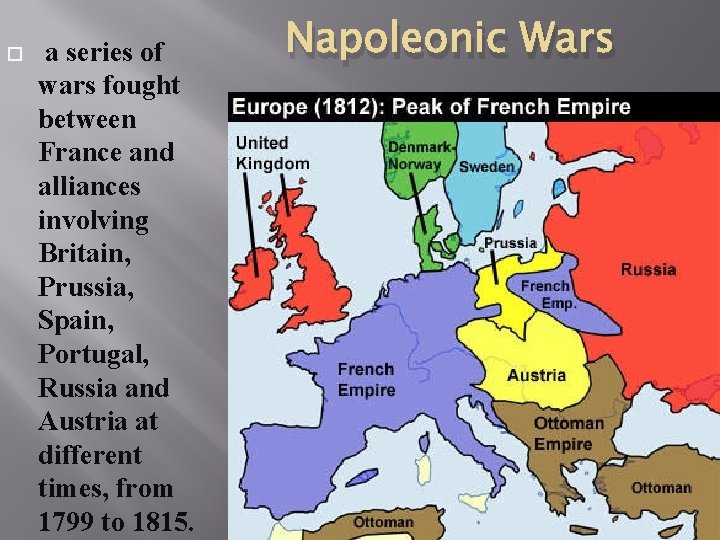
a series of wars fought between France and alliances involving Britain, Prussia, Spain, Portugal, Russia and Austria at different times, from 1799 to 1815. Napoleonic Wars
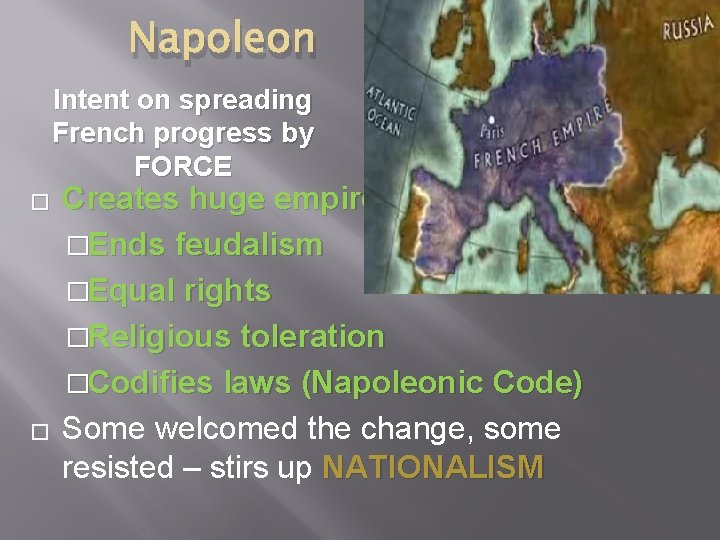
Napoleon Intent on spreading French progress by FORCE � � Creates huge empire �Ends feudalism �Equal rights �Religious toleration �Codifies laws (Napoleonic Code) Some welcomed the change, some resisted – stirs up NATIONALISM
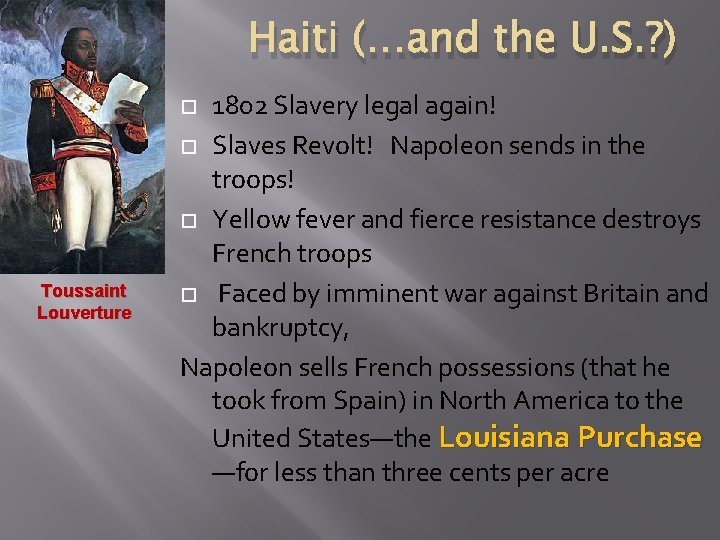
Haiti (…and the U. S. ? ) 1802 Slavery legal again! Slaves Revolt! Napoleon sends in the troops! Yellow fever and fierce resistance destroys French troops Faced by imminent war against Britain and bankruptcy, Napoleon sells French possessions (that he took from Spain) in North America to the United States—the Louisiana Purchase —for less than three cents per acre Toussaint Louverture
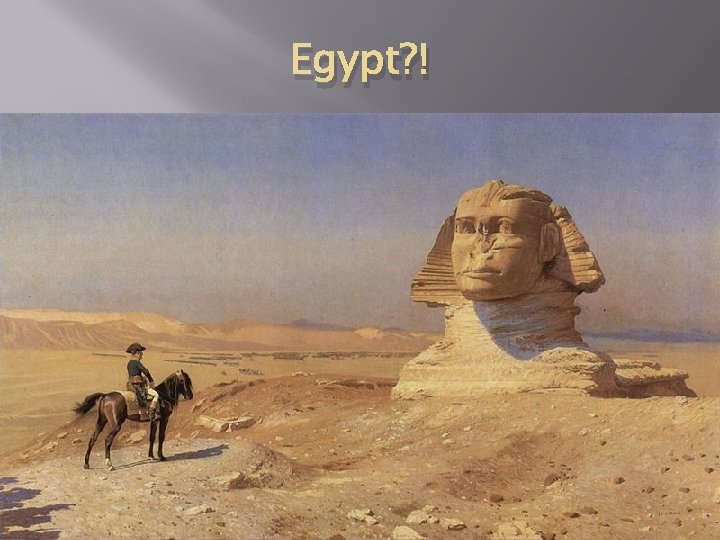
Egypt? !
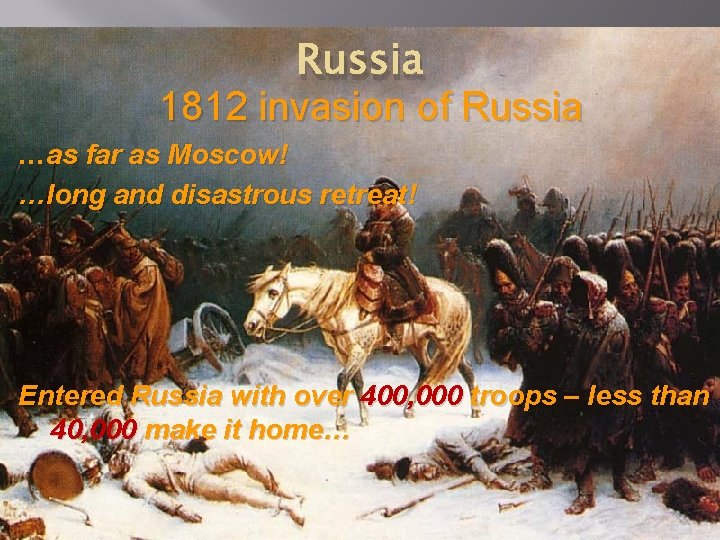
Russia 1812 invasion of Russia …as far as Moscow! …long and disastrous retreat! Entered Russia with over 400, 000 troops – less than 40, 000 make it home…
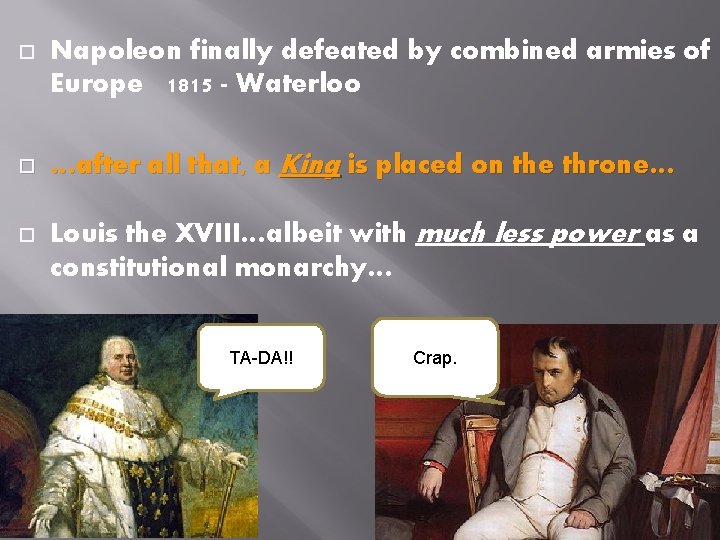
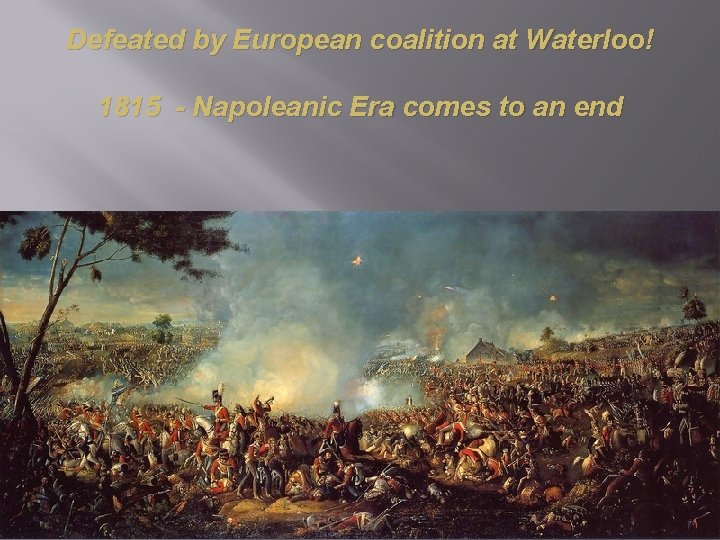
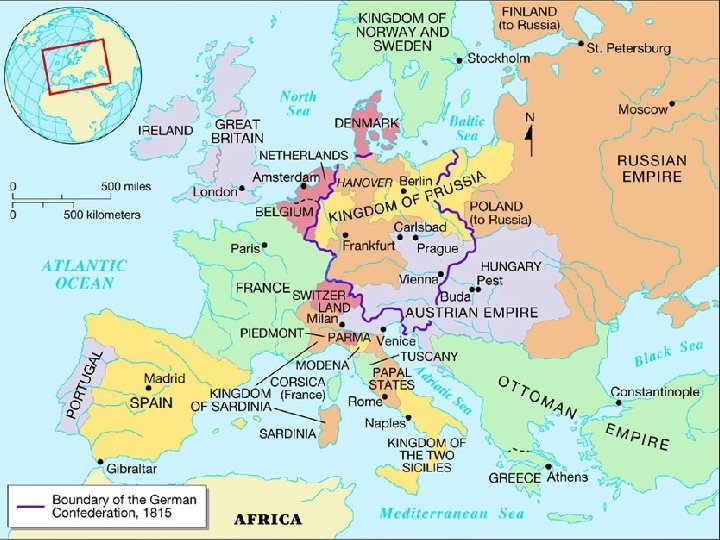
Napoleon finally defeated by combined armies of Europe 1815 - Waterloo …after all that, a King is placed on the throne… Louis the XVIII…albeit with much less power as a constitutional monarchy… TA-DA!! Crap.
Defeated by European coalition at Waterloo! 1815 - Napoleanic Era comes to an end
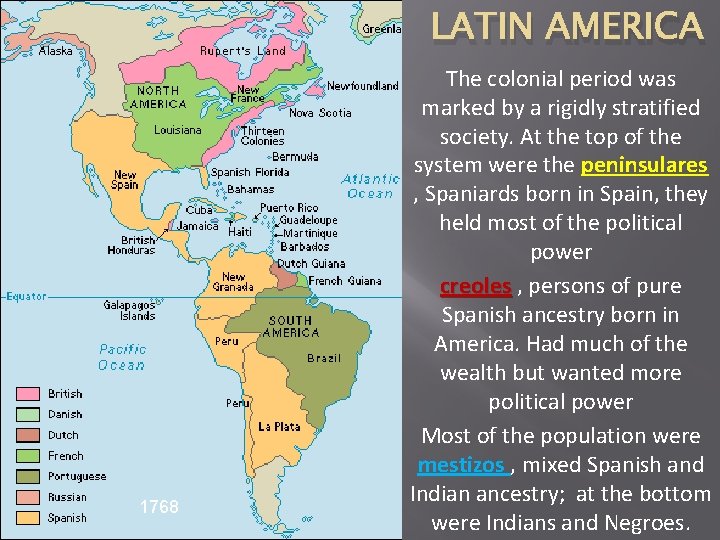
LATIN AMERICA 1768 The colonial period was marked by a rigidly stratified society. At the top of the system were the peninsulares , Spaniards born in Spain, they held most of the political power creoles , persons of pure Spanish ancestry born in America. Had much of the wealth but wanted more political power Most of the population were mestizos , mixed Spanish and Indian ancestry; at the bottom were Indians and Negroes.
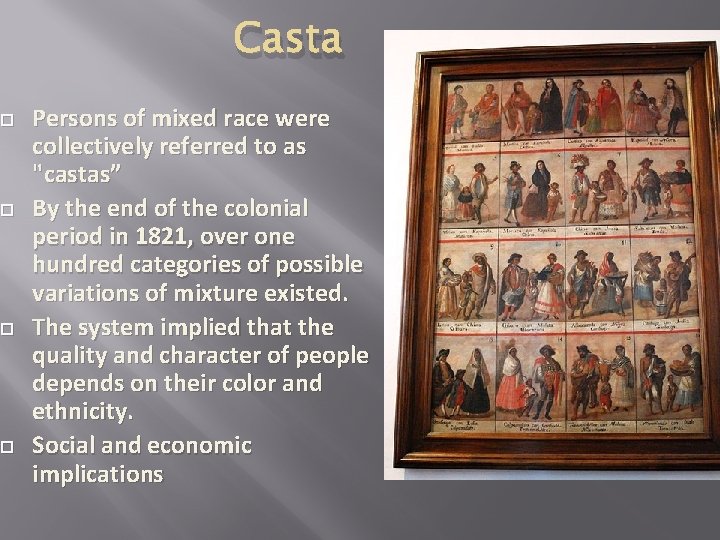
Casta Persons of mixed race were collectively referred to as "castas” By the end of the colonial period in 1821, over one hundred categories of possible variations of mixture existed. The system implied that the quality and character of people depends on their color and ethnicity. Social and economic implications
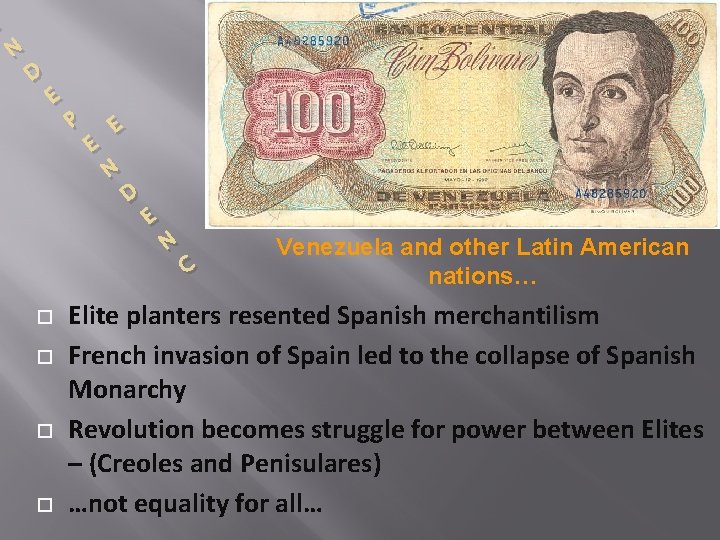
I N D E P E E N D E N C Venezuela and other Latin American nations… Elite planters resented Spanish merchantilism French invasion of Spain led to the collapse of Spanish Monarchy Revolution becomes struggle for power between Elites – (Creoles and Penisulares) …not equality for all…
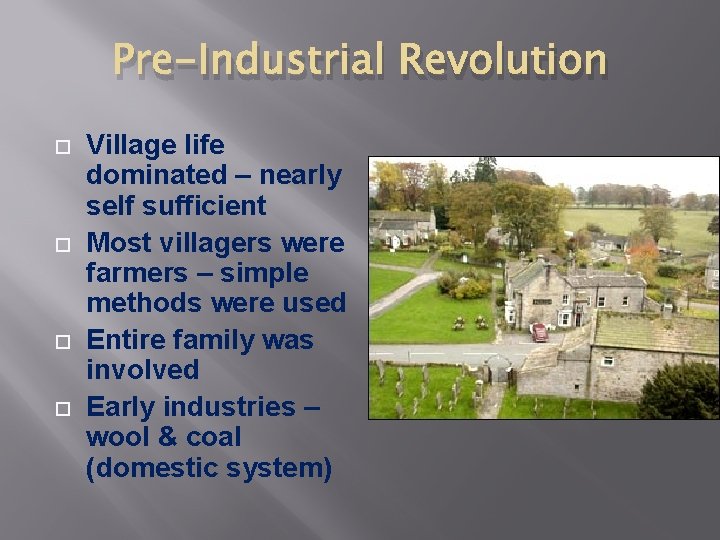
Pre-Industrial Revolution Village life dominated – nearly self sufficient Most villagers were farmers – simple methods were used Entire family was involved Early industries – wool & coal (domestic system)
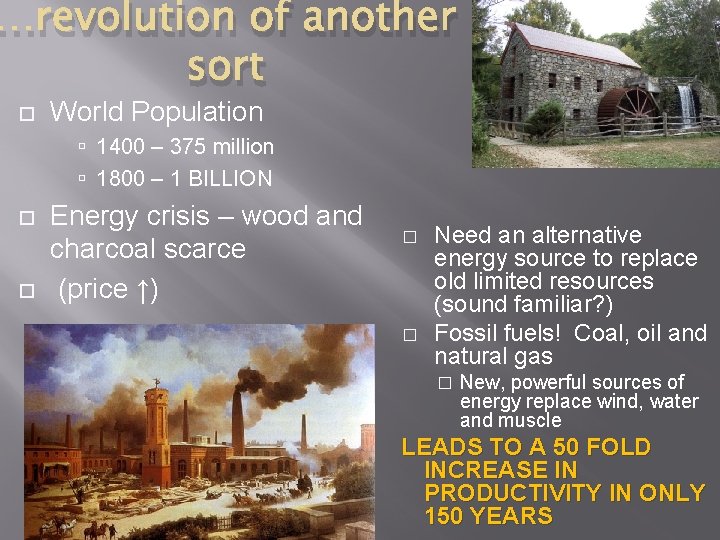
…revolution of another sort World Population 1400 – 375 million 1800 – 1 BILLION Energy crisis – wood and charcoal scarce (price ↑) � � Need an alternative energy source to replace old limited resources (sound familiar? ) Fossil fuels! Coal, oil and natural gas � New, powerful sources of energy replace wind, water and muscle LEADS TO A 50 FOLD INCREASE IN PRODUCTIVITY IN ONLY 150 YEARS
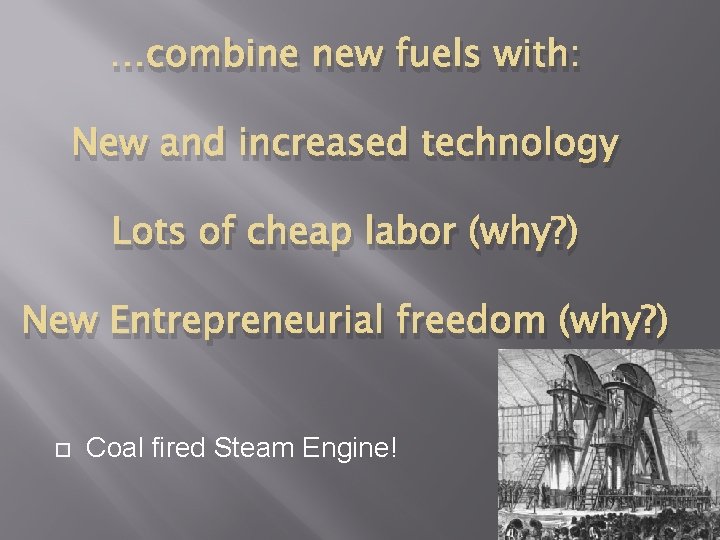
…combine new fuels with: New and increased technology Lots of cheap labor (why? ) New Entrepreneurial freedom (why? ) Coal fired Steam Engine!
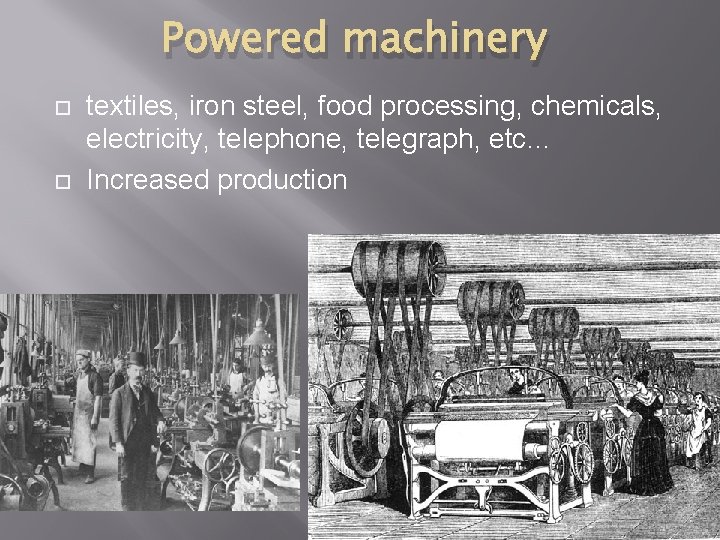
Powered machinery textiles, iron steel, food processing, chemicals, electricity, telephone, telegraph, etc… Increased production
Why Europe? � � � Europe and rest of the world very similar (life expectancy, living standards, nutrition, etc) Smaller Nation-States led to highly competitive atmosphere Newness – no large tax collecting bureaucracy, lead to alliance between leaders and merchants (charters, monopolies, scientific societies, etc) Competition – capitalism leads to innovation World Trade – forced to compete with goods from Asia
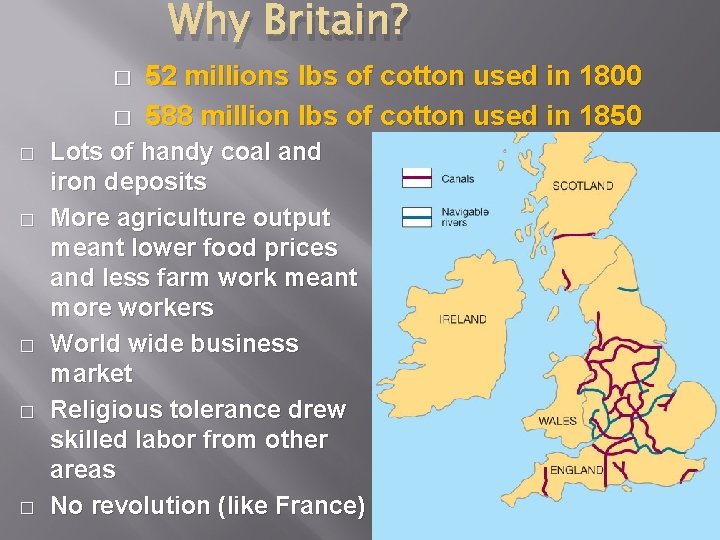
Why Britain? � � � � 52 millions lbs of cotton used in 1800 588 million lbs of cotton used in 1850 Lots of handy coal and iron deposits More agriculture output meant lower food prices and less farm work meant more workers World wide business market Religious tolerance drew skilled labor from other areas No revolution (like France)
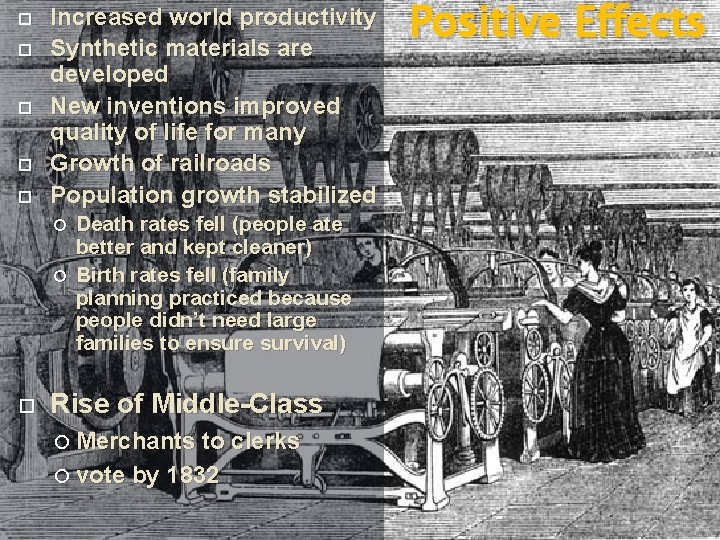
Increased world productivity Synthetic materials are developed New inventions improved quality of life for many Growth of railroads Population growth stabilized Death rates fell (people ate better and kept cleaner) Birth rates fell (family planning practiced because people didn’t need large families to ensure survival) Rise of Middle-Class Merchants to clerks vote by 1832 Positive Effects
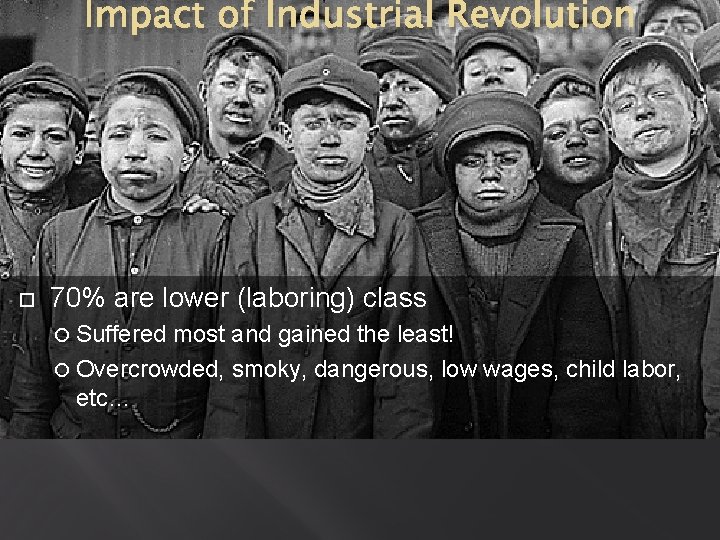
Impact of Industrial Revolution 70% are lower (laboring) class Suffered most and gained the least! Overcrowded, smoky, dangerous, low wages, child labor, etc…
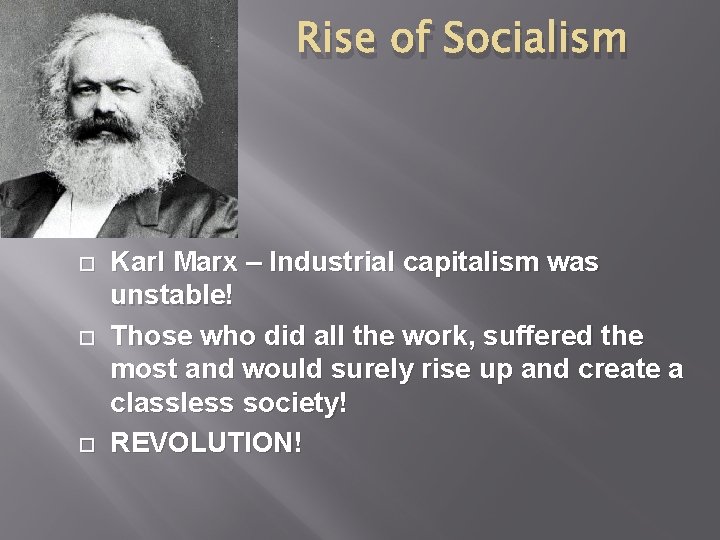
Rise of Socialism Karl Marx – Industrial capitalism was unstable! Those who did all the work, suffered the most and would surely rise up and create a classless society! REVOLUTION!
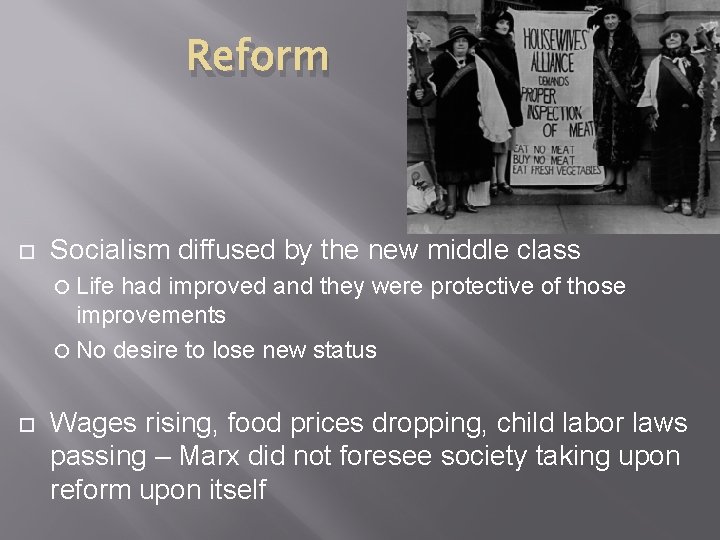
Reform Socialism diffused by the new middle class Life had improved and they were protective of those improvements No desire to lose new status Wages rising, food prices dropping, child labor laws passing – Marx did not foresee society taking upon reform upon itself
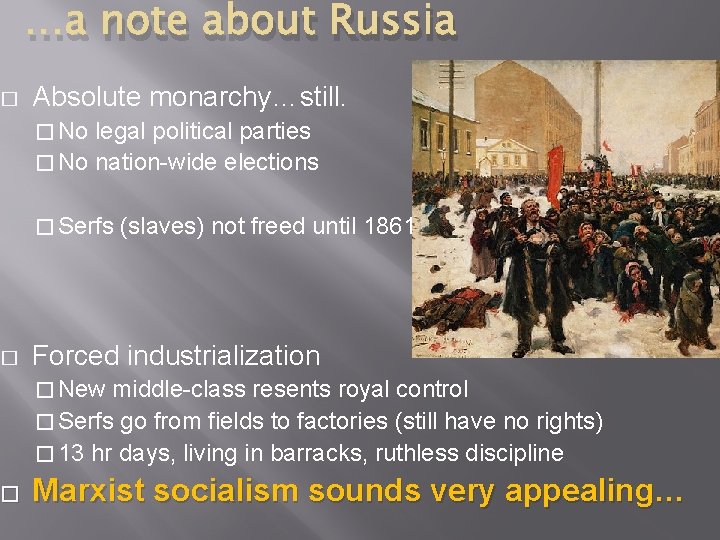
…a note about Russia � Absolute monarchy…still. � No legal political parties � No nation-wide elections � Serfs � (slaves) not freed until 1861 Forced industrialization � New middle-class resents royal control � Serfs go from fields to factories (still have no rights) � 13 hr days, living in barracks, ruthless discipline � Marxist socialism sounds very appealing…
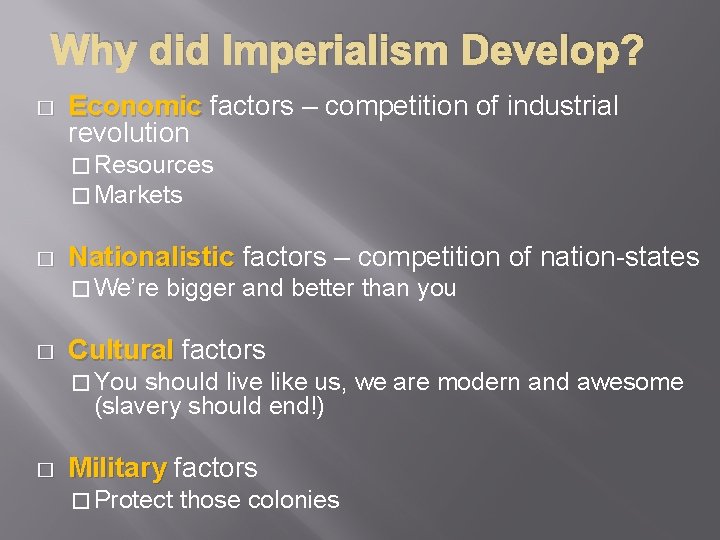
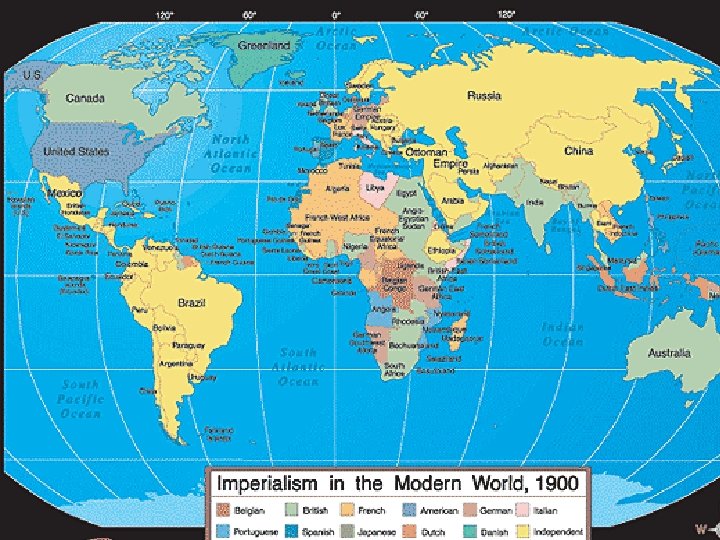
Why did Imperialism Develop? � Economic factors – competition of industrial revolution � Resources � Markets � Nationalistic factors – competition of nation-states � We’re � bigger and better than you Cultural factors � You should live like us, we are modern and awesome (slavery should end!) � Military factors � Protect those colonies
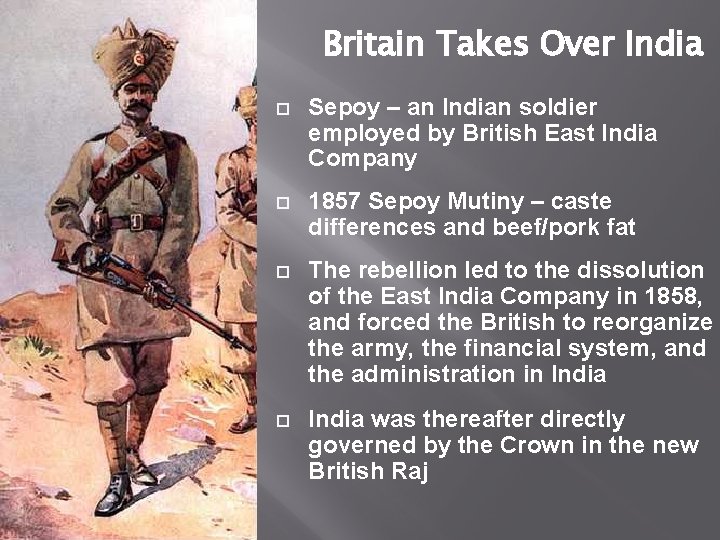
Britain Takes Over India Sepoy – an Indian soldier employed by British East India Company 1857 Sepoy Mutiny – caste differences and beef/pork fat The rebellion led to the dissolution of the East India Company in 1858, and forced the British to reorganize the army, the financial system, and the administration in India was thereafter directly governed by the Crown in the new British Raj
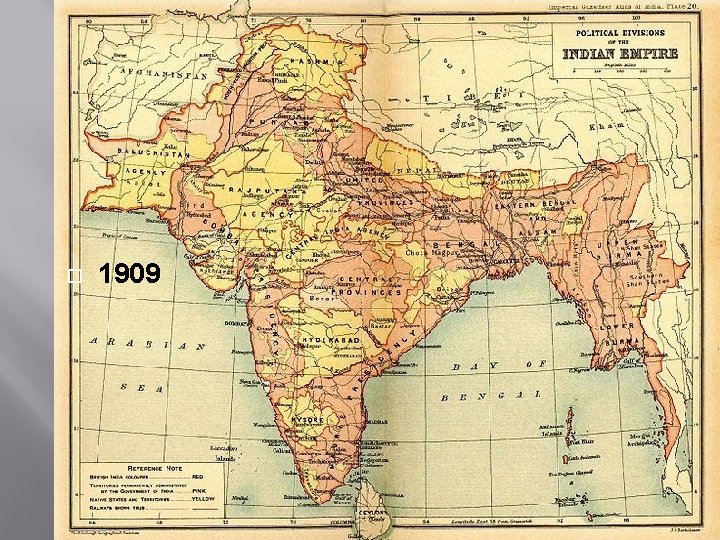
1909
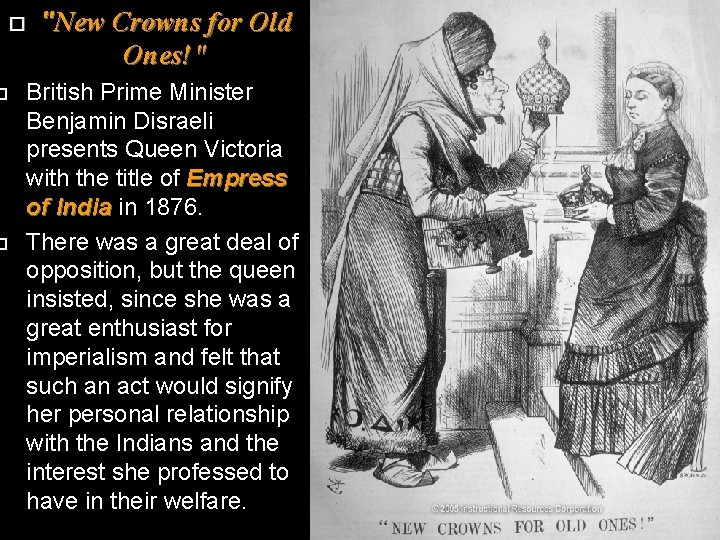
"New Crowns for Old Ones!" British Prime Minister Benjamin Disraeli presents Queen Victoria with the title of Empress of India in 1876. There was a great deal of opposition, but the queen insisted, since she was a great enthusiast for imperialism and felt that such an act would signify her personal relationship with the Indians and the interest she professed to have in their welfare.
India
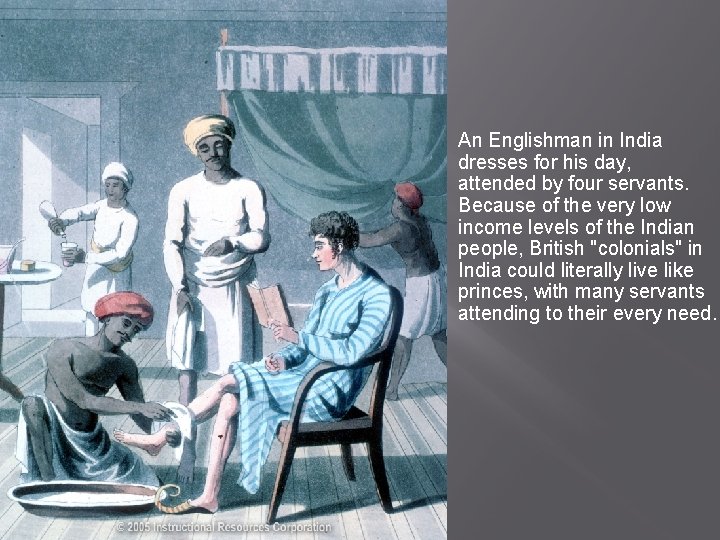
An Englishman in India dresses for his day, attended by four servants. Because of the very low income levels of the Indian people, British "colonials" in India could literally live like princes, with many servants attending to their every need.
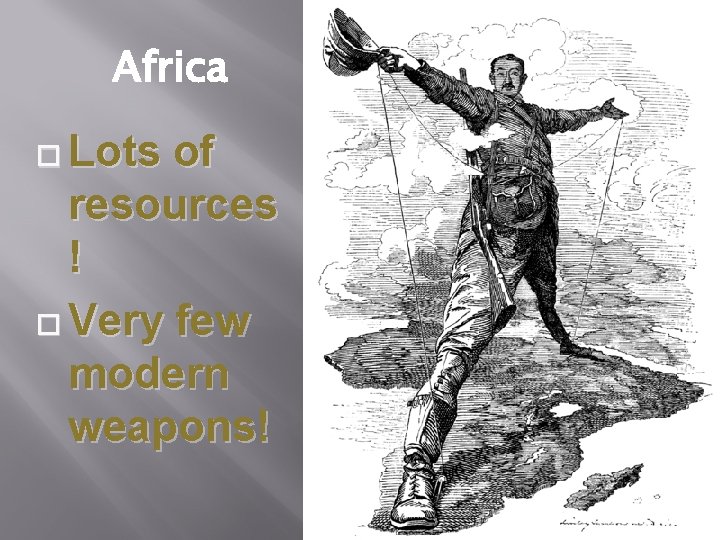
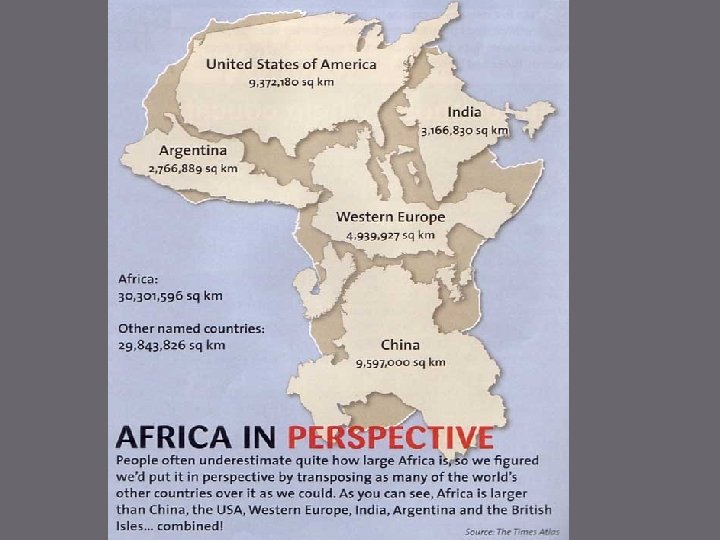
Africa Lots of resources ! Very few modern weapons!
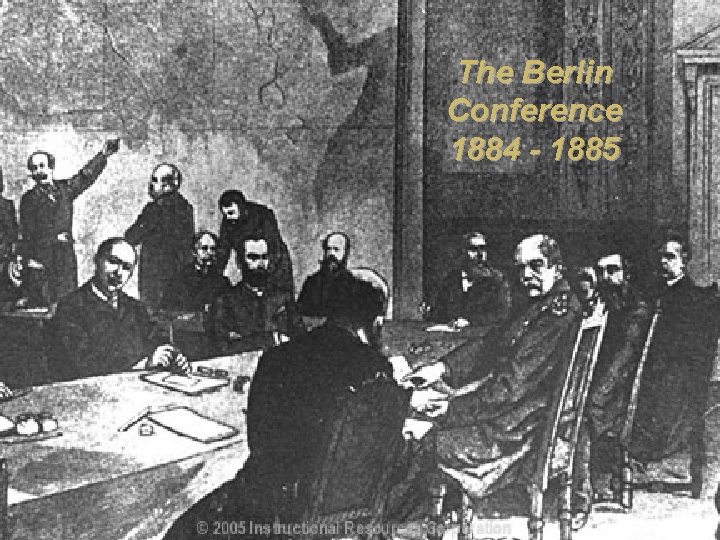
Results of Berlin Conference 1885 The Berlin Conference 1884 - 1885
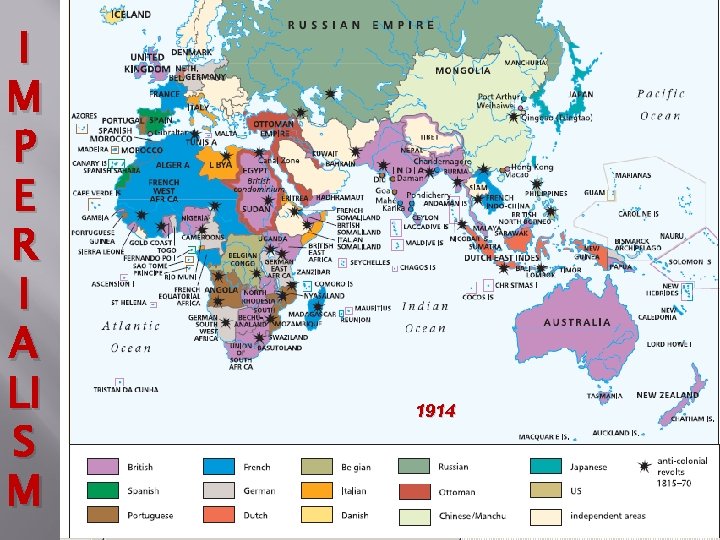
I M P E R I A LI S M 1914
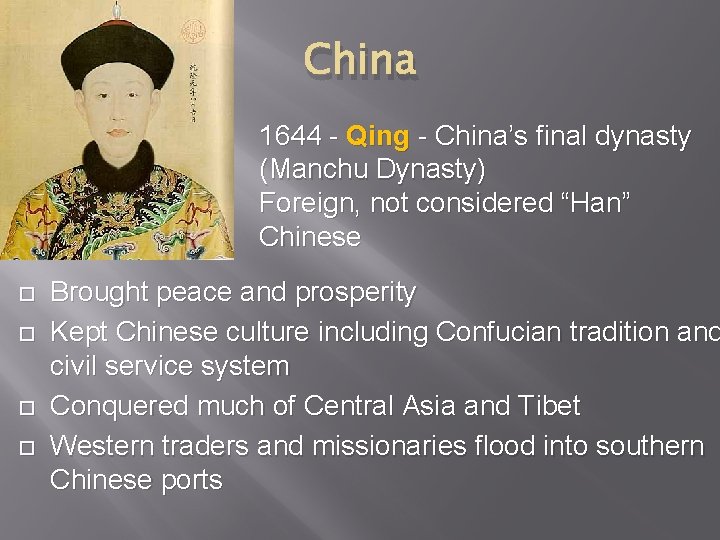
China 1644 - Qing - China’s final dynasty (Manchu Dynasty) Foreign, not considered “Han” Chinese Brought peace and prosperity Kept Chinese culture including Confucian tradition and civil service system Conquered much of Central Asia and Tibet Western traders and missionaries flood into southern Chinese ports
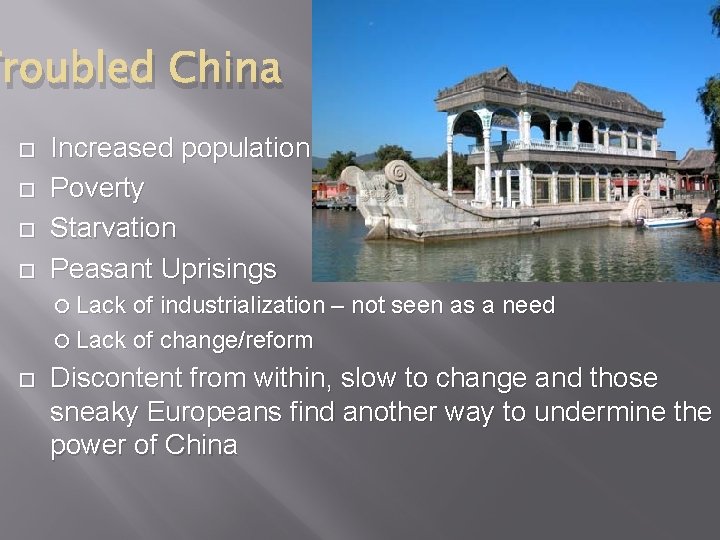
Troubled China Increased population Poverty Starvation Peasant Uprisings Lack of industrialization – not seen as a need Lack of change/reform Discontent from within, slow to change and those sneaky Europeans find another way to undermine the power of China
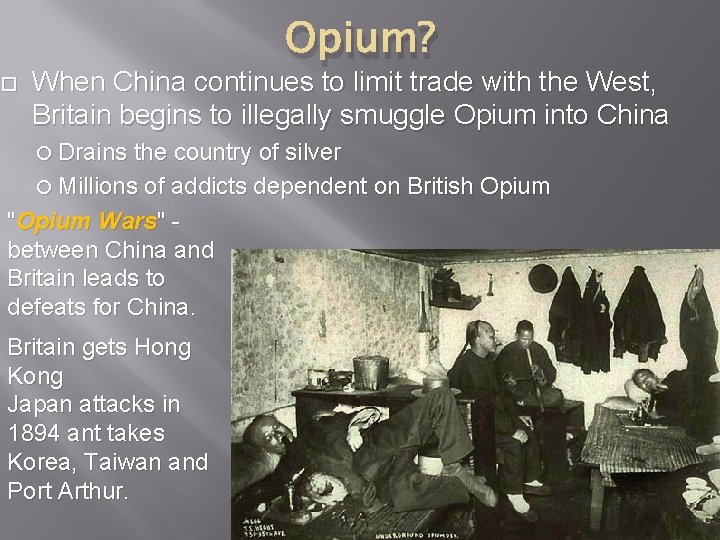
Opium? When China continues to limit trade with the West, Britain begins to illegally smuggle Opium into China Drains the country of silver Millions of addicts dependent on British Opium "Opium Wars" between China and Britain leads to defeats for China. Britain gets Hong Kong Japan attacks in 1894 ant takes Korea, Taiwan and Port Arthur.
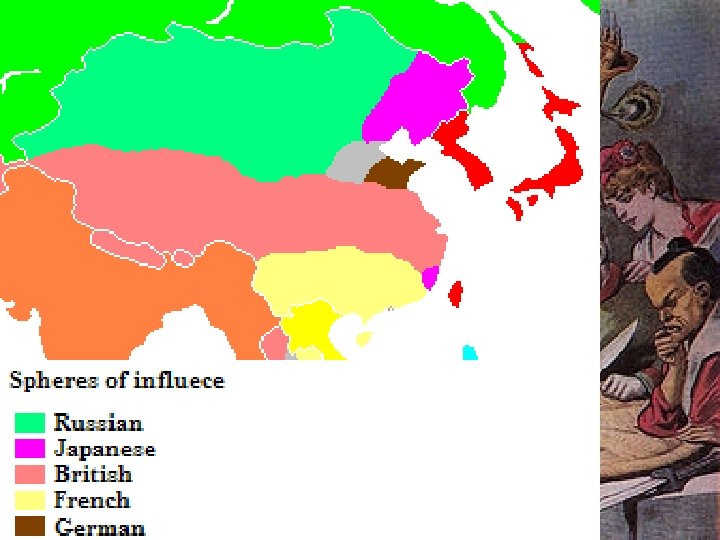
� � � 50 of China’s most prosperous ports were deemed "treaty ports" which meant that they were open to foreign trade and residence. European nations divided China into spheres of influence The wishes of the Chinese were ignored. This, understandably, created a great deal of resentment amongst the Chinese.
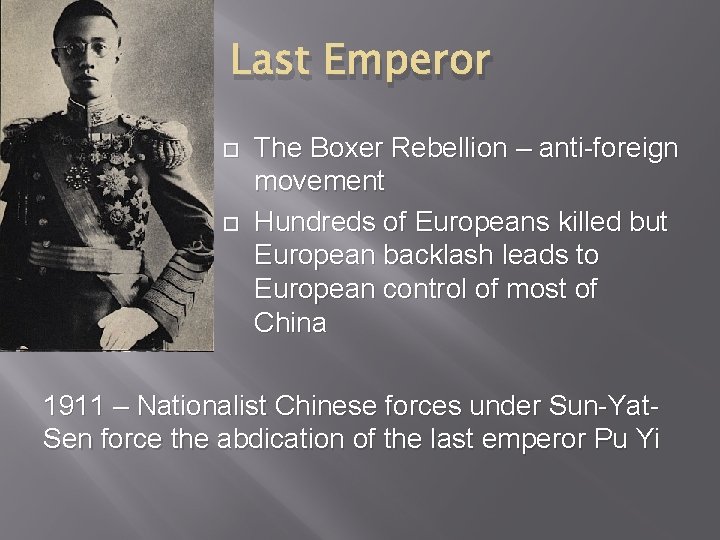
Last Emperor The Boxer Rebellion – anti-foreign movement Hundreds of Europeans killed but European backlash leads to European control of most of China 1911 – Nationalist Chinese forces under Sun-Yat. Sen force the abdication of the last emperor Pu Yi
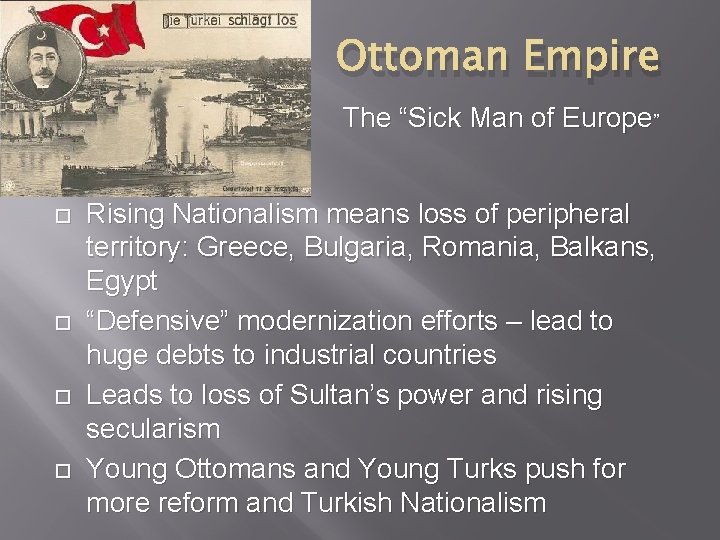
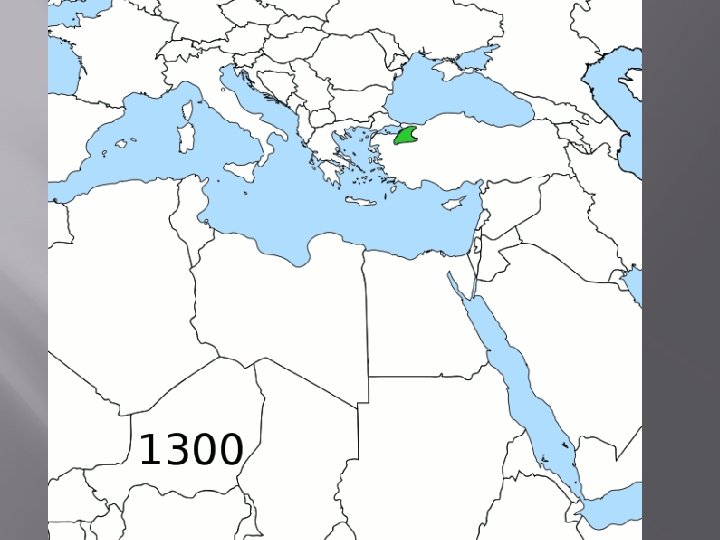
Ottoman Empire The “Sick Man of Europe” Rising Nationalism means loss of peripheral territory: Greece, Bulgaria, Romania, Balkans, Egypt “Defensive” modernization efforts – lead to huge debts to industrial countries Leads to loss of Sultan’s power and rising secularism Young Ottomans and Young Turks push for more reform and Turkish Nationalism
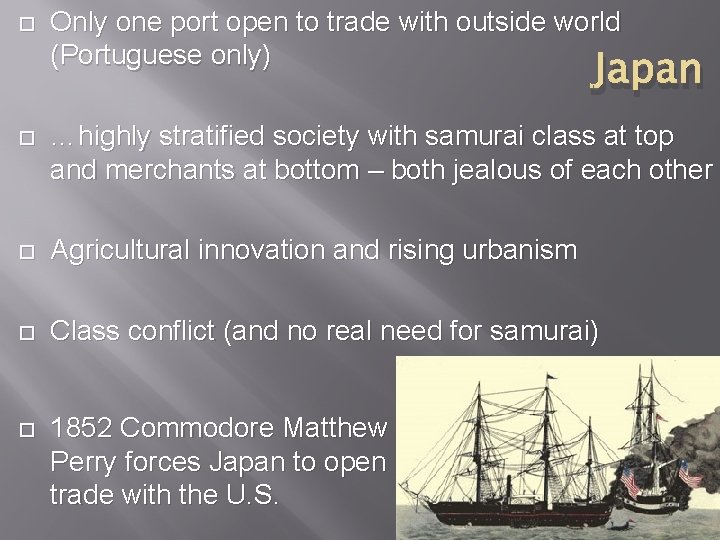
Only one port open to trade with outside world (Portuguese only) Japan …highly stratified society with samurai class at top and merchants at bottom – both jealous of each other Agricultural innovation and rising urbanism Class conflict (and no real need for samurai) 1852 Commodore Matthew Perry forces Japan to open trade with the U. S.
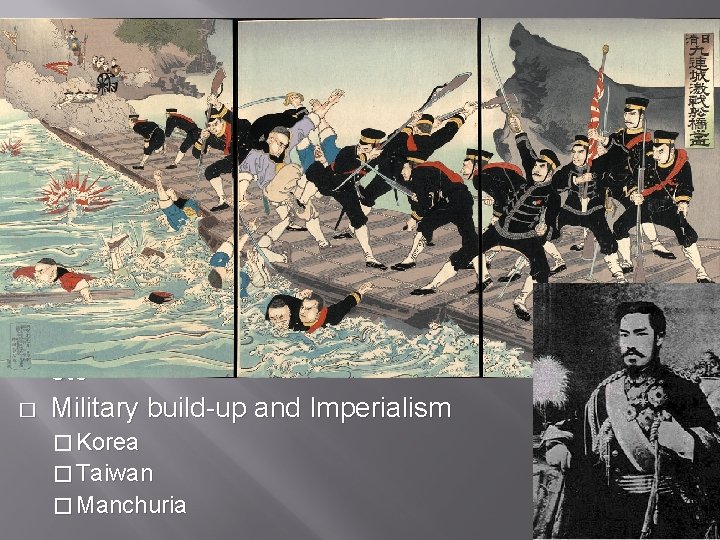
Westernization of Japan � � � Meiji Restoration – the end of the Tokugawa Shogunate in 1867 The Emperor and his ministers (making decisions in his name)(not Shogun) controls a united Japan Rapid industrialization led by nation (government monopolies created then sold to private companies); railroads, ports, etc Fascination with western technology, politics, dress, etc Military build-up and Imperialism � Korea � Taiwan � Manchuria