
What is a Resume A first Impression A
- Slides: 30
What is a Resume? Ø Ø A first Impression. A summary, a selection of highlights – but not a List! A demonstration of how you are a good match. A showcase of your “value” to the employer. It’s purpose – to help you get an interview!
A Well Designed Resume Ø EVERY WORD ON RESUME IS ESSENTIAL. Ø 4 C’s: CLEAR, CONCRETE, CONCISE, CONSISTENT! Ø Contains NO TYPOS! Ø Has been PROOFREAD FOR ACCURACY!
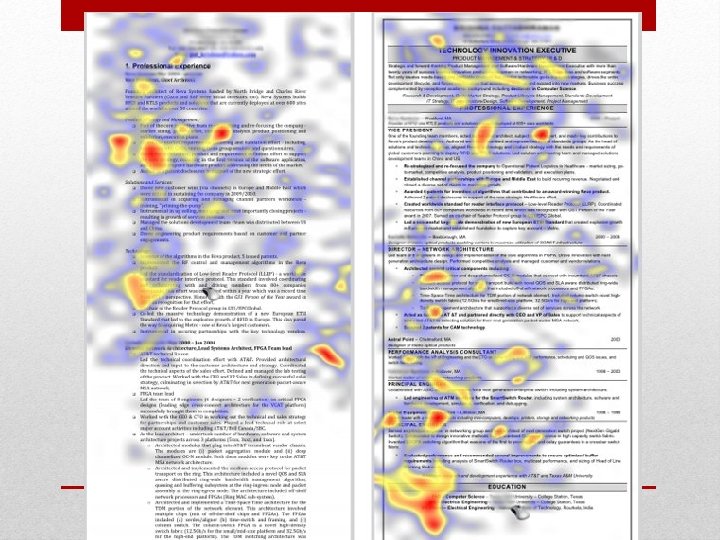
DID YOU KNOW? The average hiring manager spends just 6 seconds looking at a resume to determine whether it should land in their “KEEP” pile.
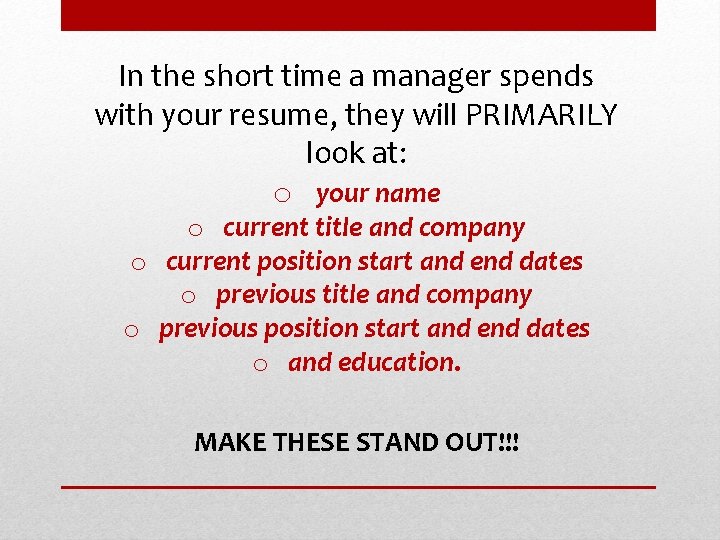
In the short time a manager spends with your resume, they will PRIMARILY look at: o your name o current title and company o current position start and end dates o previous title and company o previous position start and end dates o and education. MAKE THESE STAND OUT!!!
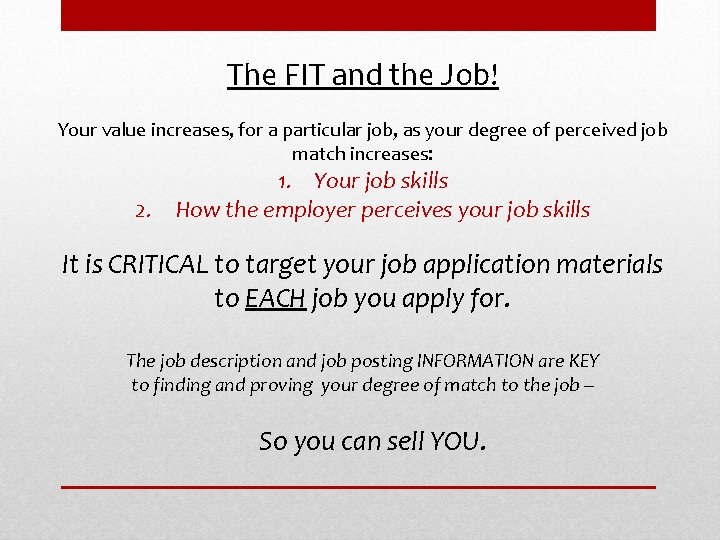
The FIT and the Job! Your value increases, for a particular job, as your degree of perceived job match increases: 1. Your job skills 2. How the employer perceives your job skills It is CRITICAL to target your job application materials to EACH job you apply for. The job description and job posting INFORMATION are KEY to finding and proving your degree of match to the job -- So you can sell YOU.
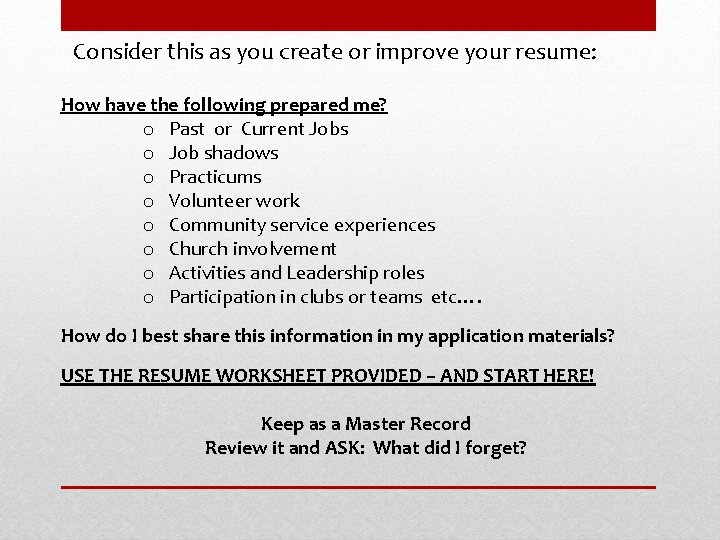
Consider this as you create or improve your resume: How have the following prepared me? o Past or Current Jobs o Job shadows o Practicums o Volunteer work o Community service experiences o Church involvement o Activities and Leadership roles o Participation in clubs or teams etc…. How do I best share this information in my application materials? USE THE RESUME WORKSHEET PROVIDED – AND START HERE! Keep as a Master Record Review it and ASK: What did I forget?
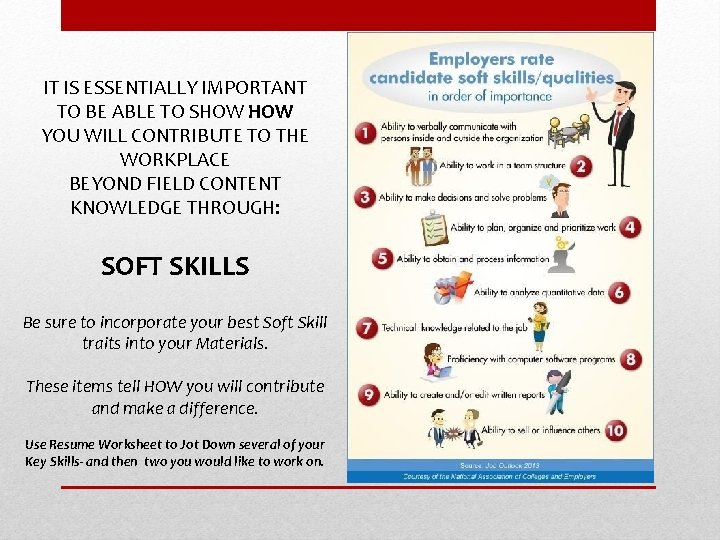
IT IS ESSENTIALLY IMPORTANT TO BE ABLE TO SHOW YOU WILL CONTRIBUTE TO THE WORKPLACE BEYOND FIELD CONTENT KNOWLEDGE THROUGH: SOFT SKILLS Be sure to incorporate your best Soft Skill traits into your Materials. These items tell HOW you will contribute and make a difference. Use Resume Worksheet to Jot Down several of your Key Skills- and then two you would like to work on.
YOUR Materials: 1) Resume 2) Reference Page 3) Cover Letter MATERIALS
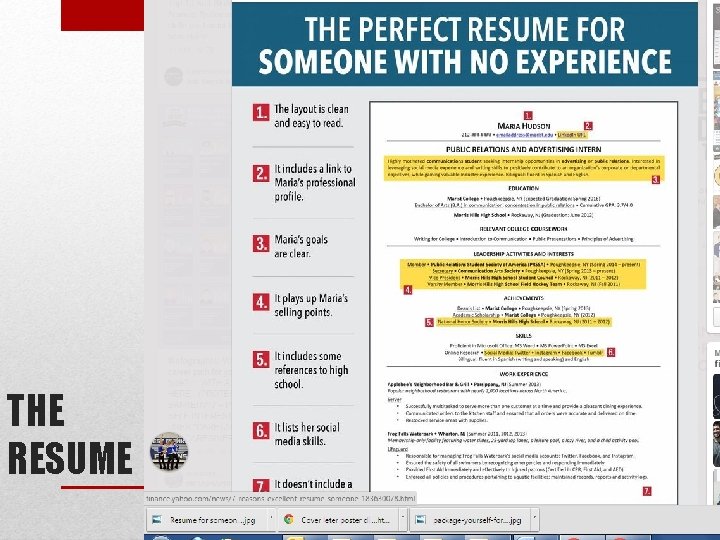
THE RESUME
RESUME STYLES & FORMATS Styles. Reverse Chronological – most common Functional –skills & strengths based *Combination – by skills, projects, work history, education Layout. Center Justified, Columned, Left Justified, Other… SEE EXAMPLES THE RESUME
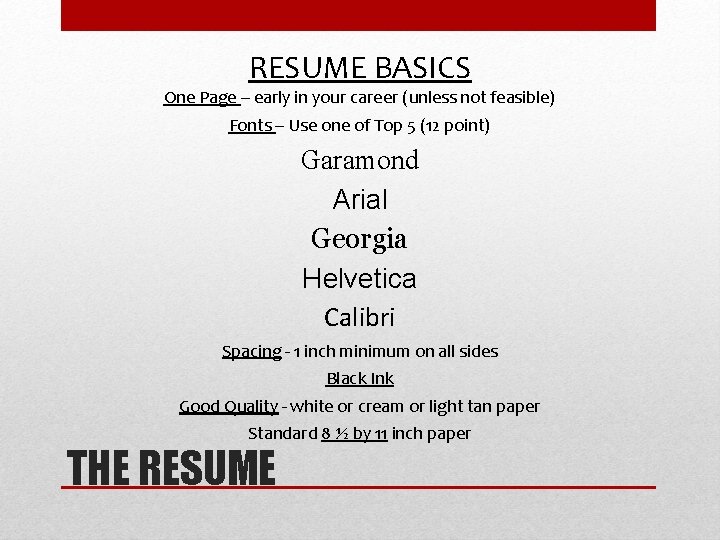
RESUME BASICS One Page – early in your career (unless not feasible) Fonts – Use one of Top 5 (12 point) Garamond Arial Georgia Helvetica Calibri Spacing - 1 inch minimum on all sides Black Ink Good Quality - white or cream or light tan paper Standard 8 ½ by 11 inch paper THE RESUME
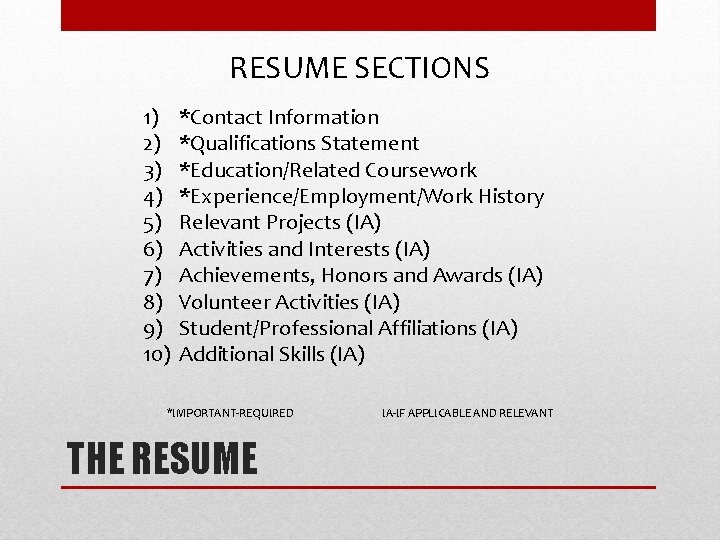
RESUME SECTIONS 1) 2) 3) 4) 5) 6) 7) 8) 9) 10) *Contact Information *Qualifications Statement *Education/Related Coursework *Experience/Employment/Work History Relevant Projects (IA) Activities and Interests (IA) Achievements, Honors and Awards (IA) Volunteer Activities (IA) Student/Professional Affiliations (IA) Additional Skills (IA) *IMPORTANT-REQUIRED THE RESUME IA-IF APPLICABLE AND RELEVANT
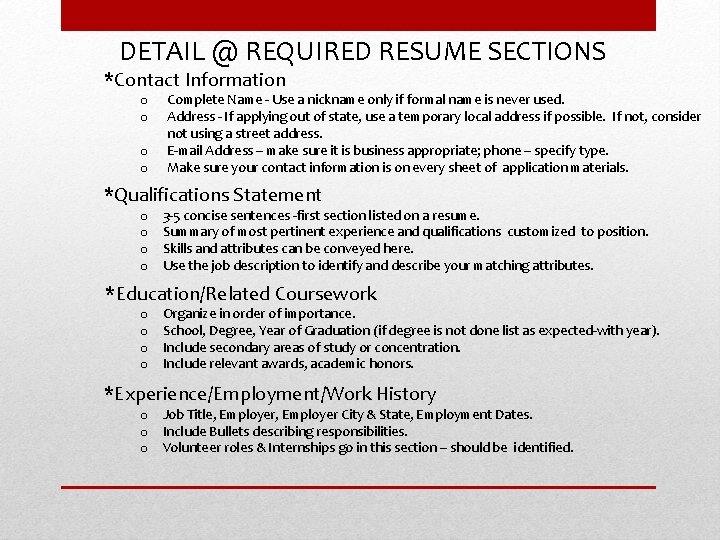
DETAIL @ REQUIRED RESUME SECTIONS *Contact Information o o Complete Name - Use a nickname only if formal name is never used. Address - If applying out of state, use a temporary local address if possible. If not, consider not using a street address. E-mail Address – make sure it is business appropriate; phone – specify type. Make sure your contact information is on every sheet of application materials. *Qualifications Statement o o 3 -5 concise sentences -first section listed on a resume. Summary of most pertinent experience and qualifications customized to position. Skills and attributes can be conveyed here. Use the job description to identify and describe your matching attributes. *Education/Related Coursework o o Organize in order of importance. School, Degree, Year of Graduation (if degree is not done list as expected-with year). Include secondary areas of study or concentration. Include relevant awards, academic honors. *Experience/Employment/Work History o Job Title, Employer City & State, Employment Dates. o Include Bullets describing responsibilities. o Volunteer roles & Internships go in this section – should be identified.
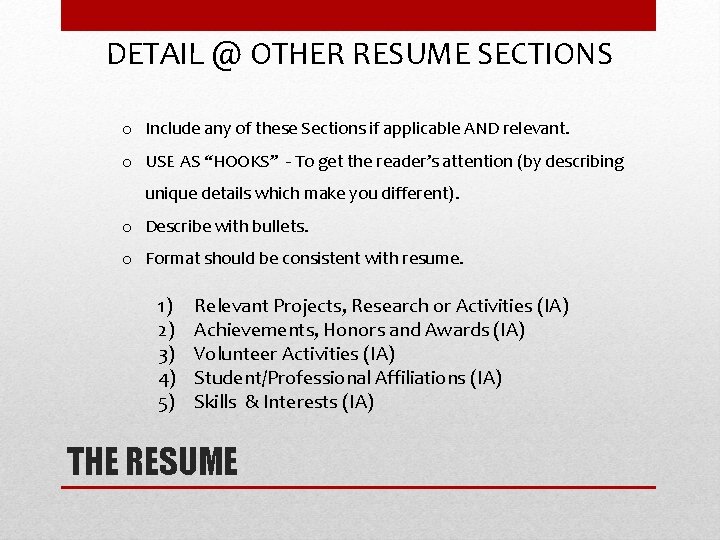
DETAIL @ OTHER RESUME SECTIONS o Include any of these Sections if applicable AND relevant. o USE AS “HOOKS” - To get the reader’s attention (by describing unique details which make you different). o Describe with bullets. o Format should be consistent with resume. 1) 2) 3) 4) 5) Relevant Projects, Research or Activities (IA) Achievements, Honors and Awards (IA) Volunteer Activities (IA) Student/Professional Affiliations (IA) Skills & Interests (IA) THE RESUME
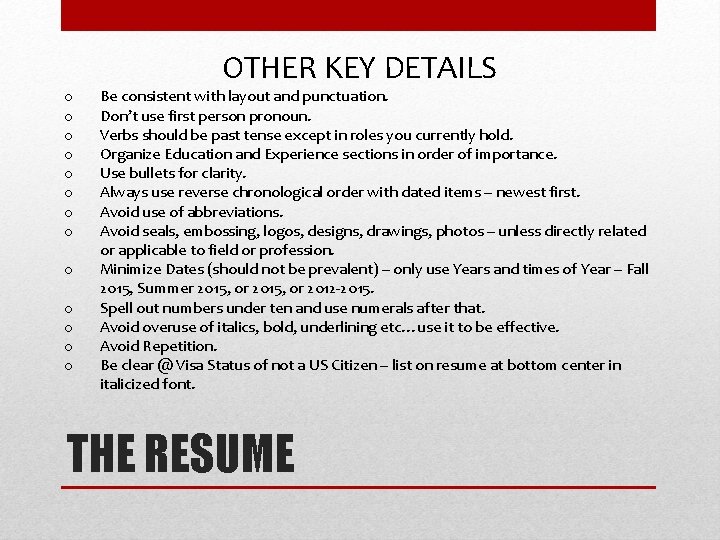
OTHER KEY DETAILS o o o o Be consistent with layout and punctuation. Don’t use first person pronoun. Verbs should be past tense except in roles you currently hold. Organize Education and Experience sections in order of importance. Use bullets for clarity. Always use reverse chronological order with dated items – newest first. Avoid use of abbreviations. Avoid seals, embossing, logos, designs, drawings, photos – unless directly related or applicable to field or profession. Minimize Dates (should not be prevalent) – only use Years and times of Year – Fall 2015, Summer 2015, or 2012 -2015. Spell out numbers under ten and use numerals after that. Avoid overuse of italics, bold, underlining etc…use it to be effective. Avoid Repetition. Be clear @ Visa Status of not a US Citizen – list on resume at bottom center in italicized font. THE RESUME
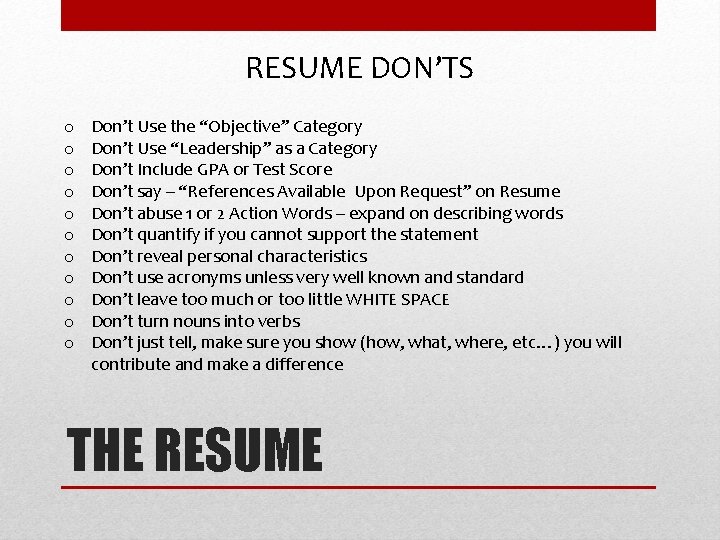
RESUME DON’TS o o o Don’t Use the “Objective” Category Don’t Use “Leadership” as a Category Don’t Include GPA or Test Score Don’t say – “References Available Upon Request” on Resume Don’t abuse 1 or 2 Action Words – expand on describing words Don’t quantify if you cannot support the statement Don’t reveal personal characteristics Don’t use acronyms unless very well known and standard Don’t leave too much or too little WHITE SPACE Don’t turn nouns into verbs Don’t just tell, make sure you show (how, what, where, etc…) you will contribute and make a difference THE RESUME
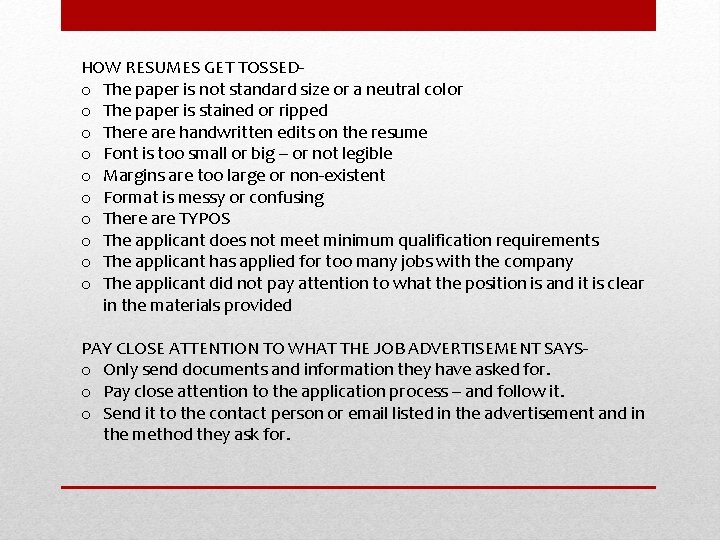
HOW RESUMES GET TOSSEDo The paper is not standard size or a neutral color o The paper is stained or ripped o There are handwritten edits on the resume o Font is too small or big – or not legible o Margins are too large or non-existent o Format is messy or confusing o There are TYPOS o The applicant does not meet minimum qualification requirements o The applicant has applied for too many jobs with the company o The applicant did not pay attention to what the position is and it is clear in the materials provided PAY CLOSE ATTENTION TO WHAT THE JOB ADVERTISEMENT SAYSo Only send documents and information they have asked for. o Pay close attention to the application process – and follow it. o Send it to the contact person or email listed in the advertisement and in the method they ask for.
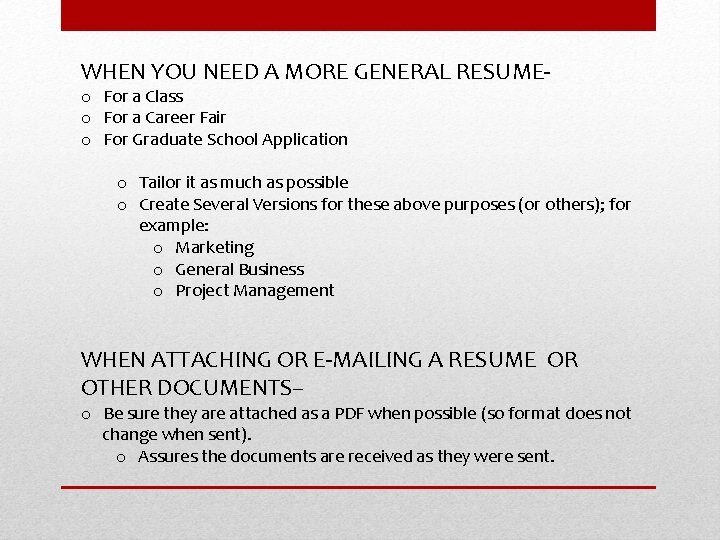
WHEN YOU NEED A MORE GENERAL RESUMEo For a Class o For a Career Fair o For Graduate School Application o Tailor it as much as possible o Create Several Versions for these above purposes (or others); for example: o Marketing o General Business o Project Management WHEN ATTACHING OR E-MAILING A RESUME OR OTHER DOCUMENTS– o Be sure they are attached as a PDF when possible (so format does not change when sent). o Assures the documents are received as they were sent.
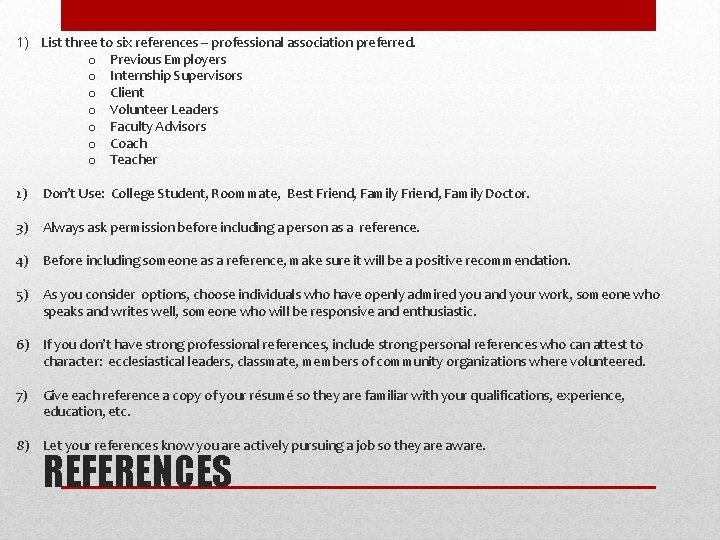
1) List three to six references – professional association preferred. o Previous Employers o Internship Supervisors o Client o Volunteer Leaders o Faculty Advisors o Coach o Teacher 2) Don’t Use: College Student, Roommate, Best Friend, Family Doctor. 3) Always ask permission before including a person as a reference. 4) Before including someone as a reference, make sure it will be a positive recommendation. 5) As you consider options, choose individuals who have openly admired you and your work, someone who speaks and writes well, someone who will be responsive and enthusiastic. 6) If you don’t have strong professional references, include strong personal references who can attest to character: ecclesiastical leaders, classmate, members of community organizations where volunteered. 7) Give each reference a copy of your résumé so they are familiar with your qualifications, experience, education, etc. 8) Let your references know you are actively pursuing a job so they are aware. REFERENCES
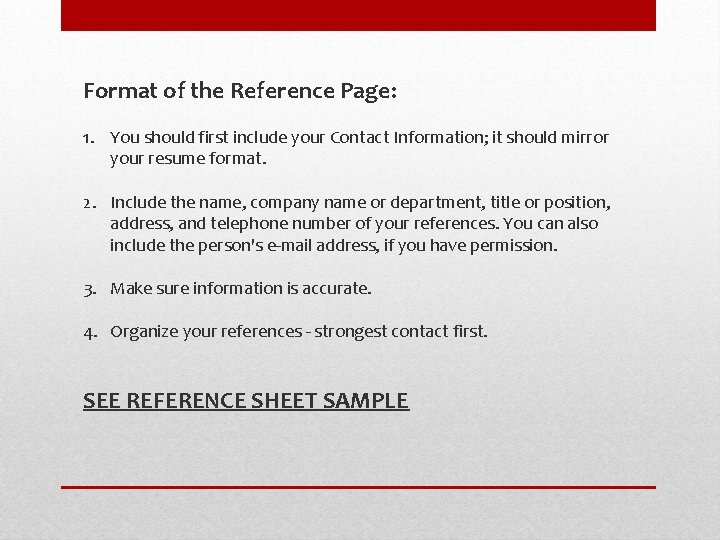
Format of the Reference Page: 1. You should first include your Contact Information; it should mirror your resume format. 2. Include the name, company name or department, title or position, address, and telephone number of your references. You can also include the person's e-mail address, if you have permission. 3. Make sure information is accurate. 4. Organize your references - strongest contact first. SEE REFERENCE SHEET SAMPLE
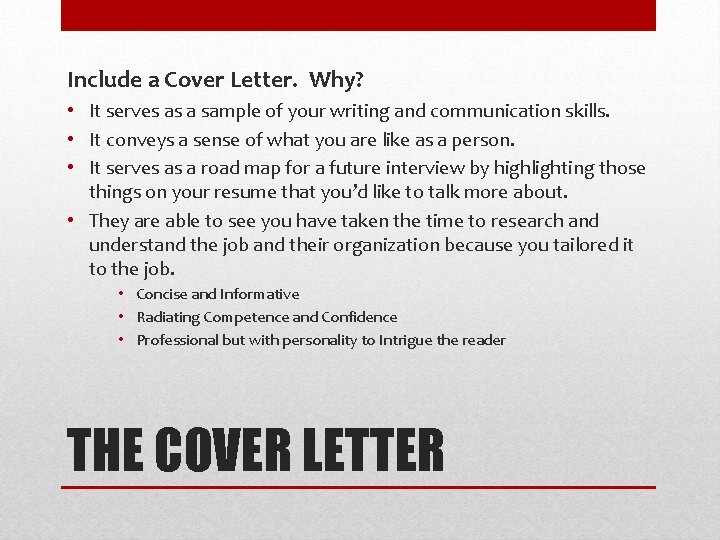
Include a Cover Letter. Why? • It serves as a sample of your writing and communication skills. • It conveys a sense of what you are like as a person. • It serves as a road map for a future interview by highlighting those things on your resume that you’d like to talk more about. • They are able to see you have taken the time to research and understand the job and their organization because you tailored it to the job. • Concise and Informative • Radiating Competence and Confidence • Professional but with personality to Intrigue the reader THE COVER LETTER
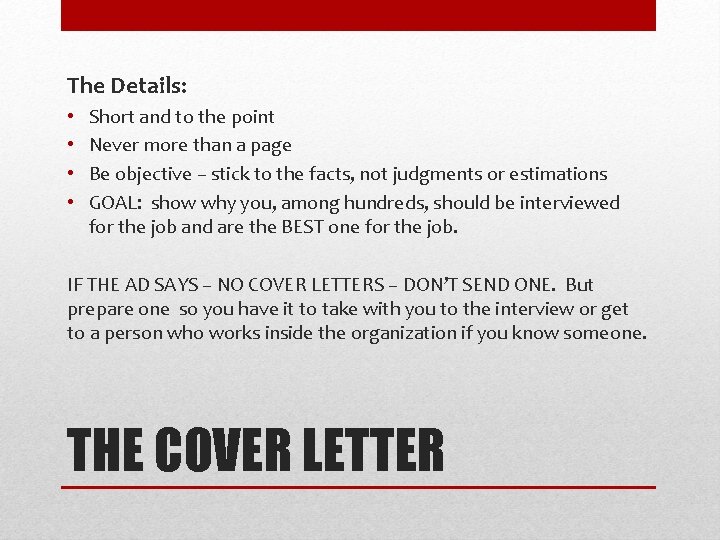
The Details: • • Short and to the point Never more than a page Be objective – stick to the facts, not judgments or estimations GOAL: show why you, among hundreds, should be interviewed for the job and are the BEST one for the job. IF THE AD SAYS – NO COVER LETTERS – DON’T SEND ONE. But prepare one so you have it to take with you to the interview or get to a person who works inside the organization if you know someone. THE COVER LETTER
Building the Letter: First, introduce yourself and explain why you are sending your resume. Define which job you are applying for. Tell how you became aware of job, if a referral use the person’s name. Tell who you are. Show you have done your homework – JOB and ORGANIZATION. Organize your information in order of importance – lead with strongest. Explain why the organization should be interested in you – describe what you can do for them. • Wrap it up with a summary or conclusion and suggest a next course of action (refer to where your contact information is). • • TERRIBLE LETTER OPENINGS – FIND A NAME SAMPLE: STRONG COVER LETTER INSPIRATIONS COVER LETTER SAMPLES THE COVER LETTER
EXERCISE: Jobs Held 1) List an example of a prior role? 2) List skills or techniques you learned and used in this role. 3) How do these skills transfer to a professional role in your field? 4) What did you learn in this role that you can apply to a role in your field?
• LIFEGUARD = working collaboratively with others, handling emergencies, customer service, leadership skills • SONIC WAITRESS = customer service, handling tense situations, managing money, working with others • ADMINISTRATIVE SUPPORT IN AN OFFICE = customer service, time management, accuracy and attention to detail, working with others APPLICATION OF EXERCISE
https: //myottawa. edu/ICS/ • OFFERS A COPY OF THIS PRESENTATION. • INCLUDES ALL INFORMATION PROVIDED TODAY. • PROVIDES ADDITIONAL RESOURCES TO YOUR STUDENT PORTAL
“CAN I WEAR MY NOSE RING TO THE INTERVIEW? ” By Ellen Gordon Reeves “JOB HUNTING HANDBOOK” By Harry Dahlstrom “Life After College” By Jenny Blake “Getting from College to Career” By Lindsey Pollak CAREER RESOURCES
Career Services Joanna Walters Director of Career Development joanna. walters@ottawa. edu 785 -248 -2350