
What is a Resolution Resolution decision about some
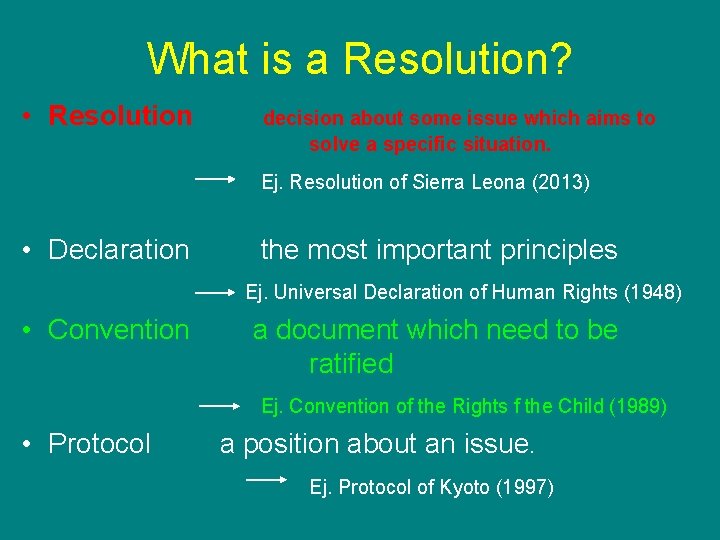
What is a Resolution? • Resolution decision about some issue which aims to solve a specific situation. Ej. Resolution of Sierra Leona (2013) • Declaration the most important principles Ej. Universal Declaration of Human Rights (1948) • Convention a document which need to be ratified Ej. Convention of the Rights f the Child (1989) • Protocol a position about an issue. Ej. Protocol of Kyoto (1997)
RESOLUTIONS THEY ARE BASICALLY STATEMENTS BY THE INTERNATIONAL COMMUNITY EXPRESSING THE DESIRE TO CHANGE A CERTAIN SITUATION AND PRESCRIBING WAYS BY WHICH IT CAN BE DONE. It shows how your delegation/country feels about a certain issue.
CONTENTS OF A RESOLUTION- a strict format - 1. THE HEADING 2. THE ADDRESS 3. PREAMBULATORY CLAUSES 4. OPERATIVE CLAUSES
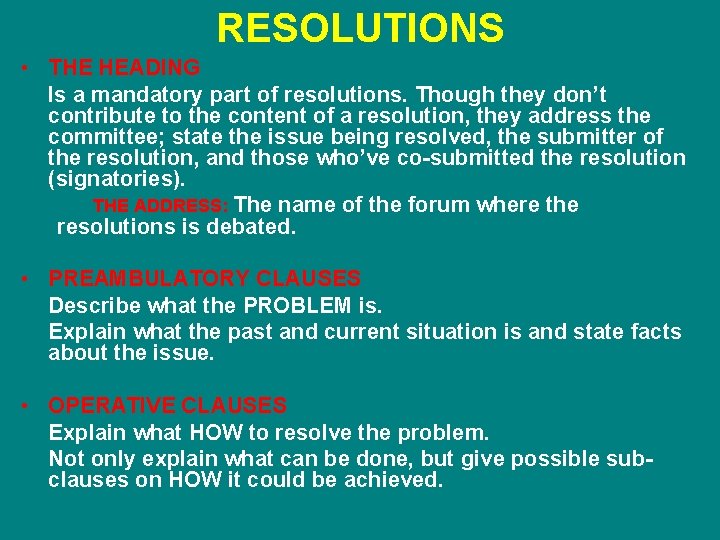
RESOLUTIONS • THE HEADING Is a mandatory part of resolutions. Though they don’t contribute to the content of a resolution, they address the committee; state the issue being resolved, the submitter of the resolution, and those who’ve co-submitted the resolution (signatories). THE ADDRESS: The name of the forum where the resolutions is debated. • PREAMBULATORY CLAUSES Describe what the PROBLEM is. Explain what the past and current situation is and state facts about the issue. • OPERATIVE CLAUSES Explain what HOW to resolve the problem. Not only explain what can be done, but give possible subclauses on HOW it could be achieved.
Resolution Do’s and Don’ts Heading: • Begin with “Forum” indicating the committee • Continue with “Submitted by” to indicate who is the main contributor/main speaker of the Resolution • Follow this by “Co-Submitted by” to illustrate those who’ve signed on (signatories) to the Resolution • Use the full official name of the delegations • Address the Committee (in Upper Case), following this, comes the Preambulatory clauses
Resolution Do’s and Don’ts Preambulatory Clauses • All Preambulatory clauses must end in commas(, ) • Leave a line between ever clause • No Clause-Opening words should be repeated in the resolution, if you need to reuse it, either use a similar word to it, or add “Further” before it like in “Further Noting” or add “with concern” or “with warning” like in “Noting with concern” • All Preambulatory clauses must be in italics and not be numbered • All acronyms must be fully written out before appearing in the abbreviated form, you only need to write them out once, and then refer to the abbreviated form for the rest of the resolution
Resolution Do’s and Don’ts Operative Clauses • All acronyms must be fully written out before appearing in the abbreviated form, you only need to write them out once, and then refer to the abbreviated form for the rest of the resolution • All Operative clauses must be underlined and be numbered • Sub Clauses must be lettered ( a), b), c), d)…) • Sub-sub Clauses must be in Roman Numerals ( i), iii), iv)…) • If a sub clause does not end the clause, their ending punctuation must be a comma (, ) • If sub-sub clauses does not end the clause, their ending punctuation must be a comma (, ) • All Operative clauses must end in semi-colons (; ) • Leave a line between every clause • No Clause-Opening words should be repeated in the resolution, if you need to reuse it, either use a similar word to it, or add “Further” before it like in “Further Requests”.
Resolution Do’s and Don’ts In the Preambulatory Clauses PLEASE DO: • State strong and recent facts about the issue • Use statistics where applicable • Mention the past situation and current situation • Recall any passed resolutions by the UN on the issue • Relate any other organisations involved in the situation • State relevant organisations’ efforts in the situation • If applicable, use developing countries/LEDCs or developed countries/ MEDCs. In the Preambulatory Clauses PLEASE DON’T: • Be too one sided/bias • Use “Third World countries”/ “poor countries” or “First World countries”/ “rich countries”. In the Operative Clauses PLEASE DO: • Aim to find solutions, which solve the smaller problems that contribute to the issue • Elaborate on the solutions in your operative clauses (sub clauses and sub-sub clauses) • Emphasize cooperation between governments and relevant UN organisations • Explain different methods of approaching the same problem through clauses. In the Operative Clauses PLEASE DON’T: • Break the sovereignty a government has over its land • Mention specific sources and specific (numbers) amount of funding • Be vague with your solutions, or simply state a way of solving something without explaining ways of doing so • Create unrealistic solutions to the issue, which are vague solutions/ not possible to be put into force
Resolution Do’s and Don’ts In All Clauses PLEASE DON’T PLAGIARISE: As Plagiarism isn’t at all tolerated at MUN conferences, even if one is trying to get ideas from resolutions. One can only use similar ideas, and rewrite them as ones own, not use that particular clause/ resolution! At MUN conferences, plagiarism is dealt with strongly and often results in one being removed from the conference.
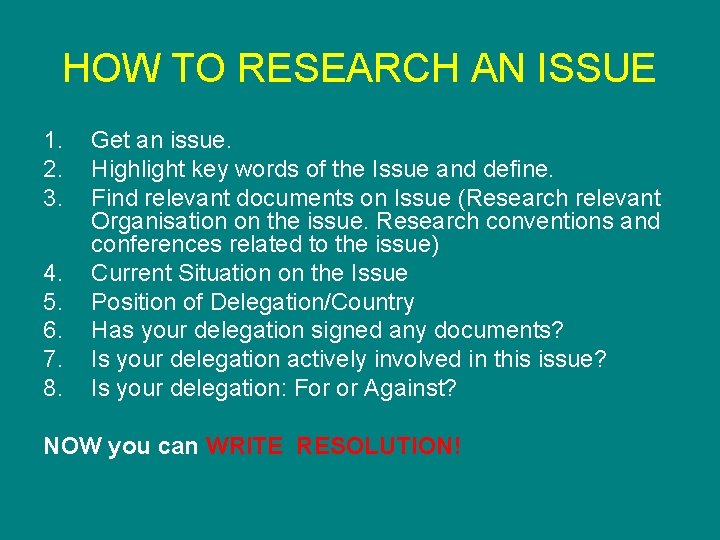
HOW TO RESEARCH AN ISSUE 1. 2. 3. 4. 5. 6. 7. 8. Get an issue. Highlight key words of the Issue and define. Find relevant documents on Issue (Research relevant Organisation on the issue. Research conventions and conferences related to the issue) Current Situation on the Issue Position of Delegation/Country Has your delegation signed any documents? Is your delegation actively involved in this issue? Is your delegation: For or Against? NOW you can WRITE RESOLUTION!
- Slides: 10