
What is a Religious Revival The First Great

- Slides: 18
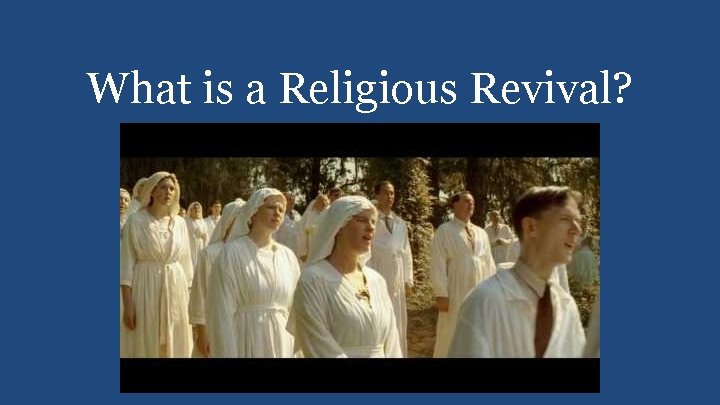
What is a Religious Revival?
The (First) Great Awakening A Journey through the Colonies Take your notes on the handout provided by the sub
Introduction It’s 1739 and you’re a colonist living in _______ (choose a colony). Like many other colonists, you attend church regularly, but lately you have noticed some changes. For one, there do not seem to be as many people at Sunday services. All the churches in your colony used to be packed on Sundays, but recently you have no trouble finding a seat, even if you’re late! You have even found yourself skipping some services‒they’re so long and your preacher is more boring than watching paint dry; half the time you fall asleep in the middle of his sermons! Perhaps it has something to do with these new “Enlightenment” ideas that seem to be catching on. People are thinking much more rationally and logically now, and science now seems to have an answer for almost any question of life. . .
Introduction In response to all these changes, you’ve heard about some itinerant (traveling) preachers who are traveling through the colonies calling for a revival of religion through more personal and emotional religious experiences. Ever since your town got a printing press, newspapers have been all the rage, and you managed to snag yourself a job writing for one. You’ve been hired to follow one of these itinerant preachers, George Whitefield, and write an article about his popular sermons. You’ve already come up with a great headline for your article‒the Great Awakening, since people no longer seem to fall asleep when he preaches. During your travels, you’ll get a chance to hear some sermons and interview some fellow colonists to get their thoughts on this “Awakening” that seems to be spreading throughout the colonies. Bon voyage!
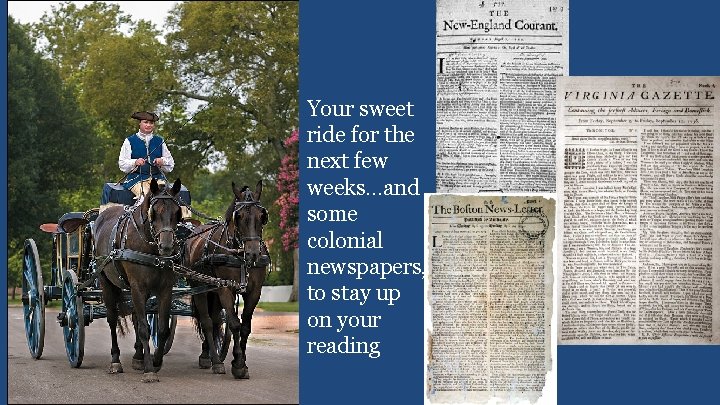
Your sweet ride for the next few weeks. . . and some colonial newspapers, to stay up on your reading
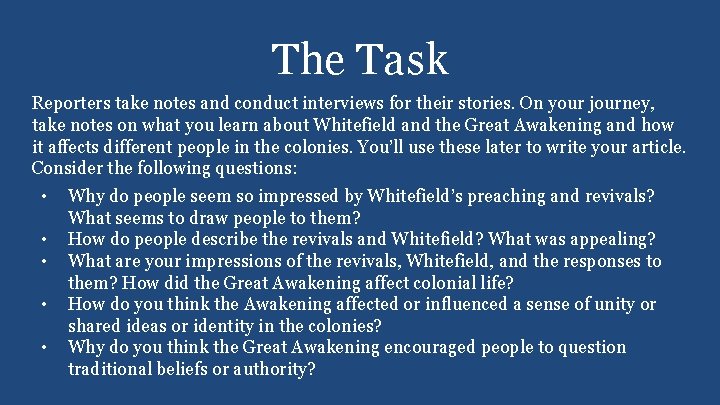
The Task Reporters take notes and conduct interviews for their stories. On your journey, take notes on what you learn about Whitefield and the Great Awakening and how it affects different people in the colonies. You’ll use these later to write your article. Consider the following questions: • • • Why do people seem so impressed by Whitefield’s preaching and revivals? What seems to draw people to them? How do people describe the revivals and Whitefield? What was appealing? What are your impressions of the revivals, Whitefield, and the responses to them? How did the Great Awakening affect colonial life? How do you think the Awakening affected or influenced a sense of unity or shared ideas or identity in the colonies? Why do you think the Great Awakening encouraged people to question traditional beliefs or authority?
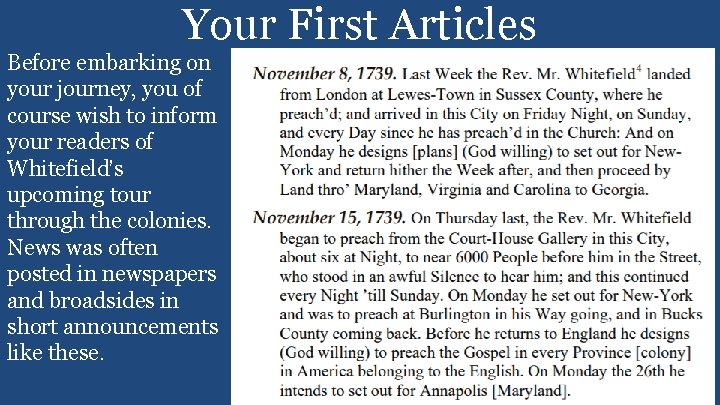
Your First Articles Before embarking on your journey, you of course wish to inform your readers of Whitefield’s upcoming tour through the colonies. News was often posted in newspapers and broadsides in short announcements like these.
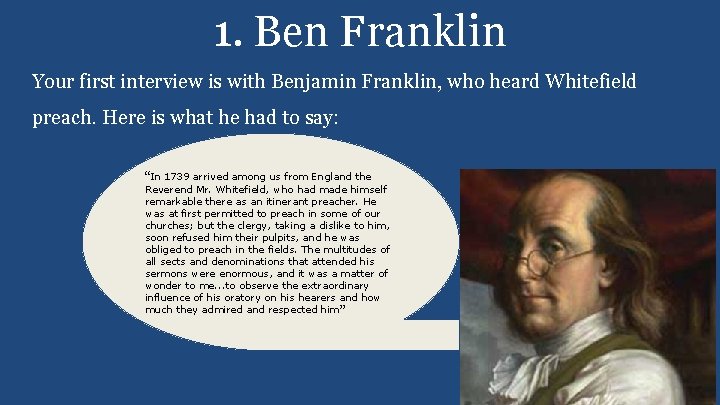
1. Ben Franklin Your first interview is with Benjamin Franklin, who heard Whitefield preach. Here is what he had to say: “In 1739 arrived among us from England the Reverend Mr. Whitefield, who had made himself remarkable there as an itinerant preacher. He was at first permitted to preach in some of our churches; but the clergy, taking a dislike to him, soon refused him their pulpits, and he was obliged to preach in the fields. The multitudes of all sects and denominations that attended his sermons were enormous, and it was a matter of wonder to me. . . to observe the extraordinary influence of his oratory on his hearers and how much they admired and respected him”
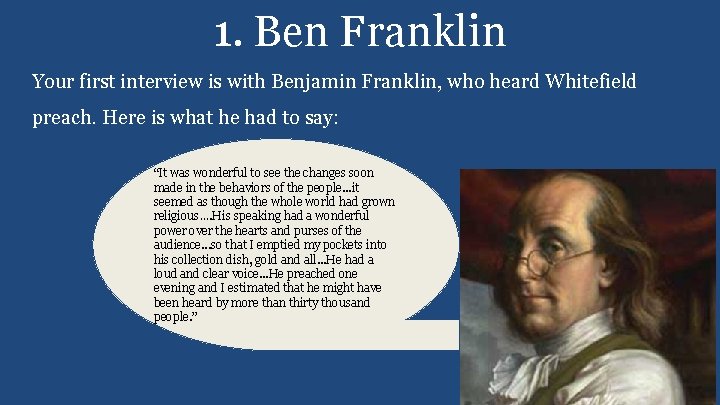
1. Ben Franklin Your first interview is with Benjamin Franklin, who heard Whitefield preach. Here is what he had to say: “It was wonderful to see the changes soon made in the behaviors of the people. . . it seemed as though the whole world had grown religious…. His speaking had a wonderful power over the hearts and purses of the audience. . . so that I emptied my pockets into his collection dish, gold and all. . . He had a loud and clear voice. . . He preached one evening and I estimated that he might have been heard by more than thirty thousand people. ”
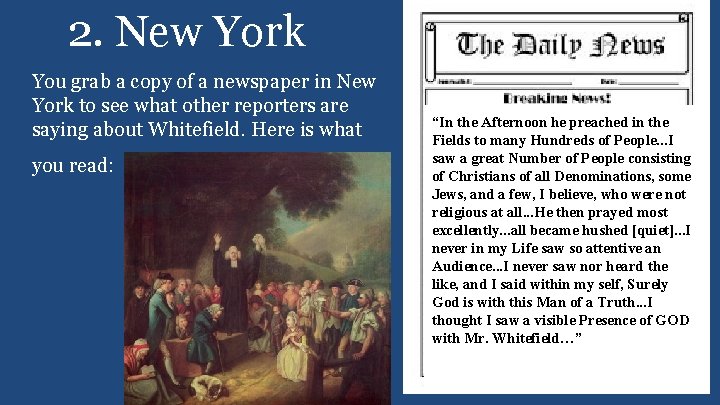
2. New York You grab a copy of a newspaper in New York to see what other reporters are saying about Whitefield. Here is what you read: “In the Afternoon he preached in the Fields to many Hundreds of People. . . I saw a great Number of People consisting of Christians of all Denominations, some Jews, and a few, I believe, who were not religious at all. . . He then prayed most excellently. . . all became hushed [quiet]. . . I never in my Life saw so attentive an Audience. . . I never saw nor heard the like, and I said within my self, Surely God is with this Man of a Truth. . . I thought I saw a visible Presence of GOD with Mr. Whitefield…”
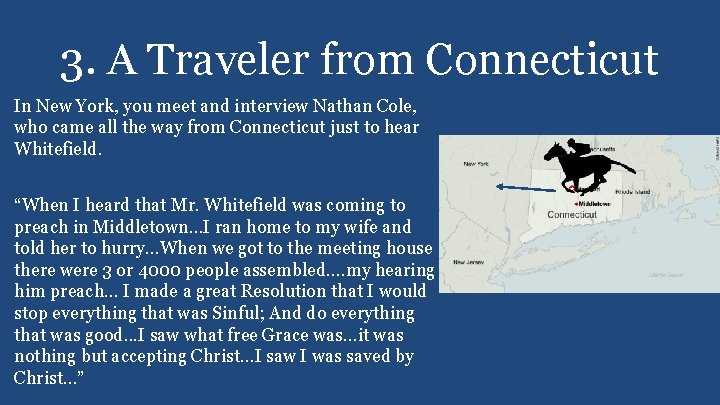
3. A Traveler from Connecticut In New York, you meet and interview Nathan Cole, who came all the way from Connecticut just to hear Whitefield. “When I heard that Mr. Whitefield was coming to preach in Middletown. . . I ran home to my wife and told her to hurry. . . When we got to the meeting house there were 3 or 4000 people assembled…. my hearing him preach. . . I made a great Resolution that I would stop everything that was Sinful; And do everything that was good. . . I saw what free Grace was. . . it was nothing but accepting Christ. . . I saw I was saved by Christ…”
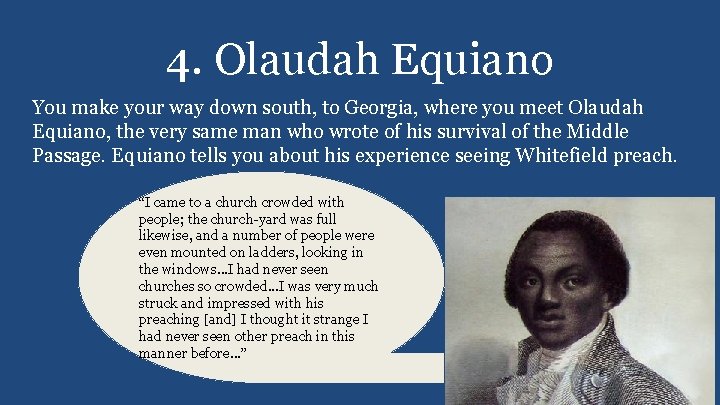
4. Olaudah Equiano You make your way down south, to Georgia, where you meet Olaudah Equiano, the very same man who wrote of his survival of the Middle Passage. Equiano tells you about his experience seeing Whitefield preach. “I came to a church crowded with people; the church-yard was full likewise, and a number of people were even mounted on ladders, looking in the windows. . . I had never seen churches so crowded. . . I was very much struck and impressed with his preaching [and] I thought it strange I had never seen other preach in this manner before. . . ”
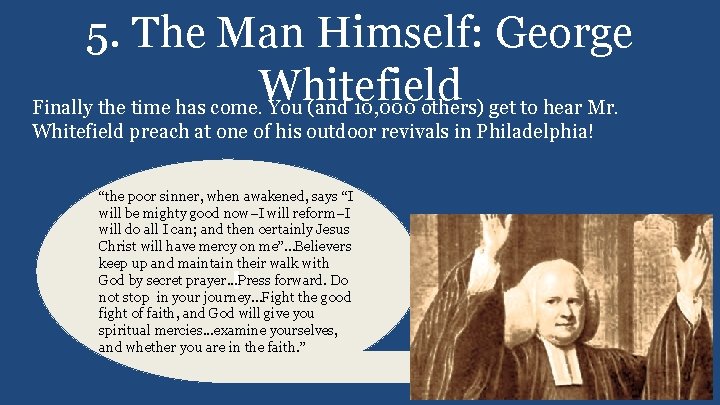
5. The Man Himself: George Whitefield Finally the time has come. You (and 10, 000 others) get to hear Mr. Whitefield preach at one of his outdoor revivals in Philadelphia! “the poor sinner, when awakened, says “I will be mighty good now–I will reform–I will do all I can; and then certainly Jesus Christ will have mercy on me”. . . Believers keep up and maintain their walk with God by secret prayer. . . Press forward. Do not stop in your journey. . . Fight the good fight of faith, and God will give you spiritual mercies. . . examine yourselves, and whether you are in the faith. ”
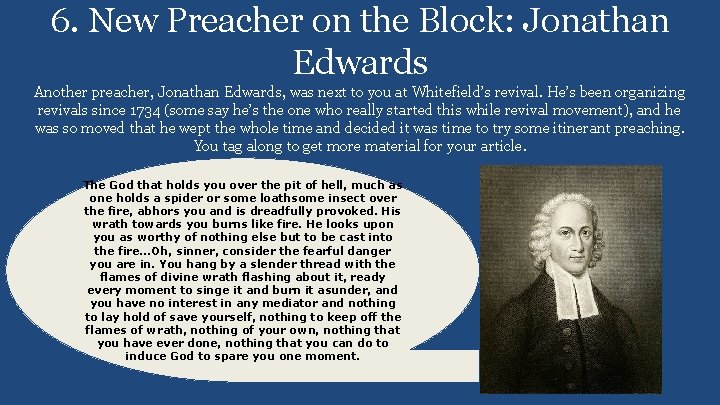
6. New Preacher on the Block: Jonathan Edwards Another preacher, Jonathan Edwards, was next to you at Whitefield’s revival. He’s been organizing revivals since 1734 (some say he’s the one who really started this while revival movement), and he was so moved that he wept the whole time and decided it was time to try some itinerant preaching. You tag along to get more material for your article. The God that holds you over the pit of hell, much as one holds a spider or some loathsome insect over the fire, abhors you and is dreadfully provoked. His wrath towards you burns like fire. He looks upon you as worthy of nothing else but to be cast into the fire. . . Oh, sinner, consider the fearful danger you are in. You hang by a slender thread with the flames of divine wrath flashing about it, ready every moment to singe it and burn it asunder, and you have no interest in any mediator and nothing to lay hold of save yourself, nothing to keep off the flames of wrath, nothing of your own, nothing that you have ever done, nothing that you can do to induce God to spare you one moment.
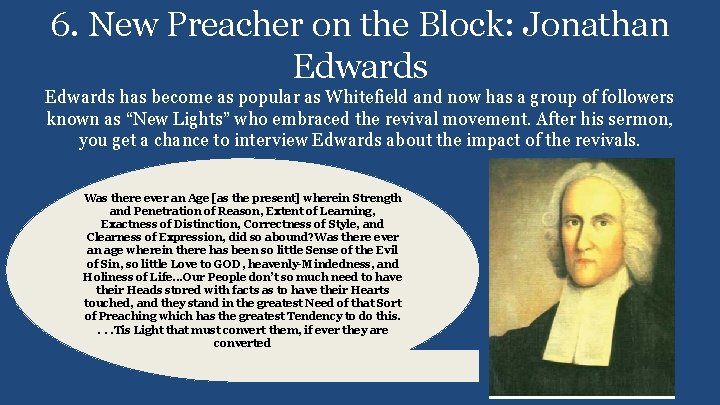
6. New Preacher on the Block: Jonathan Edwards has become as popular as Whitefield and now has a group of followers known as “New Lights” who embraced the revival movement. After his sermon, you get a chance to interview Edwards about the impact of the revivals. Was there ever an Age [as the present] wherein Strength and Penetration of Reason, Extent of Learning, Exactness of Distinction, Correctness of Style, and Clearness of Expression, did so abound? Was there ever an age wherein there has been so little Sense of the Evil of Sin, so little Love to GOD, heavenly-Mindedness, and Holiness of Life. . . Our People don’t so much need to have their Heads stored with facts as to have their Hearts touched, and they stand in the greatest Need of that Sort of Preaching which has the greatest Tendency to do this. . Tis Light that must convert them, if ever they are converted
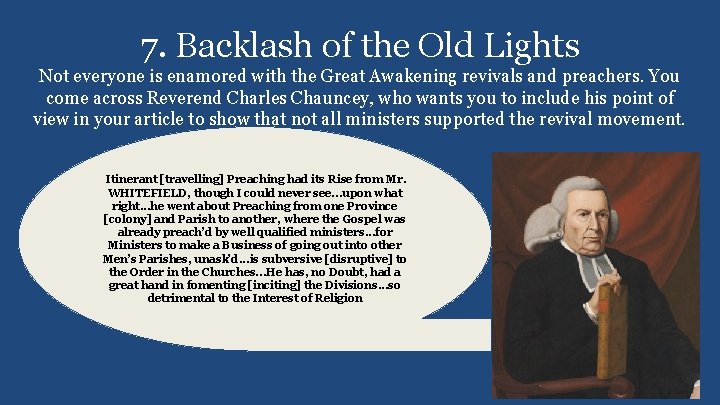
7. Backlash of the Old Lights Not everyone is enamored with the Great Awakening revivals and preachers. You come across Reverend Charles Chauncey, who wants you to include his point of view in your article to show that not all ministers supported the revival movement. Itinerant [travelling] Preaching had its Rise from Mr. WHITEFIELD, though I could never see. . . upon what right. . . he went about Preaching from one Province [colony] and Parish to another, where the Gospel was already preach’d by well qualified ministers. . . for Ministers to make a Business of going out into other Men’s Parishes, unask’d. . . is subversive [disruptive] to the Order in the Churches. . . He has, no Doubt, had a great hand in fomenting [inciting] the Divisions. . . so detrimental to the Interest of Religion
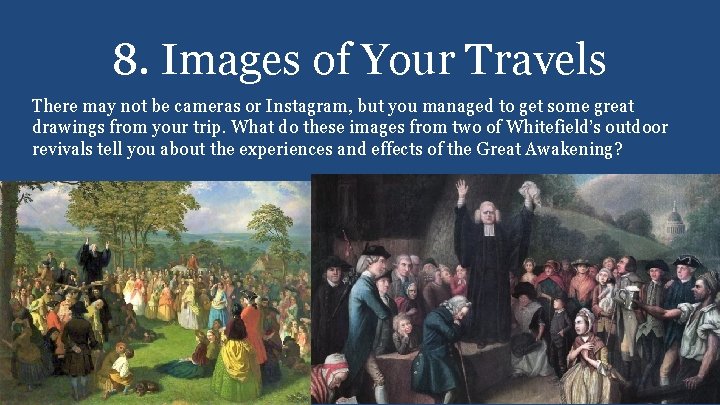
8. Images of Your Travels There may not be cameras or Instagram, but you managed to get some great drawings from your trip. What do these images from two of Whitefield’s outdoor revivals tell you about the experiences and effects of the Great Awakening?
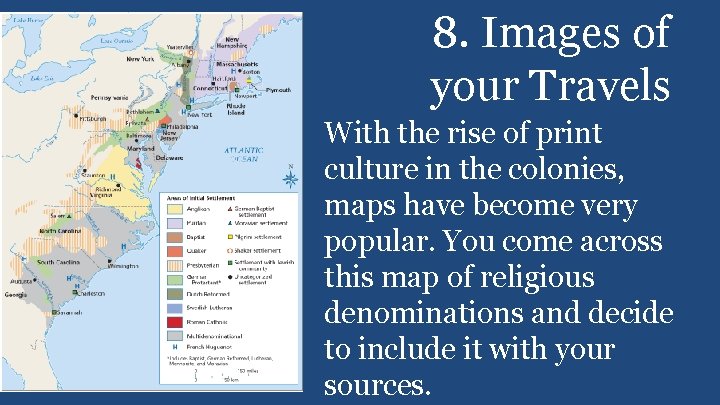
8. Images of your Travels With the rise of print culture in the colonies, maps have become very popular. You come across this map of religious denominations and decide to include it with your sources.