
What is a Protist The protists form a
- Slides: 11
What is a Protist? The protists form a group of organisms that really do not fit into any other kingdom. Although there is a lot of variety within the protists, they do share some common characteristics.
• All protist are eukaryotic. That is, all protist have cells with nuclei. • All protist live in moist environments. • Protist can be unicellular or multicellular. • Protist can be microscopic or can be over 100 meters (300 feet) long. • Some protist are heterotrophs, while others are autotrophs.
Since protist vary so much, we will group them into three subcategories: • animal-like protist • fungus-like protists • plant-like protists
Animal-like Protist that are classified as animal-like are called protozoans and share some common traits with animals: • All animal-like protist are heterotrophs. • Likewise, all animal-like protist are able to move in their environment in order to find their food. • Unlike, animals, however, animal-like protist are all unicellular.
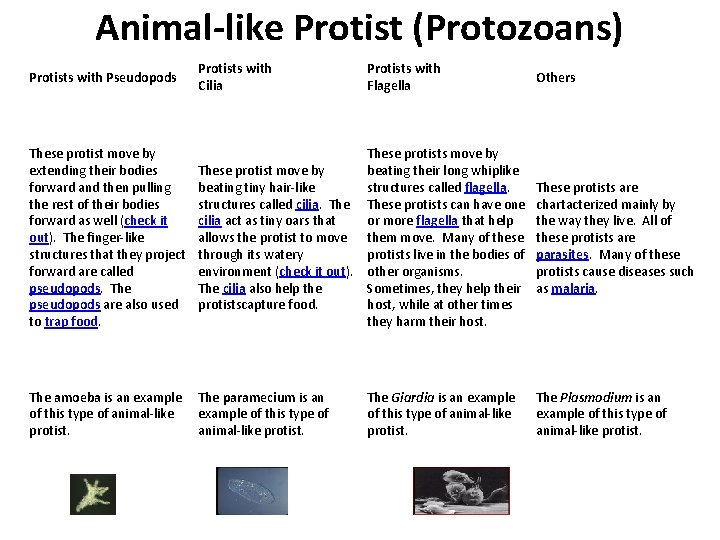
Animal-like protist are divided into four basic groups based on how they move and live.
Animal-like Protist (Protozoans) Protists with Pseudopods Protists with Cilia Protists with Flagella These protist move by extending their bodies forward and then pulling the rest of their bodies forward as well (check it out). The finger-like structures that they project forward are called pseudopods. The pseudopods are also used to trap food. These protists move by These protist move by beating their long whiplike structures called flagella. beating tiny hair-like structures called cilia. These protists can have one cilia act as tiny oars that or more flagella that help allows the protist to move them move. Many of these through its watery protists live in the bodies of environment (check it out). other organisms. The cilia also help the Sometimes, they help their protistscapture food. host, while at other times they harm their host. These protists are chartacterized mainly by the way they live. All of these protists are parasites. Many of these protists cause diseases such as malaria. The amoeba is an example of this type of animal-like protist. The paramecium is an example of this type of animal-like protist. The Plasmodium is an example of this type of animal-like protist. The Giardia is an example of this type of animal-like protist. Others
Plant-like Protist (Algae) • Plant-like protist are autotrophic. • They can live in soil, on the bark of trees, in fresh water, and in salt water. • These protist are very important to the Earth because they produce a lot of oxygen, and most living things need oxygen to survive. • These plant-like protist form the base of aquatic food chains. • These plant-like protist can be unicellular, multicellular, or live in colonies.
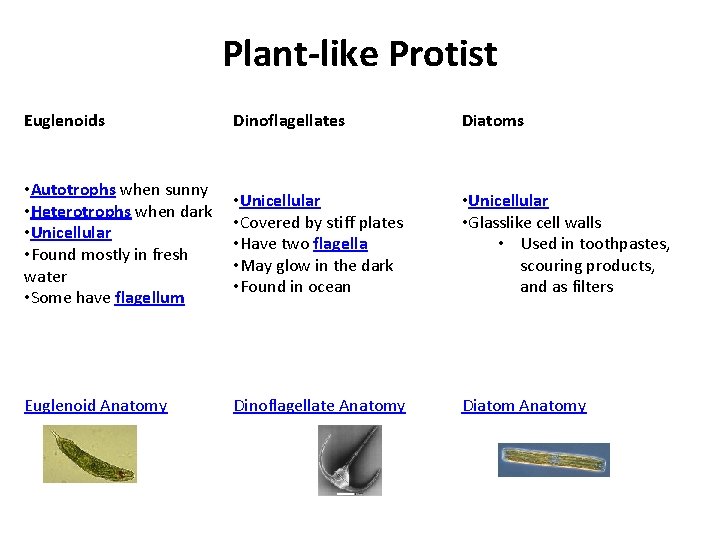
Plant-like Protist Euglenoids Dinoflagellates Diatoms • Autotrophs when sunny • Heterotrophs when dark • Unicellular • Found mostly in fresh water • Some have flagellum • Unicellular • Covered by stiff plates • Have two flagella • May glow in the dark • Found in ocean • Unicellular • Glasslike cell walls • Used in toothpastes, scouring products, and as filters Euglenoid Anatomy Dinoflagellate Anatomy Diatom Anatomy
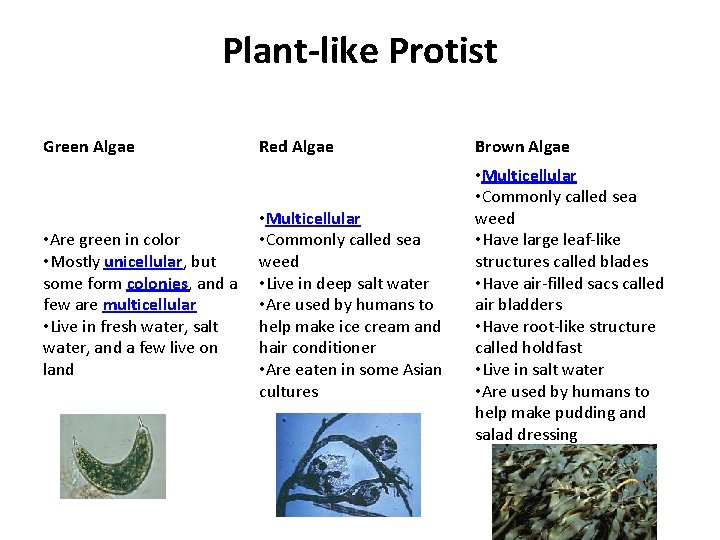
Plant-like Protist Green Algae • Are green in color • Mostly unicellular, but some form colonies, and a few are multicellular • Live in fresh water, salt water, and a few live on land Red Algae Brown Algae • Multicellular • Commonly called sea weed • Live in deep salt water • Are used by humans to help make ice cream and hair conditioner • Are eaten in some Asian cultures • Multicellular • Commonly called sea weed • Have large leaf-like structures called blades • Have air-filled sacs called air bladders • Have root-like structure called holdfast • Live in salt water • Are used by humans to help make pudding and salad dressing
Fungus-like Protist • Fungus-like protist are heterotrophs with cell walls. • They reproduce by forming spores. • All fungus-like protist are able to move at some point in their lives. • There are essentially three types of fungus-like protist: water molds, downy mildews, and slime molds.
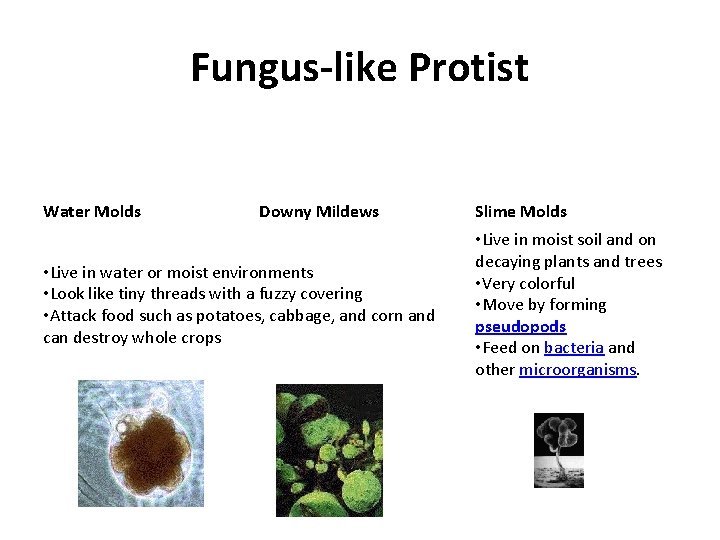
Fungus-like Protist Water Molds Downy Mildews • Live in water or moist environments • Look like tiny threads with a fuzzy covering • Attack food such as potatoes, cabbage, and corn and can destroy whole crops Slime Molds • Live in moist soil and on decaying plants and trees • Very colorful • Move by forming pseudopods • Feed on bacteria and other microorganisms.