
What Is a Product A Product Defined A
- Slides: 27
What Is a Product? • A Product Defined – A good, a service, or an idea received in an exchange – It can be tangible (a good) or intangible (a service or an idea) or a combination of both. – It can include functional, social, and psychological utilities or benefits. • Why Buyers Purchase a Product – To get the benefits and satisfaction that they think the product will provide – Symbols and cues provided by marketing help consumers make judgments about products. Copyright © Houghton Mifflin Company. All rights reserved. 1
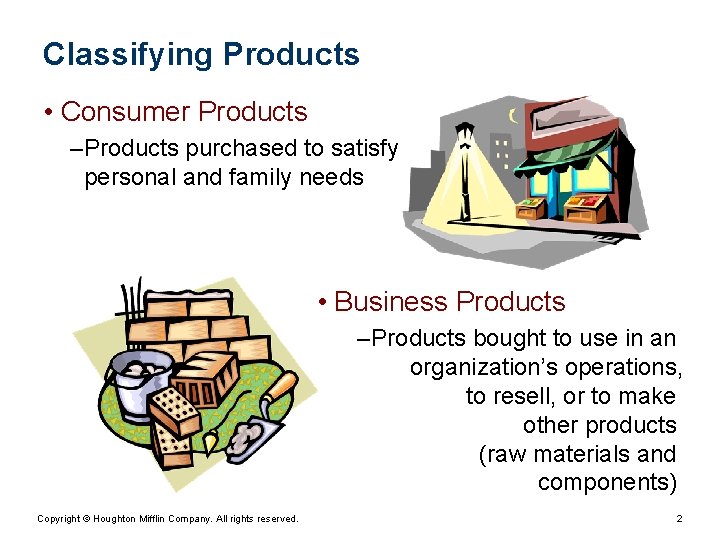
Classifying Products • Consumer Products – Products purchased to satisfy personal and family needs • Business Products – Products bought to use in an organization’s operations, to resell, or to make other products (raw materials and components) Copyright © Houghton Mifflin Company. All rights reserved. 2
Consumer Products • Convenience Products – Relatively inexpensive, frequently purchased items for which buyers exert minimal purchasing effort • Bic lighter • Bic perfume? – Characteristics • • Marketed through many retail outlets Relatively low per-unit gross margins Little promotional effort at the retail level Packaging is important marketing mix element Copyright © Houghton Mifflin Company. All rights reserved. 3
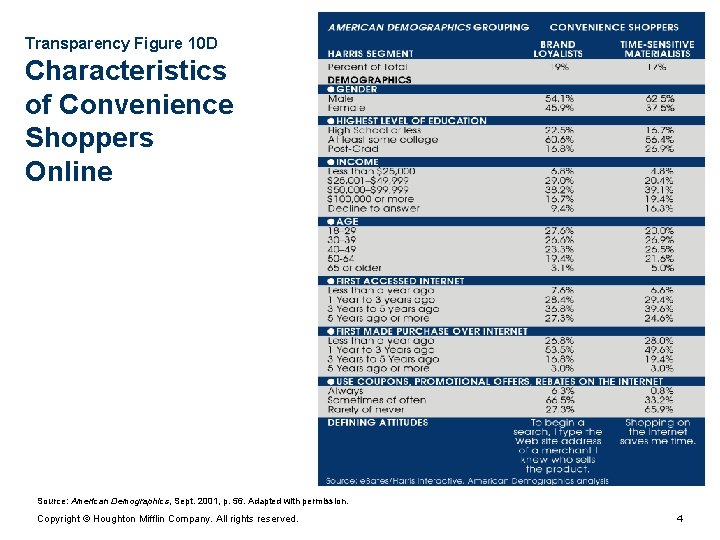
Transparency Figure 10 D Characteristics of Convenience Shoppers Online Source: American Demographics, Sept. 2001, p. 56. Adapted with permission. Copyright © Houghton Mifflin Company. All rights reserved. 4
Consumer Products (cont’d) • Shopping Products – Items for which buyers are willing to expend considerable effort in planning and making purchases • Furniture, computer – Characteristics • • Expected to last a long time; less frequently purchased Do not have brand loyalty appeal Require fewer retail outlets Inventory turnover is lower Gross margins are higher More amenable to personal selling Supported (servicing and promoting the product) by both the producer and channel members Copyright © Houghton Mifflin Company. All rights reserved. 5
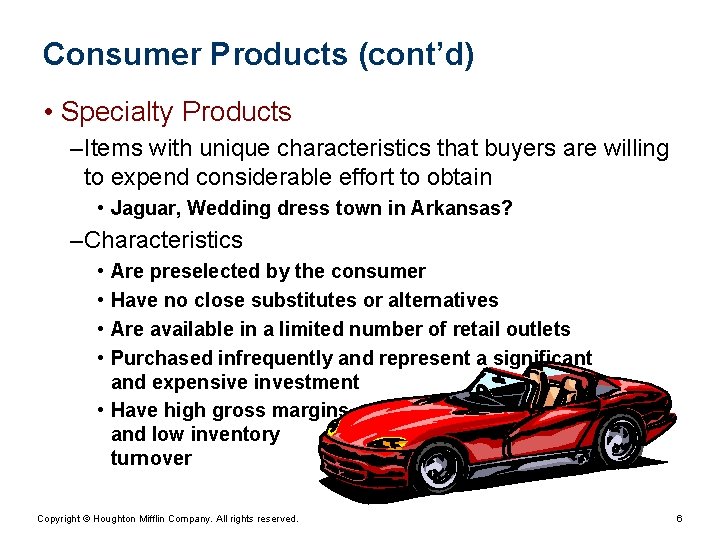
Consumer Products (cont’d) • Specialty Products – Items with unique characteristics that buyers are willing to expend considerable effort to obtain • Jaguar, Wedding dress town in Arkansas? – Characteristics • • Are preselected by the consumer Have no close substitutes or alternatives Are available in a limited number of retail outlets Purchased infrequently and represent a significant and expensive investment • Have high gross margins and low inventory turnover Copyright © Houghton Mifflin Company. All rights reserved. 6
Consumer Products (cont’d) • Unsought Products – Products purchased to solve a sudden problem, products of which the customers are unaware, and products that people do not necessarily think about buying • Propane generators for power outages, funeral services • Remember Y 2 K? – Characteristics • Speed and problem resolution of the utmost importance • Price and other features not considered • No consideration of substitutes or alternatives • Purchased infrequently Copyright © Houghton Mifflin Company. All rights reserved. 7
Business Products • Installations – Facilities and nonportable major equipment • Office buildings, factories and warehouses, production lines, very large machines • Software, database systems • Accessory Equipment – Equipment used in production or office activities • File cabinets, small motors, calculators, and tools Copyright © Houghton Mifflin Company. All rights reserved. 8
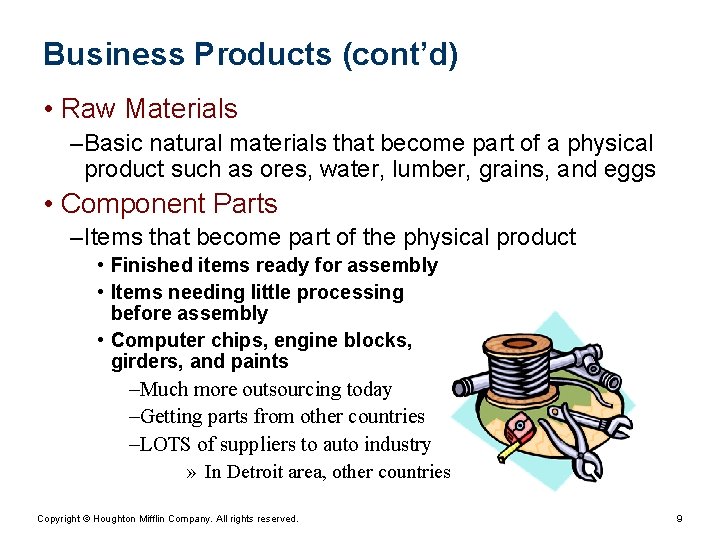
Business Products (cont’d) • Raw Materials – Basic natural materials that become part of a physical product such as ores, water, lumber, grains, and eggs • Component Parts – Items that become part of the physical product • Finished items ready for assembly • Items needing little processing before assembly • Computer chips, engine blocks, girders, and paints –Much more outsourcing today –Getting parts from other countries –LOTS of suppliers to auto industry » In Detroit area, other countries Copyright © Houghton Mifflin Company. All rights reserved. 9
Business Products (cont’d) • Process Materials – Materials that are not readily identifiable when used directly in the production of other products such as screws, knobs, and handles • BSF, 3 M corporate campaigns • MRO Supplies – Maintenance, repair, and operating items that facilitate production and do not become part of the finished product such as cleaners, rubber bands, and staples Copyright © Houghton Mifflin Company. All rights reserved. 10
Business Products (cont’d) • Business Services – The intangible products that many organizations use in their operations such as cleaning, legal, consulting, and repair service. • Insurance providers • Ad agencies • Janitorial services Copyright © Houghton Mifflin Company. All rights reserved. 11
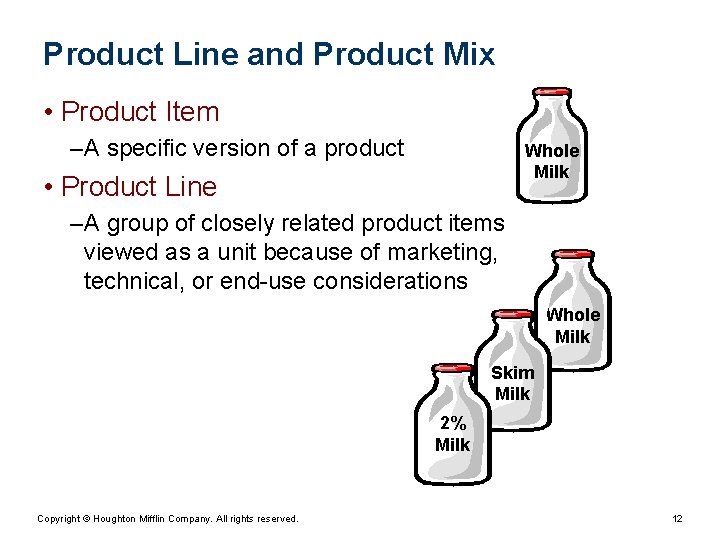
Product Line and Product Mix • Product Item – A specific version of a product Whole Milk • Product Line – A group of closely related product items viewed as a unit because of marketing, technical, or end-use considerations Whole Milk Skim Milk 2% Milk Copyright © Houghton Mifflin Company. All rights reserved. 12
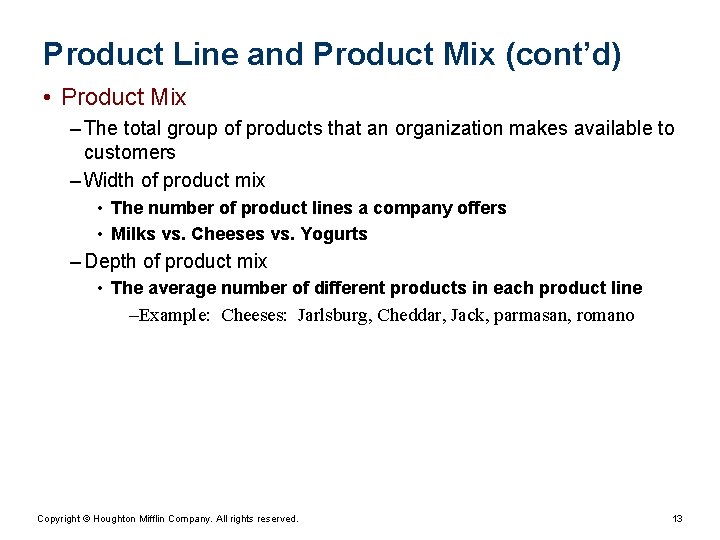
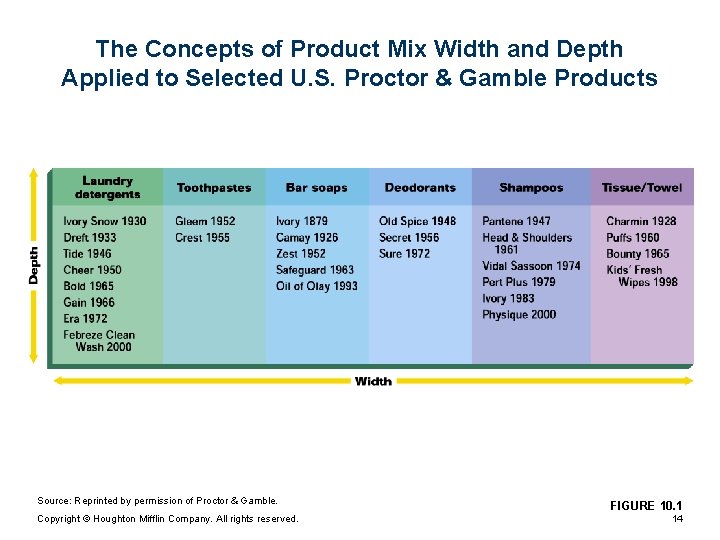
Product Line and Product Mix (cont’d) • Product Mix – The total group of products that an organization makes available to customers – Width of product mix • The number of product lines a company offers • Milks vs. Cheeses vs. Yogurts – Depth of product mix • The average number of different products in each product line –Example: Cheeses: Jarlsburg, Cheddar, Jack, parmasan, romano Copyright © Houghton Mifflin Company. All rights reserved. 13
The Concepts of Product Mix Width and Depth Applied to Selected U. S. Proctor & Gamble Products Source: Reprinted by permission of Proctor & Gamble. Copyright © Houghton Mifflin Company. All rights reserved. FIGURE 10. 1 14
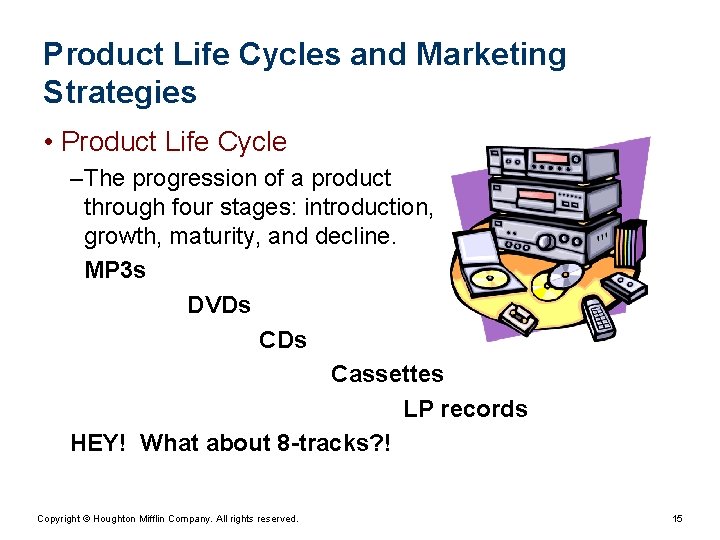
Product Life Cycles and Marketing Strategies • Product Life Cycle – The progression of a product through four stages: introduction, growth, maturity, and decline. MP 3 s DVDs Cassettes LP records HEY! What about 8 -tracks? ! Copyright © Houghton Mifflin Company. All rights reserved. 15
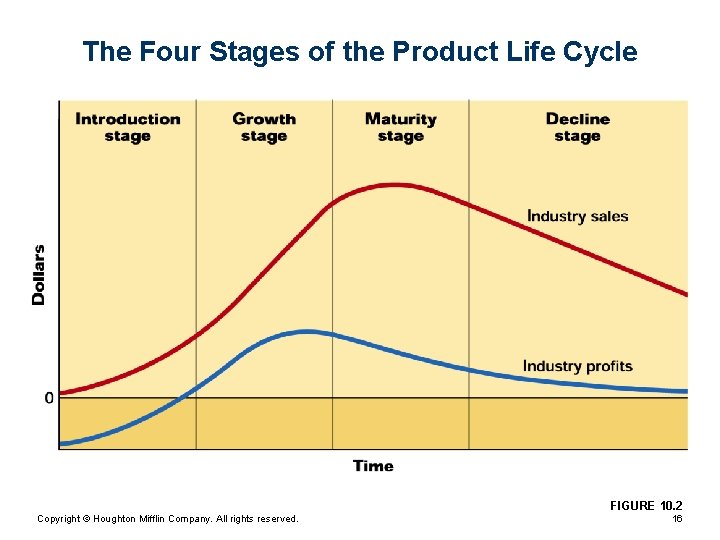
The Four Stages of the Product Life Cycle FIGURE 10. 2 Copyright © Houghton Mifflin Company. All rights reserved. 16
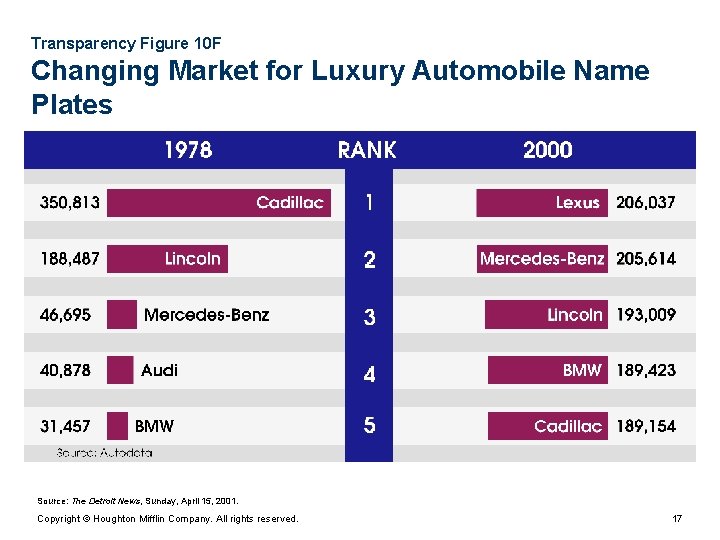
Transparency Figure 10 F Changing Market for Luxury Automobile Name Plates Source: The Detroit News, Sunday, April 15, 2001. Copyright © Houghton Mifflin Company. All rights reserved. 17
The Product Life Cycle • Introduction – The initial stage of a product’s life cycle—its first appearance in the marketplace—when sales start at zero and profits are negative – Why new products fail • Lack of resources, knowledge, and marketing skills to successfully launch the product • High pricing to recoup research and development costs Copyright © Houghton Mifflin Company. All rights reserved. 18
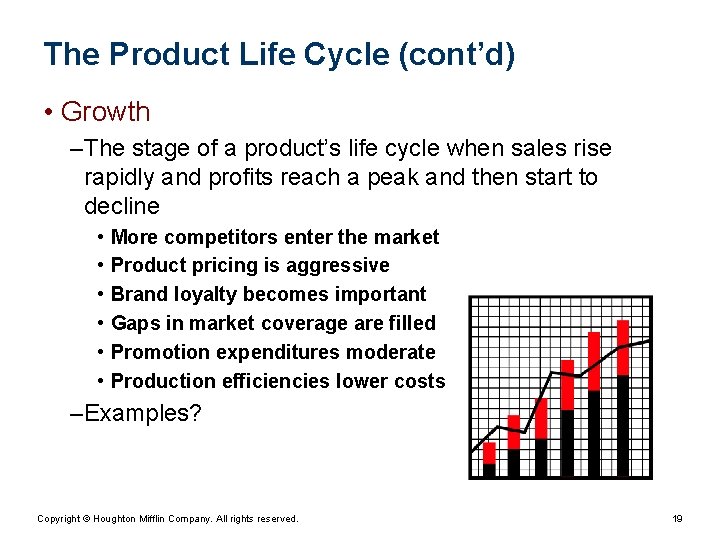
The Product Life Cycle (cont’d) • Growth – The stage of a product’s life cycle when sales rise rapidly and profits reach a peak and then start to decline • • • More competitors enter the market Product pricing is aggressive Brand loyalty becomes important Gaps in market coverage are filled Promotion expenditures moderate Production efficiencies lower costs – Examples? Copyright © Houghton Mifflin Company. All rights reserved. 19
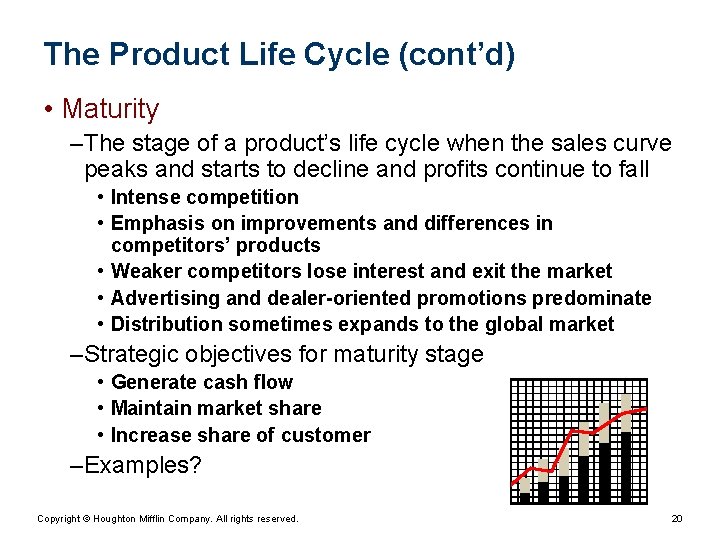
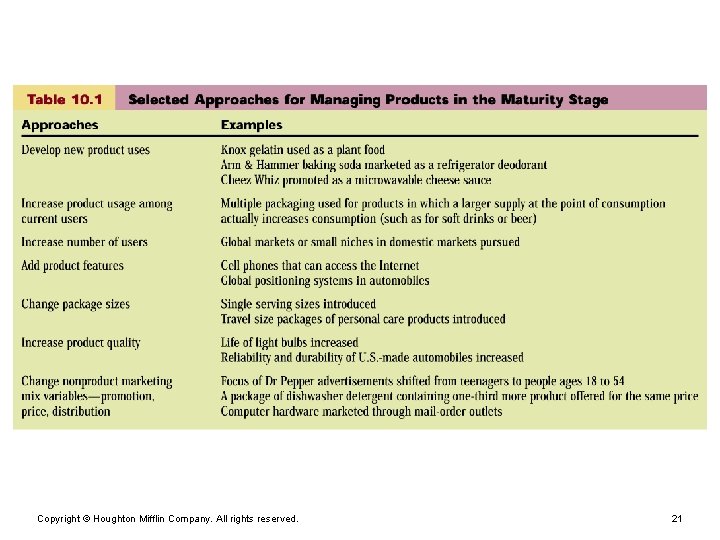
The Product Life Cycle (cont’d) • Maturity – The stage of a product’s life cycle when the sales curve peaks and starts to decline and profits continue to fall • Intense competition • Emphasis on improvements and differences in competitors’ products • Weaker competitors lose interest and exit the market • Advertising and dealer-oriented promotions predominate • Distribution sometimes expands to the global market – Strategic objectives for maturity stage • Generate cash flow • Maintain market share • Increase share of customer – Examples? Copyright © Houghton Mifflin Company. All rights reserved. 20
Copyright © Houghton Mifflin Company. All rights reserved. 21
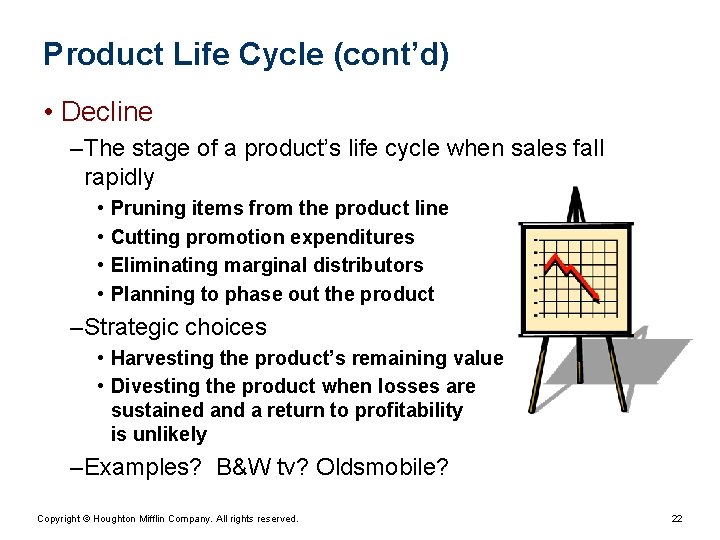
Product Life Cycle (cont’d) • Decline – The stage of a product’s life cycle when sales fall rapidly • • Pruning items from the product line Cutting promotion expenditures Eliminating marginal distributors Planning to phase out the product – Strategic choices • Harvesting the product’s remaining value • Divesting the product when losses are sustained and a return to profitability is unlikely – Examples? B&W tv? Oldsmobile? Copyright © Houghton Mifflin Company. All rights reserved. 22
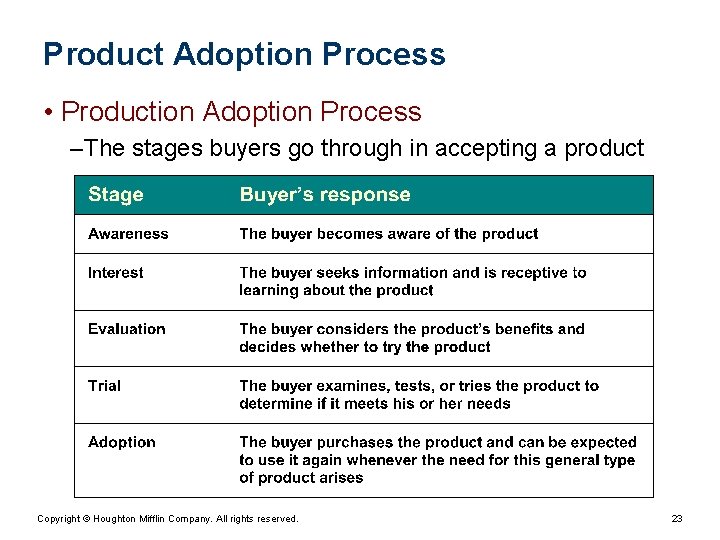
Product Adoption Process • Production Adoption Process – The stages buyers go through in accepting a product Copyright © Houghton Mifflin Company. All rights reserved. 23
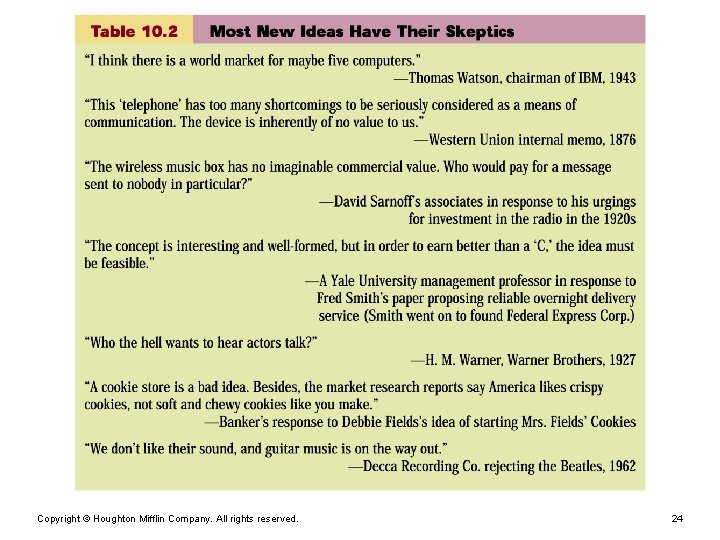
Copyright © Houghton Mifflin Company. All rights reserved. 24
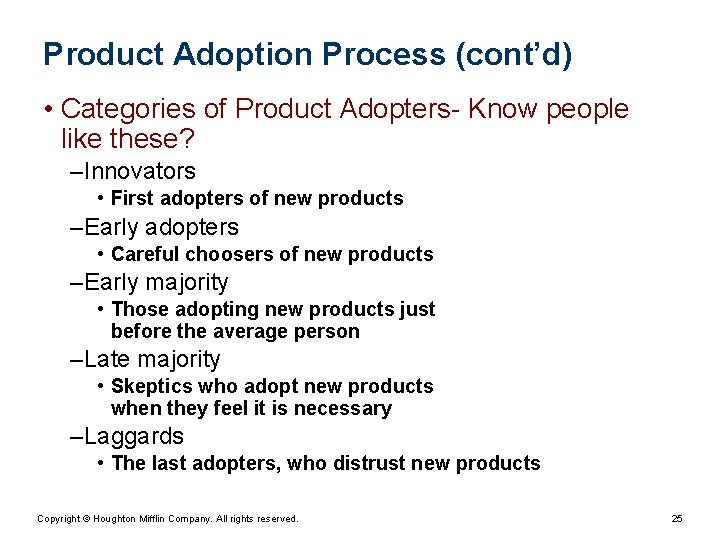
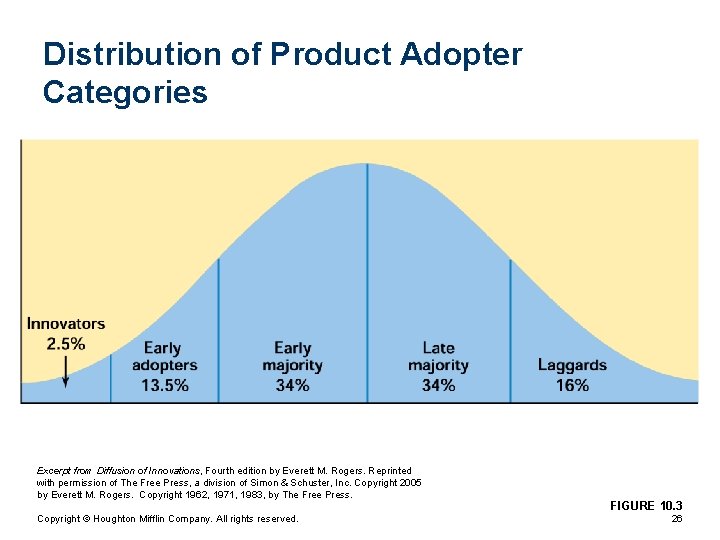
Product Adoption Process (cont’d) • Categories of Product Adopters- Know people like these? – Innovators • First adopters of new products – Early adopters • Careful choosers of new products – Early majority • Those adopting new products just before the average person – Late majority • Skeptics who adopt new products when they feel it is necessary – Laggards • The last adopters, who distrust new products Copyright © Houghton Mifflin Company. All rights reserved. 25
Distribution of Product Adopter Categories Source: Reprinted with permission of The Free Press, a Division of Excerpt from Diffusion of Innovations, Fourth edition by Everett M. Rogers. Reprinted Simon & Schuster, Inc. , from Diffusion of Innovations, Fourth Edition with permission of The Free Press, a division of Simon & Schuster, Inc. Copyright 2005 Everett M. Rogers. Copyright © 1995, Everett Rogers. byby Everett M. Rogers. Copyright 1962, 1971, 1983, by by The Free M. Press. Copyright © 1962, 1971, 1983 by The Free Press Copyright © Houghton Mifflin Company. All rights reserved. FIGURE 10. 3 26
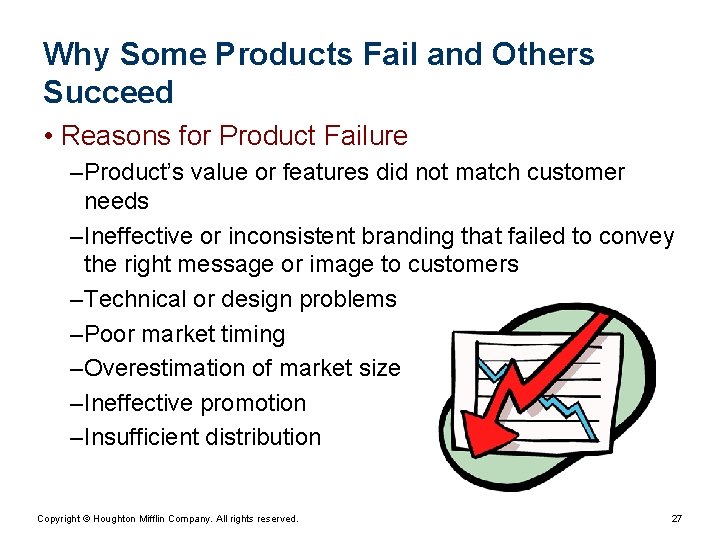
Why Some Products Fail and Others Succeed • Reasons for Product Failure – Product’s value or features did not match customer needs – Ineffective or inconsistent branding that failed to convey the right message or image to customers – Technical or design problems – Poor market timing – Overestimation of market size – Ineffective promotion – Insufficient distribution Copyright © Houghton Mifflin Company. All rights reserved. 27