
What is a PIP Longitudinal application of improvement
- Slides: 8
What is a PIP? ■ Longitudinal application of improvement tools & methods taught during this course ■ Experiential learning, something personal you want to improve
Selecting Your PIP Focus • Personal § I will run 10 miles per week by February 28 th § I will be home by 6 pm three times per week by March 1 st • Clinic-based § I will decrease my progress note writing time to less than 15 minutes per note by June 6 th
PIP Guidelines • You will need a project that: • • • Provides multiple data points per week Is something over which you have control to implement change Is a topic you are comfortable presenting in front of the group
PIP Timeline 1. Module/Week 1: § Problem Statement § Aim Statement 2. Module/Week 2: § Process Map & Fishbone § Collect Baseline Data 3. Module/Week 3: PDSA Cycle #1 4. Module/Week 4: PDSA Cycle #2 5. Module/Week 5: PDSA Cycle #3 6. Module/Week 6: PRESENATIONS!
TO DO FOR MODULE ONE 1. 2. 3. 4. Choose a project Create a Problem Statement Create an Aim Statement using SMART goals Fill out slides 1 & 2 in the PIP final presentation powerpoint template
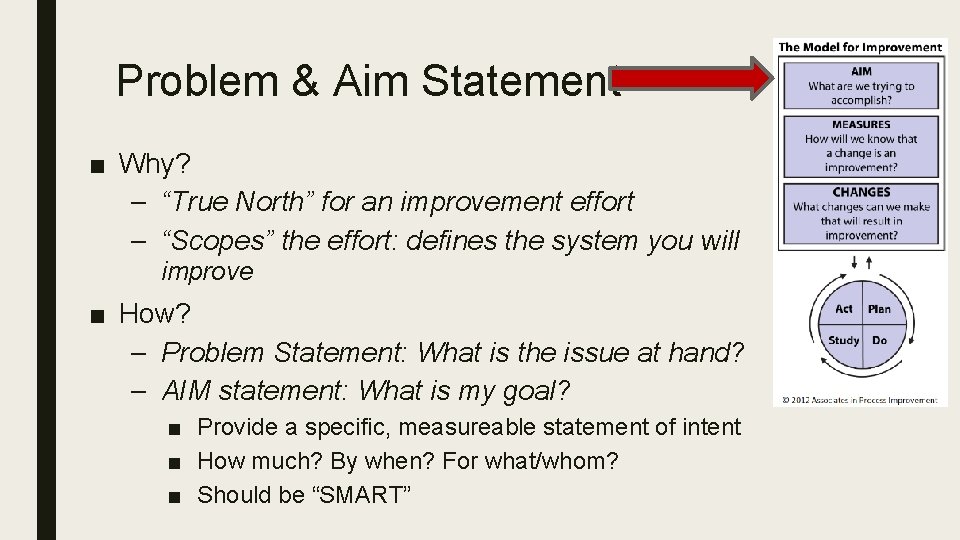
Problem & Aim Statement ■ Why? – “True North” for an improvement effort – “Scopes” the effort: defines the system you will improve ■ How? – Problem Statement: What is the issue at hand? – AIM statement: What is my goal? ■ Provide a specific, measureable statement of intent ■ How much? By when? For what/whom? ■ Should be “SMART”
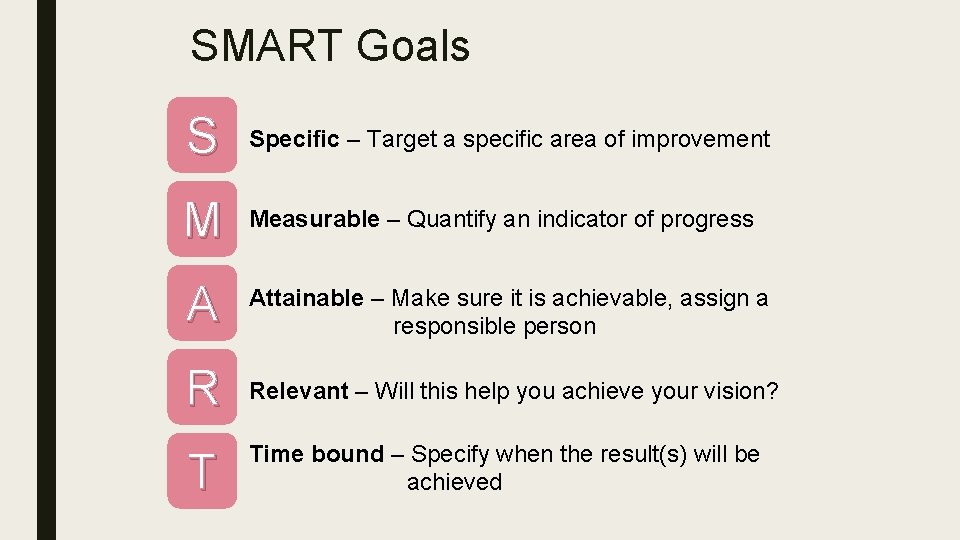
SMART Goals S Specific – Target a specific area of improvement M Measurable – Quantify an indicator of progress A Attainable – Make sure it is achievable, assign a responsible person R Relevant – Will this help you achieve your vision? T Time bound – Specify when the result(s) will be achieved
Problem & Aim Statement examples ■ Problem Statement: Patients admitted to the hospital are at risk of not being able to communicate their health care wishes. Identification of a surrogate decision maker can expedite appropriate care decisions in emergent situations. ■ Aim Statement: Have a surrogate decision maker documented in a reliable, reproducible way for 40% of all hospitalized patients by April 30 th, 2017 ■ Problem Statement: Diabetes can lead to diabetic kidney disease which is marked by proteinuria. Our clinic patients have low rates of testing for protein/creatinine ratio. ■ Aim Statement: To increase the number of patients with diabetes in our