
What is a Photogram A Photogram is a
- Slides: 15
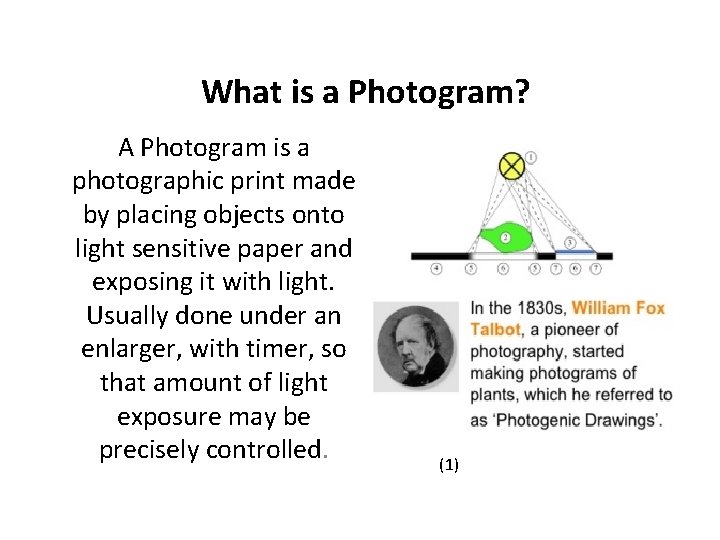
What is a Photogram? A Photogram is a photographic print made by placing objects onto light sensitive paper and exposing it with light. Usually done under an enlarger, with timer, so that amount of light exposure may be precisely controlled. (1)
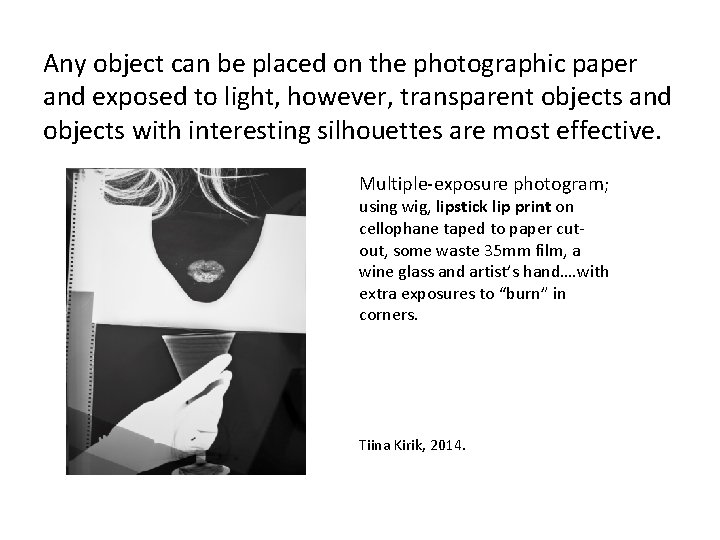
Any object can be placed on the photographic paper and exposed to light, however, transparent objects and objects with interesting silhouettes are most effective. Multiple-exposure photogram; using wig, lipstick lip print on cellophane taped to paper cutout, some waste 35 mm film, a wine glass and artist’s hand…. with extra exposures to “burn” in corners. Tiina Kirik, 2014.
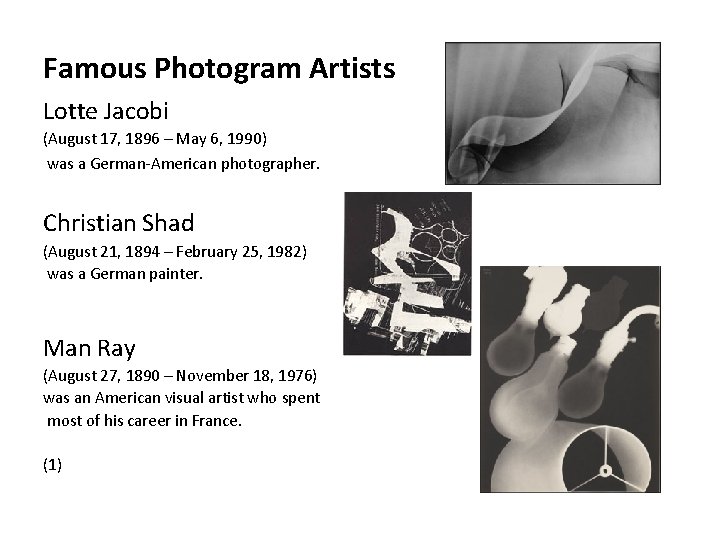
Famous Photogram Artists Lotte Jacobi (August 17, 1896 – May 6, 1990) was a German-American photographer. Christian Shad (August 21, 1894 – February 25, 1982) was a German painter. Man Ray (August 27, 1890 – November 18, 1976) was an American visual artist who spent most of his career in France. (1)
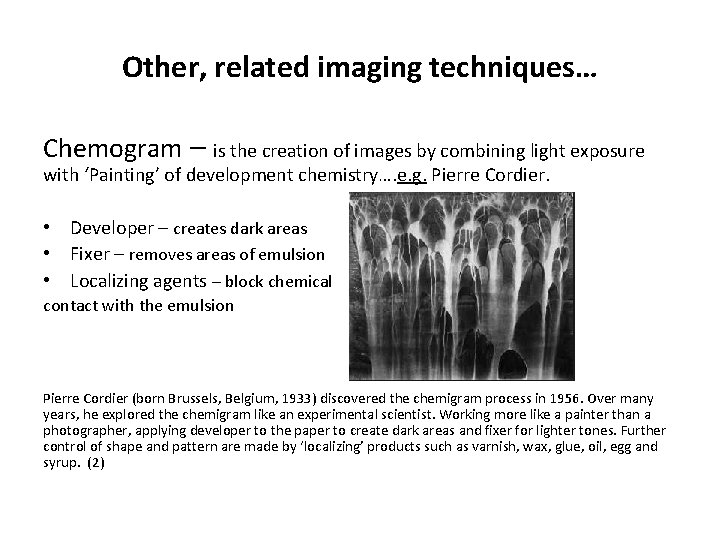
Other, related imaging techniques… Chemogram – is the creation of images by combining light exposure with ‘Painting’ of development chemistry…. e. g. Pierre Cordier. • Developer – creates dark areas • Fixer – removes areas of emulsion • Localizing agents – block chemical contact with the emulsion Pierre Cordier (born Brussels, Belgium, 1933) discovered the chemigram process in 1956. Over many years, he explored the chemigram like an experimental scientist. Working more like a painter than a photographer, applying developer to the paper to create dark areas and fixer for lighter tones. Further control of shape and pattern are made by ‘localizing’ products such as varnish, wax, glue, oil, egg and syrup. (2)
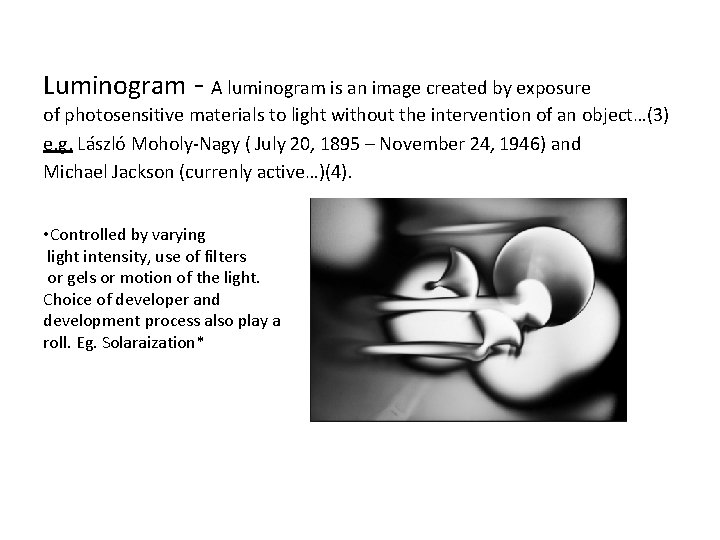
Luminogram - A luminogram is an image created by exposure of photosensitive materials to light without the intervention of an object…(3) e. g. László Moholy-Nagy ( July 20, 1895 – November 24, 1946) and Michael Jackson (currenly active…)(4). • Controlled by varying light intensity, use of filters or gels or motion of the light. Choice of developer and development process also play a roll. Eg. Solaraization*
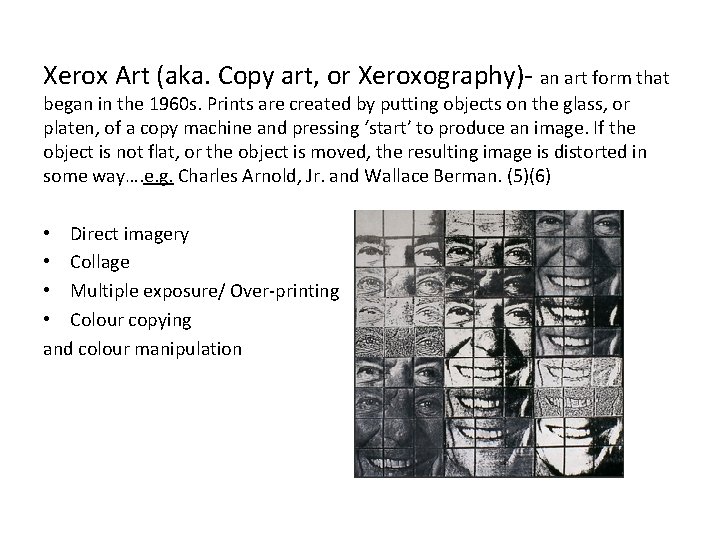
Xerox Art (aka. Copy art, or Xeroxography)- an art form that began in the 1960 s. Prints are created by putting objects on the glass, or platen, of a copy machine and pressing ‘start’ to produce an image. If the object is not flat, or the object is moved, the resulting image is distorted in some way…. e. g. Charles Arnold, Jr. and Wallace Berman. (5)(6) • Direct imagery • Collage • Multiple exposure/ Over-printing • Colour copying and colour manipulation
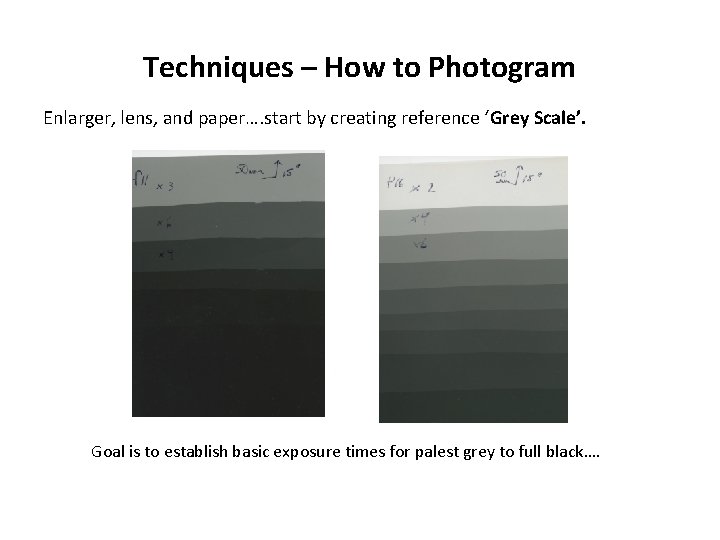
Techniques – How to Photogram Enlarger, lens, and paper…. start by creating reference ‘Grey Scale’. Goal is to establish basic exposure times for palest grey to full black….
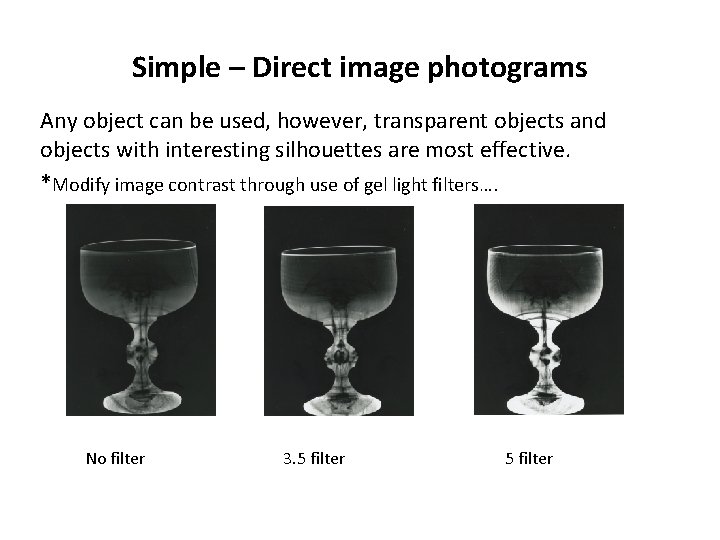
Simple – Direct image photograms Any object can be used, however, transparent objects and objects with interesting silhouettes are most effective. *Modify image contrast through use of gel light filters…. No filter 3. 5 filter
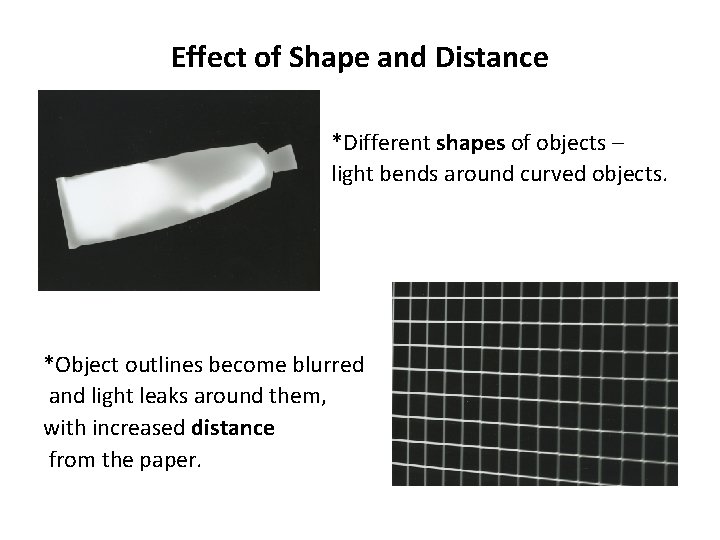
Effect of Shape and Distance *Different shapes of objects – light bends around curved objects. *Object outlines become blurred and light leaks around them, with increased distance from the paper.
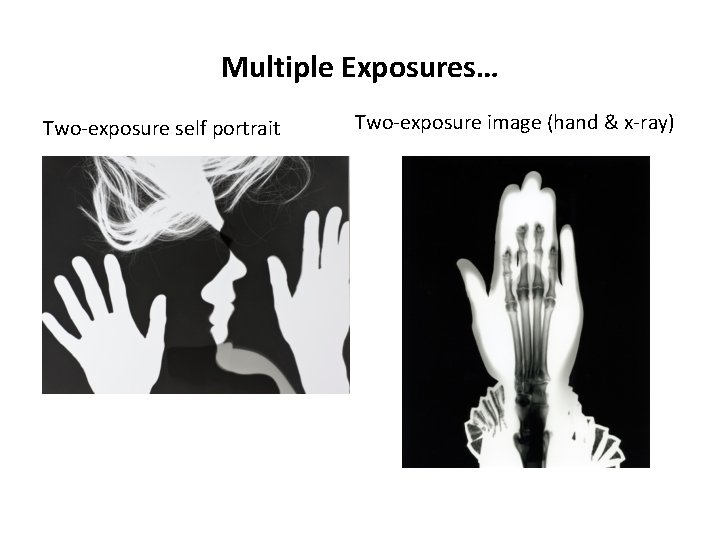
Multiple Exposures… Two-exposure self portrait Two-exposure image (hand & x-ray)
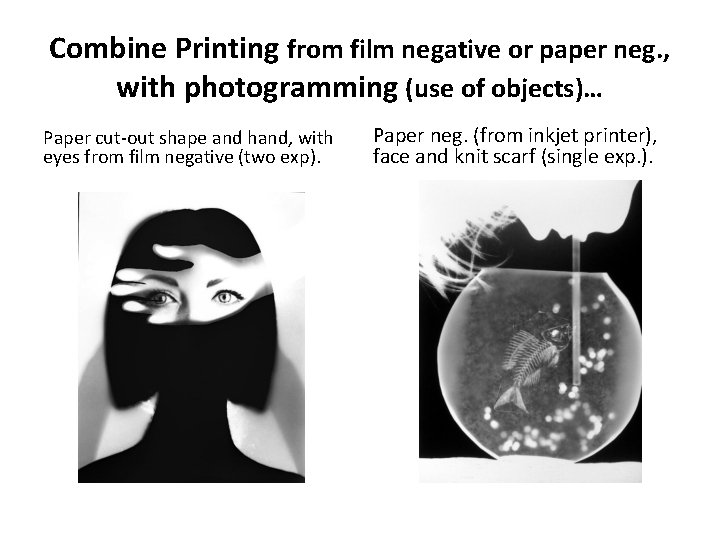
Combine Printing from film negative or paper neg. , with photogramming (use of objects)… Paper cut-out shape and hand, with eyes from film negative (two exp). Paper neg. (from inkjet printer), face and knit scarf (single exp. ).
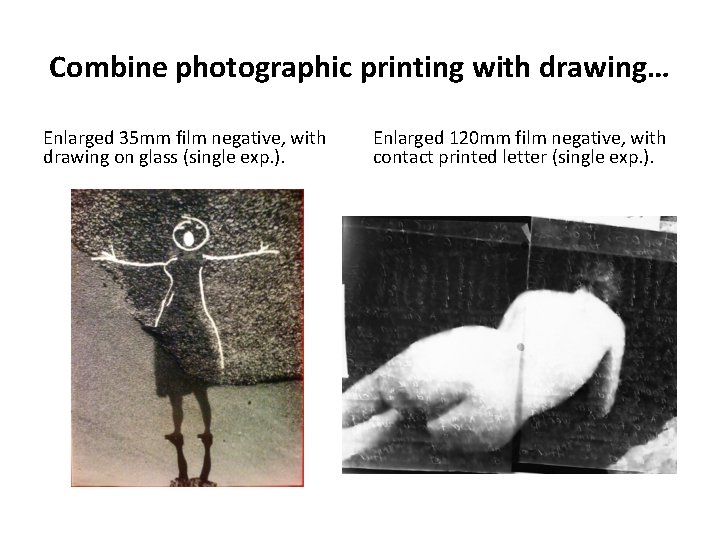
Combine photographic printing with drawing… Enlarged 35 mm film negative, with drawing on glass (single exp. ). Enlarged 120 mm film negative, with contact printed letter (single exp. ).
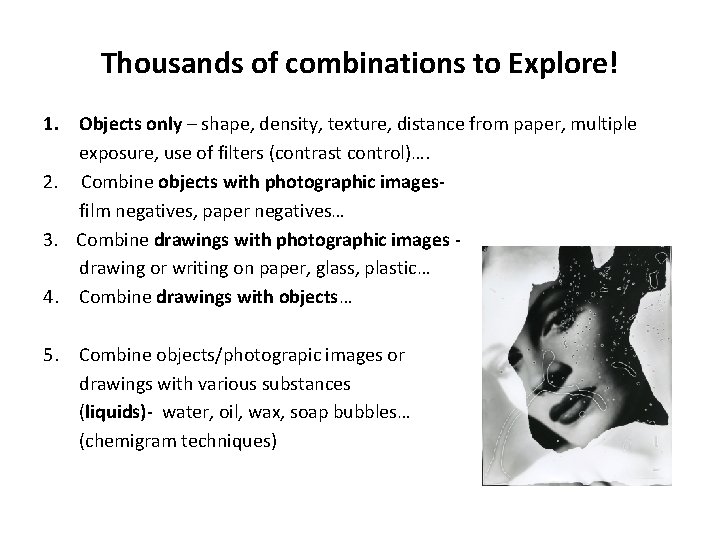
Thousands of combinations to Explore! 1. Objects only – shape, density, texture, distance from paper, multiple exposure, use of filters (contrast control)…. 2. Combine objects with photographic images film negatives, paper negatives… 3. Combine drawings with photographic images drawing or writing on paper, glass, plastic… 4. Combine drawings with objects… 5. Combine objects/photograpic images or drawings with various substances (liquids)- water, oil, wax, soap bubbles… (chemigram techniques)
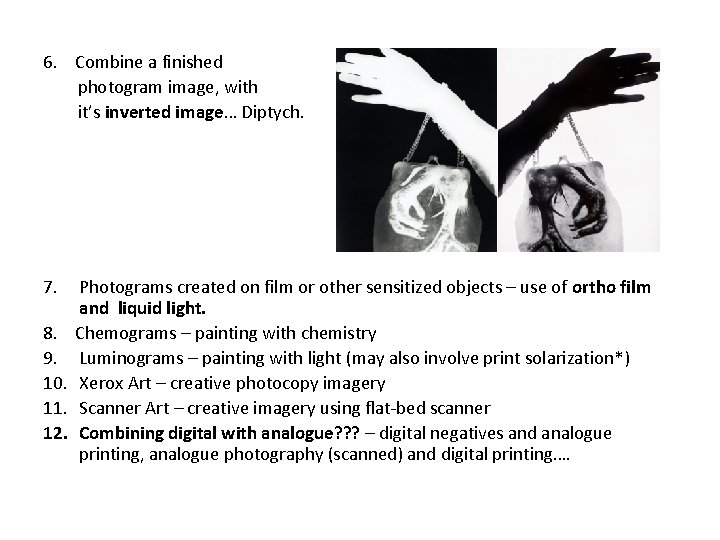
6. Combine a finished photogram image, with it’s inverted image… Diptych. 7. Photograms created on film or other sensitized objects – use of ortho film and liquid light. 8. Chemograms – painting with chemistry 9. Luminograms – painting with light (may also involve print solarization*) 10. Xerox Art – creative photocopy imagery 11. Scanner Art – creative imagery using flat-bed scanner 12. Combining digital with analogue? ? ? – digital negatives and analogue printing, analogue photography (scanned) and digital printing….
Thank you