
What is a national corpus Primary objective of
What is a national corpus
Primary objective of a national corpus is to provide linguists with a tool to investigate a language in the diversity of types of texts through making complex lexical grammatical queries. The corpus allows to investigate various linguistic phenomena by observing the possible range of contexts in which they occur.
Examples of searchable corpora online British National Corpus Russian National Corpus Eastern Armenian National Corpus Czech National Corpus
To show just one example: Eastern Armenian National Corpus • about 90 million tokens • powerful search engine for making complex lexical morphological queries • a diachronic corpus covering SEA texts from the mid-19 th century to the present • both written discourse and oral discourse • open access
A national corpus is a large-scale, linguistically diversified and balanced collection of texts provided with a flexible search engine.
How large? RNC 150 mln BNC 100 mln EANC 90 mln Essentially, depends on the type of research envisaged
How diversified? As diversified as practicable EANC – extension of the press subcorpus to cover early Armenian press, soon to cover internet forums RNC – effort to cover snail mail and electronic communication
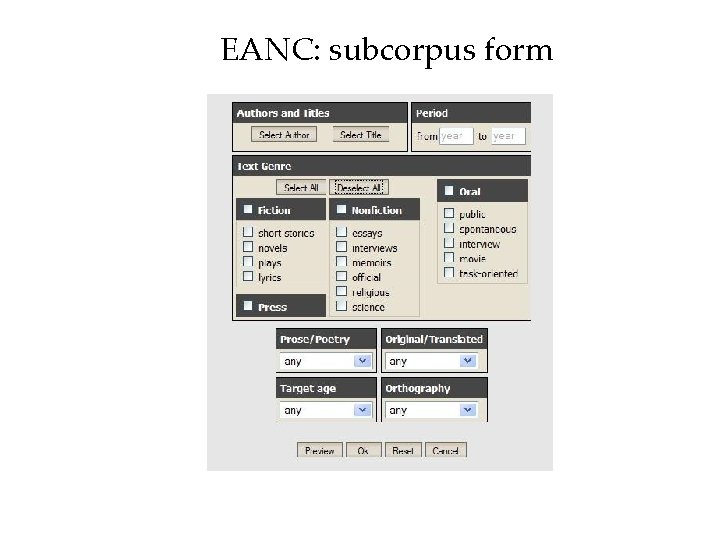
EANC: subcorpus form
How balanced? Balance is a vague notion… At least not disproportionate – less poetry than prose etc. Even a disbalanced corpus can be balanced by creating predefined subcorpora.
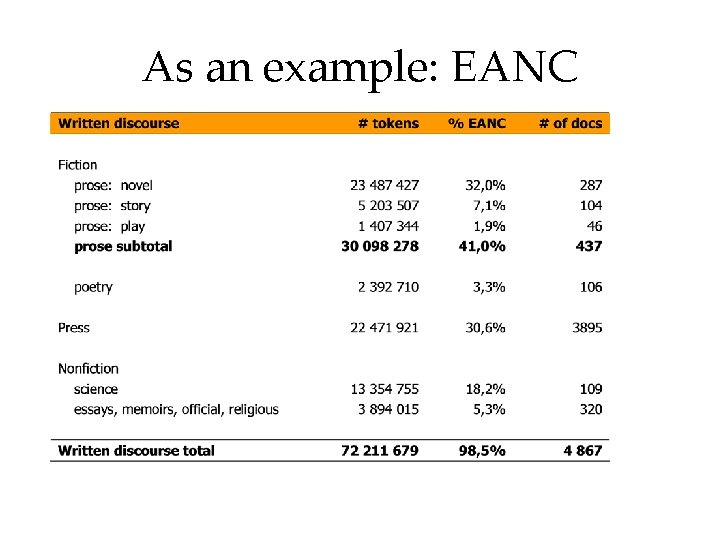
As an example: EANC
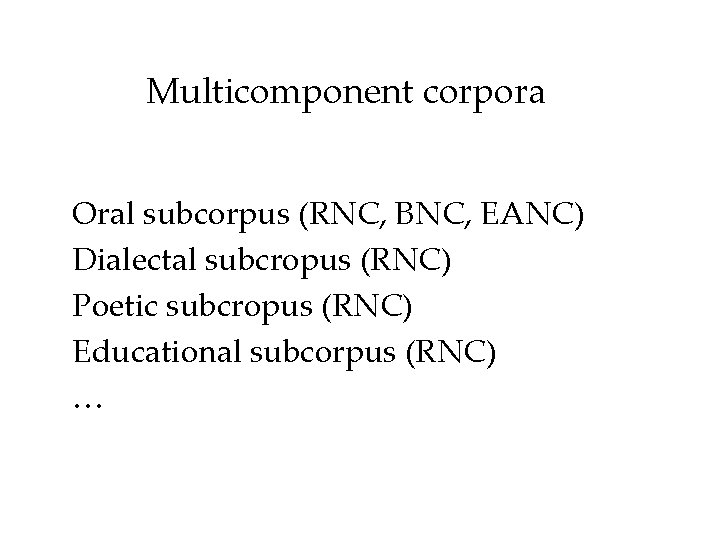
Multicomponent corpora Oral subcorpus (RNC, BNC, EANC) Dialectal subcropus (RNC) Poetic subcropus (RNC) Educational subcorpus (RNC) …
Library or corpus? Difference in target audience and intended usage • electronic library is intended for readers • corpus is intended for researchers Implied differences: Ø corpus must be able to respond to queries Ø library have major problems related to copyright
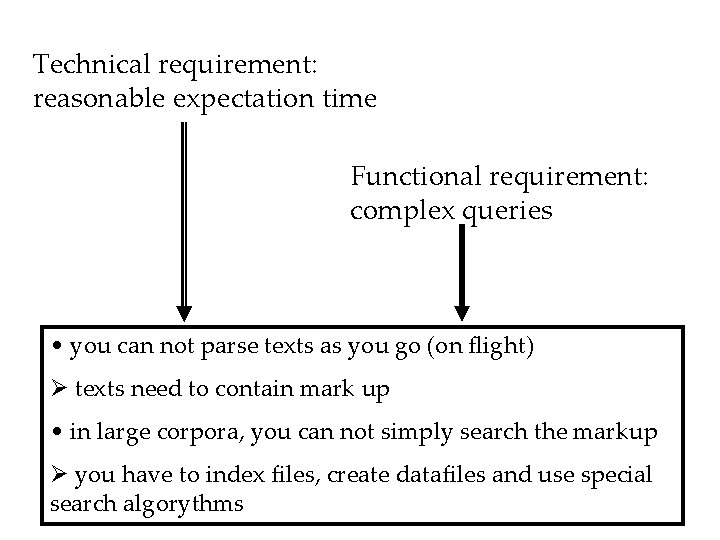
Technical requirement: reasonable expectation time Functional requirement: complex queries • you can not parse texts as you go (on flight) Ø texts need to contain mark up • in large corpora, you can not simply search the markup Ø you have to index files, create datafiles and use special search algorythms
Parsing • wordlist • inflection type attributed to its each item Сlassification of inflectional types needs to be as exhaustive and formal as a logical calculus. Parser creates a list of endings and a list of stems; when parsing a wordform, it tries to match the ending of the word with an ending in the list, then tries to match the rest with the stem, and checks whether this ending is allowed to be added to this stem.
Parsing Some tokens are not recognized at all; these tokens can not be searched by means of lexical or grammatical queries. • recent loanwords • neologisms • elements of codeswitching • abbreviations • proper names • technical terms • distorted spellings • cases of inflectional variance not included into the wordlist • scanning errors • typos and misspellings in the original texts
Parsing Some tokens receive several analyses. The actual applicability of these analyses depend on the context and may not be evaluated by the parser.
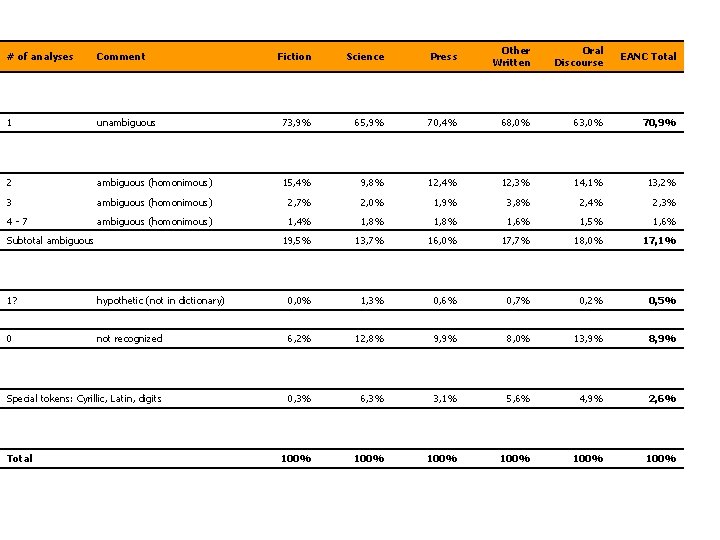
Fiction Science Press Other Written unambiguous 73, 9% 65, 9% 70, 4% 2 ambiguous (homonimous) 15, 4% 9, 8% 3 ambiguous (homonimous) 2, 7% 4 - 7 ambiguous (homonimous) # of analyses Comment 1 Subtotal ambiguous Oral Discourse EANC Total 68, 0% 63, 0% 70, 9% 12, 4% 12, 3% 14, 1% 13, 2% 2, 0% 1, 9% 3, 8% 2, 4% 2, 3% 1, 4% 1, 8% 1, 6% 1, 5% 1, 6% 19, 5% 13, 7% 16, 0% 17, 7% 18, 0% 17, 1% 0, 0% 1, 3% 0, 6% 0, 7% 0, 2% 0, 5% 1? hypothetic (not in dictionary) 0 not recognized 6, 2% 12, 8% 9, 9% 8, 0% 13, 9% 8, 9% Special tokens: Cyrillic, Latin, digits 0, 3% 6, 3% 3, 1% 5, 6% 4, 9% 2, 6% 100% 100% Total
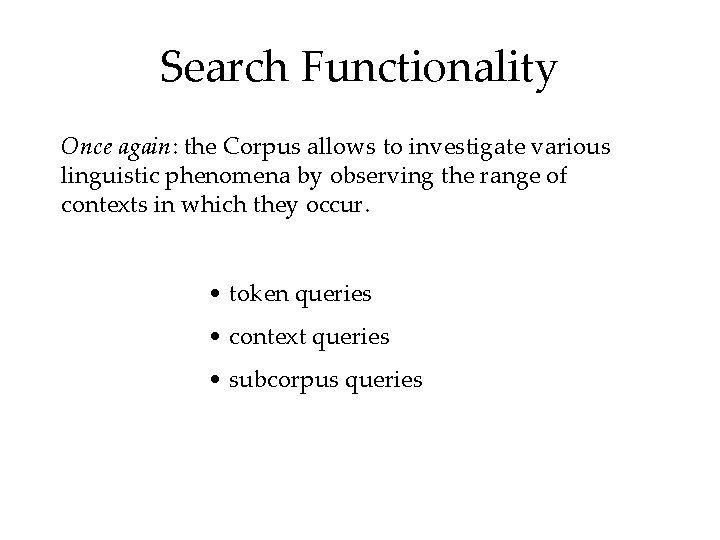
Search Functionality Once again: the Corpus allows to investigate various linguistic phenomena by observing the range of contexts in which they occur. • token queries • context queries • subcorpus queries
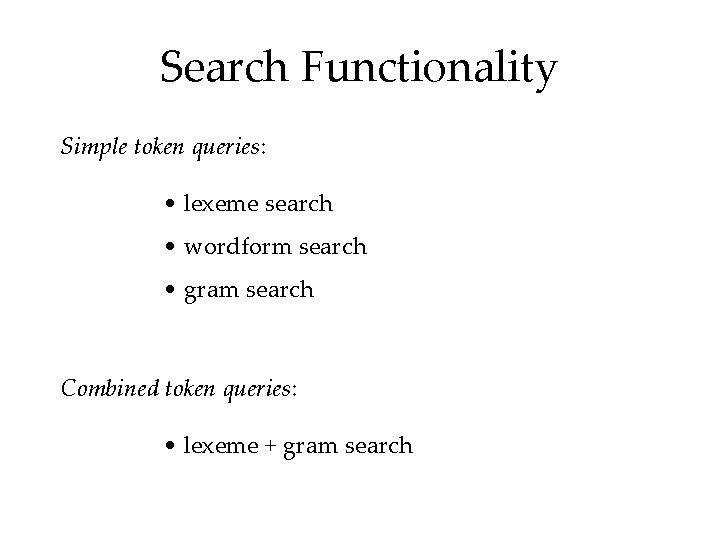
Search Functionality Simple token queries: • lexeme search • wordform search • gram search Combined token queries: • lexeme + gram search
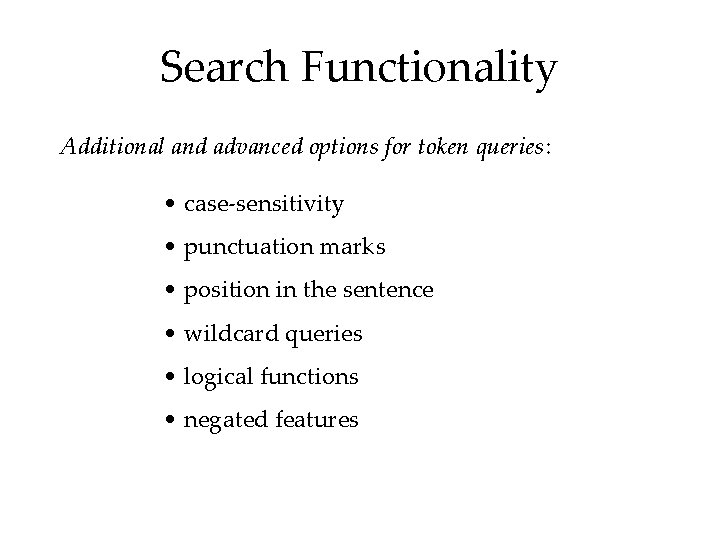
Search Functionality Additional and advanced options for token queries: • case-sensitivity • punctuation marks • position in the sentence • wildcard queries • logical functions • negated features
Search Functionality Context queries: a combination of several token queries • search for tokens at a specified distance • search for tokens within one sentence • search for tokens in adjacent sentences • increasing the number of tokens ad infinitum
Search Functionality Subcorpus selection: searching in a specified type of texts only • search within a specific period of time • search in texts of specified authors • search in specified genres/types of texts
Search Functionality Working with the results • expanding the context • pop-up grammar • sort by…
Extras • Translations (EANC) • Disambiguation (RNC) • Electronic library (EANC) • Syntactic markup • Statistics (RNC? )
Possible applications Ø Linguistics (corpus-based grammars projects under way) Ø Education (www. studiorum. ruscorpora. ru to appear) Ø Normative linguistics Ø Literature and culture studies Ø etc.
- Slides: 25