
What is a miniCEX A workplacebased assessment n

What is a mini-CEX ? A workplace-based assessment n a short episode of real student-patient interaction within the workplace n observed and judged by the supervising clinician (observer) n followed by feedback

Why do mini-CEX ? Workplace-based assessment drives experiential learning?

Are Clinical Skills Important? Clinical skills are essential for patient care Clinical skills : Medical interviewing Physical examination Clinical judgment Communication skills Evaluation of clinical skills requires direct observation

diagnosis and medical interview n Hampton n (BMJ, 1975): Medical interview: 82% – Physical exam: 9% – Laboratory: 9% n Kirch (Medicine, 1996) – Medical interview (+Ph/Ex): 70% – Imaging: 35%
Importance of complete Clinical Skills To decrease diagnostic errors – Inaccurate/ incomplete medical interview is one important reason of diagnostic errors. Wrong information leads to wrong decisions To increase patient satisfaction – Higher with better communication skills To improve patient self-care – Better adherence and outcomes associated with better physician communication skills
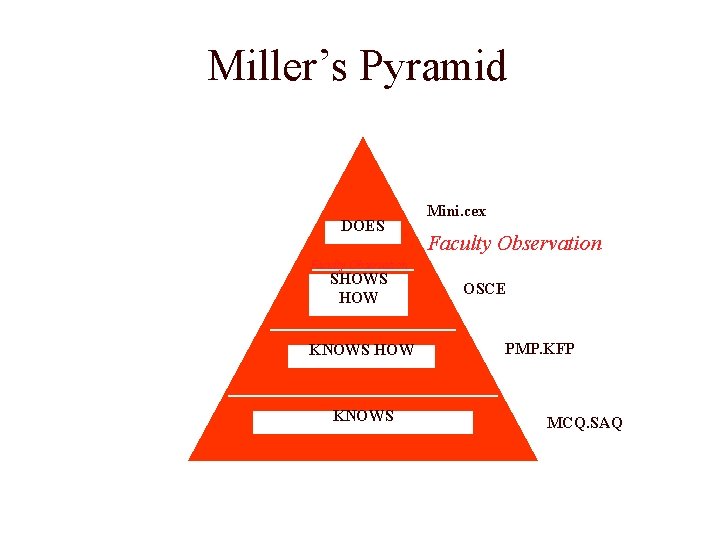
Miller’s Pyramid DOES Mini. cex Faculty Observation SHOWS HOW KNOWS OSCE PMP. KFP MCQ. SAQ

how to do mini. CEX ? too simple
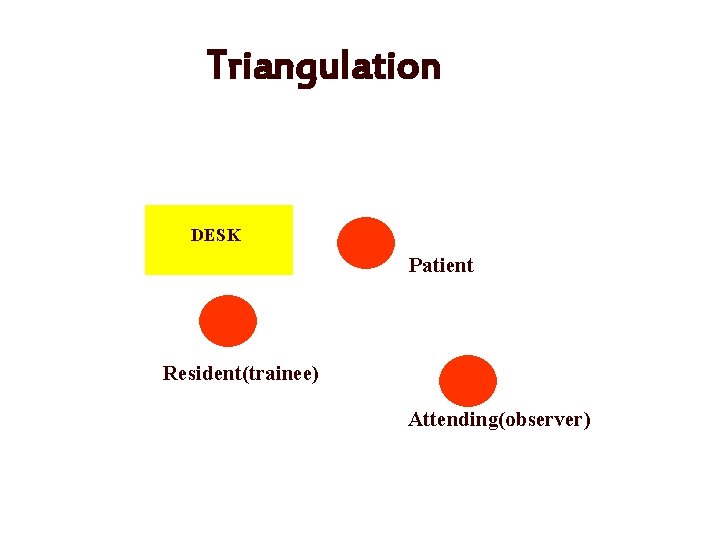
Triangulation DESK Patient Resident(trainee) Attending(observer)

§ In the mini-CEX, a single faculty Member(observer) observes the trainee`s interact with a patient in any of a variety of settings including the hospital, outpatient clinic, and E. D § In fact, the mini CEX can assess a range of core competencies that a trainee uses during day to day encounters with patients.
Encounters should … § take place In the normal working environment. take place In different working environment. § cover different cases and different specialty areas. § be observed by different skilled observers. § During the encounters … § Observer must assess trainee`s clinical skills & fill the feedback form. § Observer must note some extra information such as complexity of patient`s problem §

One encounter takes 20 min & has 2 steps Exam : 15_20 min Feedback : ~5 min The trainee conducts a focused history and physical examination and then provides a diagnosis and treatment plan. The faculty member(observer) scores the performance using a structured document and then provides educational feedback.

FEEDBACK n The feedback session is the most important part of the mini-cex & it should occure immediately after the encounter. n The observer should discuss both the positive & negative aspects of encounter with the trainee. n The observer should also discuss a plan to improve any areas of weakness.
n. To be most effective, feedback needs to be interactive nstrengths and weaknesses. n→ (agreement & signature)

Mini_CEX program n Trainees have to complete at least one encounter for every 3 months (4 encounters in a year) in order to be eligible for central exam at the end of the year. n The trainee should meet an educational supervisor during the program. During this meetings they can map out a learning plan for next period, according to trainee`s rotations & his/her past encounters.
n The trainee is responsible for instigating each mini- CEX encounter. n Each assessment should focus on a limited number of competencies & different encounters should include a range of cases with each focusing on specific aspects of the clinical skills. (e. g. history taking, PH/EX, … )
n Each observer may have his/her own way to run the encounters with the trainees. One accepted format is : n To choose the last patient of a day ( e. g : the last outpatient in the clinic or the last patient on the ward round) →To be less disruptive to the flow of the clinical workload. n →To allow for feedback to occur straight after the encounter. n
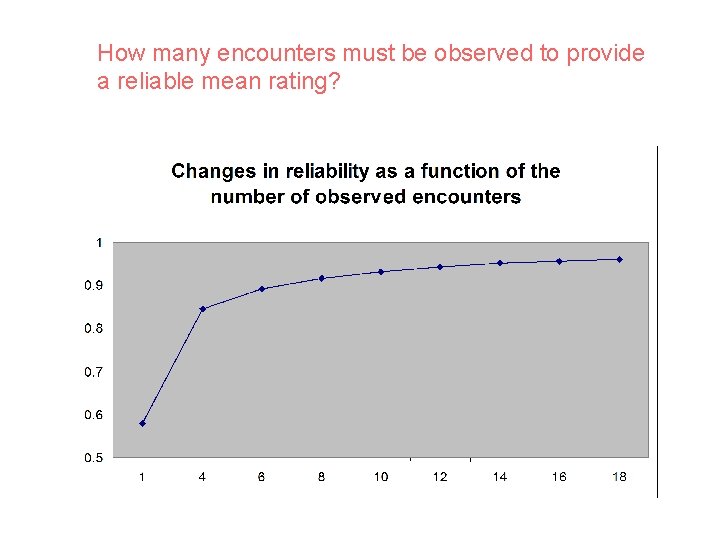
How many encounters must be observed to provide a reliable mean rating?
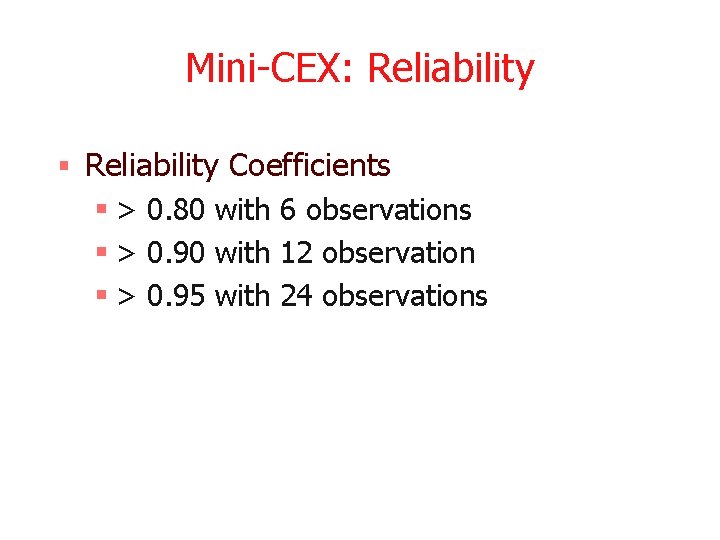
Mini-CEX: Reliability § Reliability Coefficients § > 0. 80 with 6 observations § > 0. 90 with 12 observation § > 0. 95 with 24 observations
Mini-Clinical Examination (Mini-CEX) The evidence will be rated and recorded in the Portfolio. Immediate feedback will be provided by the observer rating the student. A learning plan will be developed, based on the strengths and developmental needs observed
Summary n Basic clinical skills are important: so is the need to observe them! n Observation is a complex skill that requires training and practice n Direct observation by educators will remain a critical component of both evaluation and feedback
- Slides: 22