
What is a life cycle Put these stages

- Slides: 19
What is a life cycle? Put these stages of our life cycle in order Teenager Child Birth Middle Aged Pensioner Conception Young Adult Baby 3. 1. 4 P RODUCT LIFE CYCLE 3. 1. 4 PRODUCT LIFE CYCLE
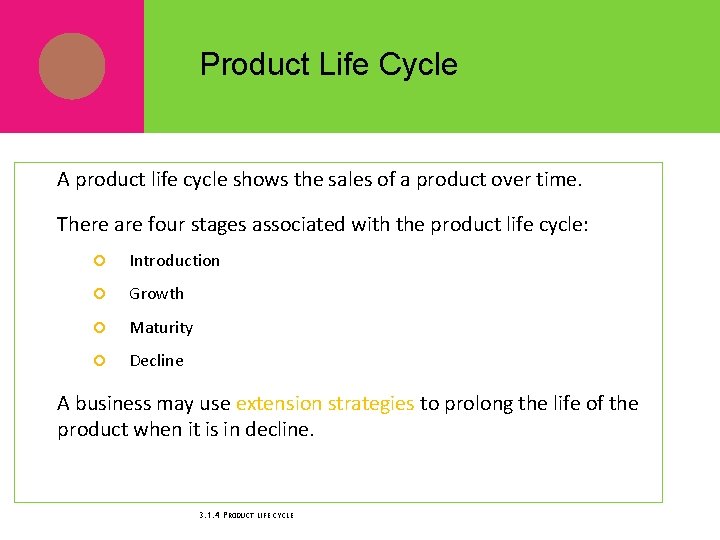
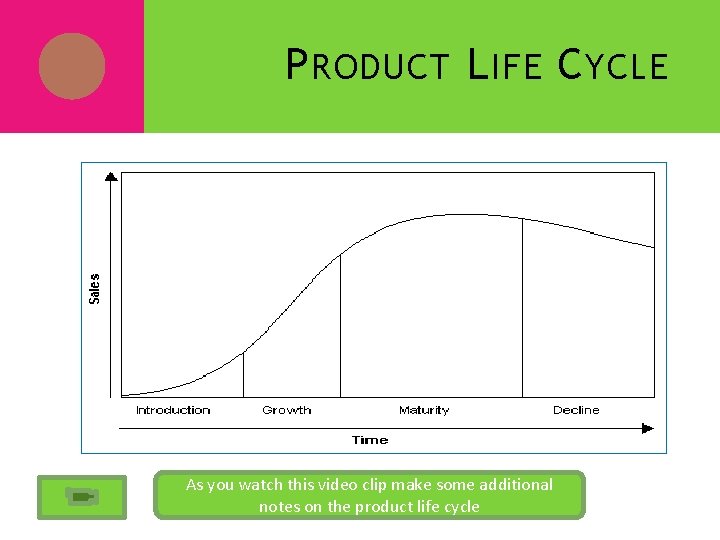
Product Life Cycle A product life cycle shows the sales of a product over time. There are four stages associated with the product life cycle: Introduction Growth Maturity Decline A business may use extension strategies to prolong the life of the product when it is in decline. 3. 1. 4 PRODUCT LIFE CYCLE
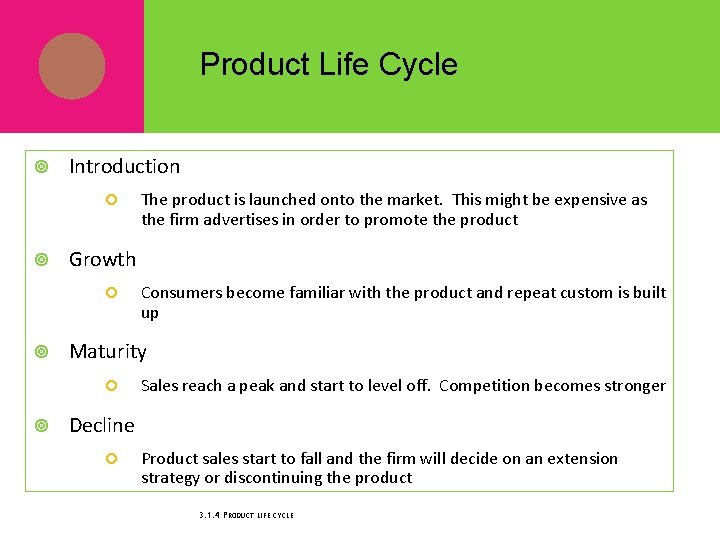
Product Life Cycle Introduction Growth Consumers become familiar with the product and repeat custom is built up Maturity The product is launched onto the market. This might be expensive as the firm advertises in order to promote the product Sales reach a peak and start to level off. Competition becomes stronger Decline Product sales start to fall and the firm will decide on an extension strategy or discontinuing the product 3. 1. 4 PRODUCT LIFE CYCLE
P RODUCT L IFE C YCLE As you watch this video clip make some additional notes on the product life cycle 3. 1. 4 PRODUCT LIFE CYCLE
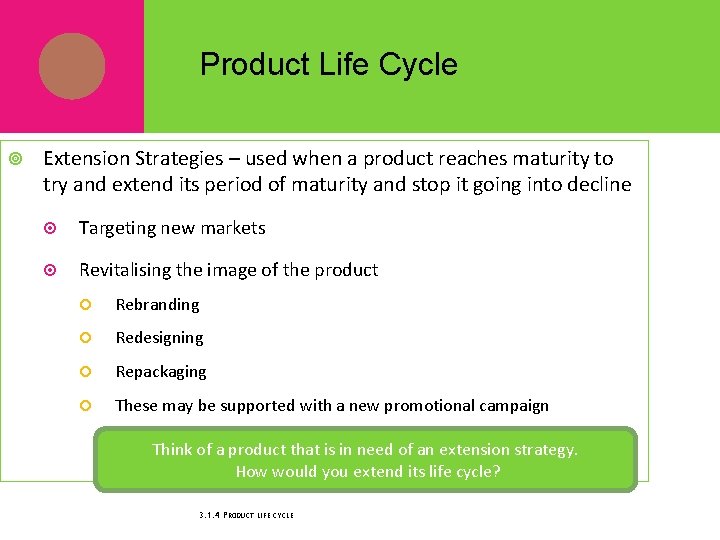
Product Life Cycle Extension Strategies – used when a product reaches maturity to try and extend its period of maturity and stop it going into decline Targeting new markets Revitalising the image of the product Rebranding Redesigning Repackaging These may be supported with a new promotional campaign Think of a product that is in need of an extension strategy. How would you extend its life cycle? 3. 1. 4 PRODUCT LIFE CYCLE
G ROUP A CTIVITY On A 3 paper draw a product life cycle diagram Choose one large organisation e. g. Apple and carry out some research into its product range Add your chosen business’ product range to the product life cycle diagram Do you think that the business has a balanced product portfolio? Justify your answer. 3. 1. 4 PRODUCT LIFE CYCLE
Product Life Cycle Impact of extension strategies on other aspects of the business: Operations management Finance Increased costs for product development and promotion Marketing Research and development is required The 4 ps will need to be considered People Has the business the human resource skills required to develop the product 3. 1. 4 PRODUCT LIFE CYCLE
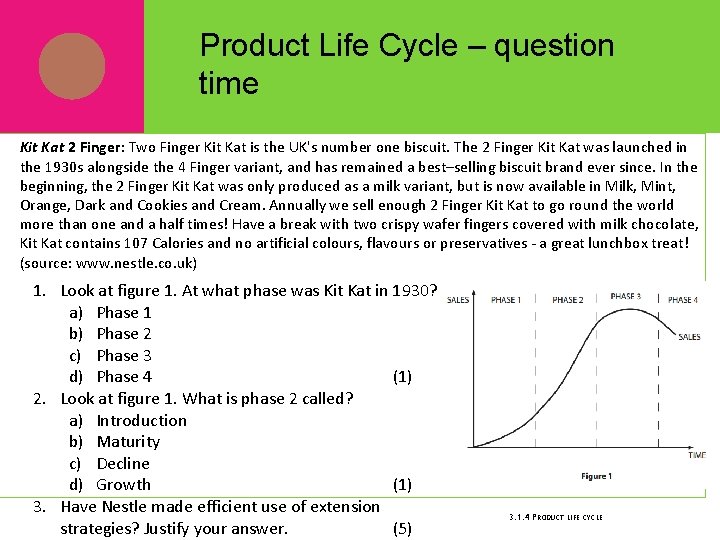
Product Life Cycle – question time Kit Kat 2 Finger: Two Finger Kit Kat is the UK's number one biscuit. The 2 Finger Kit Kat was launched in the 1930 s alongside the 4 Finger variant, and has remained a best–selling biscuit brand ever since. In the beginning, the 2 Finger Kit Kat was only produced as a milk variant, but is now available in Milk, Mint, Orange, Dark and Cookies and Cream. Annually we sell enough 2 Finger Kit Kat to go round the world more than one and a half times! Have a break with two crispy wafer fingers covered with milk chocolate, Kit Kat contains 107 Calories and no artificial colours, flavours or preservatives - a great lunchbox treat! (source: www. nestle. co. uk) 1. Look at figure 1. At what phase was Kit Kat in 1930? a) Phase 1 b) Phase 2 c) Phase 3 d) Phase 4 (1) 2. Look at figure 1. What is phase 2 called? a) Introduction b) Maturity c) Decline d) Growth (1) 3. Have Nestle made efficient use of extension strategies? Justify your answer. (5) 3. 1. 4 PRODUCT LIFE CYCLE
5 M INUTE T EST Draw a product life cycle What is an extension strategy? Why might an extension strategy impact on the finance department? End 3. 1. 4 PRODUCT LIFE CYCLE
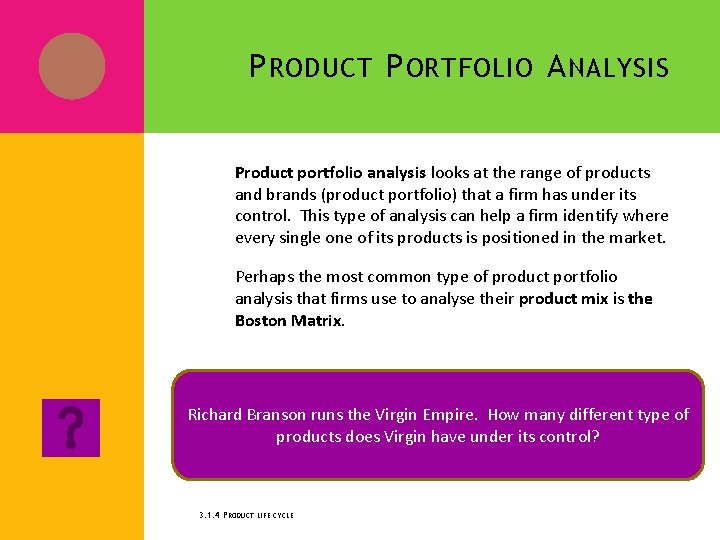
P RODUCT P ORTFOLIO A NALYSIS Product portfolio analysis looks at the range of products and brands (product portfolio) that a firm has under its control. This type of analysis can help a firm identify where every single one of its products is positioned in the market. Perhaps the most common type of product portfolio analysis that firms use to analyse their product mix is the Boston Matrix. Richard Branson runs the Virgin Empire. How many different type of products does Virgin have under its control? 3. 1. 4 PRODUCT LIFE CYCLE
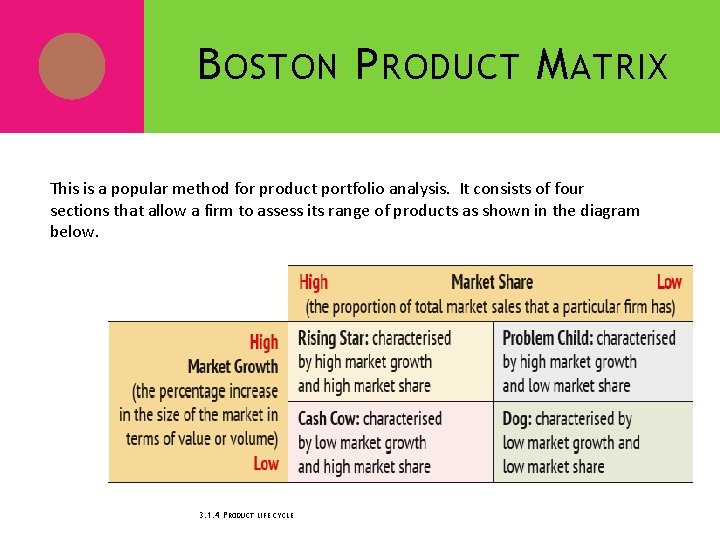
B OSTON P RODUCT M ATRIX This is a popular method for product portfolio analysis. It consists of four sections that allow a firm to assess its range of products as shown in the diagram below. 3. 1. 4 PRODUCT LIFE CYCLE
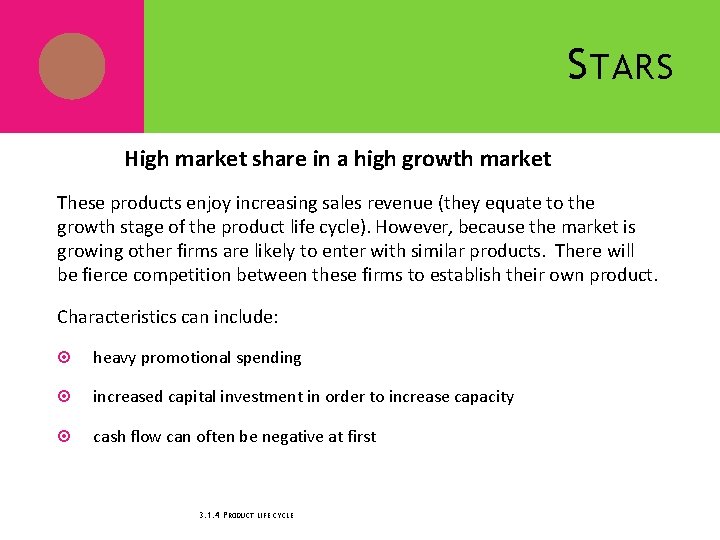
S TARS High market share in a high growth market These products enjoy increasing sales revenue (they equate to the growth stage of the product life cycle). However, because the market is growing other firms are likely to enter with similar products. There will be fierce competition between these firms to establish their own product. Characteristics can include: heavy promotional spending increased capital investment in order to increase capacity cash flow can often be negative at first 3. 1. 4 PRODUCT LIFE CYCLE
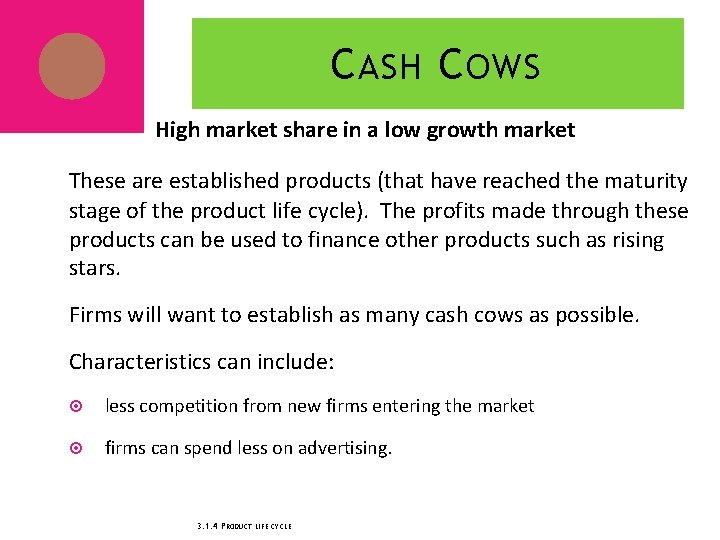
C ASH C OWS High market share in a low growth market These are established products (that have reached the maturity stage of the product life cycle). The profits made through these products can be used to finance other products such as rising stars. Firms will want to establish as many cash cows as possible. Characteristics can include: less competition from new firms entering the market firms can spend less on advertising. 3. 1. 4 PRODUCT LIFE CYCLE
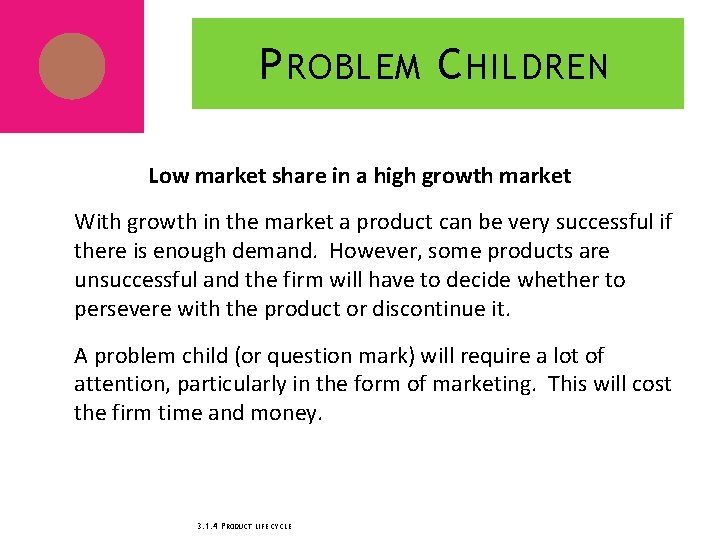
P ROBLEM C HILDREN Low market share in a high growth market With growth in the market a product can be very successful if there is enough demand. However, some products are unsuccessful and the firm will have to decide whether to persevere with the product or discontinue it. A problem child (or question mark) will require a lot of attention, particularly in the form of marketing. This will cost the firm time and money. 3. 1. 4 PRODUCT LIFE CYCLE
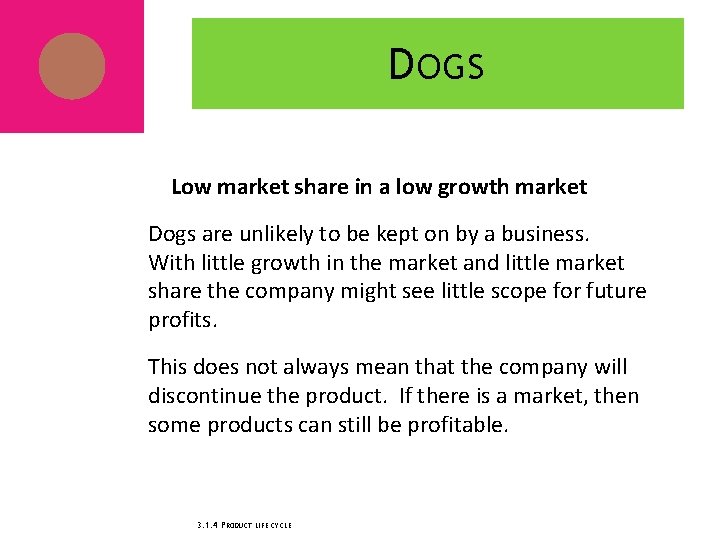
D OGS Low market share in a low growth market Dogs are unlikely to be kept on by a business. With little growth in the market and little market share the company might see little scope for future profits. This does not always mean that the company will discontinue the product. If there is a market, then some products can still be profitable. 3. 1. 4 PRODUCT LIFE CYCLE
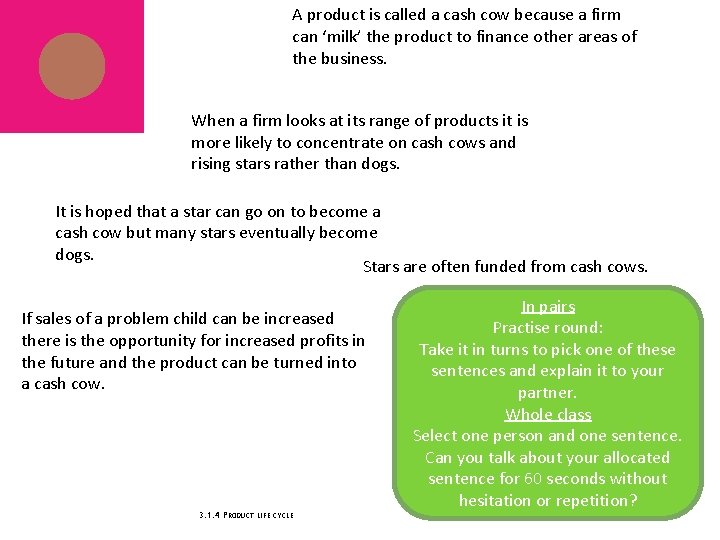
A product is called a cash cow because a firm can ‘milk’ the product to finance other areas of the business. When a firm looks at its range of products it is more likely to concentrate on cash cows and rising stars rather than dogs. It is hoped that a star can go on to become a cash cow but many stars eventually become dogs. Stars are often funded from cash cows. If sales of a problem child can be increased there is the opportunity for increased profits in the future and the product can be turned into a cash cow. 3. 1. 4 PRODUCT LIFE CYCLE In pairs Practise round: Take it in turns to pick one of these sentences and explain it to your partner. Whole class Select one person and one sentence. Can you talk about your allocated sentence for 60 seconds without hesitation or repetition?
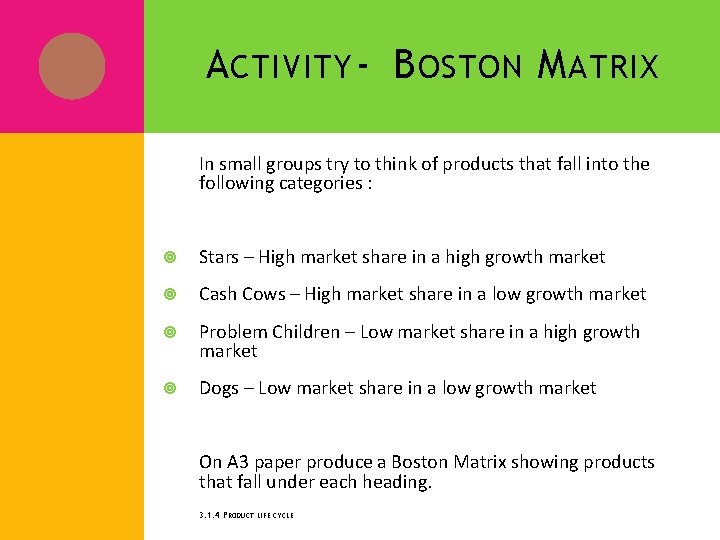
A CTIVITY - B OSTON M ATRIX In small groups try to think of products that fall into the following categories : Stars – High market share in a high growth market Cash Cows – High market share in a low growth market Problem Children – Low market share in a high growth market Dogs – Low market share in a low growth market On A 3 paper produce a Boston Matrix showing products that fall under each heading. 3. 1. 4 PRODUCT LIFE CYCLE
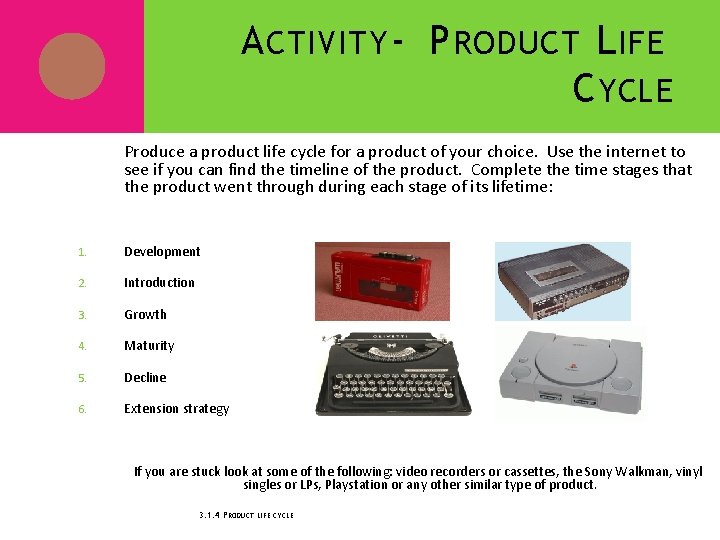
A CTIVITY - P RODUCT L IFE C YCLE Produce a product life cycle for a product of your choice. Use the internet to see if you can find the timeline of the product. Complete the time stages that the product went through during each stage of its lifetime: 1. Development 2. Introduction 3. Growth 4. Maturity 5. Decline 6. Extension strategy If you are stuck look at some of the following: video recorders or cassettes, the Sony Walkman, vinyl singles or LPs, Playstation or any other similar type of product. 3. 1. 4 PRODUCT LIFE CYCLE
Q UESTION TIME 1. The Boston Matrix categorises products in relation to market share and market growth. What name is given to a product that has high market share in a low growth market? a) Cash cow b) Rising star c) Problem child d) Dog (1) 2. Describe how the use of the Boston Matrix may benefit a business. (3) 3. Where would you place the Mc. Donald’s Big Mac a) On the Boston Matrix b) On a product life cycle? Justify your decisions. (6) 3. 1. 4 PRODUCT LIFE CYCLE