
What is a leader n n Identify people
- Slides: 28
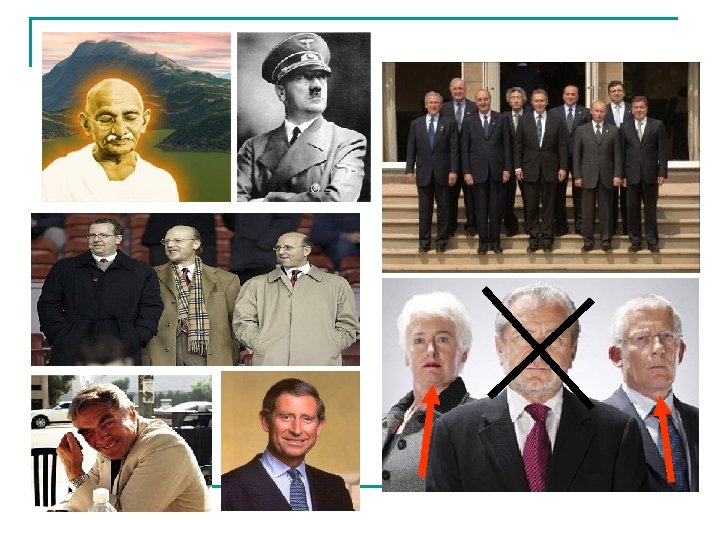
What is a leader? n n Identify people in school or public life that you would refer to as ‘leaders’ Make a list of the characteristics that define a ‘leader’
18 December 2021 Leadership 4. 9 Key Influences on the Change Process: Leadership Objectives: n. Use established theory to identify leadership styles and characteristics n. Distinguish between leadership and management as key concepts
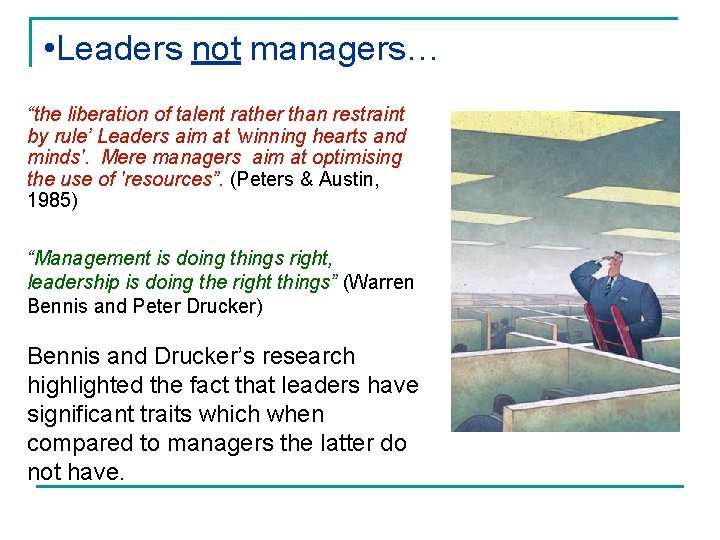
• Leaders not managers… “the liberation of talent rather than restraint by rule’ Leaders aim at 'winning hearts and minds'. Mere managers aim at optimising the use of 'resources”. (Peters & Austin, 1985) “Management is doing things right, leadership is doing the right things” (Warren Bennis and Peter Drucker) Bennis and Drucker’s research highlighted the fact that leaders have significant traits which when compared to managers the latter do not have.
• Trait Theory (Bennis) • Accept the status quo • Administer Managers and copy Leaders • Ask how and when Innovation and originality • Ask. Administer what and whycopy The Develop listed ‘traits’ are either those • Challenge Mainthe status quo of managers of leaders. • Classic good soldier Focus on systems & structure Focus on people • Develop on control Inspire trust • Do Rely the right things • Do Short-range things rightview - bottom line Use Long-range your intuition help view and - the horizon • Focus on people of a partner to break the longer Ask how and when Ask what and why • Focus on systems & structure list into two shorter lists to • Innovation and originality Accept the status quo Challenge the statusand quoleaders represent managers • Inspire trust Classic good soldier Own person traits… • Long-range view - the horizon Do things right Do the right things • Maintain • Own person How use this in an exam? If discussing leadership identify traits and • Relytoon control comment howview “Bennis and Drucker” identified a range of leadership traits… • Short-range - bottom line § § § § §
What should a leader prioritise; people in an organisation or results?
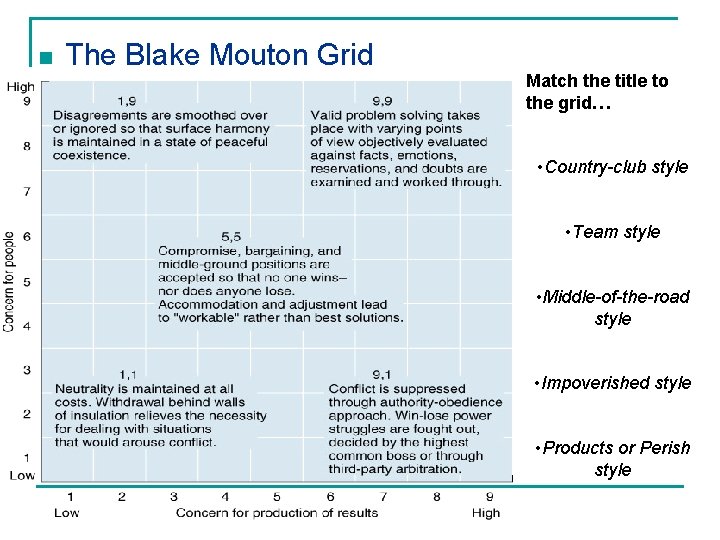
n The Blake Mouton Grid Match the title to the grid… • Country-club style • Team style • Middle-of-the-road style • Impoverished style • Products or Perish style
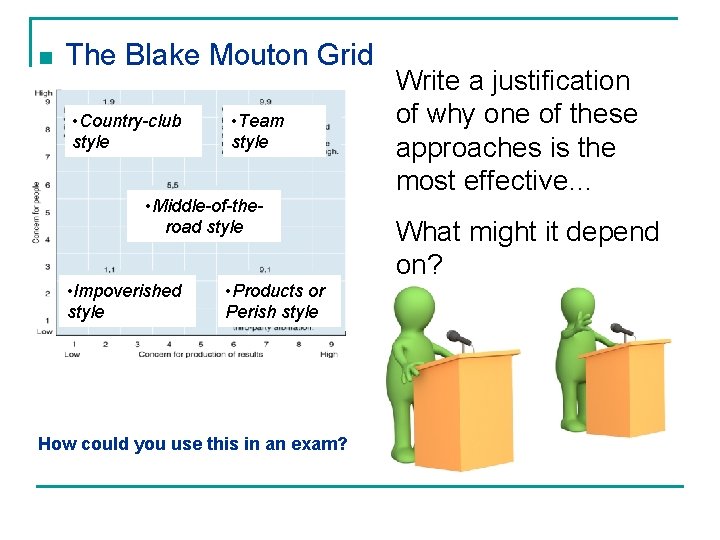
n The Blake Mouton Grid • Country-club style • Team style • Middle-of-theroad style • Impoverished style • Products or Perish style How could you use this in an exam? Write a justification of why one of these approaches is the most effective… What might it depend on?
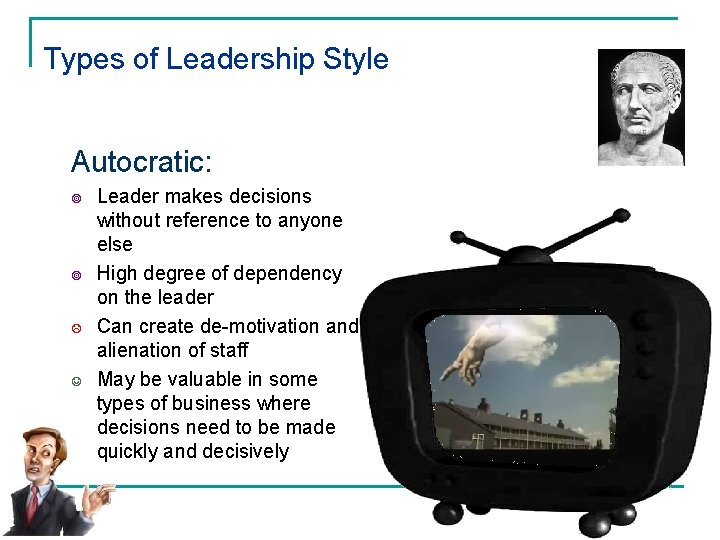
Types of Leadership Style Autocratic: ¥ ¥ L J Leader makes decisions without reference to anyone else High degree of dependency on the leader Can create de-motivation and alienation of staff May be valuable in some types of business where decisions need to be made quickly and decisively
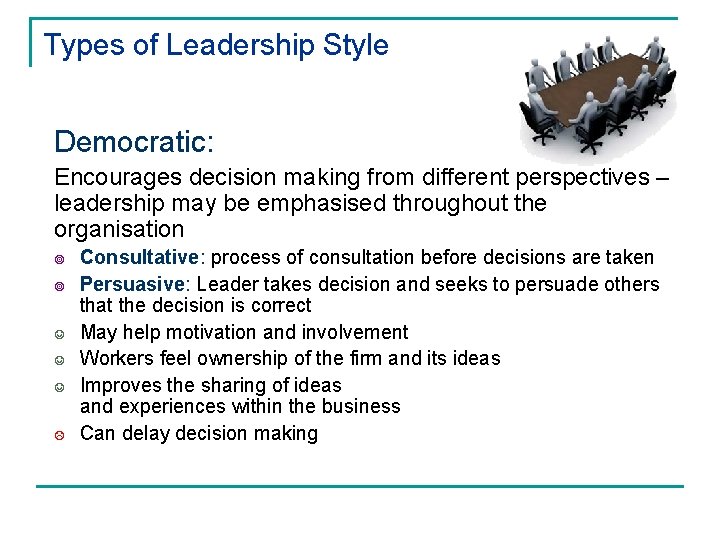
Types of Leadership Style Democratic: Encourages decision making from different perspectives – leadership may be emphasised throughout the organisation ¥ ¥ J J J L Consultative: process of consultation before decisions are taken Persuasive: Leader takes decision and seeks to persuade others that the decision is correct May help motivation and involvement Workers feel ownership of the firm and its ideas Improves the sharing of ideas and experiences within the business Can delay decision making
Types of Leadership Style Laissez-Faire: ¥ ¥ ¥ J J L ‘Let it be’ – the leadership responsibilities are shared by all Relies on good team work Relies on good interpersonal relations Can be very useful in businesses where creative ideas are important Can be highly motivational, as people have control over their working life Can make coordination and decision making time-consuming and lacking in overall direction
Types of Leadership Style Bureaucratic: ¥ ¥ Leader relies on complex and rigid rules and procedures Typically a tall hierarchical structure Clear roles with a lack of flexibility Focus on aptitude rather than ‘flair’ in the workforce
Types of Leadership Style Paternalistic: ¥ ¥ ¥ Leader acts as a ‘father figure’ Paternalistic leader makes decision but may consult Believes in the need to support staff
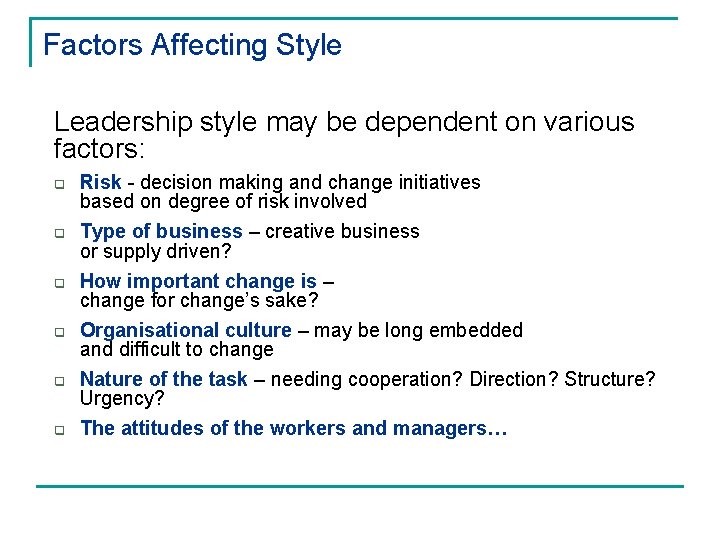
Factors Affecting Style Leadership style may be dependent on various factors: q q q Risk - decision making and change initiatives based on degree of risk involved Type of business – creative business or supply driven? How important change is – change for change’s sake? Organisational culture – may be long embedded and difficult to change Nature of the task – needing cooperation? Direction? Structure? Urgency? The attitudes of the workers and managers…
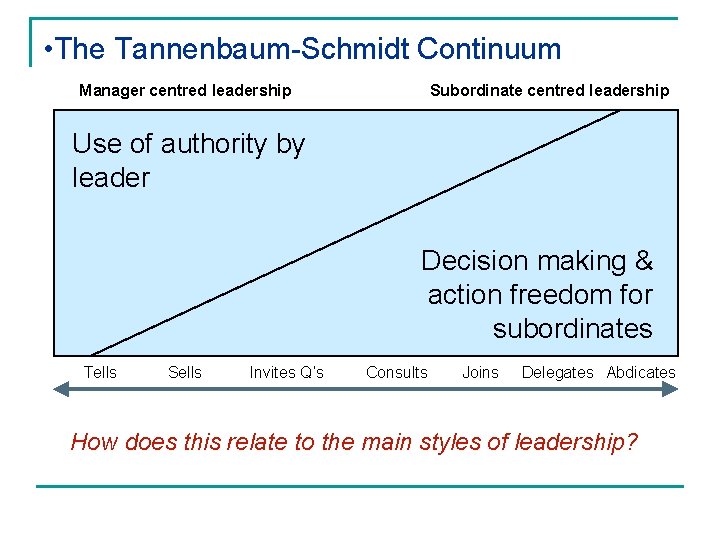
• The Tannenbaum-Schmidt Continuum Manager centred leadership Subordinate centred leadership Use of authority by leader Decision making & action freedom for subordinates Tells Sells Invites Q’s Consults Joins Delegates Abdicates How does this relate to the main styles of leadership?
Power Play! It has come to your attention that an employee has failed to hit the sales targets that they were set. They missed the target by a significant margin – how are you going to tackle this situation? n
Reward Power… (if you do this I will give you…) n Based on the ability to provide rewards to subordinates that they value n n n Financial rewards (bonuses, rises etc…) Non-financial (promotion, praise, company cars and other benefits) Utilised more commonly in a democratic culture of leadership
Coercive Power… (you will obey me) n Based on the subordinates fear of the leader… If you can't stand the heat q q q n Loss of status Loss of job Physical force / violence VERY autocratic style of leadership
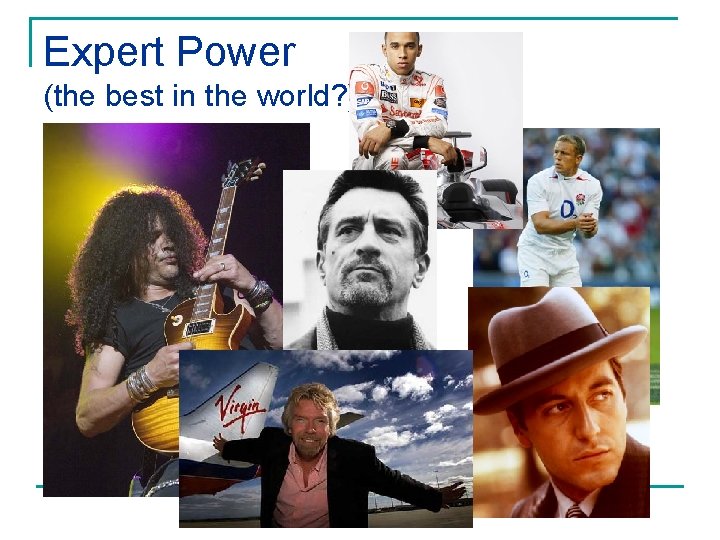
Expert Power (the best in the world? )
Expert Power… n Based on the perception of the leader as having particular expertise, skills or knowledge – therefore a right to lead others in these areas n Leader is irreplaceable, or hard to replace so highly valued by the organisation n Stereotypically may suit a paternalistic, perhaps autocratic leadership style, but this is a generalisation
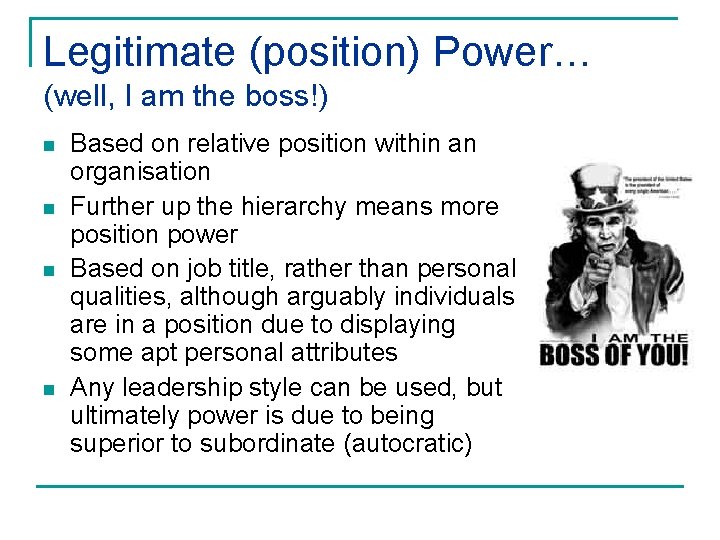
Legitimate (position) Power… (well, I am the boss!) n n Based on relative position within an organisation Further up the hierarchy means more position power Based on job title, rather than personal qualities, although arguably individuals are in a position due to displaying some apt personal attributes Any leadership style can be used, but ultimately power is due to being superior to subordinate (autocratic)
Referent Power… (I will because it’s you…) n Power based upon charisma and the respect and admiration of others, a role model to others, e. g. Sir Alan Sugar! n Can be expressed at all levels in the organisation n Dependant upon strong communication and interpersonal skills, often outside of formal channels of communication and authority
The appropriate leadership style n In each of these examples, what would be the most appropriate style of leadership? Justify your answer. 1. Training all the staff on the companies ethical code of conduct Trying to find a solution to a long-standing quality problem on a bread production line An oil company responding to and environmental disaster resulting from a crash involving one of its tankers Teams of IT software designers working on a major new IT development 2. 3. 4.
Summary questions n n What makes a good leader? Explain the difference between paternalistic and democratic styles of leadership Give examples of business situations when an authoritarian style of leadership might be appropriate Explain the difference between leading and manging change in a manufacturing business that need to improve productivity in order to maintain competitiveness
The key question… New Chief Executives have been appointed at Nokia and Thomas Cook in the last few years to try to turn around the business with a new strategy. To what extent does the success of a new strategy depend on the leader? Justify your answer with reference to Nokia, Thomas Cook and/or any other businesses that you know.
Examiner report n n This was by far the most popular question in Section B. Better responses were clearly focused on the relationship between a leader and a new strategy. They considered the role of leaders in determining the success of a new strategy; for example, in terms of providing the vision, allocating resources and bringing about the change successfully. Weaker responses discussed the role of leaders in general or the role leaders can play in terms of the overall success of a business rather than relating specifically to a new strategy. Students often provided examples of leaders in their responses but it is important that these examples are used in supporting an argument. Simply stating that Harriet Green transformed Thomas Cook or that Howard Schultz turned around Starbucks does not provide much insight into the role that leaders actually play in influencing the success of a new strategy or help to evaluate the factors that determine the effectiveness of a leader in this situation. Again the advice is to build the arguments with support from cases, data or other material relevant to the context rather than describe a series of business cases with no clear underlying answer to the question. This question was about leaders and the success of a new strategy and the links between these two factors needed to be examined, discussed and debated.
Exemplar essays and examiner feedback n Before or after?