
What is a law w Norms are behavioral
What is a “law? ” w Norms are behavioral codes that guide people into actions that conform to societal expectation ü Folkways are everyday norms based on custom, tradition, or etiquette (violate somebody’s personal space) ü Mores are norms based on broad societal morals (illegitimate childbearing) ü Laws are norms supported by codified social sanctions. BUT: Mores and folkways have always influenced the law 1
Brief History of Law I w 2000 BC Earliest Surviving Legal Codes n n 1750 BC Code of Hammurabi: lex talionis Roman “Twelve Tables”: 451 BC w “Dark Ages” (500 -1000 AD) n Written codes were lost and superstitions and fear of magic dominated thinking. 2
Brief History of Law II w Before the Norman Conquest (1060 AD), the legal system in England was decentralized. n n n Power given to tithings, hundreds and shires. Several legal/court systems were active Wergild (compensation) was divided between the King and victim. 3
Development of Common Law w Norman Conquest (1066 AD) n n William the Conqueror establishes “royal court” Stare decisis became the dominant standard w English common law born during the reign of Henry II (1154 -1189) n n n “Circuit Judges” Royal Prosecutors and movement toward national law Development of Jury System 4
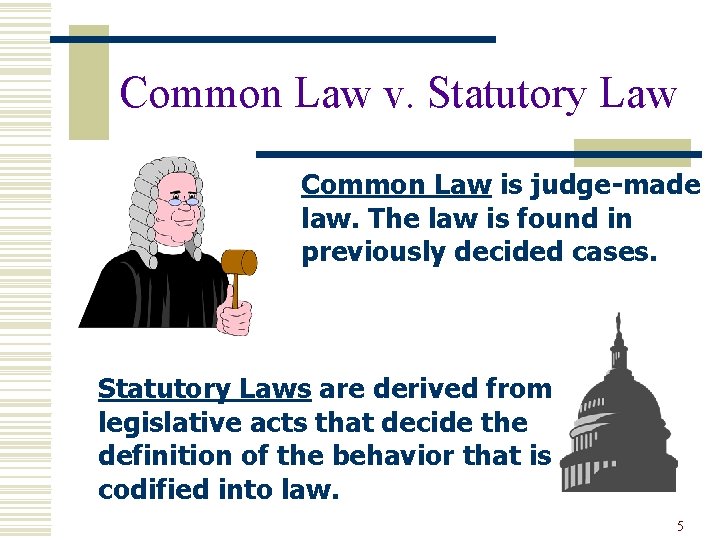
Common Law v. Statutory Law Common Law is judge-made law. The law is found in previously decided cases. Statutory Laws are derived from legislative acts that decide the definition of the behavior that is codified into law. 5
Criminal and Tort Law w Both seek to control behavior. w Both impose sanctions (punishments) w Similar areas of legal action exist: e. g. , n n personal assaults white-collar offenses like environmental pollution 6
Criminal and w A public offense w Enforcement is state business w Punishment is often loss of liberties or sometimes death w Fines go to the state w State doesn’t ordinarily appeal w Proof beyond a reasonable doubt Tort Law w A civil or private wrong w Individuals bring action w Sanction is normally monetary damages w Both parties can appeal w Individuals receives the compensation for harm done w “Preponderance of the evidence” is required for a decision. 7
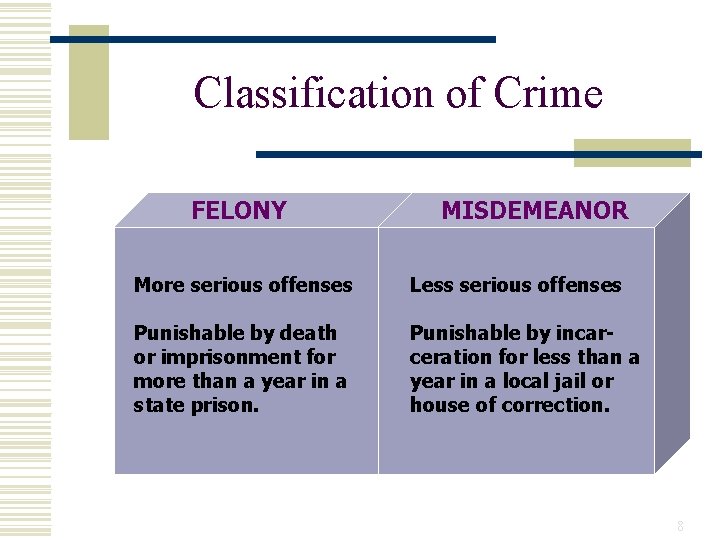
Classification of Crime FELONY MISDEMEANOR More serious offenses Less serious offenses Punishable by death or imprisonment for more than a year in a state prison. Punishable by incarceration for less than a year in a local jail or house of correction. 8
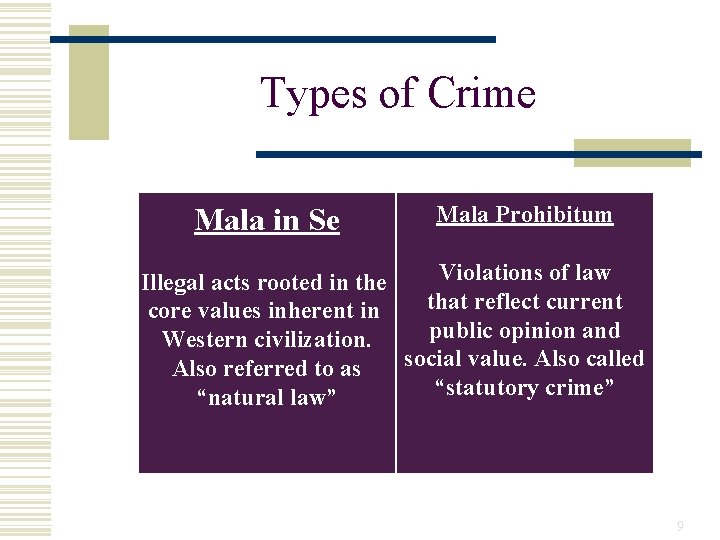
Types of Crime Mala in Se Mala Prohibitum Violations of law Illegal acts rooted in the that reflect current core values inherent in public opinion and Western civilization. social value. Also called Also referred to as “statutory crime” “natural law” 9

Substantive vs. Procedural Law w Substantive Law n Written code that defines crimes and punishments w Procedural Law n Rules of the court, trials. . . 10
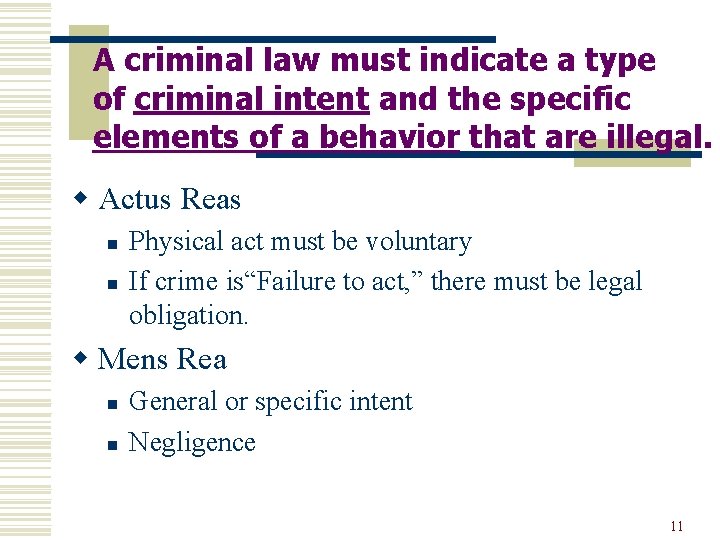
A criminal law must indicate a type of criminal intent and the specific elements of a behavior that are illegal. w Actus Reas n n Physical act must be voluntary If crime is“Failure to act, ” there must be legal obligation. w Mens Rea n n General or specific intent Negligence 11
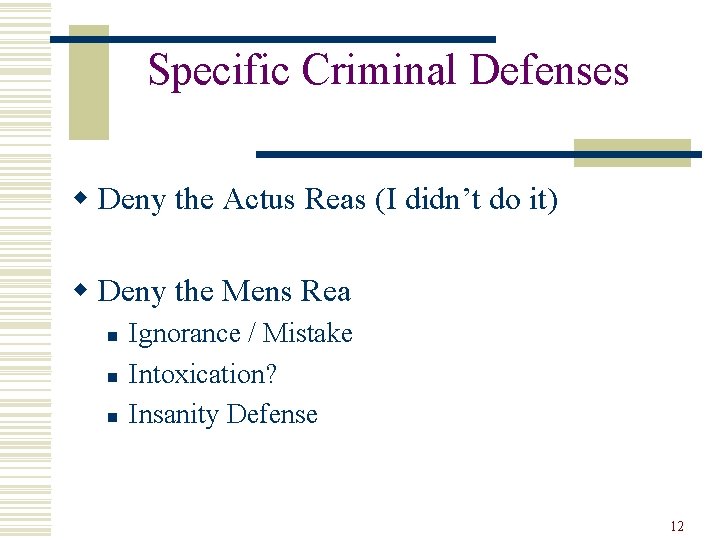
Specific Criminal Defenses w Deny the Actus Reas (I didn’t do it) w Deny the Mens Rea n n n Ignorance / Mistake Intoxication? Insanity Defense 12
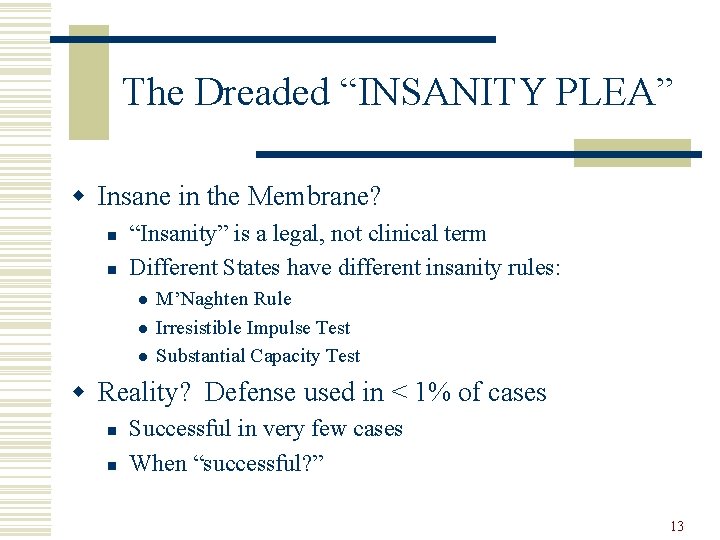
The Dreaded “INSANITY PLEA” w Insane in the Membrane? n n “Insanity” is a legal, not clinical term Different States have different insanity rules: l l l M’Naghten Rule Irresistible Impulse Test Substantial Capacity Test w Reality? Defense used in < 1% of cases n n Successful in very few cases When “successful? ” 13
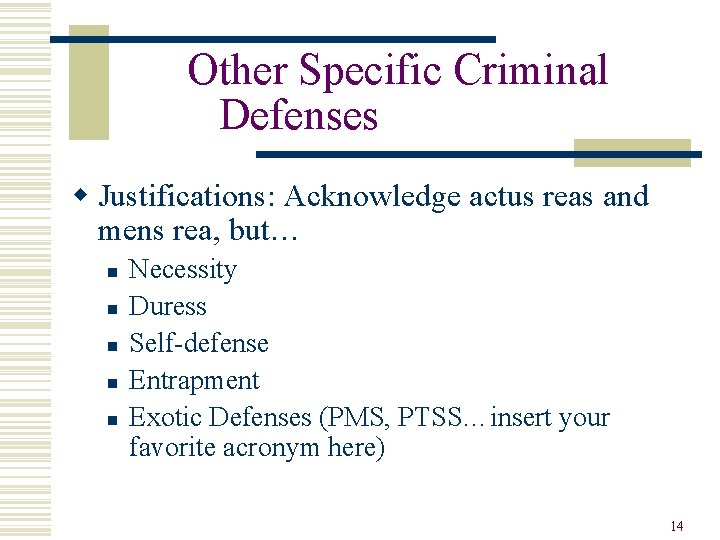
Other Specific Criminal Defenses w Justifications: Acknowledge actus reas and mens rea, but… n n n Necessity Duress Self-defense Entrapment Exotic Defenses (PMS, PTSS…insert your favorite acronym here) 14
- Slides: 14