
What is a JHA and How Do I
- Slides: 18
What is a JHA and How Do I Use It? Presented by Bill Jividan, CSP
Purpose n To inform safety proponents about a very useful tool that can be used to indentify hazards and to have a plan on how to control or eliminate hazards.
What is a hazard? n A hazard is the potential for harm. In practical terms, a hazard often is associated with a condition or activity that, if left uncontrolled, can result in an injury or illness.
JHA Definition n OSHA defines a Job Hazard Analysis as: a technique that focuses on job tasks as a way to identify hazards before they occur. n It focuses on the relationship between the worker, the task, the tools, and the work environment. n A JHA is on component of the larger commitment of a safety and health management system.
What’s the difference between JHA and JSA’s? n A Job Hazard Analysis should be the preliminary step to evaluating hazards associated with any job category or function. n The JHA assigns risk while the JSA identifies specific hazards and provides tools to remediate the hazards.
Continued n Performing a JHA prior to a JSA is critical because it allows a company to prioritize the implementation of its workplace safety efforts.
Why is a JHA important? n One of the best ways to determine and establish proper work procedures is to conduct a JHA. n A JHA is one component of the larger commitment of a safety and health management system
What value does a JHA have? n JHA’s help identify, eliminate and prevent hazards in the workplace. n This will likely result in fewer worker injuries and illnesses, safer, more effective work methods and reduced workers compensation costs and increased worker productivity.
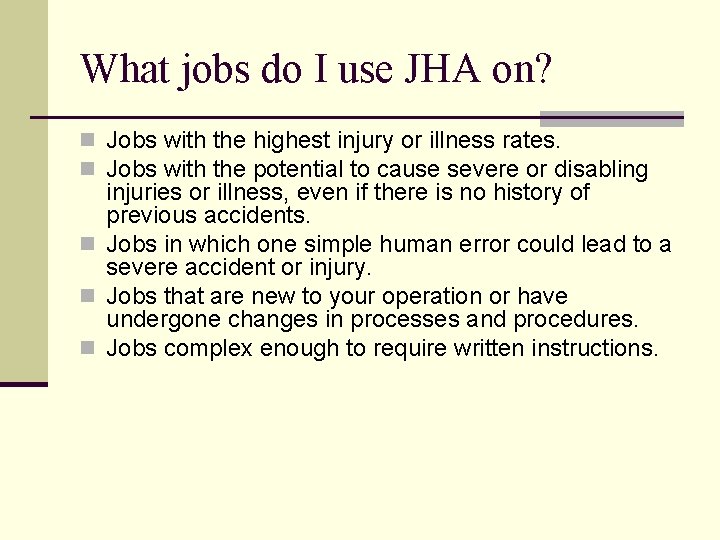
What jobs do I use JHA on? n Jobs with the highest injury or illness rates. n Jobs with the potential to cause severe or disabling injuries or illness, even if there is no history of previous accidents. n Jobs in which one simple human error could lead to a severe accident or injury. n Jobs that are new to your operation or have undergone changes in processes and procedures. n Jobs complex enough to require written instructions.
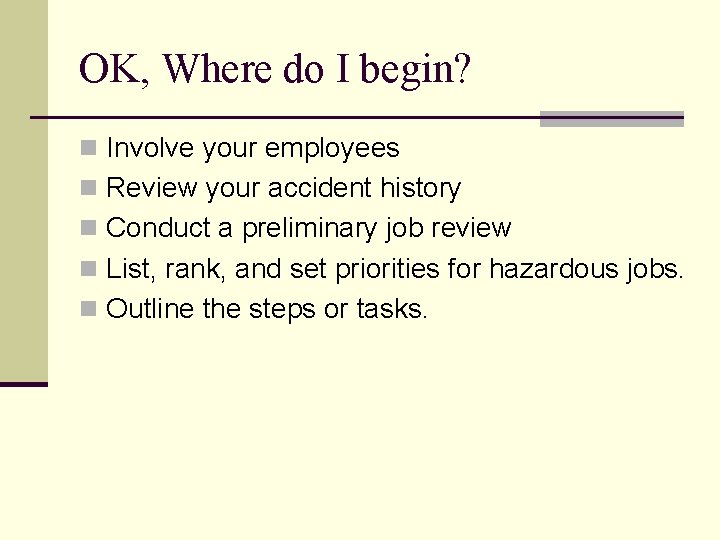
OK, Where do I begin? n Involve your employees n Review your accident history n Conduct a preliminary job review n List, rank, and set priorities for hazardous jobs. n Outline the steps or tasks.
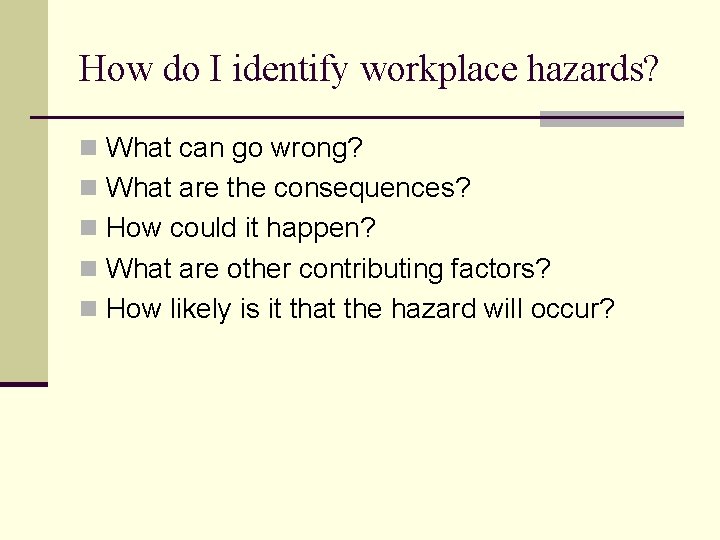
How do I identify workplace hazards? n What can go wrong? n What are the consequences? n How could it happen? n What are other contributing factors? n How likely is it that the hazard will occur?
Sample JHA
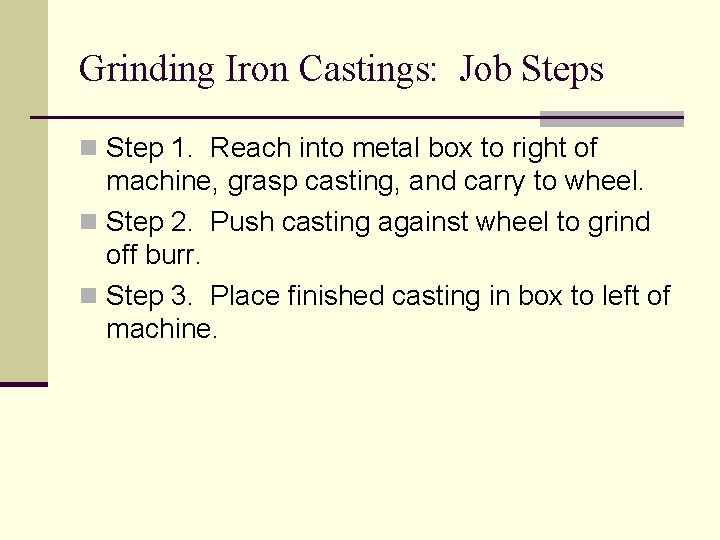
Grinding Iron Castings: Job Steps n Step 1. Reach into metal box to right of machine, grasp casting, and carry to wheel. n Step 2. Push casting against wheel to grind off burr. n Step 3. Place finished casting in box to left of machine.
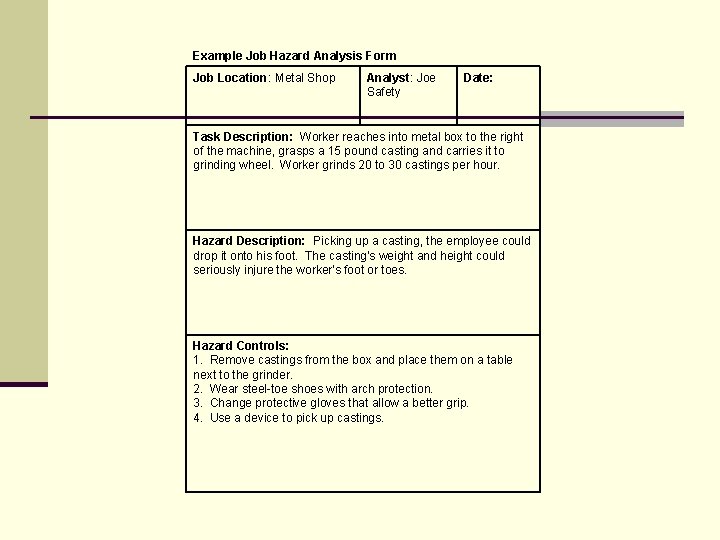
Example Job Hazard Analysis Form Job Location: Metal Shop Analyst: Joe Safety Date: Task Description: Worker reaches into metal box to the right of the machine, grasps a 15 pound casting and carries it to grinding wheel. Worker grinds 20 to 30 castings per hour. Hazard Description: Picking up a casting, the employee could drop it onto his foot. The casting's weight and height could seriously injure the worker's foot or toes. Hazard Controls: 1. Remove castings from the box and place them on a table next to the grinder. 2. Wear steel-toe shoes with arch protection. 3. Change protective gloves that allow a better grip. 4. Use a device to pick up castings.
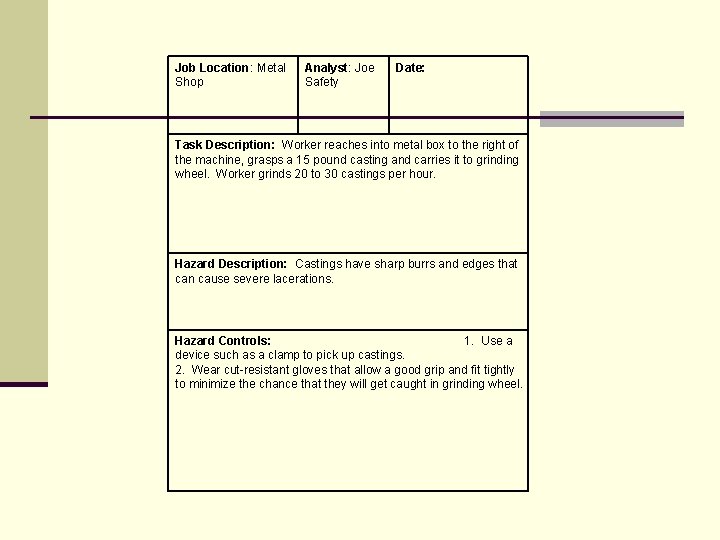
Job Location: Metal Shop Analyst: Joe Safety Date: Task Description: Worker reaches into metal box to the right of the machine, grasps a 15 pound casting and carries it to grinding wheel. Worker grinds 20 to 30 castings per hour. Hazard Description: Castings have sharp burrs and edges that can cause severe lacerations. Hazard Controls: 1. Use a device such as a clamp to pick up castings. 2. Wear cut-resistant gloves that allow a good grip and fit tightly to minimize the chance that they will get caught in grinding wheel.
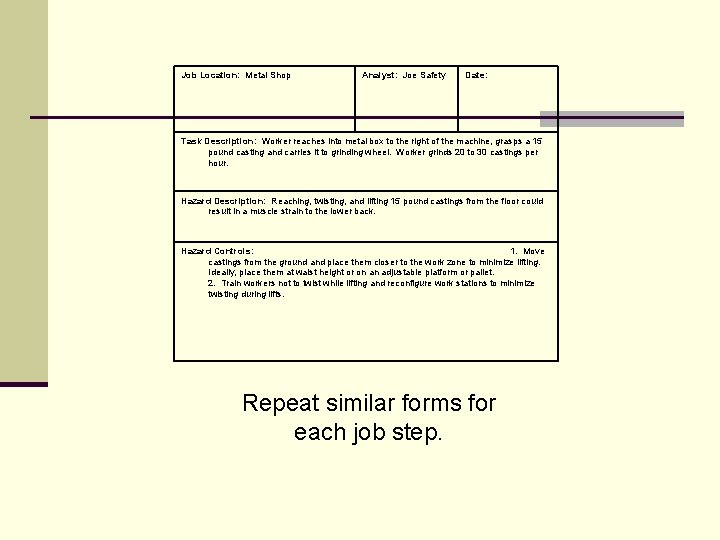
Job Location: Metal Shop Analyst: Joe Safety Date: Task Description: Worker reaches into metal box to the right of the machine, grasps a 15 pound casting and carries it to grinding wheel. Worker grinds 20 to 30 castings per hour. Hazard Description: Reaching, twisting, and lifting 15 pound castings from the floor could result in a muscle strain to the lower back. Hazard Controls: 1. Move castings from the ground and place them closer to the work zone to minimize lifting. Ideally, place them at waist height or on an adjustable platform or pallet. 2. Train workers not to twist while lifting and reconfigure work stations to minimize twisting during lifts. Repeat similar forms for each job step.
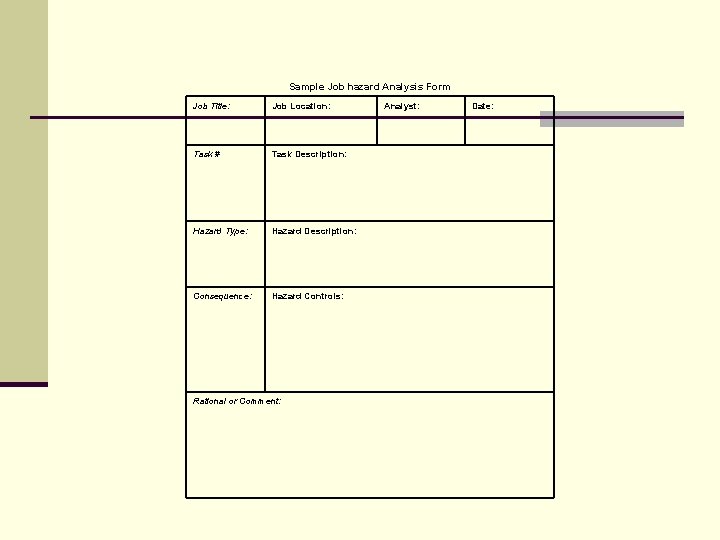
Sample Job hazard Analysis Form Job Title: Job Location: Task # Task Description: Hazard Type: Hazard Description: Consequence: Hazard Controls: Rational or Comment: Analyst: Date:
Questions? n Presented by n Bill Jividan CSP n bjividan@yahoo. com