
What is a Human being How can we
What is a Human being? How can we “conceptualize” - think about - human beings?
Biological Determinism
Biological Determinism The “strong” claims that (1) Peoples’ actions are greatly affected—if not totally determined—by their genetic endowment: the genes that comprise their genome. “Purple” people—by their nature; due to the genes they possess—are more likely to have violent or overly-aggressive tendencies and, as a result, commit more crimes than others. “Green” people—by their nature; due to the genes they possess—are more likely to be sexually promiscuous and, as a result are more likely to be guilty of rape and infidelity than others. “Orange” people—by their nature; due to the genes they possess—are less intelligent than others and, as a result, are more likely to make poor choices in life.
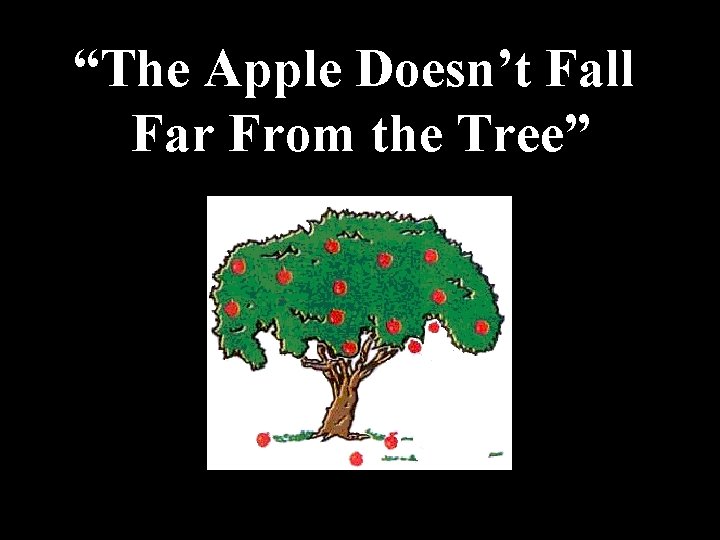
“The Apple Doesn’t Fall Far From the Tree”

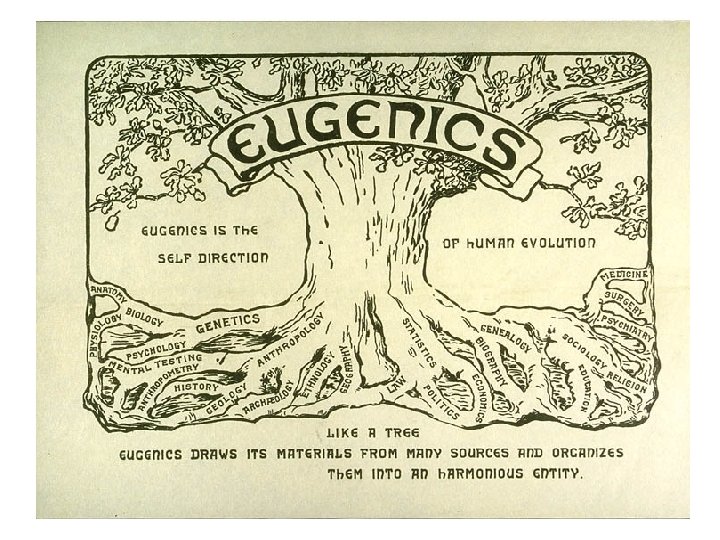
Eugenics
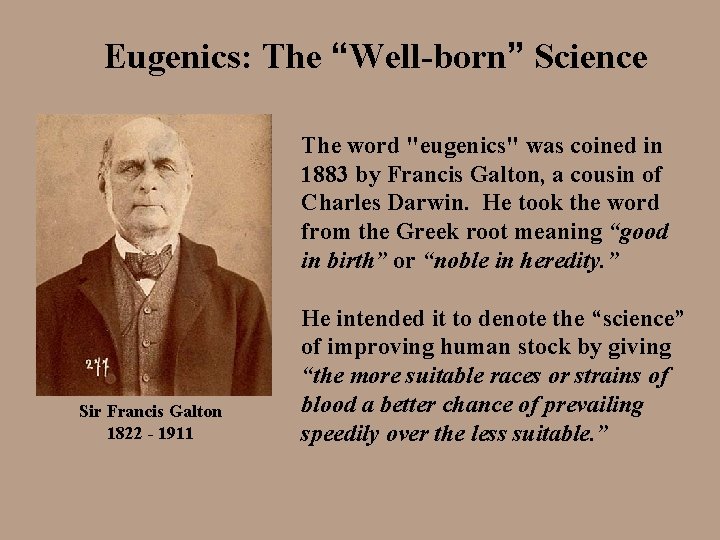
Eugenics: The “Well-born” Science The word "eugenics" was coined in 1883 by Francis Galton, a cousin of Charles Darwin. He took the word from the Greek root meaning “good in birth” or “noble in heredity. ” Sir Francis Galton 1822 - 1911 He intended it to denote the “science” of improving human stock by giving “the more suitable races or strains of blood a better chance of prevailing speedily over the less suitable. ”
Social Contexts – Social Problems Habitual criminals and the high cost of justice Industrialization and the Flood of Immigration “Race Suicide” — declining birth rates The “Woman Problem” – changing morals; birth control “The Menace of the Feebleminded”
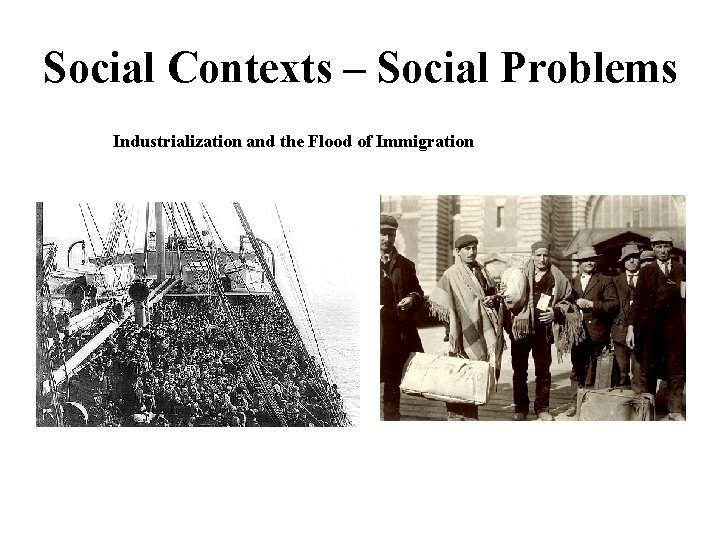
Social Contexts – Social Problems Industrialization and the Flood of Immigration
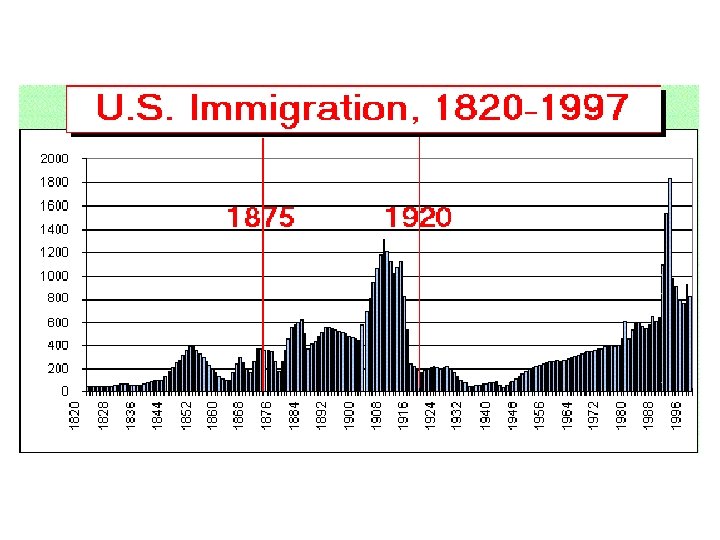
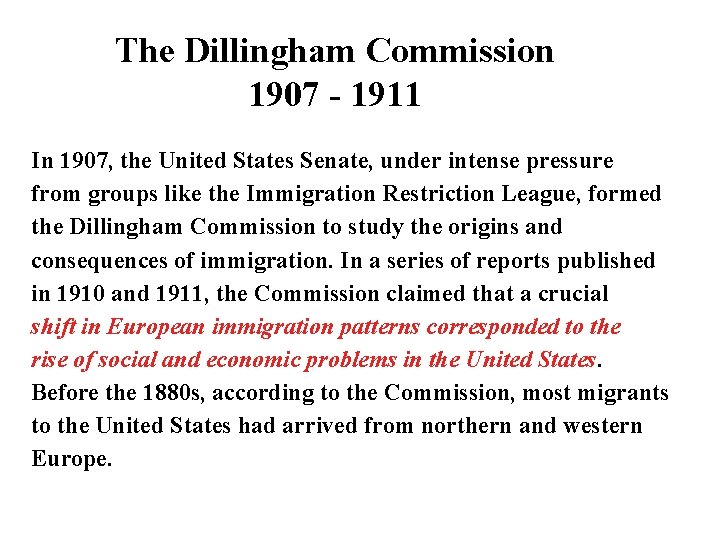
The Dillingham Commission 1907 - 1911 In 1907, the United States Senate, under intense pressure from groups like the Immigration Restriction League, formed the Dillingham Commission to study the origins and consequences of immigration. In a series of reports published in 1910 and 1911, the Commission claimed that a crucial shift in European immigration patterns corresponded to the rise of social and economic problems in the United States. Before the 1880 s, according to the Commission, most migrants to the United States had arrived from northern and western Europe.
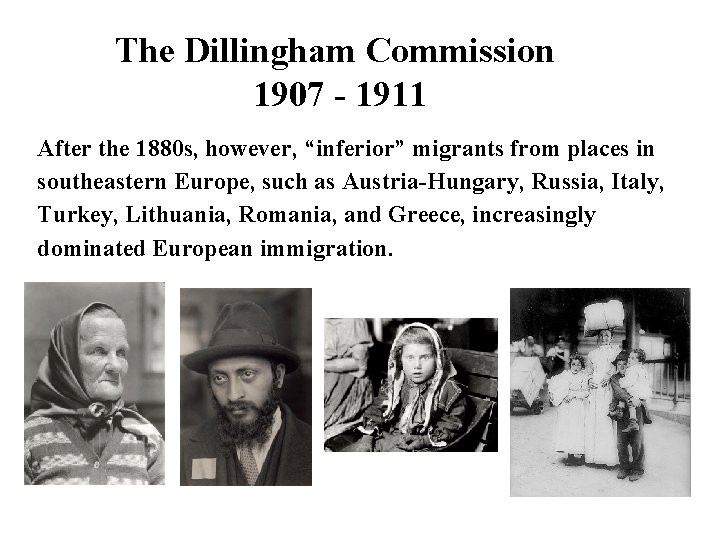
The Dillingham Commission 1907 - 1911 After the 1880 s, however, “inferior” migrants from places in southeastern Europe, such as Austria-Hungary, Russia, Italy, Turkey, Lithuania, Romania, and Greece, increasingly dominated European immigration.
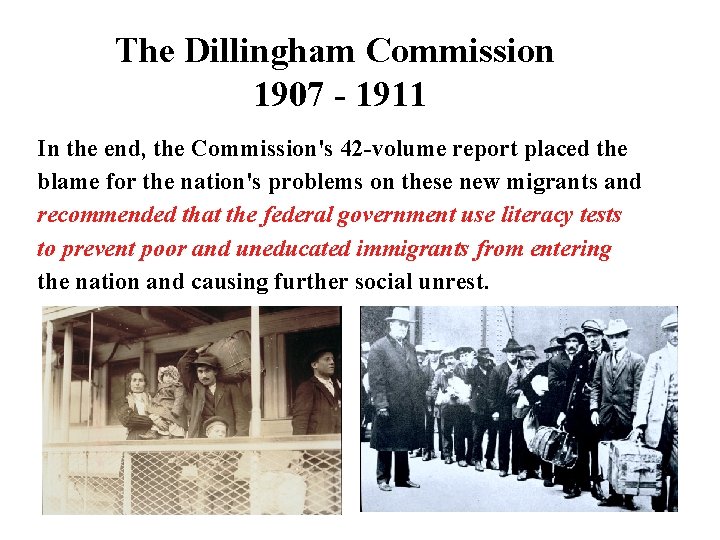
The Dillingham Commission 1907 - 1911 In the end, the Commission's 42 -volume report placed the blame for the nation's problems on these new migrants and recommended that the federal government use literacy tests to prevent poor and uneducated immigrants from entering the nation and causing further social unrest.
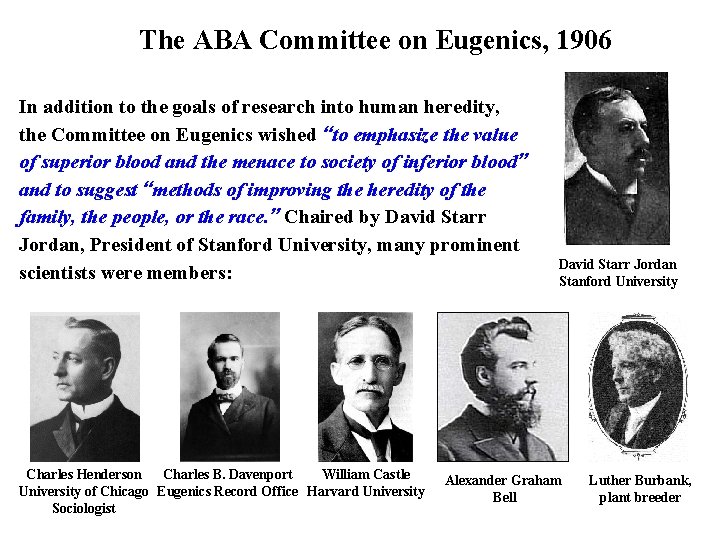
The ABA Committee on Eugenics, 1906 In addition to the goals of research into human heredity, the Committee on Eugenics wished “to emphasize the value of superior blood and the menace to society of inferior blood” and to suggest “methods of improving the heredity of the family, the people, or the race. ” Chaired by David Starr Jordan, President of Stanford University, many prominent scientists were members: Charles Henderson Charles B. Davenport William Castle University of Chicago Eugenics Record Office Harvard University Sociologist David Starr Jordan Stanford University Alexander Graham Bell Luther Burbank, plant breeder
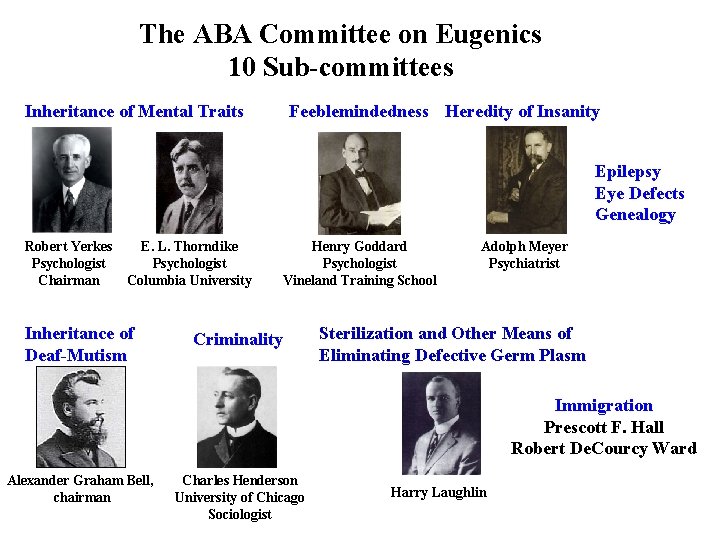
The ABA Committee on Eugenics 10 Sub-committees Inheritance of Mental Traits Feeblemindedness Heredity of Insanity Epilepsy Eye Defects Genealogy Robert Yerkes Psychologist Chairman E. L. Thorndike Psychologist Columbia University Inheritance of Deaf-Mutism Henry Goddard Psychologist Vineland Training School Criminality Adolph Meyer Psychiatrist Sterilization and Other Means of Eliminating Defective Germ Plasm Immigration Prescott F. Hall Robert De. Courcy Ward Alexander Graham Bell, chairman Charles Henderson University of Chicago Sociologist Harry Laughlin
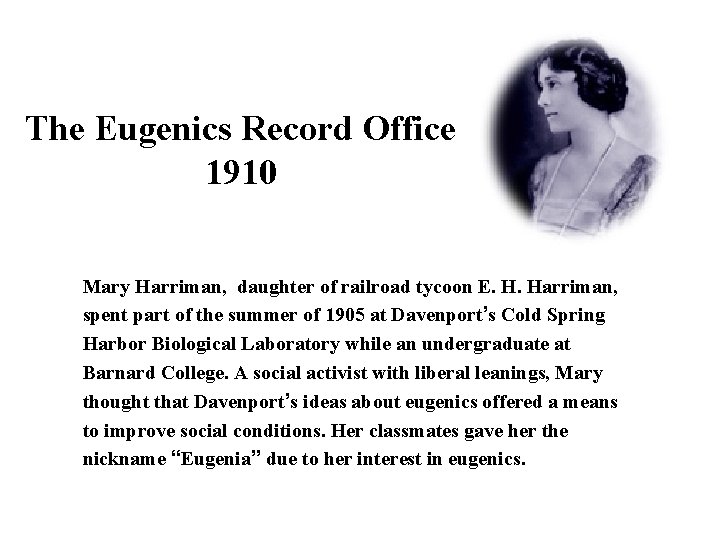
The Eugenics Record Office 1910 Mary Harriman, daughter of railroad tycoon E. H. Harriman, spent part of the summer of 1905 at Davenport’s Cold Spring Harbor Biological Laboratory while an undergraduate at Barnard College. A social activist with liberal leanings, Mary thought that Davenport’s ideas about eugenics offered a means to improve social conditions. Her classmates gave her the nickname “Eugenia” due to her interest in eugenics.

The American Eugenics Society

Psychology
Human Beings are Learning Machines
Learning A relatively permanent change in behavior due to experience
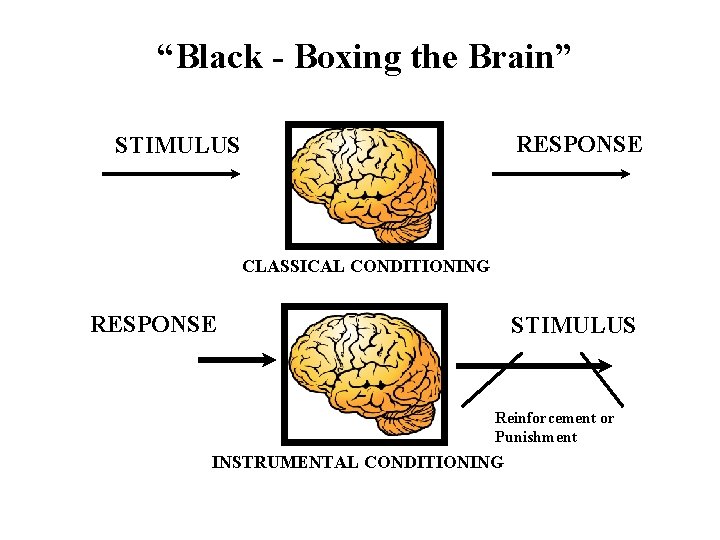
“Black - Boxing the Brain” RESPONSE STIMULUS CLASSICAL CONDITIONING RESPONSE STIMULUS Reinforcement or Punishment INSTRUMENTAL CONDITIONING
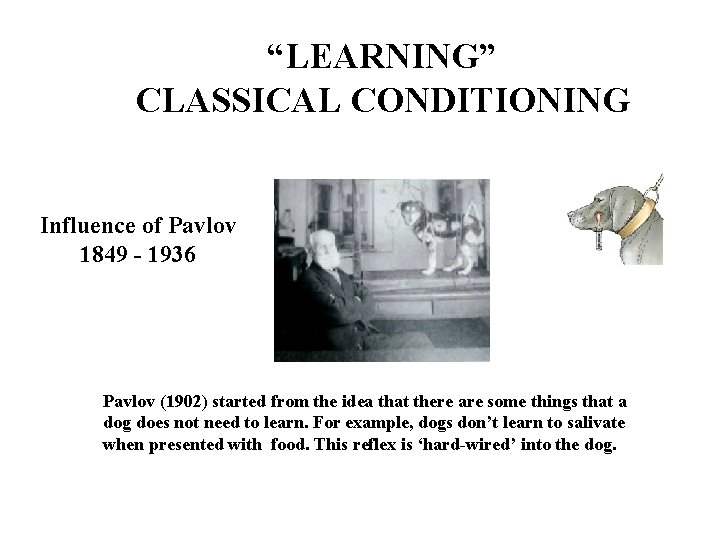
“LEARNING” CLASSICAL CONDITIONING Influence of Pavlov 1849 - 1936 Pavlov (1902) started from the idea that there are some things that a dog does not need to learn. For example, dogs don’t learn to salivate when presented with food. This reflex is ‘hard-wired’ into the dog.
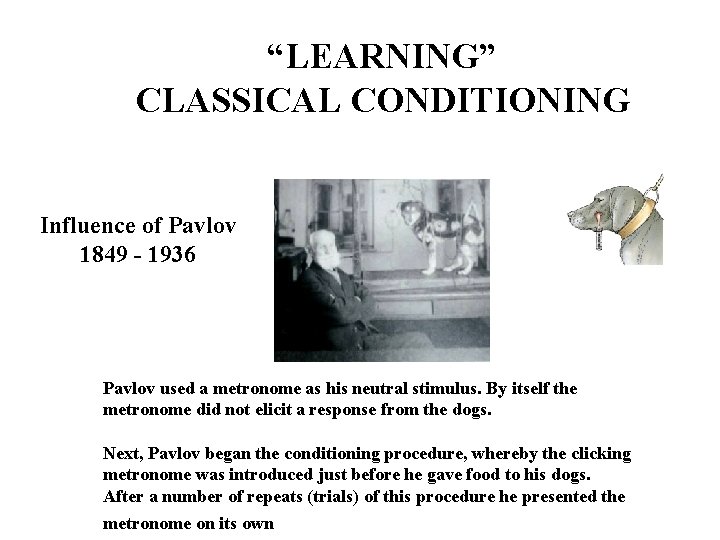
“LEARNING” CLASSICAL CONDITIONING Influence of Pavlov 1849 - 1936 Pavlov used a metronome as his neutral stimulus. By itself the metronome did not elicit a response from the dogs. Next, Pavlov began the conditioning procedure, whereby the clicking metronome was introduced just before he gave food to his dogs. After a number of repeats (trials) of this procedure he presented the metronome on its own
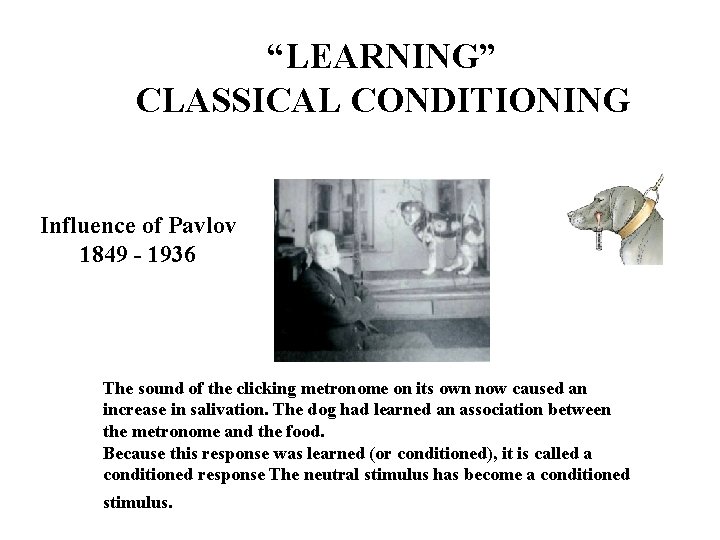
“LEARNING” CLASSICAL CONDITIONING Influence of Pavlov 1849 - 1936 The sound of the clicking metronome on its own now caused an increase in salivation. The dog had learned an association between the metronome and the food. Because this response was learned (or conditioned), it is called a conditioned response The neutral stimulus has become a conditioned stimulus.

“LEARNING” CLASSICAL CONDITIONING Built on the foundation of reflexes 1. 2. 3. Unconditioned stimulus (UCS) elicits Unconditioned response (UCR) Neutral stimulus is paired with the unconditioned stimulus close in time and repeatedly 4. Neutral stimulus acquires the power to elicits the response. 5. Neutral stimulus is now the conditioned stimulus (CS) which elicits the conditioned response (CR).
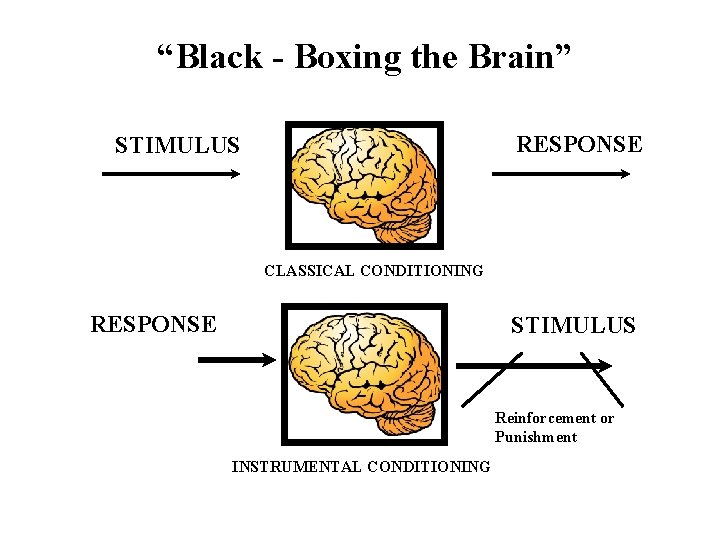
“Black - Boxing the Brain” RESPONSE STIMULUS CLASSICAL CONDITIONING RESPONSE STIMULUS Reinforcement or Punishment INSTRUMENTAL CONDITIONING
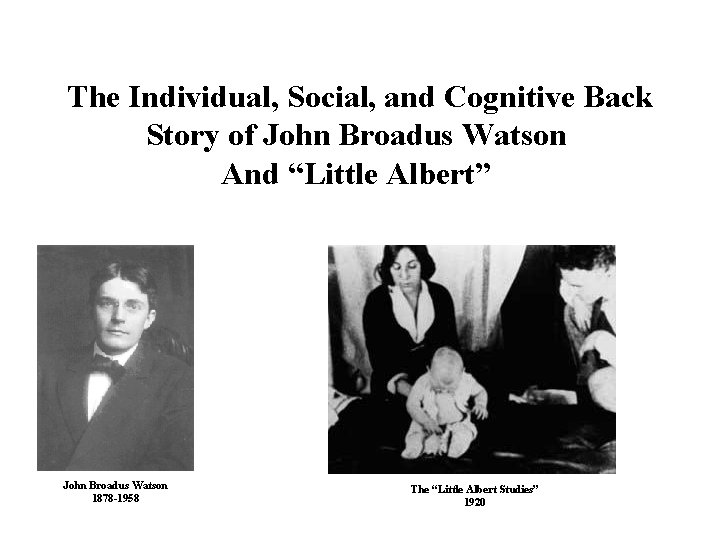
The Individual, Social, and Cognitive Back Story of John Broadus Watson And “Little Albert” John Broadus Watson 1878 -1958 The “Little Albert Studies” 1920
Watson and the University of Chicago Watson entered the University of Chicago in the fall of 1900. He is described as “an ambitious, status-conscious young man desperately insecure about his lack of means and social sophistication. He had $50 in his pocket and paid his board and tuition by working as an assistant janitor at the university and a waiter in a students’ boardinghouse. He chose experimental psychology as his major field and was drawn to animal psychology, doing research under the direction of Jacques Loeb. It is during this time that Watson became convinced that man was but a biological mechanism. ” (Kerry Buckley, Mechanical Man, 1989)

Watson and the University of Chicago “Watson found his identity with those of his generation who discovered that the problems created by an expanding industrial society also provided opportunities for new professions that offered solutions to these problems. When Watson entered the University of Chicago, psychology was considered to be one of the newest professions with particular promise. ” (Kerry Buckley, Mechanical Man, 1989)
Watson and “Psychology as the Behaviorist Views It” In 1913 Watson delivered a series of lectures at Columbia University, which “sent reverberations throughout the psychological community. Watson coined the term “Behaviorism” to distinguish his brand of psychology from the Structuralists and Functionalists.
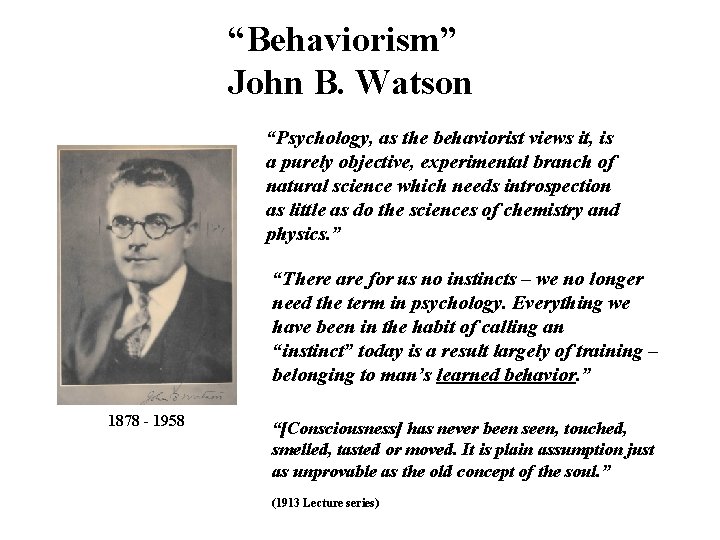
“Behaviorism” John B. Watson “Psychology, as the behaviorist views it, is a purely objective, experimental branch of natural science which needs introspection as little as do the sciences of chemistry and physics. ” “There are for us no instincts – we no longer need the term in psychology. Everything we have been in the habit of calling an “instinct” today is a result largely of training – belonging to man’s learned behavior. ” 1878 - 1958 “[Consciousness] has never been seen, touched, smelled, tasted or moved. It is plain assumption just as unprovable as the old concept of the soul. ” (1913 Lecture series)
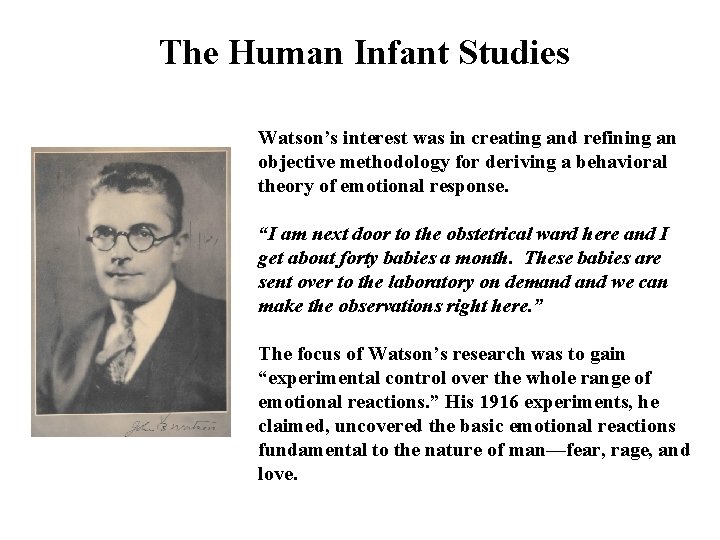
The Human Infant Studies Watson’s interest was in creating and refining an objective methodology for deriving a behavioral theory of emotional response. “I am next door to the obstetrical ward here and I get about forty babies a month. These babies are sent over to the laboratory on demand we can make the observations right here. ” The focus of Watson’s research was to gain “experimental control over the whole range of emotional reactions. ” His 1916 experiments, he claimed, uncovered the basic emotional reactions fundamental to the nature of man—fear, rage, and love.
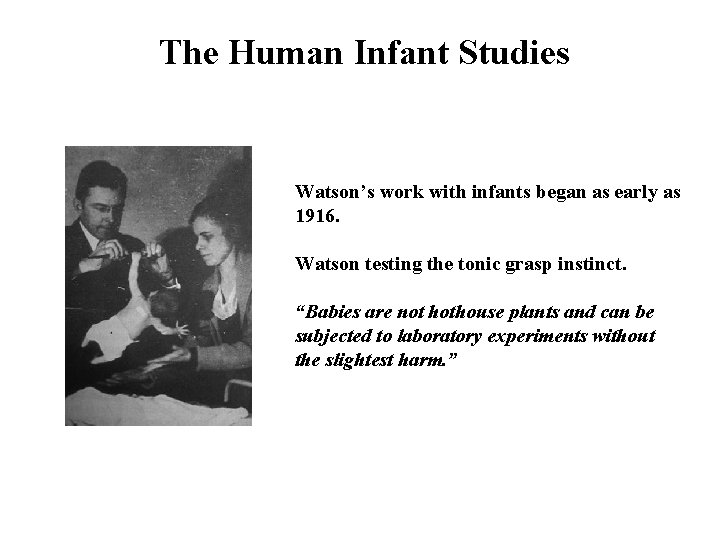
The Human Infant Studies Watson’s work with infants began as early as 1916. Watson testing the tonic grasp instinct. “Babies are not hothouse plants and can be subjected to laboratory experiments without the slightest harm. ”
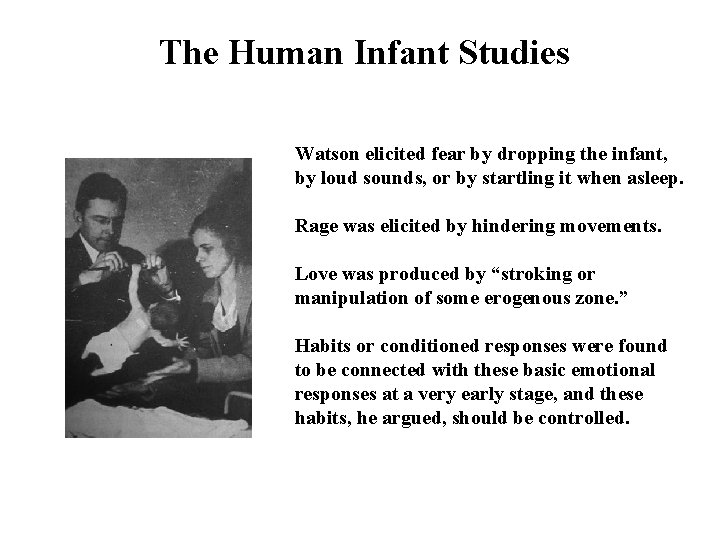
The Human Infant Studies Watson elicited fear by dropping the infant, by loud sounds, or by startling it when asleep. Rage was elicited by hindering movements. Love was produced by “stroking or manipulation of some erogenous zone. ” Habits or conditioned responses were found to be connected with these basic emotional responses at a very early stage, and these habits, he argued, should be controlled.
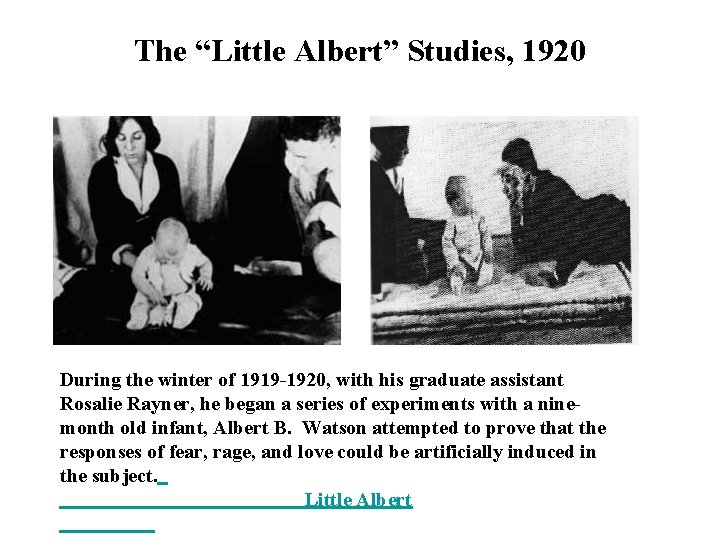
The “Little Albert” Studies, 1920 During the winter of 1919 -1920, with his graduate assistant Rosalie Rayner, he began a series of experiments with a ninemonth old infant, Albert B. Watson attempted to prove that the responses of fear, rage, and love could be artificially induced in the subject. Little Albert
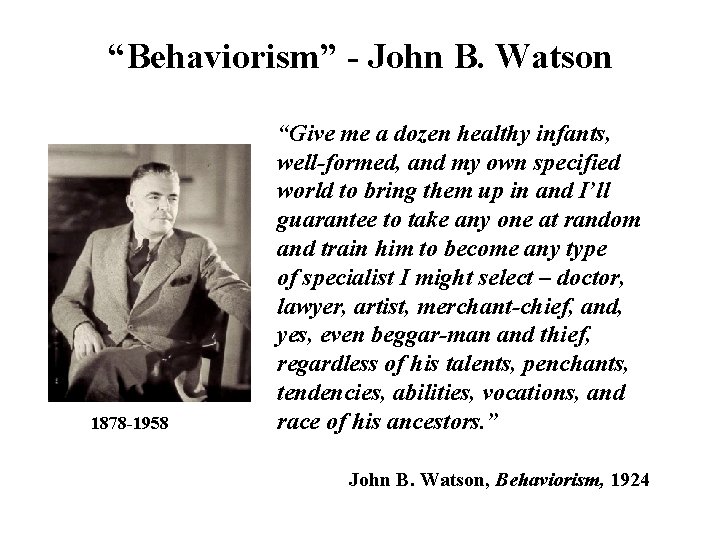
“Behaviorism” - John B. Watson 1878 -1958 “Give me a dozen healthy infants, well-formed, and my own specified world to bring them up in and I’ll guarantee to take any one at random and train him to become any type of specialist I might select – doctor, lawyer, artist, merchant-chief, and, yes, even beggar-man and thief, regardless of his talents, penchants, tendencies, abilities, vocations, and race of his ancestors. ” John B. Watson, Behaviorism, 1924
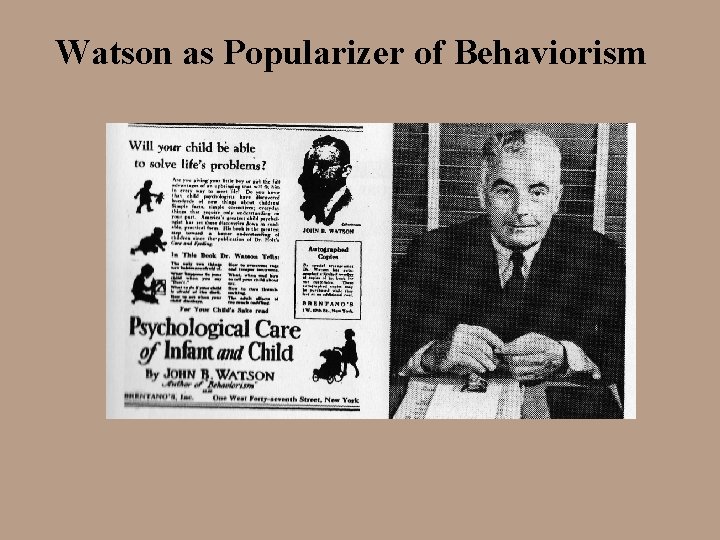
Watson as Popularizer of Behaviorism
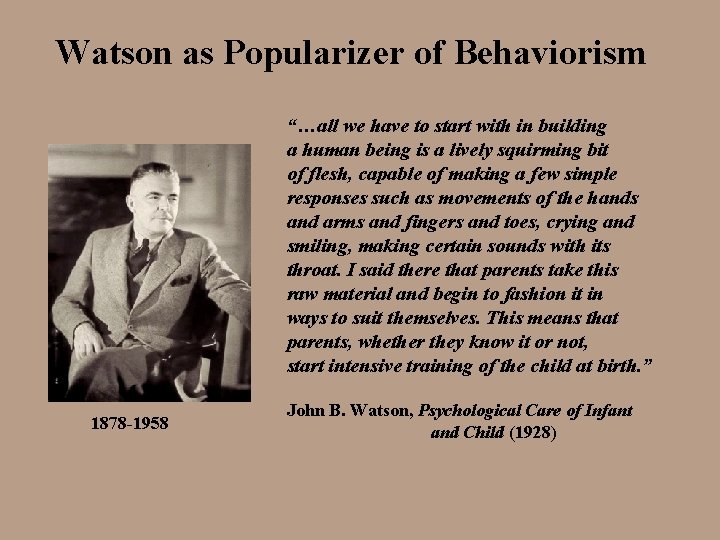
Watson as Popularizer of Behaviorism “…all we have to start with in building a human being is a lively squirming bit of flesh, capable of making a few simple responses such as movements of the hands and arms and fingers and toes, crying and smiling, making certain sounds with its throat. I said there that parents take this raw material and begin to fashion it in ways to suit themselves. This means that parents, whether they know it or not, start intensive training of the child at birth. ” 1878 -1958 John B. Watson, Psychological Care of Infant and Child (1928)
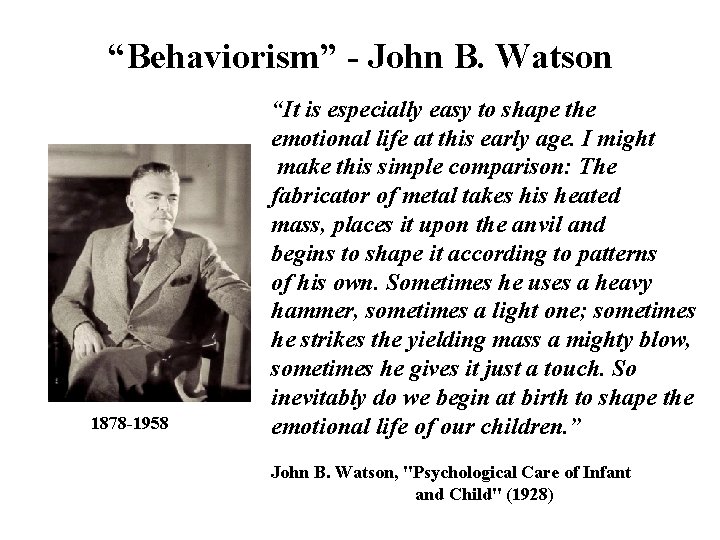
“Behaviorism” - John B. Watson 1878 -1958 “It is especially easy to shape the emotional life at this early age. I might make this simple comparison: The fabricator of metal takes his heated mass, places it upon the anvil and begins to shape it according to patterns of his own. Sometimes he uses a heavy hammer, sometimes a light one; sometimes he strikes the yielding mass a mighty blow, sometimes he gives it just a touch. So inevitably do we begin at birth to shape the emotional life of our children. ” John B. Watson, "Psychological Care of Infant and Child" (1928)
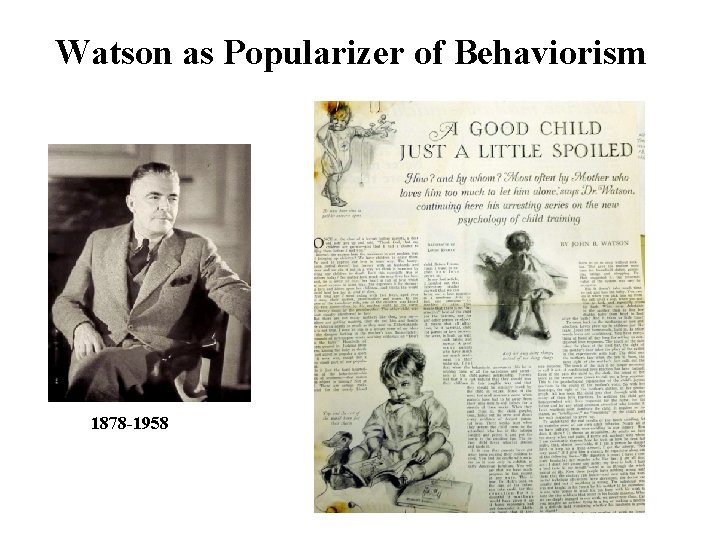
Watson as Popularizer of Behaviorism 1878 -1958
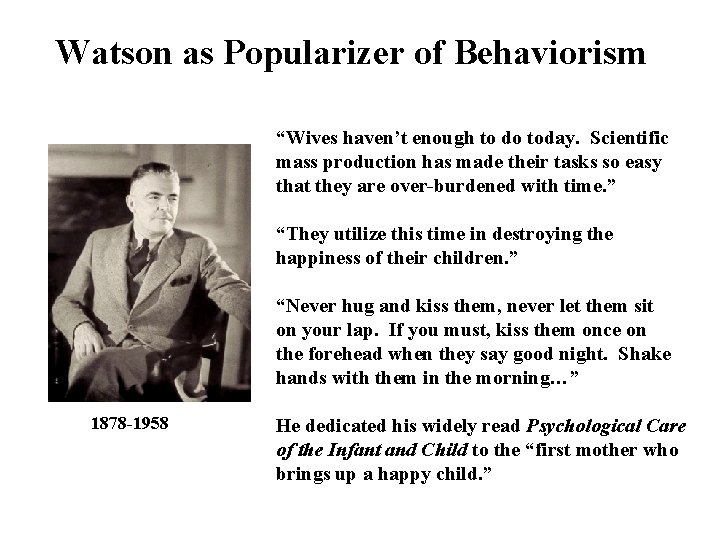
Watson as Popularizer of Behaviorism “Wives haven’t enough to do today. Scientific mass production has made their tasks so easy that they are over-burdened with time. ” “They utilize this time in destroying the happiness of their children. ” “Never hug and kiss them, never let them sit on your lap. If you must, kiss them once on the forehead when they say good night. Shake hands with them in the morning…” 1878 -1958 He dedicated his widely read Psychological Care of the Infant and Child to the “first mother who brings up a happy child. ”
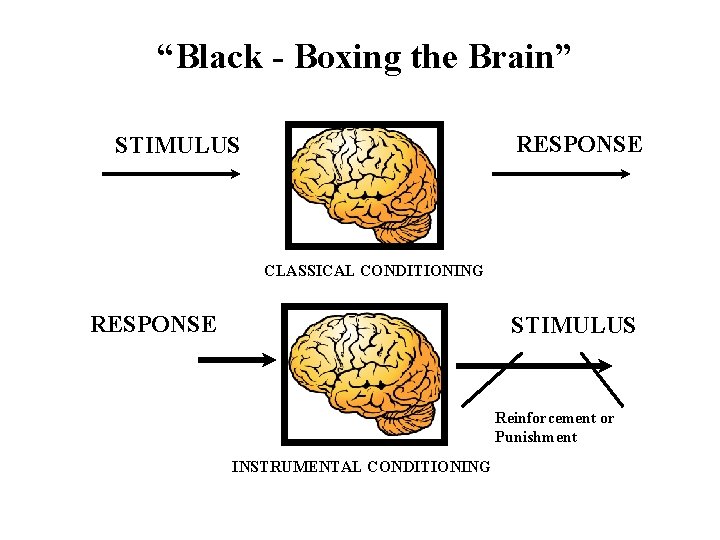
“Black - Boxing the Brain” RESPONSE STIMULUS CLASSICAL CONDITIONING RESPONSE STIMULUS Reinforcement or Punishment INSTRUMENTAL CONDITIONING
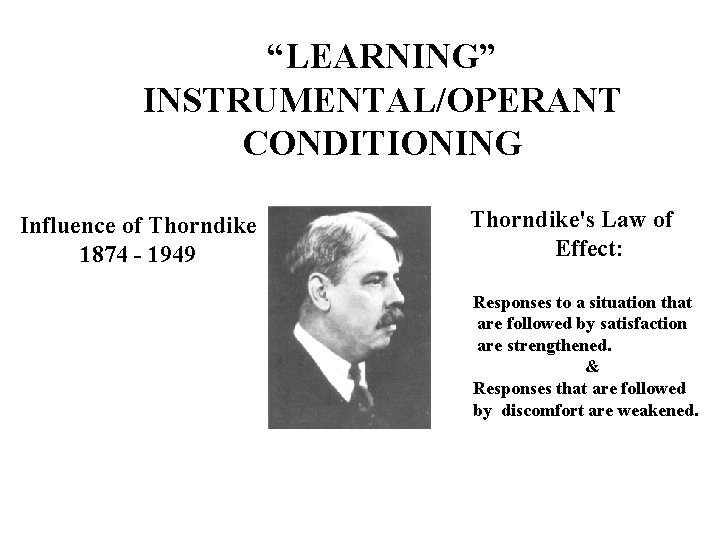
“LEARNING” INSTRUMENTAL/OPERANT CONDITIONING Influence of Thorndike 1874 - 1949 Thorndike's Law of Effect: Responses to a situation that are followed by satisfaction are strengthened. & Responses that are followed by discomfort are weakened.
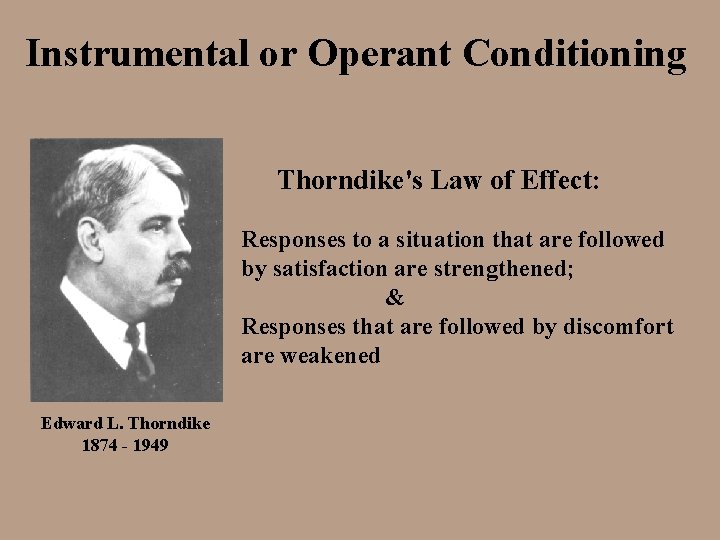
Instrumental or Operant Conditioning Thorndike's Law of Effect: Responses to a situation that are followed by satisfaction are strengthened; & Responses that are followed by discomfort are weakened Edward L. Thorndike 1874 - 1949
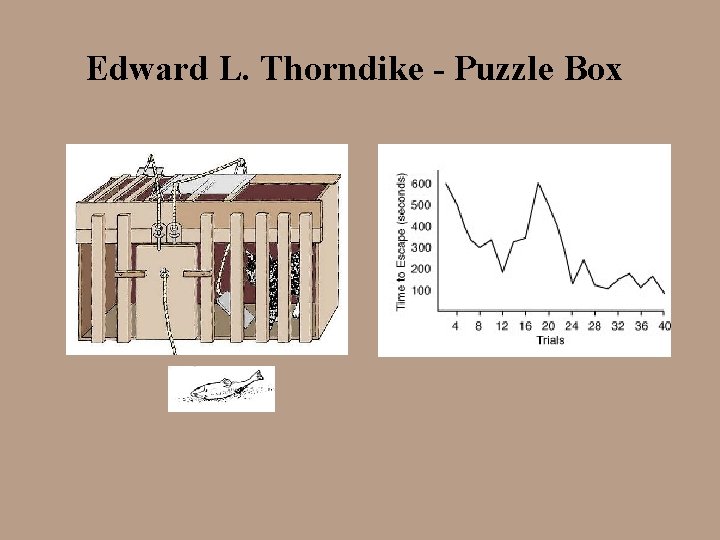
Edward L. Thorndike - Puzzle Box

B. F. Skinner 1904 - 1990 R S Reinforcements Punishments
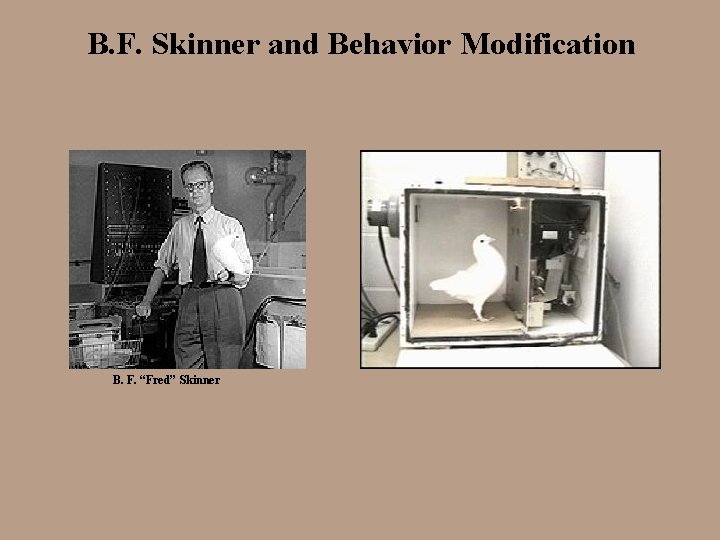
B. F. Skinner and Behavior Modification B. F. “Fred” Skinner
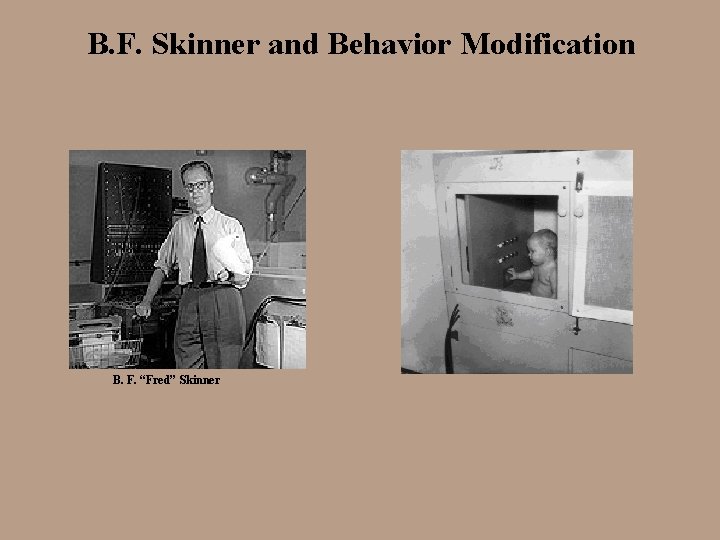
B. F. Skinner and Behavior Modification B. F. “Fred” Skinner

Sheldon & Penny
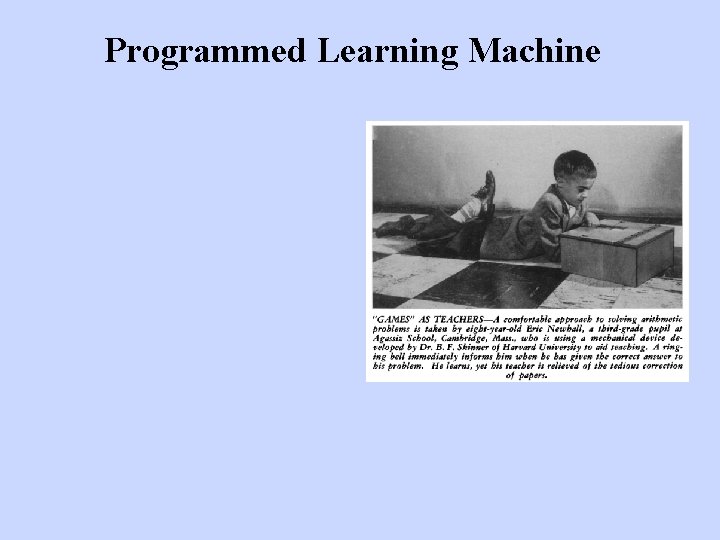
Programmed Learning Machine
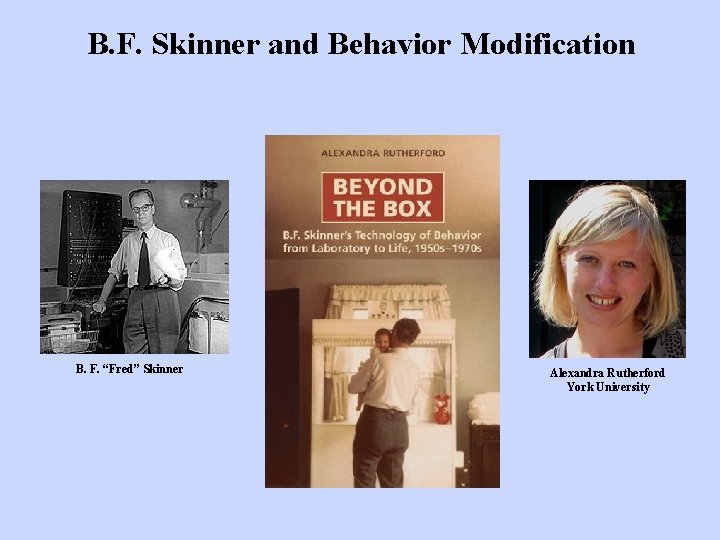
B. F. Skinner and Behavior Modification B. F. “Fred” Skinner Alexandra Rutherford York University
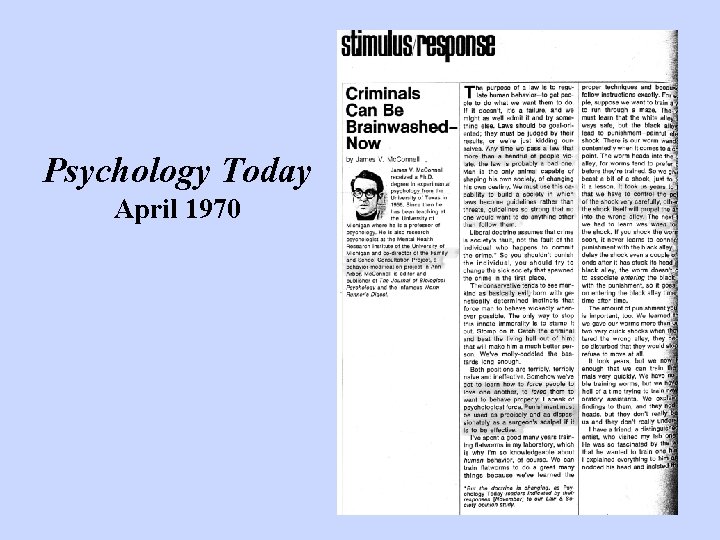
Psychology Today April 1970
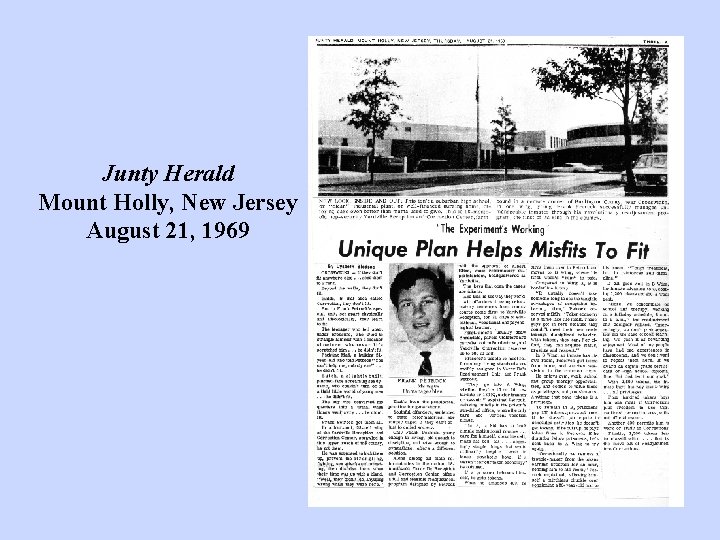
Junty Herald Mount Holly, New Jersey August 21, 1969

1971 4 Oscar Nominations: Best Director Best Picture Best Screenplay Best Film Editing Gross: $25, 589, 355
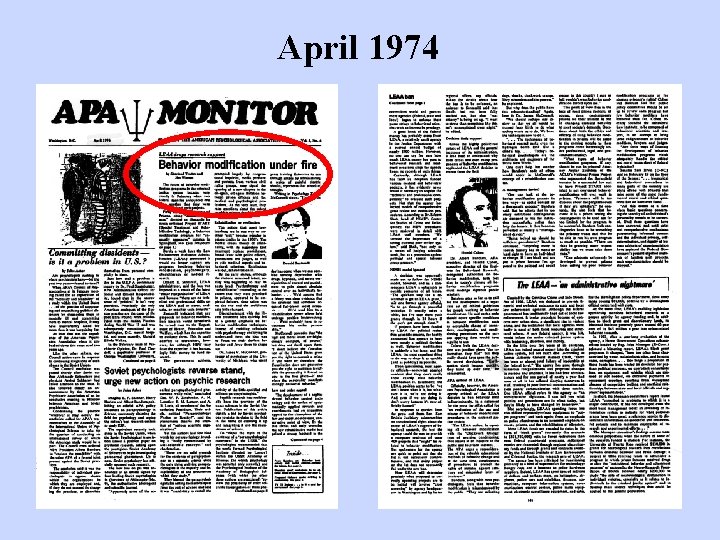
April 1974
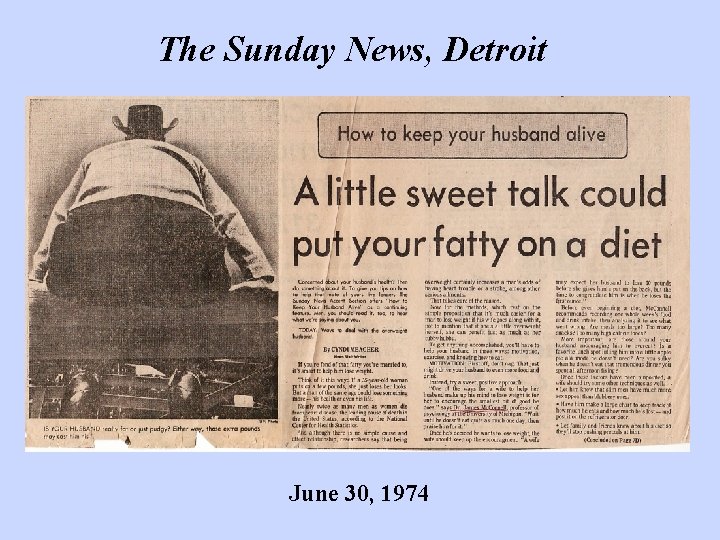
The Sunday News, Detroit June 30, 1974
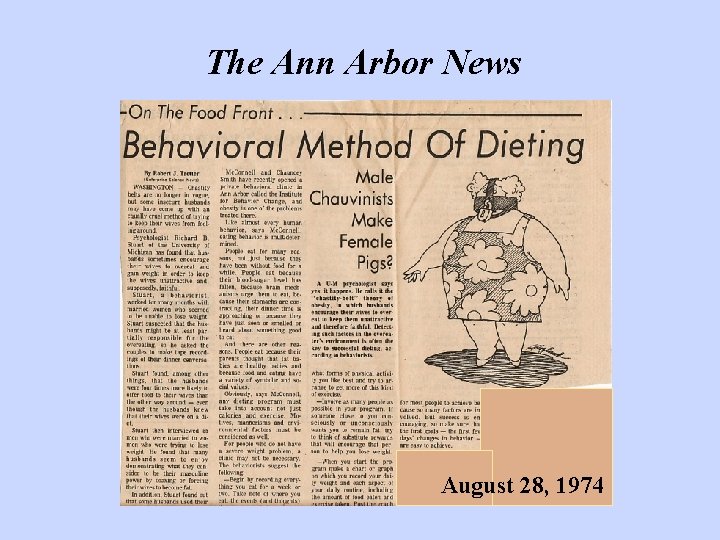
The Ann Arbor News August 28, 1974
- Slides: 57