
What is a Graph A graph G V
- Slides: 25
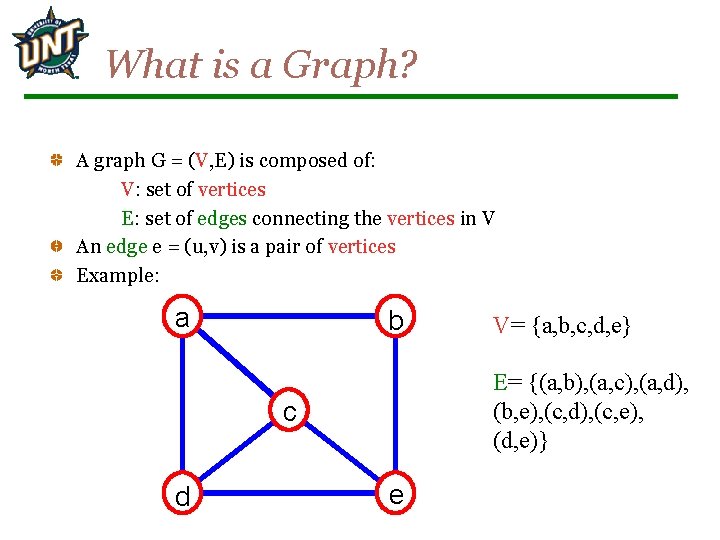
What is a Graph? A graph G = (V, E) is composed of: V: set of vertices E: set of edges connecting the vertices in V An edge e = (u, v) is a pair of vertices Example: a b E= {(a, b), (a, c), (a, d), (b, e), (c, d), (c, e), (d, e)} c d V= {a, b, c, d, e} e
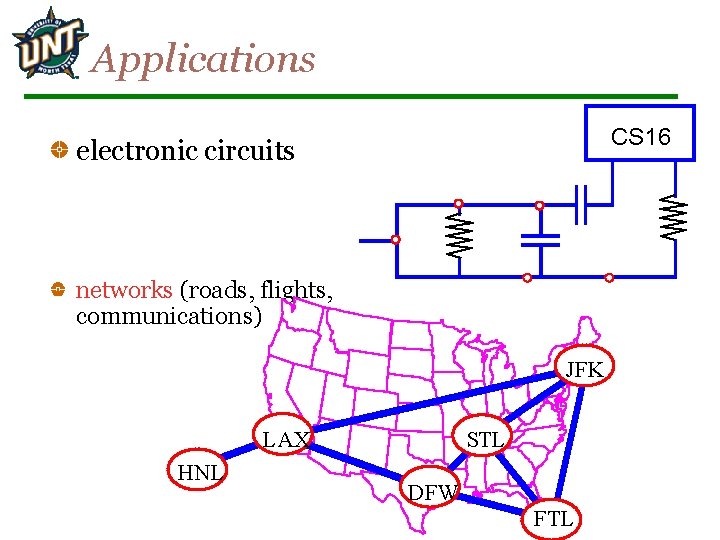
Applications CS 16 electronic circuits networks (roads, flights, communications) JFK LAX HNL STL DFW FTL
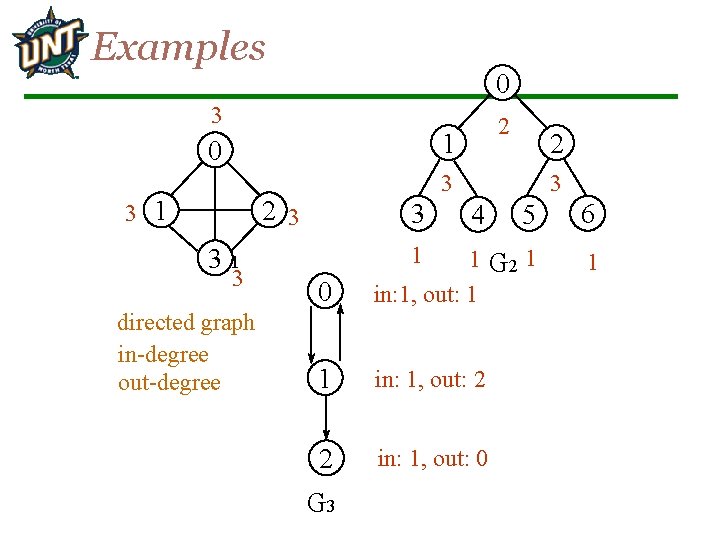
Terminology: Degree of a Vertex The degree of a vertex is the number of edges incident to that vertex For directed graph, the in-degree of a vertex v is the number of edges that have v as the head the out-degree of a vertex v is the number of edges that have v as the tail
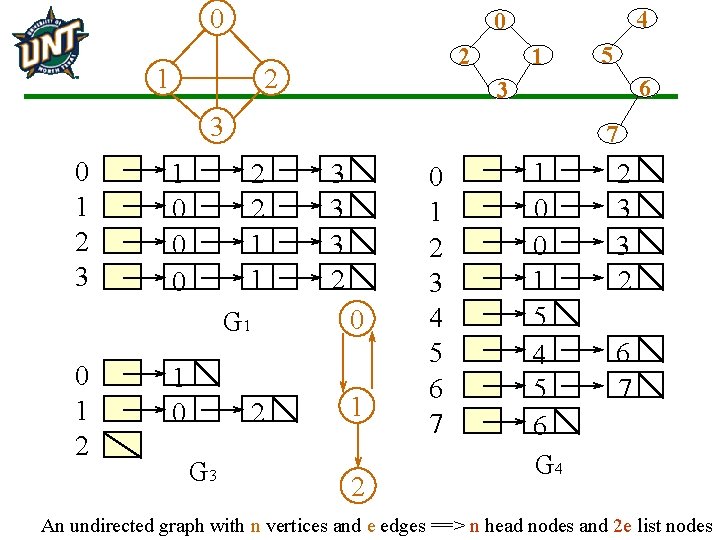
Examples 0 3 2 1 0 3 1 3 2 3 3 directed graph in-degree out-degree 3 5 6 1 0 1 G 2 1 in: 1, out: 1 1 in: 1, out: 2 2 in: 1, out: 0 4 1 3 G 1 3 2 G 3
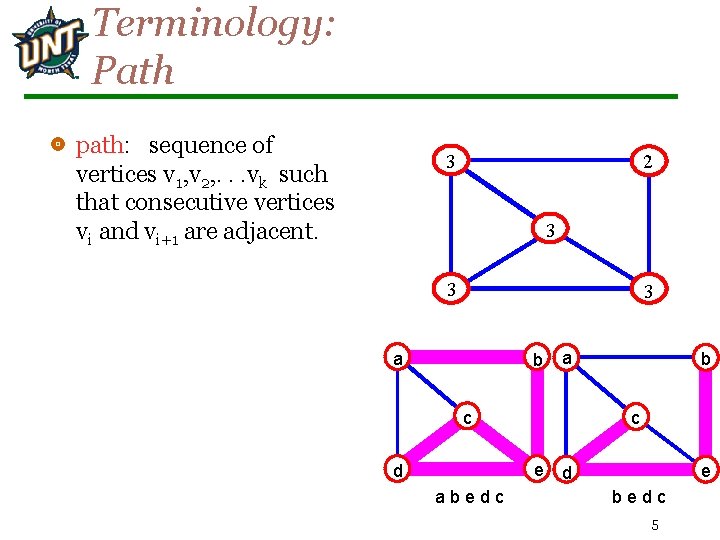
Terminology: Path path: sequence of vertices v 1, v 2, . . . vk such that consecutive vertices vi and vi+1 are adjacent. 3 2 3 3 3 a b a c b c e d d abedc e bedc 5
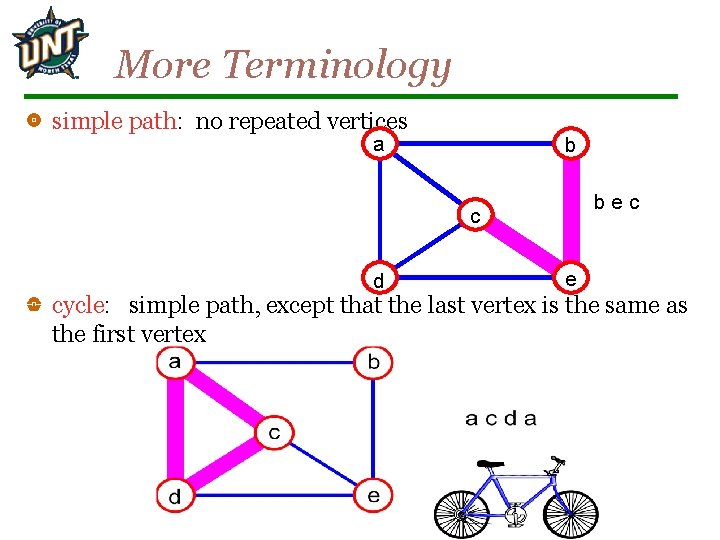
More Terminology simple path: no repeated vertices a b bec c d e cycle: simple path, except that the last vertex is the same as the first vertex
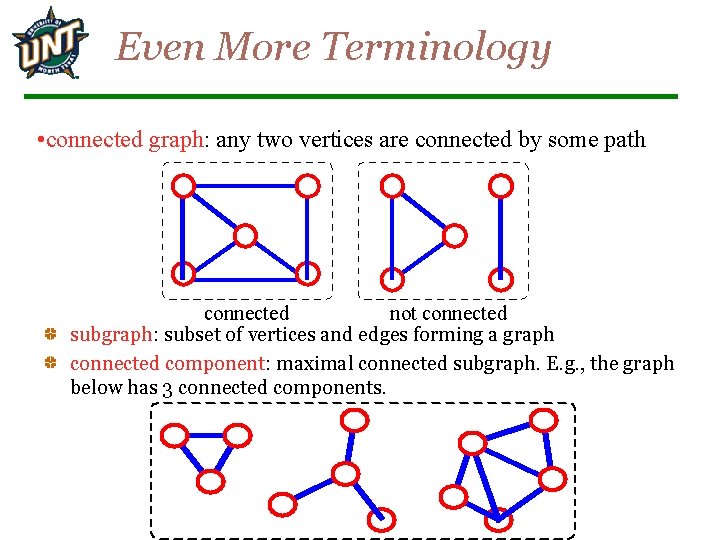
Even More Terminology • connected graph: any two vertices are connected by some path connected not connected subgraph: subset of vertices and edges forming a graph connected component: maximal connected subgraph. E. g. , the graph below has 3 connected components.
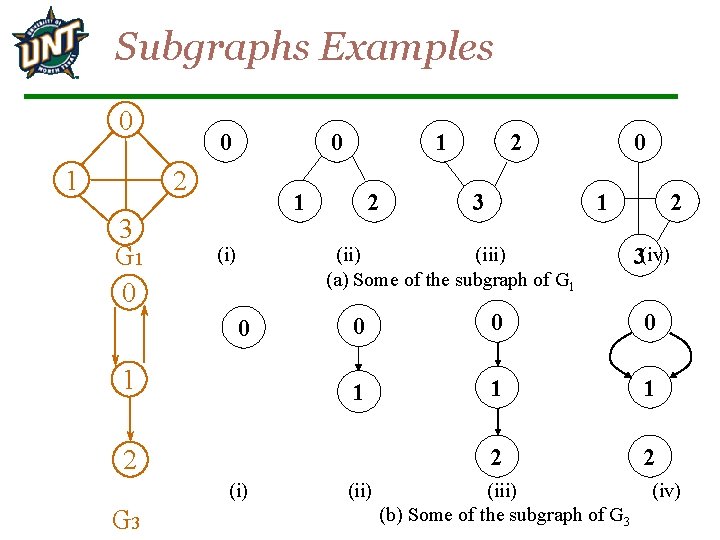
Subgraphs Examples 0 1 0 0 2 3 G 1 0 1 1 (i) 2 3 0 1 (ii) (iii) (a) Some of the subgraph of G 1 0 1 (i) 2 3(iv) 0 0 0 1 1 1 2 2 2 G 3 2 (ii) (iii) (b) Some of the subgraph of G 3 (iv)
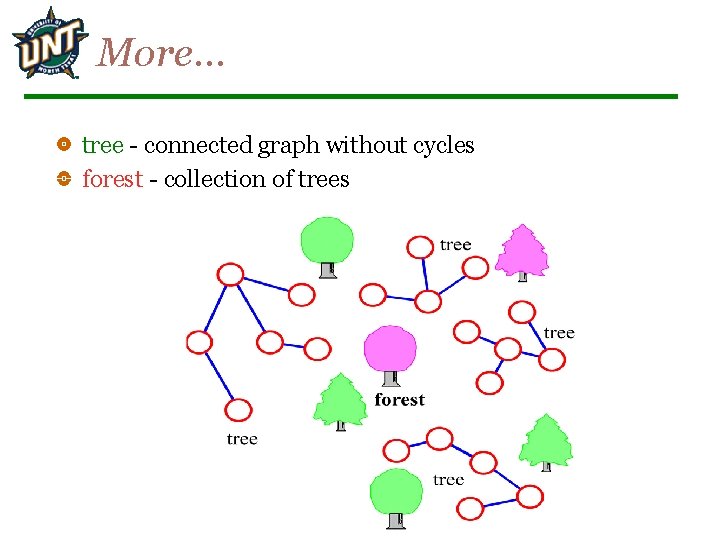
More… tree - connected graph without cycles forest - collection of trees
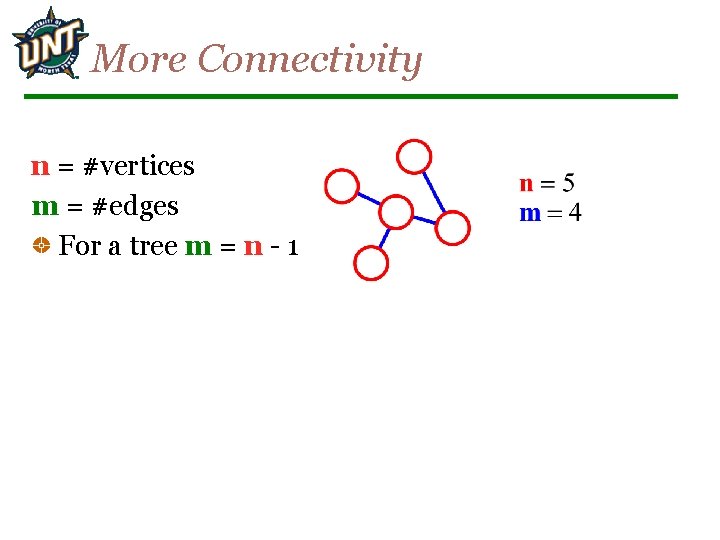
More Connectivity n = #vertices m = #edges For a tree m = n - 1
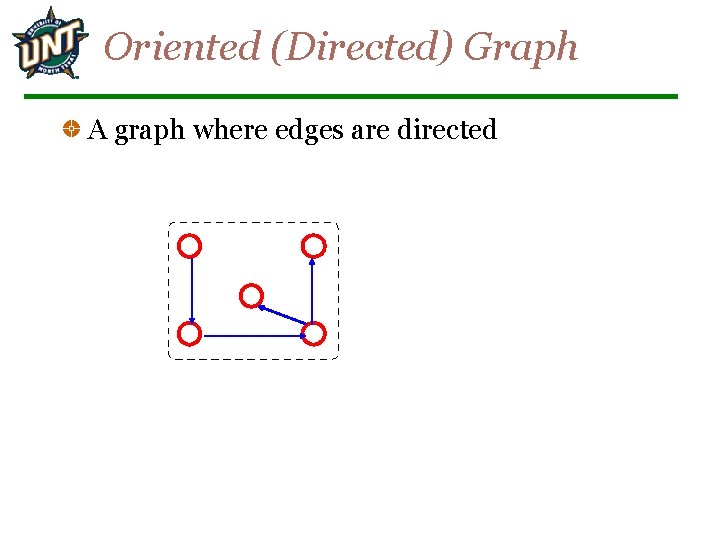
Oriented (Directed) Graph A graph where edges are directed
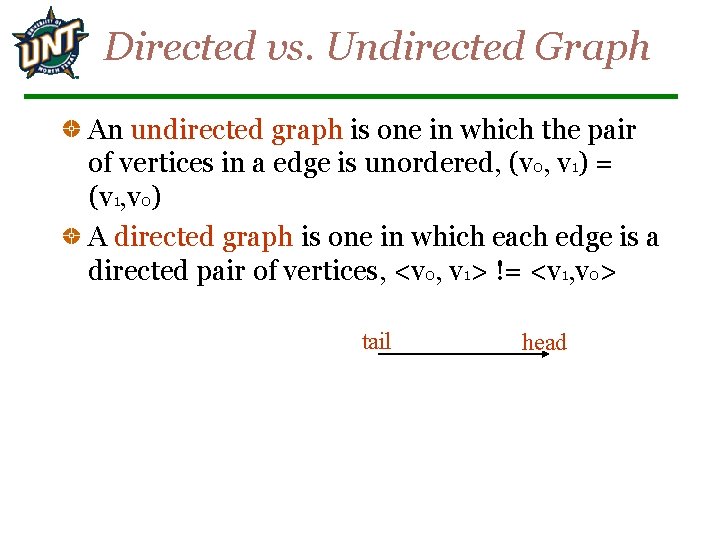
Directed vs. Undirected Graph An undirected graph is one in which the pair of vertices in a edge is unordered, (v 0, v 1) = (v 1, v 0) A directed graph is one in which each edge is a directed pair of vertices, <v 0, v 1> != <v 1, v 0> tail head
Graph Representations Adjacency Matrix Adjacency Lists
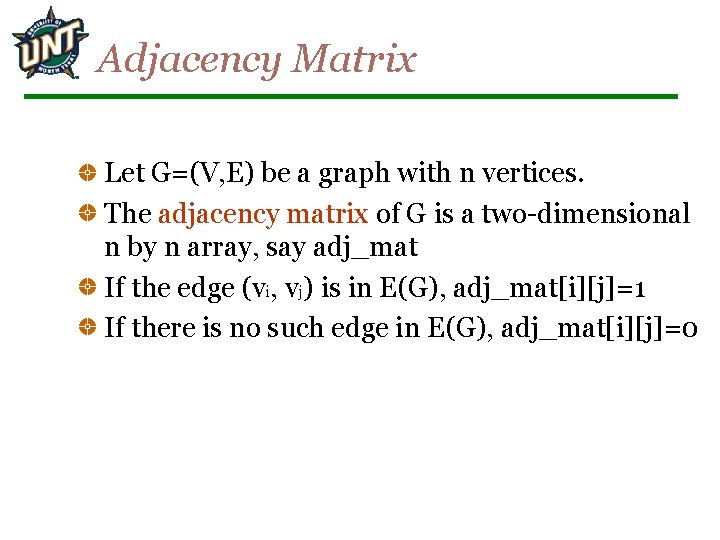
Adjacency Matrix Let G=(V, E) be a graph with n vertices. The adjacency matrix of G is a two-dimensional n by n array, say adj_mat If the edge (vi, vj) is in E(G), adj_mat[i][j]=1 If there is no such edge in E(G), adj_mat[i][j]=0
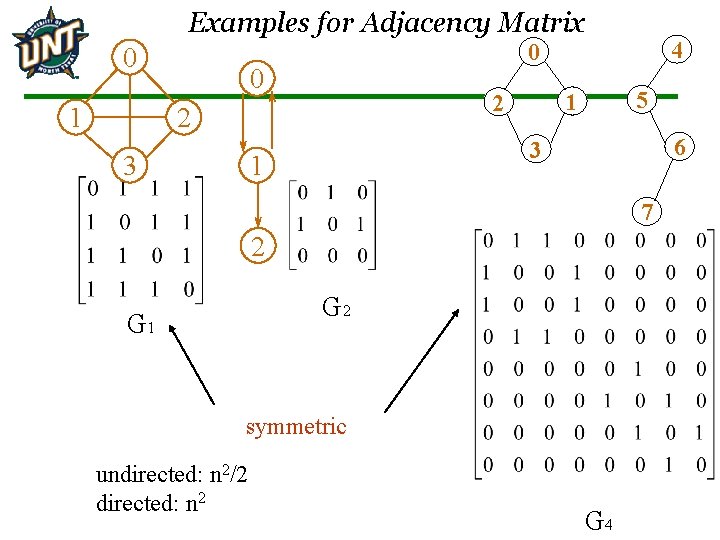
Examples for Adjacency Matrix 0 1 0 5 1 2 2 3 4 0 6 3 1 7 2 G 1 symmetric undirected: n 2/2 directed: n 2 G 4
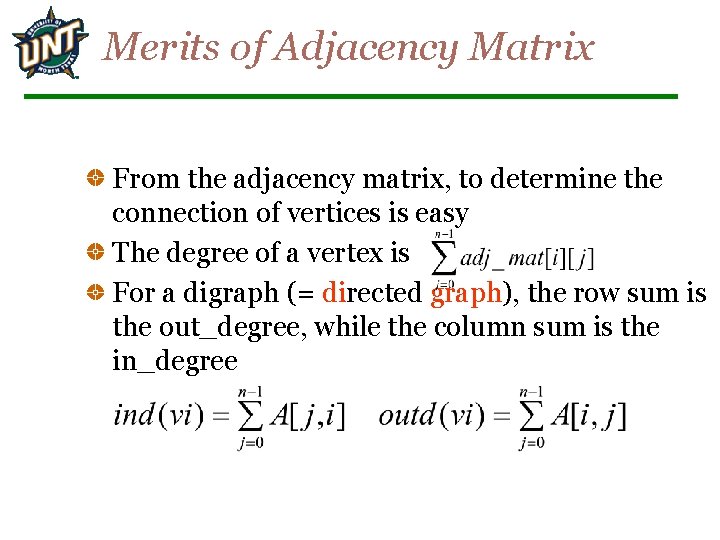
Merits of Adjacency Matrix From the adjacency matrix, to determine the connection of vertices is easy The degree of a vertex is For a digraph (= directed graph), the row sum is the out_degree, while the column sum is the in_degree
0 4 0 1 1 2 2 6 3 3 0 1 2 3 1 0 0 0 7 2 2 1 1 G 1 0 1 2 1 0 2 G 3 5 3 3 3 2 0 1 2 3 4 5 6 7 1 0 0 1 5 4 5 6 G 4 2 3 3 2 6 7 An undirected graph with n vertices and e edges ==> n head nodes and 2 e list nodes
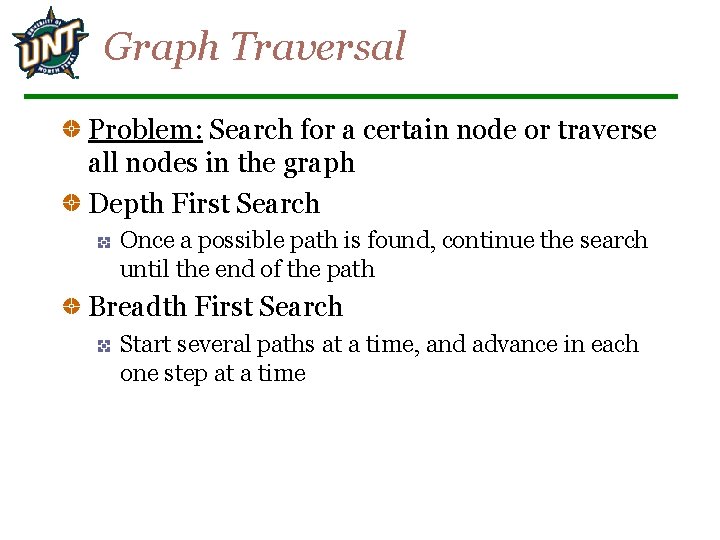
Graph Traversal Problem: Search for a certain node or traverse all nodes in the graph Depth First Search Once a possible path is found, continue the search until the end of the path Breadth First Search Start several paths at a time, and advance in each one step at a time
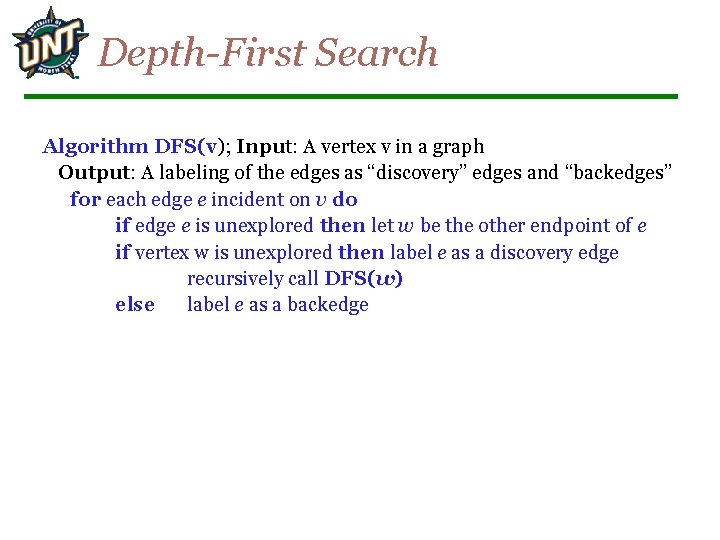
Depth-First Search Algorithm DFS(v); Input: A vertex v in a graph Output: A labeling of the edges as “discovery” edges and “backedges” for each edge e incident on v do if edge e is unexplored then let w be the other endpoint of e if vertex w is unexplored then label e as a discovery edge recursively call DFS(w) else label e as a backedge
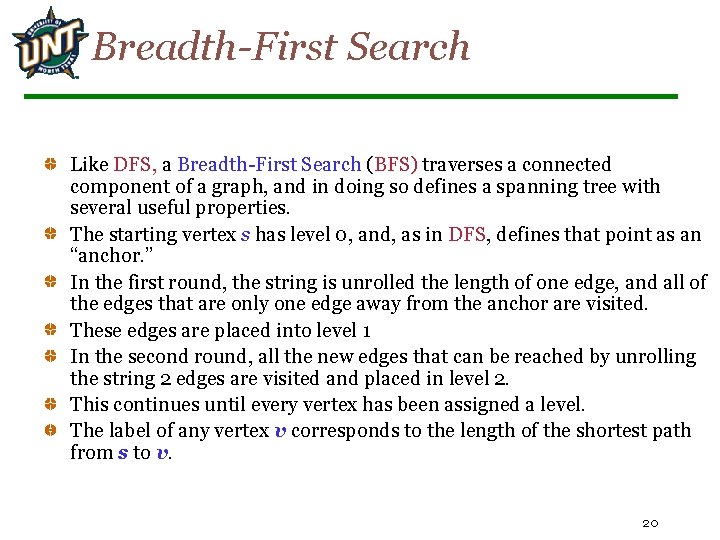
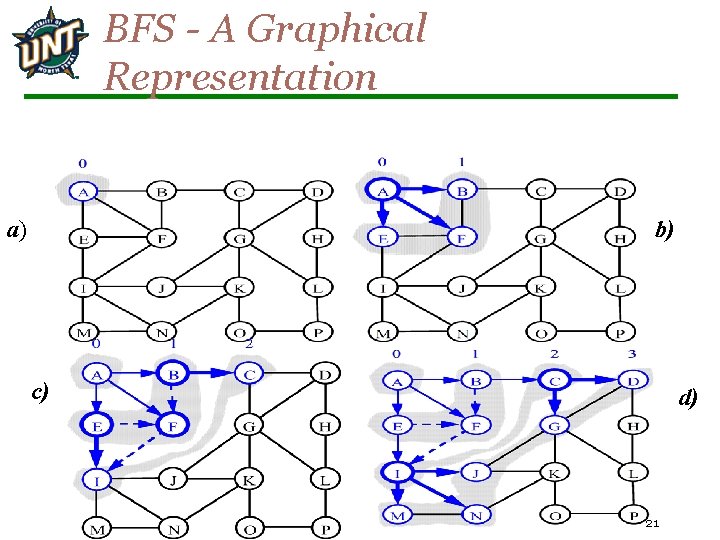
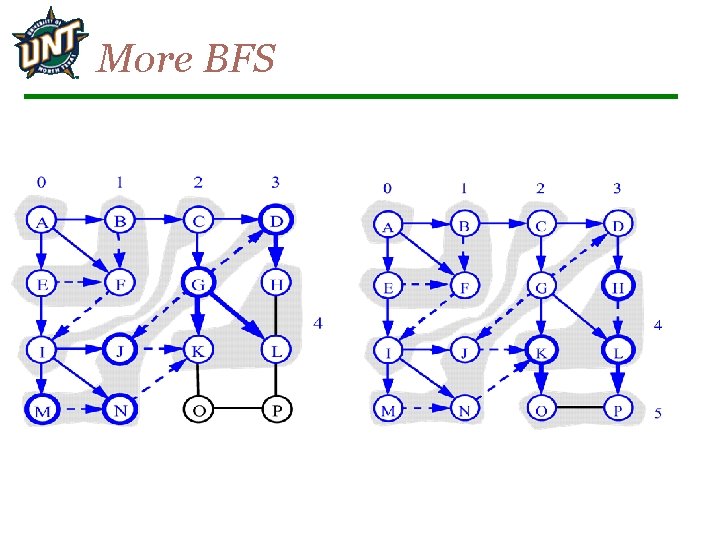
Breadth-First Search Like DFS, a Breadth-First Search (BFS) traverses a connected component of a graph, and in doing so defines a spanning tree with several useful properties. The starting vertex s has level 0, and, as in DFS, defines that point as an “anchor. ” In the first round, the string is unrolled the length of one edge, and all of the edges that are only one edge away from the anchor are visited. These edges are placed into level 1 In the second round, all the new edges that can be reached by unrolling the string 2 edges are visited and placed in level 2. This continues until every vertex has been assigned a level. The label of any vertex v corresponds to the length of the shortest path from s to v. 20
BFS - A Graphical Representation a) b) c) d) 21
More BFS
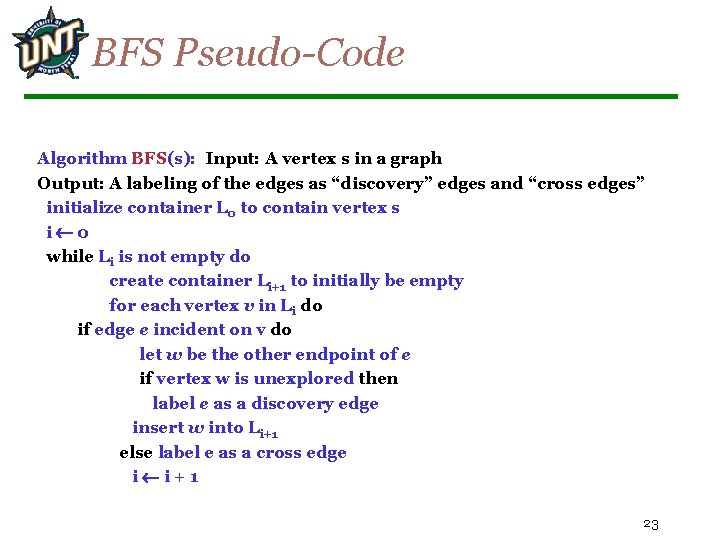
BFS Pseudo-Code Algorithm BFS(s): Input: A vertex s in a graph Output: A labeling of the edges as “discovery” edges and “cross edges” initialize container L 0 to contain vertex s i 0 while Li is not empty do create container Li+1 to initially be empty for each vertex v in Li do if edge e incident on v do let w be the other endpoint of e if vertex w is unexplored then label e as a discovery edge insert w into Li+1 else label e as a cross edge i i+1 23
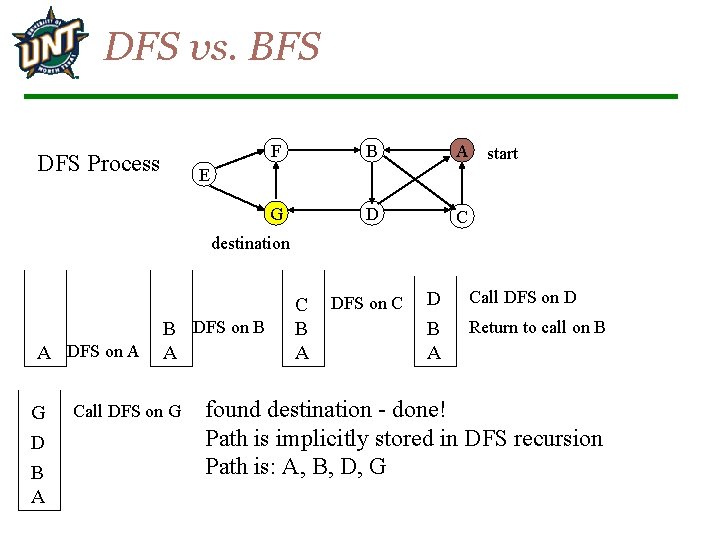
DFS vs. BFS DFS Process F B A G D C start E destination A DFS on A G D B A B DFS on B A Call DFS on G C B A DFS on C D B A Call DFS on D Return to call on B found destination - done! Path is implicitly stored in DFS recursion Path is: A, B, D, G
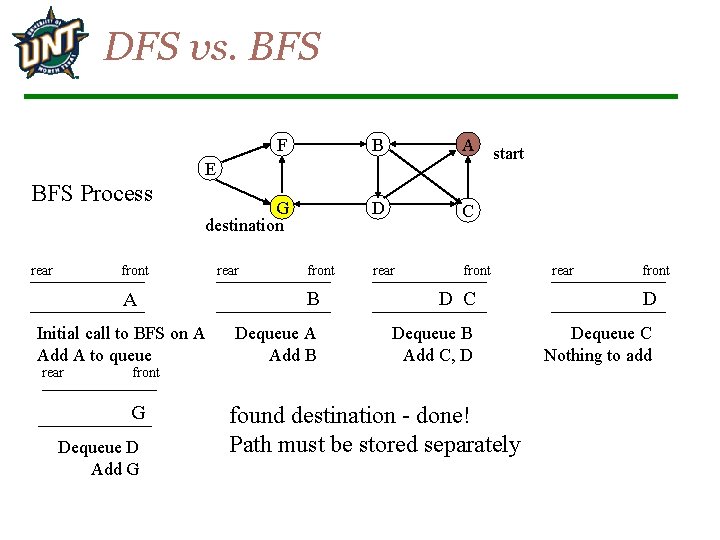
DFS vs. BFS F B A G destination D C rear front E BFS Process rear front A Initial call to BFS on A Add A to queue rear front B D C Dequeue A Add B Dequeue B Add C, D start front G Dequeue D Add G found destination - done! Path must be stored separately rear front D Dequeue C Nothing to add